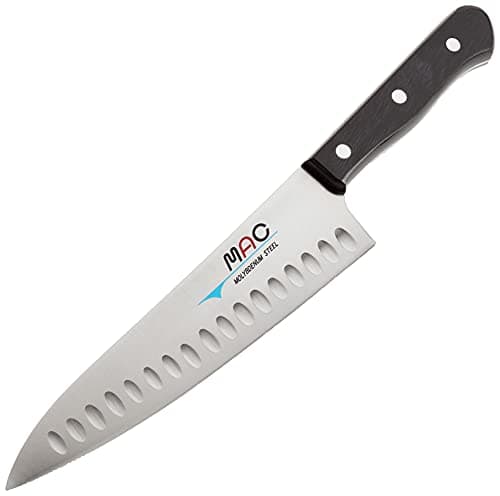
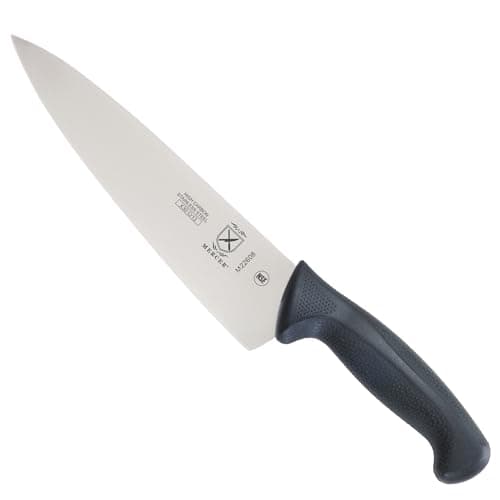
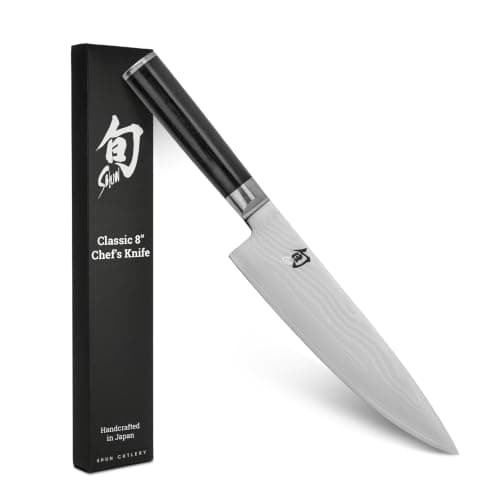
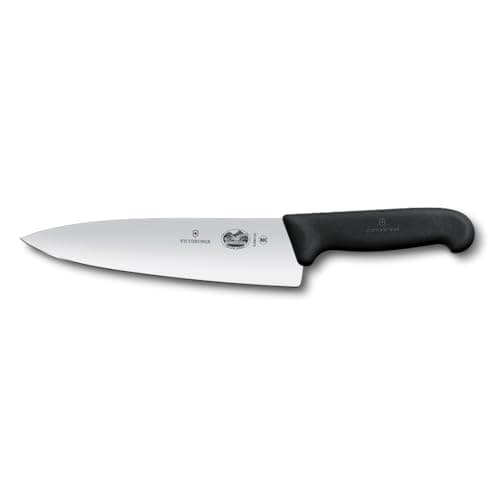
Buy the Victorinox Fibrox Pro 8". If you dice onions most days and want the cleanest cut available at any sensible price, buy the MAC Chef Series 8" instead. Those are the only two answers this page really needs. An onion is a layered sphere that you have to halve through a woody root, strip a papery skin off, and then cut in two directions while the layers try to separate — and the part of the knife that does most of that work is the tip, not the belly. That single fact rules out half the knives people get recommended for “vegetables.”
It is also why this page disagrees with our own best knives for cutting vegetables roundup, which ranks a nakiri first. That is the right answer for cabbage, carrots and squash: a tall, flat, tipless blade that chops cleanly through to the board in one stroke is exactly what dense vegetables want. An onion wants something else. You cannot pierce the root plate with a nakiri, you cannot score the stem end, and you cannot run a tip along a curved layer to make the vertical cuts that produce an even dice. Both findings are true at the same time, which is the whole reason this is a separate page.
Everything below is judged from published specifications — steel and hardness on the Rockwell scale, edge angle, blade length, height and weight, construction — and the value math against the live price. See how we review: we do not have a test lab and we do not claim one. The rubric on this page is onion-specific(tip and root work, dice geometry, thinness behind the edge, knuckle clearance, value), so the averages here are deliberately not comparable with the dense-vegetable scores on the vegetables roundup — the same knife can be right for one job and third-best for the other.
What actually decides whether a knife is good at onions
Four things, in this order. Nothing else on a spec sheet matters much for this job.
1. A usable tip.Every onion starts with the same three cuts: trim the stem end, split the bulb from stem to root, and — if you want an even dice — leave the root intact so the halves hold together. All three are tip work. A pointed French or gyuto profile does them without thinking. A sheepsfoot profile (santoku, nakiri, most cleavers) makes you improvise, and improvising on a round, slippery object is how people cut themselves. If you only read one line on this page, read this one.
2. A flat section in the middle of the edge.After the halves are peeled you make a fan of vertical cuts, then rotate ninety degrees and cross-cut. The vertical cuts have to reach the board or the dice comes out as half-joined accordion strips. An edge with a deep continuous curve only touches the board at one point, which is the single most common reason a home cook's onion dice looks ragged. Most 8-inch chef's knives have two or three inches of near-flat edge behind the curve; Japanese profiles have more of it than German ones.
3. Thinness behind the edge.This is the one that surprises people. Onion cells hold the sulfur compounds that become the tear gas; the more cells a blade ruptures on its way through, the more of that gas you get and the faster the cut surfaces go slimy. A thin, keen blade parts the layers; a thick, dull one crushes them. “Sharp knives make you cry less” is not folklore, it is a consequence of how much cell wall you destroy — and it is also why the honest fix for watery eyes is a stone, not a gadget. Our how to sharpen kitchen knives guide is the cheapest upgrade available to anyone reading this page.
4. Knuckle clearance.An onion half is two to three inches tall. If the blade is not tall enough at the heel, your knuckles hit the board before the edge finishes the cut, and you start lifting the handle — which curves the cut and ruins the dice. Blade height at the heel matters more on this job than on almost anything else a chef's knife does.
Notice what is missing from that list: hardness, Damascus cladding, brand, bolster, and the number of knives in the block. A cheap stamped knife that is thin and pointed will out-dice a flagship that has gone dull. If you want the general framework rather than this one job, read how to choose a chef's knife.
The best knife for dicing onions
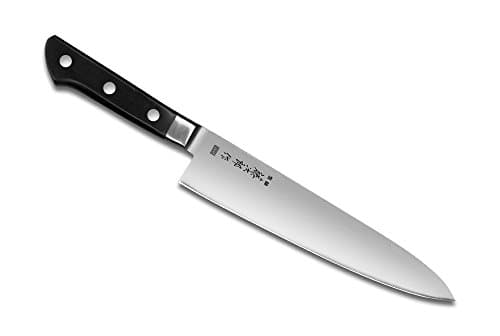
An 8-inch pointed chef's knife or a 210mm gyuto, with at least two inches of near-flat edge and a blade tall enough at the heel to clear your knuckles. The Victorinox and the MAC at the top of this page are both that knife; so is the Tojiro, with slightly more flat edge and slightly less forgiveness.
The dice itself is three moves, and the knife only has to not fight you during them. Split the onion pole to pole, through the root, and leave the root attached — that is what holds the layers together for everything that follows. Peel, lay the half flat side down, and make vertical cuts angled slightly toward the center of the onion so each one stays perpendicular to the curved layers; this is where a tip earns its keep, because the first and last cuts of the fan are tip cuts. Then rotate and cross-cut. If your dice is coming out as long strips still joined at one end, your vertical cuts are not reaching the board, and that is a profile and clearance problem rather than a sharpness problem.
One thing worth saying because almost nobody does: hand size changes the right answer more than brand does. If an 8-inch blade feels like too much knife, you will cut worse with it than with a 7-inch, and the pages for smaller hands and larger hands are more useful to you than any ranking. The length argument in general is in chef knife sizes, and the grip that makes any of this work is in how to hold a chef's knife.
The best knife for mincing onion
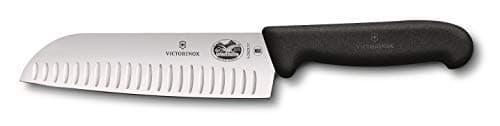
A flat-edged blade, which means the santoku on this page rather than the winner. Mincing is the opposite of dicing: you want the whole edge in contact with the board, repeatedly, with no tip work at all once you start. A santoku's straight edge does that in one pass; a curved French profile needs you to rock and reposition, which is slower and less even.
The classic restaurant technique — pin the tip down with your fingertips and pivot the handle through the pile — works on any knife but works best on a blade with a long flat section and enough height to keep your guiding hand clear. If you mince alliums in volume, a nakiri is the most committed version of that geometry, and the one job where its tiplessness genuinely does not matter.
The best knife shape for onions
Pointed, with a flat middle and a tall heel. In practice that is the French or German chef's knife profile, or the Japanese gyuto, and the gyuto is marginally better because it is flatter. In order of suitability, with the honest reason for each:
Gyuto or chef's knife — buy this. Point for the root and stem, flat section for the vertical fan, length for a big onion, height for your knuckles. Nothing else does all four.
Santoku — excellent second knife.Better than a chef's knife at the mincing half of the job, useless at the first three cuts. See chef knife vs santoku.
Nakiri — wrong knife here, right answer elsewhere. This is the one place we contradict our own vegetables roundup, and the reason is narrow and specific: a nakiri is the best dense-vegetable blade we rank and it cannot start an onion. If you own one, use it after the halving, not before. The shape argument is in chef knife vs nakiri and santoku vs nakiri.
Cleaver — only if it is a Chinese vegetable cleaver and you are practiced. A thin Chinese cai dao has the height and the flat edge and can scoop the dice off the board, but it has no point and it is a specialist tool. A Western heavy cleaver is the wrong object entirely. See chef knife vs cleaver.
Paring or utility knife — no. Too short to span the onion, too little height to clear your knuckles. Fine for peeling a shallot, wrong for a dice. The honest comparison is in chef knife vs utility knife.
Does a sharp knife really make you cry less?
Yes, and the mechanism is worth understanding because it is the one piece of onion advice that is both true and free. Onion cells store a sulfur compound and, separately, an enzyme. When a blade ruptures the cell walls the two mix, and the reaction produces the volatile compound that irritates your eyes. The amount you get is roughly proportional to how many cells you destroy — so a thin, keen edge that parts the layers releases less of it than a thick or dull one that crushes its way through.
That makes sharpness, not hardware, the actual fix. A knife that has not been touched in two years is the single biggest contributor to a watery onion session in most kitchens, and the cure costs less than a gadget: learn to use a stone, or get a sharpener matched to your blade's angle. Start with how to tell if a knife needs sharpening, then the beginner stone roundup or the right angle for your knives. Chilling the onion for a quarter of an hour and cutting the root end last both help a little; neither helps as much as a sharp knife.
What the knife sits on matters too
An onion is a rolling object and a dice is a precision cut, so a board that slides is a real problem rather than an annoyance. Wood or a soft composite, large enough that the halves do not crowd the edge, and heavy or gripped enough that it stays put. Glass and stone boards do two bad things at once here: they move, and they wreck the edge you just paid for — board hardness is the largest single determinant of how long an edge lasts. The options are ranked in best cutting boards for knives, and the care routine that keeps any of these knives in onion-ready condition is in knife care and maintenance.
If single-job pages are useful to you, the other one worth reading is the protein equivalent: fish is the job where a chef's knife is comprehensively the wrong tool and flex decides everything, which is the mirror image of the argument on this page. It is in the best knives for cutting fish.