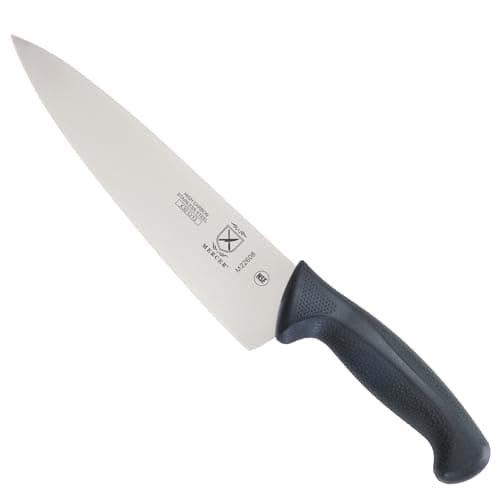
The Mercer Culinary Millennia is the knife more people have learned to cook on than almost any other, because culinary schools buy it by the crate. It is a stamped blade in Japanese steel around 56 HRC, with a Santoprene-over-polypropylene handle, NSF certification, and a price low enough that a school can hand one to every student. We have not cooked with this unit; the assessment below comes from published specifications and the value math on how we review.
The honest verdict is narrow and useful: this is the least you can spend without buying junk. It is not a refined knife, it will not hold an edge, and it does not feel like anything special — but it is safe, light, properly certified, and it cuts. That is why it anchors the bottom of our under-$100 roundup and appears in our professional list. If you can stretch a little further, the Victorinox is a meaningfully better knife.
Why culinary schools buy it
Three reasons, and none of them is that it is the best knife. It is NSF certified, so it satisfies the sanitation requirements a teaching kitchen has to meet. The Santoprene handle grips reliably with wet hands, which matters enormously when the person holding it has never used a chef's knife before. And it costs little enough that a school can equip a class and write off the ones that vanish. Those are institutional criteria, and they happen to overlap well with what a beginner at home needs — which is the actual case for buying one.
What ~56 HRC stamped steel means in practice
It means the edge goes off faster than you would like. A stamped blade cut from rolled sheet at around 56 HRC will dull under normal home use within weeks, not months, and the only thing that keeps it feeling sharp is a honing habit. The upside is the mirror image: soft steel comes back on any stone in a few minutes, and it will not chip when you meet a chicken bone or a hard board. For someone learning to sharpen, that forgiveness is worth real money — the argument we make at length in easiest knives to sharpen. Pair it with a coarse-and-medium stone from our beginner stone roundup and you have a complete, genuinely capable setup for very little.
Millennia versus Victorinox Fibrox Pro
This is the comparison that matters, because they are the two knives at the bottom of every serious list. The Victorinox costs somewhat more and is better in most measurable ways: the Swiss X50CrMoV15 is a touch better behaved, the blade geometry is thinner, and the Fibrox handle is the most widely trusted grip in professional kitchens. The Mercer's case is simply that it costs less and is not far behind. If your budget genuinely stops here, buy the Mercer with confidence. If it stretches, buy the Victorinox.
Millennia versus Renaissance
Mercer's own range is the other useful comparison. The Renaissance is forged, full tang, German-sourced steel with a triple-riveted handle, and it typically costs a little under twice the Millennia. That is a genuine step up in feel, balance and durability, and it is the natural upgrade for someone who trained on a Millennia and now wants a knife of their own — a path we describe in our professional roundup. What it does not buy is a longer-lasting edge, because the steel is in the same broad hardness band.
Who should buy it
A student, a first apartment, a holiday rental, a camp kitchen, a spare drawer, or anyone who wants a second 8-inch knife so two people can prep at once. It is also the right knife to learn sharpening on, because ruining a knife at this price while you practice costs nothing. Who should not: anyone buying their one good knife. For that, the picks in our beginner ranking and flagship roundup are worth the extra money several times over.
How we picked
We did not lab-test these knives
Everyone in this category says they tested twenty knives in a professional kitchen. We have not hands-on tested any of these, and we say so. What we did instead: compiled the published specifications — steel type and hardness (HRC), edge angle, blade geometry, weight and build — applied established sharpening standards, ran the value math (spec quality ÷ live price), and scored each product against a published rubric. The scores are judgments from documented research — not measurements we took, because we do not have a test lab and we will not pretend we do. Where a number came from someone else's work, we name them in Sources.