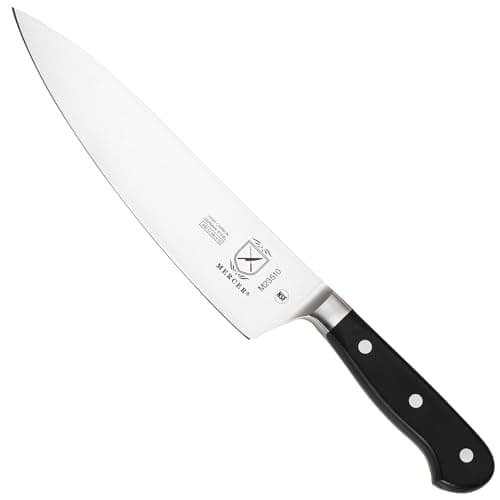
Mercer is best known for the Millennia — the stamped, textured-handle knife that culinary schools issue by the crate. The Renaissance is the other half of the story: a properly forged, taper-ground German knife with a full bolster and a full tang, sold at a price that sits far closer to stamped knives than to Wusthof or Zwilling. For anyone who wants forged heft without leaving the budget band, it is the most direct route there is.
We have not cooked with this unit. The assessment below is compiled from published specifications — X50CrMoV15 at around 58 HRC, forged construction, full bolster, full tang, taper-ground spine — combined with the value math we run on every pick. Our full method is in how we review. It ranks in best chef knives for the money and best chef knives under $100.
Forged, and what that actually means here
Forging shapes the blade from a heated billet under pressure rather than cutting it from rolled sheet. It does not make the steel better and it does not make the edge sharper — those come from alloy, heat treatment and grind. What it does is let the maker put mass where they want it: a thick spine tapering toward the tip, a substantial heel, and a bolster that shifts the balance point back to your pinch grip. The Renaissance uses all of that, and the result feels markedly different in the hand from a Millennia costing a fraction less. Whether you want that difference is genuinely a preference — stamped vs forged lays out both sides.
X50CrMoV15 at around 58 HRC
This is the standard German kitchen alloy — the same family Wusthof and Zwilling use — and 58 HRC is toward the harder end of the Western range. In practice that means decent edge retention by Western standards, easy resharpening, and failure by rolling rather than chipping, which a honing rod fixes in seconds. It will not hold an edge like a 60+ HRC Japanese blade and it will not take as keen a grind, but it will survive treatment that would chip one. See knife steel types explained.
The full bolster: the one real caveat
The Renaissance has a full bolster — the thick collar between blade and handle runs all the way down to the heel of the edge. In the hand that is a genuine benefit: it stops your fingers sliding forward onto the blade and gives the knife its secure, planted feel. Over years it creates a problem. Because the bolster physically blocks the heel from touching a stone or a sharpener, that section never gets sharpened. Sharpen the rest of the blade repeatedly and the un-sharpened heel is eventually left standing proud, which needs a professional to grind back.
This is not a reason to avoid the knife — it takes many years of regular sharpening to become noticeable, and half-bolster designs are still the minority at this price. It is a reason to know about it, hone rather than sharpen wherever possible, and not be surprised in a decade. The mechanism is covered in chef knife anatomy explained.
Renaissance or Millennia?
They are the same brand answering two different questions. The Millenniais stamped, lighter, has a textured Santoprene grip with a protective finger point, and costs less — it is the better knife for long prep sessions, wet hands and anyone who prefers agility. The Renaissanceis forged, heavier, better balanced at the pinch, and feels considerably more substantial. If you have used a Millennia and wished it had more presence, the Renaissance is exactly that knife. If you have used one and liked how light it was, stay where you are — see the Millennia review.
How it compares to Wusthof and Zwilling
Honestly: the same steel formula, a similar hardness, a similar forged construction, and a fraction of the price. What the German premium brands give you beyond that is finishing refinement, a keener factory grind, a lifetime warranty with a real service network, and in Zwilling's case ice-hardening that improves retention. Those are real things. They are not three times the knife. If value is your primary criterion, the Renaissance is one of the strongest cases on this site — and if you want the German brands anyway, our German roundup ranks them.
Living with it
At 58 HRC this responds well to a honing rod, so weekly honing will keep it working for months between sharpenings. When it does need a stone, a standard Western angle of around 20 degrees per side is right — do not try to thin it to a Japanese 15 degrees, as this steel is not hard enough to support that edge and it will roll. Hand-wash and dry immediately; the riveted handle and the bolster join are both places water sits if you let it. Never the dishwasher.
Where it sits in our rankings
It scores 8.0 overall, which puts it above the Gladiator and below the premium Japanese knives — driven almost entirely by a value score of 9. It loses points on sharpness against keener-ground blades and on the weight that comes with forging. That profile makes it the specific recommendation for one buyer: someone who wants forged construction and does not want to pay for a name.
How we picked
We did not lab-test these knives
Everyone in this category says they tested twenty knives in a professional kitchen. We have not hands-on tested any of these, and we say so. What we did instead: compiled the published specifications — steel type and hardness (HRC), edge angle, blade geometry, weight and build — applied established sharpening standards, ran the value math (spec quality ÷ live price), and scored each product against a published rubric. The scores are judgments from documented research — not measurements we took, because we do not have a test lab and we will not pretend we do. Where a number came from someone else's work, we name them in Sources.