Skip to content
The Edge Bench

Roundups & reviews · Chef Knives

The best German chef knives, ranked

Tough, forgiving, easy to sharpen - seven Western forged and stamped blades ranked, plus the difference between made in Germany and merely German-engineered.

By Stephen V.Updated How we review
#ad

We earn a commission when you buy through our Amazon links, at no extra cost to you. It never changes a verdict, and we say so when the cheaper knife is the better buy. How this works.

German knives are the forgiving half of the kitchen-knife world. Softer steel around 56–58 HRC, a wider edge angle, more weight behind the blade, and a build that tolerates bone, hard boards and a housemate who puts knives in the dishwasher. They dull sooner than Japanese steel and they come back on any stone in minutes, which for a lot of households is the better half of the trade.

This is the counterpart to our Japanese chef knives roundup, and the two pages answer the same question from opposite sides. We ranked these on edge and steel, out-of-the-box sharpness, handling, build and value, from published specifications rather than a test kitchen — the method is on how we review. One thing this page takes seriously that most do not: the difference between a knife forged in Solingen and one marketed as "German-engineered" and manufactured elsewhere. Both can be good. They are not the same claim.

The short answer

Quick picks

#KnifeBest forScorePrice
01
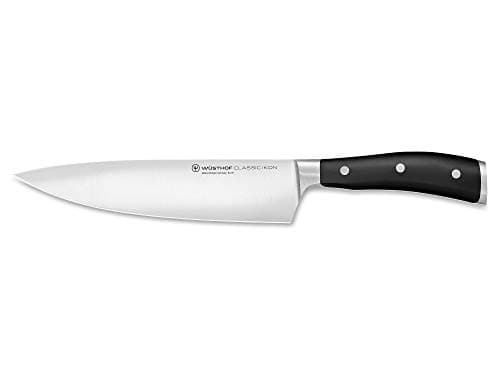
Wusthof Wusthof Classic 8"
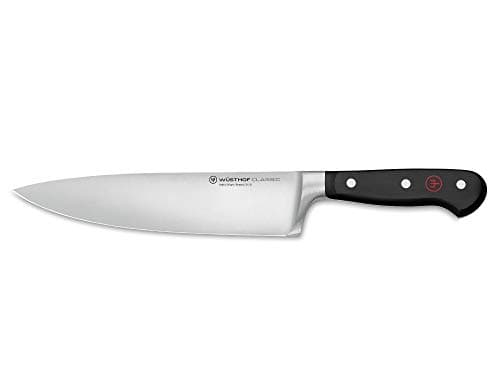
Wusthof Classic 8"

The definitive German chef's knife. Fully forged in Solingen from X50CrMoV15 at around 58 HRC, with a full bolster, full tang and a Precision Edge ground keener than the German norm - the knife every other blade on this page is measured against.

Best overall German
8.2
$170.00Amazon
02
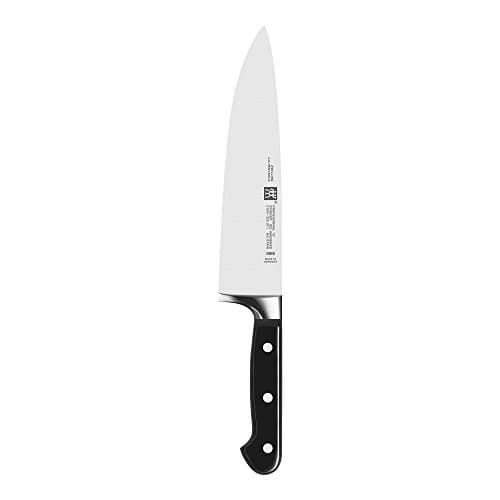
Zwilling Zwilling Professional S 8"
Zwilling Professional S 8"

The best forged German knife per dollar. FRIODUR ice-hardened steel from Zwilling's own German factory, a full bolster and a genuinely tough build - it does what the Wusthof Classic does for meaningfully less, and gives up very little doing it.

Best value forged
8.1
$97.53Amazon
03
Messermeister Messermeister Meridian Elite 8"
Messermeister Meridian Elite 8"

The German knife for people who sharpen their own. Hot-drop hammer forged in Solingen from 1.4116 at around 58 HRC, hand-stropped to a 15-degree edge - and, crucially, bolsterless at the heel, so the whole blade reaches the stone for its entire life.

Best for people who sharpen
8.4
Check price →
04
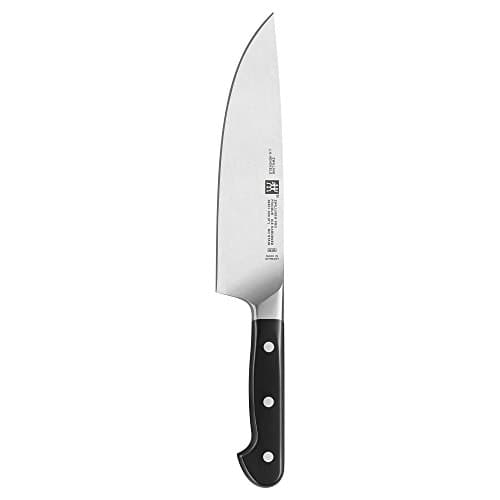
Zwilling Zwilling Pro 8"
Zwilling Pro 8"

Zwilling's answer to the bolster problem. The Pro line uses a curved, sloped bolster that leaves the heel of the blade accessible while keeping the finger protection - a real design improvement over the Professional S, at a real price increase.

Best bolster design
8.0
$169.99Amazon
05
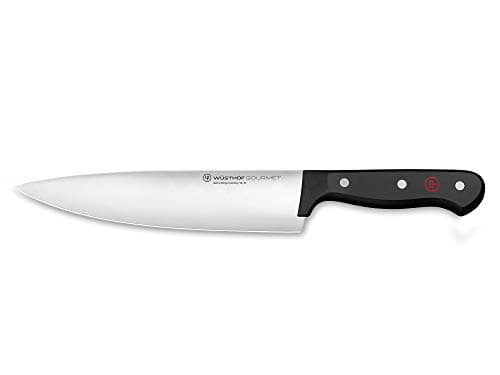
Wusthof Wusthof Gourmet 8"
Wusthof Gourmet 8"

The light Wusthof. Laser-cut rather than forged, around 56 HRC and roughly 6.4 oz against the Classic's 9.1 - so you get Solingen manufacturing and the familiar riveted handle in a knife that is far less tiring, for a lot less money.

Best light Solingen blade
7.6
$100.00Amazon
06
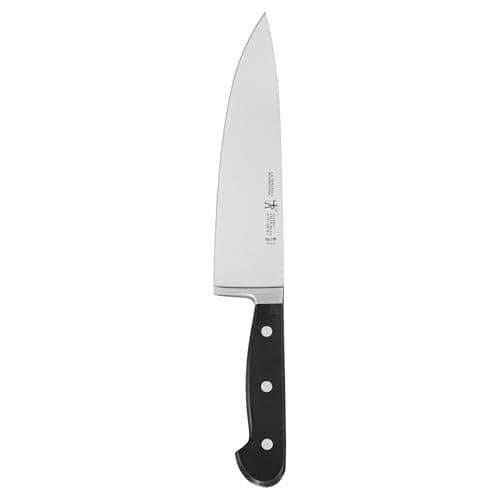
Henckels HENCKELS Classic 8"
HENCKELS Classic 8"

The budget entry to the German look and feel - with an honest asterisk. HENCKELS is Zwilling's value brand and the line is German-engineered rather than made in Germany, which is exactly why it costs a third of the Professional S. As a first forged-style knife it is fine.

Best budget German-style
7.2
$79.95Amazon
07
Mercer Culinary Mercer Renaissance 8"
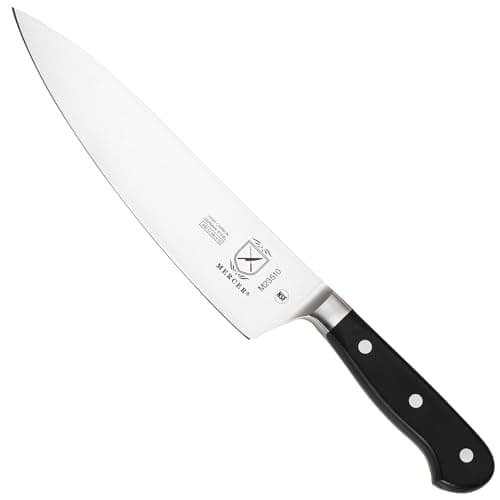
Mercer Renaissance 8"

German steel, German shape, not a German price - and not made in Germany either. A forged, full-tang knife in German-sourced steel that costs about a third of what a Solingen equivalent does, which is a very hard combination to argue with on value alone.

Best German-steel value
8.1
$54.55Amazon

#ad · Live prices from the Amazon Product API, as of Sep 2, 2026. Where we have no verified live price, we show none — a gap beats a number that has rotted.

In detail

The picks, in full

01
Wusthof Wusthof Classic 8"

Best overall German

Wusthof Classic 8"

Forged in SolingenX50CrMoV15, ~58 HRC~14 deg/side edgeFull bolster, full tang, ~9.1 oz
8.2/10

The definitive German chef's knife. Fully forged in Solingen from X50CrMoV15 at around 58 HRC, with a full bolster, full tang and a Precision Edge ground keener than the German norm - the knife every other blade on this page is measured against.

Edge & steel
8.5
Sharpness
8
Handling
8
Build
9.5
Value
7

Pros

  • Forged, full-tang construction that will outlast the kitchen it lives in
  • Keener factory grind than traditional 20-degree German knives
  • Curved belly is made for rock-chopping
  • Well-established service network and warranty

Cons

  • At about 9.1 oz it is heavy through a long prep session
  • Full bolster means the heel never fully reaches a stone
  • Priced at the top of the German mainstream

Don't buy this if…

you want a light knife or you sharpen your own blades and dislike bolsters - the Messermeister solves the second problem.

$170.00View on Amazon

Price as of Sep 2, 2026. Prices change — Amazon's at checkout is the one that counts.

#ad · we may earn a commission from this link to Wusthof Classic 8"

02
Zwilling Zwilling Professional S 8"

Best value forged

Zwilling Professional S 8"

Forged, company-owned German factoryFRIODUR ice-hardened, ~57 HRC~15 deg/side edgeFull bolster
8.1/10

The best forged German knife per dollar. FRIODUR ice-hardened steel from Zwilling's own German factory, a full bolster and a genuinely tough build - it does what the Wusthof Classic does for meaningfully less, and gives up very little doing it.

Edge & steel
8
Sharpness
7.5
Handling
7.5
Build
9
Value
8.5

Pros

  • Real forged construction well below the Wusthof Classic
  • Ice-hardening gives good corrosion resistance and toughness
  • Full bolster gives a very secure pinch grip
  • Made in a factory Zwilling owns, not a licensed one

Cons

  • Heavy, and the handle shape divides opinion
  • Full bolster complicates heel sharpening

Don't buy this if…

the handle does not suit your hand - this is the one pick here worth holding in a shop first.

$97.53View on Amazon

$169.9943% off

Price as of Sep 2, 2026. Prices change — Amazon's at checkout is the one that counts.

#ad · we may earn a commission from this link to Zwilling Professional S 8"

03
Messermeister Messermeister Meridian Elite 8"

Best for people who sharpen

Messermeister Meridian Elite 8"

Forged in Solingen1.4116 steel, ~58 HRCBolsterless heel15 deg hand-stropped edge
8.4/10

The German knife for people who sharpen their own. Hot-drop hammer forged in Solingen from 1.4116 at around 58 HRC, hand-stropped to a 15-degree edge - and, crucially, bolsterless at the heel, so the whole blade reaches the stone for its entire life.

Edge & steel
8.5
Sharpness
8.5
Handling
8.5
Build
9
Value
7.5

Pros

  • No heel bolster, so the full edge is sharpenable forever
  • Hand-stropped 15-degree edge is keener than the German standard
  • Hot-drop forged in Solingen from a single piece of steel
  • Triple-riveted, fully exposed tang with a POM handle

Cons

  • Less brand recognition than Wusthof or Zwilling
  • Bolsterless heel means slightly less protection for your knuckles

Don't buy this if…

you want the reassuring heft of a full bolster behind the blade - the Wusthof and Zwilling deliver that.

Check price on Amazon →

No buyable offer at the last price check (Sep 2, 2026). We show nothing rather than a stale number.

#ad · we may earn a commission from this link to Messermeister Meridian Elite 8"

04
Zwilling Zwilling Pro 8"

Best bolster design

Zwilling Pro 8"

Forged, company-owned German factoryFRIODUR ice-hardenedCurved sloped bolsterFull tang
8.0/10

Zwilling's answer to the bolster problem. The Pro line uses a curved, sloped bolster that leaves the heel of the blade accessible while keeping the finger protection - a real design improvement over the Professional S, at a real price increase.

Edge & steel
8
Sharpness
8
Handling
8
Build
9
Value
7

Pros

  • Sloped bolster keeps the heel sharpenable without losing hand protection
  • Broad, curved belly that rock-chops confidently
  • Same ice-hardened German steel as the Professional S
  • Well-balanced despite the weight

Cons

  • Costs close to the Wusthof Classic without a clear edge over it
  • Still a heavy knife by any standard

Don't buy this if…

the Professional S handle already suits you - you are paying mainly for the bolster.

$169.99View on Amazon

Price as of Sep 2, 2026. Prices change — Amazon's at checkout is the one that counts.

#ad · we may earn a commission from this link to Zwilling Pro 8"

05
Wusthof Wusthof Gourmet 8"

Best light Solingen blade

Wusthof Gourmet 8"

Precision-stamped in SolingenX50CrMoV15, ~56 HRC~6.4 ozRiveted synthetic handle
7.6/10

The light Wusthof. Laser-cut rather than forged, around 56 HRC and roughly 6.4 oz against the Classic's 9.1 - so you get Solingen manufacturing and the familiar riveted handle in a knife that is far less tiring, for a lot less money.

Edge & steel
7
Sharpness
7.5
Handling
8.5
Build
7.5
Value
7.5

Pros

  • Noticeably lighter than the forged Classic, which suits some hands far better
  • Made in Solingen, unlike most stamped knives at this price
  • Costs substantially less than the forged Wusthof lines
  • Same handle geometry buyers already know

Cons

  • Softer at ~56 HRC, so it dulls sooner than the Classic
  • No bolster heft or forged balance
  • Still costs more than better-value stamped knives from other brands

Don't buy this if…

you are buying purely on value - a Victorinox Fibrox does the light-stamped job for less.

$100.00View on Amazon

Price as of Sep 2, 2026. Prices change — Amazon's at checkout is the one that counts.

#ad · we may earn a commission from this link to Wusthof Gourmet 8"

06
Henckels HENCKELS Classic 8"

Best budget German-style

HENCKELS Classic 8"

German-engineeredStainless steel, ~56 HRCTraditional riveted handleFull bolster
7.2/10

The budget entry to the German look and feel - with an honest asterisk. HENCKELS is Zwilling's value brand and the line is German-engineered rather than made in Germany, which is exactly why it costs a third of the Professional S. As a first forged-style knife it is fine.

Edge & steel
6.5
Sharpness
7
Handling
7.5
Build
7
Value
8

Pros

  • The cheapest way into the classic German shape and feel
  • Traditional triple-riveted handle is comfortable and familiar
  • Backed by Zwilling's distribution and warranty

Cons

  • German-engineered, not made in Germany - the price reflects that
  • Softer steel needs honing frequently
  • Full bolster on a budget knife is the worst of both worlds for sharpening

Don't buy this if…

you want a knife made in Solingen - this line is not, and the price is the tell.

$79.95View on Amazon

Price as of Sep 2, 2026. Prices change — Amazon's at checkout is the one that counts.

#ad · we may earn a commission from this link to HENCKELS Classic 8"

07
Mercer Culinary Mercer Renaissance 8"

Best German-steel value

Mercer Renaissance 8"

Forged, full tangGerman-sourced steelTriple-riveted handleFull bolster
8.1/10

German steel, German shape, not a German price - and not made in Germany either. A forged, full-tang knife in German-sourced steel that costs about a third of what a Solingen equivalent does, which is a very hard combination to argue with on value alone.

Edge & steel
7.5
Sharpness
7.5
Handling
8
Build
8
Value
9.5

Pros

  • Forged construction at a stamped-knife price
  • The shape, weight and feel of a much more expensive German knife
  • Widely used in culinary schools, so it is a known quantity
  • The best pure value on this page by a distance

Cons

  • Not made in Germany, whatever the steel origin
  • Fit and finish trail the Solingen knives on close inspection
  • Full bolster, same long-term sharpening compromise

Don't buy this if…

provenance matters to you - this is German steel and German styling, made elsewhere.

$54.55View on Amazon

Price as of Sep 2, 2026. Prices change — Amazon's at checkout is the one that counts.

#ad · we may earn a commission from this link to Mercer Renaissance 8"

"Made in Solingen" versus "German-engineered"

Solingen is a protected designation: a knife can only carry it if the essential manufacturing steps happened there. "German steel," "German engineering," and "designed in Germany" carry no such protection and are used freely on knives made anywhere. Neither claim tells you the knife is bad — the Mercer Renaissance on this page is excellent value precisely because it uses German steel and German geometry without German labor costs. But if you are paying a Solingen premium, check you are getting Solingen manufacturing, and if you are not, do not pay for it.

The bolster question

A full bolster — the thick collar of steel that runs all the way down to the heel — is the defining feature of traditional German knives, and it is the one thing that will genuinely annoy you a decade from now. Because it sits proud of the edge, the heel never touches a stone, so over years of sharpening the rest of the blade recedes and the heel is left standing out. Modern designs solve this in two ways: a sloped or curved bolster (Zwilling Pro) or no heel bolster at all (Messermeister Meridian Elite). If you intend to maintain your own knives, this matters more than steel type — we go into it in easiest knives to sharpen.

Forged or stamped?

Forged knives are hammered from a single billet: heavier, usually with a bolster, and generally hardened a little higher. Stamped knives are cut from rolled sheet: lighter, thinner, cheaper, and often softer. Wusthof's own range makes the comparison cleanly — the forged Classic sits at roughly 58 HRC and 9.1 oz, the laser-cut Gourmet at around 56 HRC and 6.4 oz. Forged is not automatically better for you. If your hands tire, if you have a small board, or if you prefer a nimble knife, a good stamped blade is the better tool and you will use it more. What you give up is edge retention and heft.

How to keep a German edge

Soft German steel rolls rather than chips, and a rolled edge is fixed in seconds with a honing steel. Get into the habit of a few light passes before you cook and you will need a stone only a handful of times a year. When you do sharpen, aim for roughly 20 degrees per side unless the maker specifies keener — the Wusthof Precision Edge and the Messermeister 15-degree grind are both exceptions — and any competent stone from our whetstone roundup will do the job, because soft steel is forgiving. That forgiveness is precisely why German knives are the right recommendation for anyone learning to sharpen.

Where German knives lose

Two places, honestly. They tire your hand: a 9 oz forged blade is a lot of weight to move through a big prep session, and Japanese knives at 6–7 oz genuinely feel better three hours in. And they need honing far more often, because softer steel deforms sooner under the same use. If neither of those bothers you, German is the more practical choice for most kitchens. If both do, read the Japanese roundup instead, and the side-by-side comparison before you commit either way.

What we would skip

Skip the Zwilling Four Star — reviewers consistently rate it below both the Professional S and the Pro despite similar pricing. Skip the HENCKELS Statement and Solution lines, which are stamped budget ranges that give up too much in steel and finish to justify themselves when a Victorinox or a Mercer sits at the same price. And skip any knife whose listing says "German steel" without naming an alloy: X50CrMoV15 and 1.4116 are near-identical specifications, and a maker proud of using them says so.

How we picked

We did not lab-test these knives

Everyone in this category says they tested twenty knives in a professional kitchen. We have not hands-on tested any of these, and we say so. What we did instead: compiled the published specifications — steel type and hardness (HRC), edge angle, blade geometry, weight and build — applied established sharpening standards, ran the value math (spec quality ÷ live price), and scored each product against a published rubric. The scores are judgments from documented research — not measurements we took, because we do not have a test lab and we will not pretend we do. Where a number came from someone else's work, we name them in Sources.

Questions

Frequently asked

What is the best German chef's knife?
The Wusthof Classic 8-inch, for most people. Forged in Solingen at around 58 HRC with a keener-than-standard edge and a build that lasts decades. The Zwilling Professional S does nearly the same job for less.
What steel do German knives use?
Almost always X50CrMoV15 or the near-identical 1.4116, hardened to roughly 56–58 HRC. It is tough, corrosion-resistant and easy to sharpen - see our steel guide.
Is a Henckels the same as a Zwilling?
Not quite. Zwilling J.A. Henckels makes knives in its own German factories; the HENCKELS brand is the value line, described as German-engineered rather than made in Germany. The price difference reflects a real manufacturing difference.
Why do German knives have a bolster?
It adds weight and balance and protects your fingers from the edge. The cost is that a full bolster keeps the heel of the blade off a sharpening stone, which distorts the edge over years of maintenance.
German or Japanese - which should I buy?
German if you want a tough, forgiving knife you can sharpen easily and use without thinking. Japanese if you want a keener edge that lasts longer and will treat the blade carefully. The full comparison is here.

Keep reading

Receipts

Sources

We do not run a testing lab, and we do not pretend to. Where a spec or a measured number came from someone else's work — a manufacturer's page, a published standard — we name them and link them. Where we could not verify something, we say so on the page rather than quietly leaving it out. Read our full method.