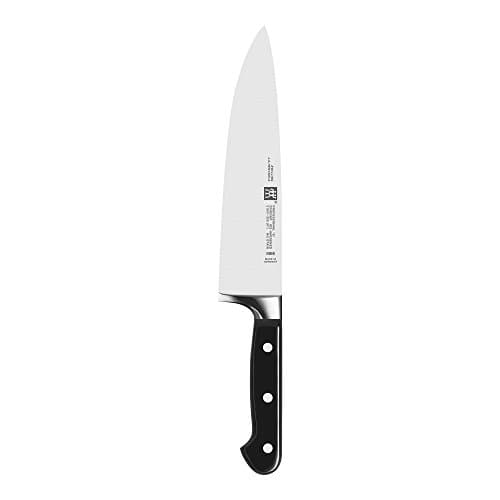
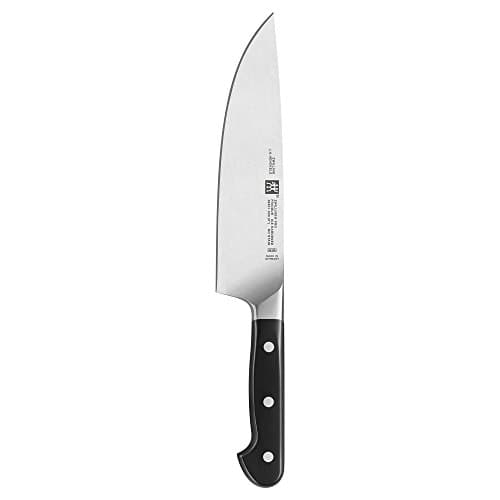
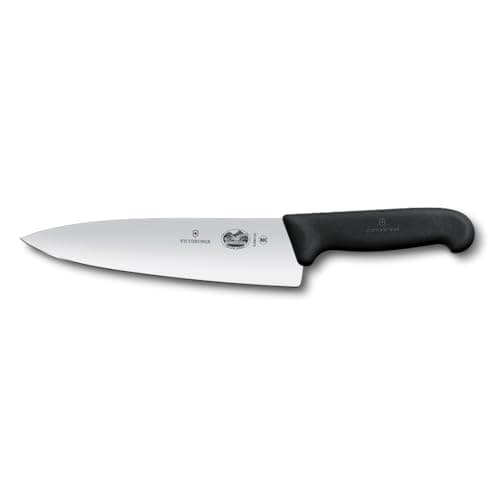
Buy the Victorinox Fibrox Pro 8" unless you have a specific reason to want a forging. It wins this comparison 8.2 to 8.0 on our shared rubric, at a fraction of the money. The specific reasons are real and there are two of them: you want weight behind the knife, or you intend to sharpen on stones for the next thirty years and care about the heel. If neither of those is you, the Swiss knife is the better purchase and the rest of this page explains why that is not a cop-out.
A second result worth leading with, because it is the kind of thing a comparison page usually buries: the cheaper Zwilling beats the dearer one.The Professional S scores 8.1 against the Pro's 8.0. They come out of the same company-owned German factory with the same FRIODUR ice-hardening, and the Pro's premium buys one thing — a curved, sloped bolster that leaves the whole edge sharpenable. That is a genuinely valuable feature for about one buyer in ten and a waste of money for the other nine.
Scores are reproduced from the pages where each knife is already ranked, so they are directly comparable: the Victorinox from Victorinox vs Wusthof, the two Zwillings from Zwilling vs Henckels. The rubric is on how we review.
Stamped versus forged, without the marketing
The Victorinox blade is stamped: punched from rolled steel sheet, ground and heat treated. Published steel is X50CrMoV15 at roughly 55-56 HRC, ground at about 20 degrees per side, weighing around 7.4 ounces. There is no bolster and no visible tang.
The Zwilling blades are forged: formed from a billet, with a bolster and a full tang running the length of the handle, then ice-hardened in Zwilling's FRIODUR process. The Professional S publishes roughly 57 HRC on a 15-degree-per-side edge with a full bolster; the Pro has the same construction with a curved sloped bolster instead.
What the forging buys, honestly: heft, which some people want and some people hate; a bolster, which adds a finger guard and balance; a full visible tang, which is a durability signal more than a durability requirement; and a better heat treatment, which is the only one of the four that touches cutting. A couple of points of HRC and a narrower factory edge angle are a real advantage in edge retention. They are a smaller advantage than the price difference implies. The long version is stamped vs forged knives, and full tang vs partial tang deals with the tang claim specifically.
Where the Victorinox genuinely wins
Wet grip.The Fibrox handle is textured thermoplastic and it is the only handle in this comparison that does not become slippery with wet, greasy or starchy hands. That is a safety property. Zwilling's moulded synthetic handles are comfortable and well-shaped and they are not as secure when wet. We score this a 10 for Victorinox and we do not hand out many.
Weight. At around 7.4 ounces the Victorinox is substantially lighter than a forged German knife, which matters if you prep for an hour at a stretch or if your hands get tired. Lightness is the reason foodservice kitchens buy these: a cook holding a knife for eight hours has a different opinion about heft than a reviewer holding one for eight minutes.
Ease of upkeep. Mid-50s HRC steel at a wide angle is the most forgiving combination there is. The edge rolls rather than chips, a honing rod straightens it in seconds, and a replacement costs less than a stone. Easiest knives to sharpen explains why softer steel is a feature if you are learning.
Price, obviously. And not marginally. The money you do not spend here buys a honing rod, a stone and a decent board, all three of which affect how well you cut more than a forging does.
Where the Zwilling genuinely wins
Edge retention. Roughly 57 HRC with FRIODUR ice-hardening, ground at about 15 degrees per side, holds a working edge noticeably longer than 55-56 HRC at 20 degrees. This is the real cutting advantage and it is not nothing.
Build and lifespan. A forged, full-tang knife from a company-owned German factory is built to be sharpened for decades. The Victorinox will long outlast its price, but it is not a thirty-year knife in the same sense.
Heft, if you want it.Some cooks want weight falling through an onion rather than being pushed through it. That is a legitimate preference and the Victorinox cannot give it to you at any price, because Victorinox does not sell a forged chef's knife in this range.
The sloped bolster, on the Pro only.A full bolster — which the Professional S has — stops the heel of the blade a few millimetres short of the stone, so the last part of the edge never gets sharpened and gradually develops a recurve. The Pro's curved bolster is cut away so the whole edge reaches the stone. If you sharpen your own knives on stones, that is the single best argument for the Pro over the Professional S, and it is the entire argument. Full bolster vs half bolster is the page on exactly this.
The decision, as a short flowchart
Do you want weight in a knife? If yes, Zwilling Professional S. There is no Victorinox answer to that question. If no, read on.
Do you sharpen on stones, honestly, already?If yes, Zwilling Pro — the sloped bolster will matter to you for decades. If you are telling yourself you will start, buy the Victorinox and a stone and find out first; the stone costs less than the price difference.
Are your hands often wet, greasy or starchy while you cut? If yes, Victorinox, firmly. The Fibrox handle is the safest thing in this comparison and grip security outranks edge retention when a knife slips.
None of the above? Victorinox. Then spend the difference on a honing rod and a decent board, both of which will do more for your cutting than a forging.
Is Zwilling the same as Henckels?
No, and this is the most expensive confusion in German cutlery. Zwilling J.A. Henckels and “Henckels International” are two tiers under one parent company: the Zwilling lines are the premium German-made product, Henckels is the value line and is manufactured elsewhere. The twin-figures logo versus the single-figure logo is the tell. We untangle it properly at Zwilling vs Henckels and at Wusthof vs Henckels.
What about Victorinox against the other German houses?
It is the same argument with a different opponent, and the answer comes out the same way every time: Victorinox vs Wusthofruns it against Solingen's other big name, and Victorinox vs Mercer runs it against the other foodservice stamped knife, which is a much closer fight. If you want the whole field rather than a pair, start at best chef knives.
A note on what these scores do and do not mean
A 0.2 difference between an 8.2 and an 8.0 is not a verdict about which knife is better in the hand. It is the output of a rubric in which value carries the same weight as build, and we weight it that way deliberately, because a site that scores knives purely on refinement ends up recommending the most expensive thing on every page. Read the metric breakdowns rather than the averages: the Victorinox takes value and handling, the Zwillings take build and edge retention, and which column matters is a fact about your kitchen rather than about the knives. Our method, and its limits, are set out at how we review.