Skip to content
The Edge Bench

Stones, sharpeners & how-to · Sharpening

Sharpening steels and honing rods, sorted by the knives you own

One rod is right for a German block, a different one is right above 60 HRC, and a third exists because most people cannot hold an angle. Start here and you will not buy the wrong one.

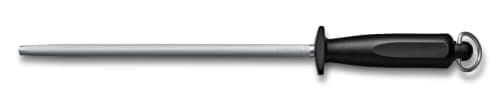
Victorinox Victorinox Swiss Classic Fibrox Honing Steel, 10 in

Our top pick · Best for Western knives

Victorinox Swiss Classic Fibrox Honing Steel, 10 in

8.7

The rod to buy for a Western block, and the reason to question what a four-times-pricier rod is really selling you. A 10-inch fine-cut steel with the Fibrox handle that made Victorinox the default in professional kitchens - it trues a 56 HRC edge in six passes, and no steel rod does that job better.

$28.00Amazon

#ad · Full ranking below

By Stephen V.Updated How we review
#ad

We earn a commission when you buy through our Amazon links, at no extra cost to you. It never changes a verdict, and we say so when the cheaper knife is the better buy. How this works.

Almost every "best sharpening steel" list ranks rods against each other as if they were competing for the same job. They are not. The rod that is correct for a German block at 56 HRC is the wrong tool above 60 HRC, and the rod that fixes the most common honing failure — a wandering angle — is not the best rod on any spec sheet. So this page does not rank the field. It routes you.

Answer one question and you are done: how hard is the steel in your knives?Not the brand, not the price, not the country of origin — the hardness. Everything about rod choice falls out of that one number, and everything else on this page is detail.

What you ownTypical hardnessThe rod
Wusthof, Zwilling, Henckels, Victorinox, most supermarket knives55–58 HRCA fine-cut steel rod
Shun, MAC, Global, Miyabi, most gyutos60–63 HRCA ceramic rod, never a ridged steel
A mixed drawer of bothVariesA ceramic rod — it is safe on everything
You have never honed anything beforeA rod with a built-in angle guide

The three picks below are one rod for each of those rows. They are not the four highest-scoring rods on the market — that list is our best honing steels roundup, and it is a different page for a different reader. These are the rods that end the decision for the block you already own, at the lowest price the specification honestly supports.

The short answer

Quick picks

#KnifeBest forScorePrice
01
Victorinox Victorinox Swiss Classic Fibrox Honing Steel, 10 in
Victorinox Swiss Classic Fibrox Honing Steel, 10 in

The rod to buy for a Western block, and the reason to question what a four-times-pricier rod is really selling you. A 10-inch fine-cut steel with the Fibrox handle that made Victorinox the default in professional kitchens - it trues a 56 HRC edge in six passes, and no steel rod does that job better.

Best for Western knives
8.7
$28.00Amazon
02
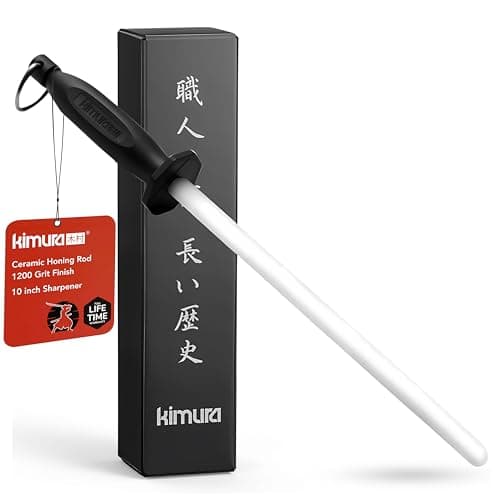
Kimura Kimura Professional Ceramic Honing Rod, 10 in
Kimura Professional Ceramic Honing Rod, 10 in

The one rod that is safe on everything in a mixed drawer. A 1200-grit ceramic surface has no ridges to catch a brittle apex, and because ceramic abrades very lightly it does not merely realign a hard edge - it refreshes it. If your block is half German and half Japanese, this is the rod that saves you owning two.

Best for hard or mixed blocks
8.3
$29.99Amazon
03
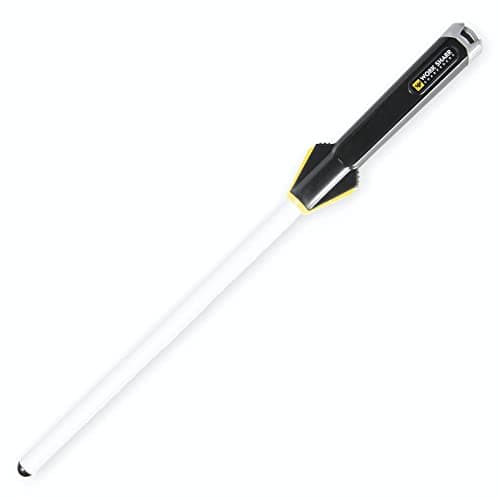
Work Sharp Work Sharp Kitchen Ceramic Honing Rod (Angle Guided)
Work Sharp Kitchen Ceramic Honing Rod (Angle Guided)

The rod that fixes the actual failure. Honing goes wrong because the angle wanders, not because the rod was cheap - and this one moulds a 20-degree guide into the body so the blade cannot sit at the wrong angle. The trade is a shorter 9-inch ceramic section.

Best if your angle wanders
8.2
$29.95Amazon

#ad · Live prices from the Amazon Product API, as of Sep 6, 2026. Where we have no verified live price, we show none — a gap beats a number that has rotted.

In detail

The picks, in full

01
Victorinox Victorinox Swiss Classic Fibrox Honing Steel, 10 in

Best for Western knives

Victorinox Swiss Classic Fibrox Honing Steel, 10 in

Fine-cut steel rod10 inFibrox gripRealigns, does not sharpen
8.7/10

The rod to buy for a Western block, and the reason to question what a four-times-pricier rod is really selling you. A 10-inch fine-cut steel with the Fibrox handle that made Victorinox the default in professional kitchens - it trues a 56 HRC edge in six passes, and no steel rod does that job better.

Effectiveness
8.5
Length & reach
8.5
Build
8.5
Grip & safety
9
Value
9

Pros

  • Ten inches comfortably covers an 8-inch chef's knife with room at the tip
  • The Fibrox handle is textured to stay safe when your hands are wet or greasy
  • Fine cut is exactly the aggression a 55-58 HRC Western edge wants

Cons

  • A steel rod barely engages hard Japanese steel, so a mixed drawer needs ceramic instead
  • Plain utilitarian looks - this is a working tool, not a gift

Don't buy this if…

any knife in your block is hard Japanese steel - a ridged steel can chip a brittle 61 HRC apex instead of straightening it.

$28.00View on Amazon

Price as of Sep 6, 2026. Prices change — Amazon's at checkout is the one that counts.

#ad · we may earn a commission from this link to Victorinox Swiss Classic Fibrox Honing Steel, 10 in

02
Kimura Kimura Professional Ceramic Honing Rod, 10 in

Best for hard or mixed blocks

Kimura Professional Ceramic Honing Rod, 10 in

1200-grit ceramic10 inHones and lightly refreshesSafe to 62 HRC
8.3/10

The one rod that is safe on everything in a mixed drawer. A 1200-grit ceramic surface has no ridges to catch a brittle apex, and because ceramic abrades very lightly it does not merely realign a hard edge - it refreshes it. If your block is half German and half Japanese, this is the rod that saves you owning two.

Effectiveness
9
Length & reach
8
Build
8
Grip & safety
8
Value
8.5

Pros

  • No ridges, so nothing to chip a hard Japanese edge against
  • Light abrasion does something for an edge a plain steel rod cannot touch
  • One rod covers a drawer containing both hardness families

Cons

  • Ceramic is brittle - a drop onto a tile floor can end it
  • Steel residue loads the surface and needs occasional cleaning to keep working

Don't buy this if…

you own only soft Western knives and want the cheapest thing that works - a fine steel rod is less fragile and does that job fully.

$29.99View on Amazon

Price as of Sep 6, 2026. Prices change — Amazon's at checkout is the one that counts.

#ad · we may earn a commission from this link to Kimura Professional Ceramic Honing Rod, 10 in

03
Work Sharp Work Sharp Kitchen Ceramic Honing Rod (Angle Guided)

Best if your angle wanders

Work Sharp Kitchen Ceramic Honing Rod (Angle Guided)

9 in ceramic abrasiveBuilt-in 20-degree guideRoughly 1200 grit equivalentRated for serrated too
8.2/10

The rod that fixes the actual failure. Honing goes wrong because the angle wanders, not because the rod was cheap - and this one moulds a 20-degree guide into the body so the blade cannot sit at the wrong angle. The trade is a shorter 9-inch ceramic section.

Effectiveness
8
Length & reach
7
Build
8
Grip & safety
9.5
Value
8.5

Pros

  • Removes the one variable that makes honing fail for beginners
  • Twenty degrees is the correct guided angle for the Western knives most first-timers own
  • Ceramic, so it is safe on harder steel as well

Cons

  • Nine inches of abrasive is short for a 10-inch chef's knife or a slicer
  • The fixed 20-degree guide is wider than a 15-degree Japanese edge wants

Don't buy this if…

you already hone confidently - you would be paying for a guide you will not use, and a longer plain rod covers more blade.

$29.95View on Amazon

$34.9514% off

Price as of Sep 6, 2026. Prices change — Amazon's at checkout is the one that counts.

#ad · we may earn a commission from this link to Work Sharp Kitchen Ceramic Honing Rod (Angle Guided)

Everything else in this cluster

Seven pages sit under this one, and each answers a single question end to end. Read the one that matches what you are stuck on.

Why hardness decides this and nothing else does

A honing rod works on an edge that has rolled. Under normal cutting the last few microns of the apex deflect sideways; the steel is still there, it is just lying over, and the knife feels dull because a bent apex presents a rounded shoulder to the food instead of a point. A rod stands it back up. That is the whole mechanism, and every rule below follows from it.

Softer steel rolls readily, which is why a German knife feels transformed after six passes on a steel rod and why professional kitchens hone Western knives constantly. Hard steel does not roll much — it is more brittle, so at the margin it chips instead. There is less bent metal to straighten, the ridges on a traditional steel rod have something hard and brittle to catch on, and the tool that was miraculous at 56 HRC becomes a liability at 61. Ceramic solves that by having no ridges at all and working through very light abrasion instead, a different mechanism that does not care whether the edge rolled.

If you do not know your knives' hardness, the country of origin tells you most of it: Western and European brands sit around 55–58 HRC, Japanese makers around 60–63. The Japanese vs German comparison covers the split properly, and honing rod materials goes deeper on what each rod surface physically does.

Length: longer than your longest knife

The working rule is that the abrasive section should be longer than the blade you are honing, because the stroke has to carry the whole edge across the rod without running the heel into the handle or the tip off the end. A 10-inch rod covers everything in a normal kitchen, from a paring knife up to a 10-inch chef's knife. Twelve inches is for slicers and carving knives. Eight or nine inches works, but you will be shortening the stroke on a full-size chef's knife — and a shortened stroke is where people unconsciously widen the angle to reach.

What a rod cannot do, at any price

No rod fixes a worn edge. When the apex has been abraded away rather than bent over, there is nothing to realign and honing produces no improvement at all — that is the moment a stone becomes necessary, not a better rod. No rod fixes a chip either: a notch has to be ground out by taking the whole edge back level with it. And a diamond rod, despite the shape, is not doing any of this — it is a sharpening tool that removes real metal on every pass, which is fine occasionally and destructive as a daily habit.

When honing stops working, the honest next purchase is a stone, and the cheapest legitimate route into that is covered in best sharpening stones for beginners. If you would rather not learn freehand at all, guided systems hold the angle mechanically.

The one we would skip

Skip the diamond rod as your onlyrod. It sits on the shelf beside the steel and ceramic ones, looks identical, and is doing a completely different job: at roughly 1200-grit diamond it cuts steel of any hardness on every pass. Used deliberately, now and then, on a knife you want back in service fast, that is genuinely useful. Used the way people use a honing rod — before every session, out of habit — it will visibly thin a knife over a few years. Own one alongside a steel or ceramic rod if you want it, never instead of one.
How we picked

We did not lab-test these knives

Everyone in this category says they tested twenty knives in a professional kitchen. We have not hands-on tested any of these, and we say so. What we did instead: compiled the published specifications — steel type and hardness (HRC), edge angle, blade geometry, weight and build — applied established sharpening standards, ran the value math (spec quality ÷ live price), and scored each product against a published rubric. The scores are judgments from documented research — not measurements we took, because we do not have a test lab and we will not pretend we do. Where a number came from someone else's work, we name them in Sources.

Questions

Frequently asked

Is a sharpening steel the same as a honing rod?
In US kitchen retail the two names are used for the same tool, and most listings say "sharpening steel" for what is really a honing rod. There is a real distinction underneath: a plain steel rod realigns and removes essentially no metal, while a ceramic or diamond rod carries an abrasive and does remove some. Sharpening steel vs honing steel works through what that changes when you buy.
Which honing rod should I buy if I only own one?
A ceramic rod around 1200 grit. It is safe on soft Western steel and on hard Japanese steel, which a ridged steel rod is not, so it is the only single rod that covers a mixed drawer without a compromise you have to keep thinking about.
Does a honing rod sharpen a knife?
A plain steel rod does not — it realigns a rolled edge and removes essentially no metal. Ceramic abrades very lightly, so it realigns and slightly refreshes. A diamond rod genuinely sharpens and removes real metal on every pass. Full mechanism at sharpening vs honing.
What length honing rod do I need?
Longer than your longest blade. Ten inches covers a normal kitchen up to a 10-inch chef's knife; go to 12 inches only if you hone slicers or carving knives. Anything shorter than the blade forces a stubby stroke, and a stubby stroke is where the angle quietly goes wrong.
How often should I use it?
Before a long prep session, or whenever the knife stops biting the way it did. It takes about thirty seconds and removes no meaningful metal, so there is no cost to doing it often — and doing it often is what stretches the gap between real sharpenings. How often to sharpen knives puts intervals on both jobs.
My rod does nothing anymore. Is it worn out?
Almost certainly not. Steel rods effectively never wear out, and ceramic ones usually just need cleaning — steel residue loads the surface and stops it working. If the rod is clean and honing still does nothing, the edge is worn rather than rolled, and it needs a stone.

Keep reading

Receipts

Sources

We do not run a testing lab, and we do not pretend to. Where a spec or a measured number came from someone else's work — a manufacturer's page, a published standard — we name them and link them. Where we could not verify something, we say so on the page rather than quietly leaving it out. Read our full method.