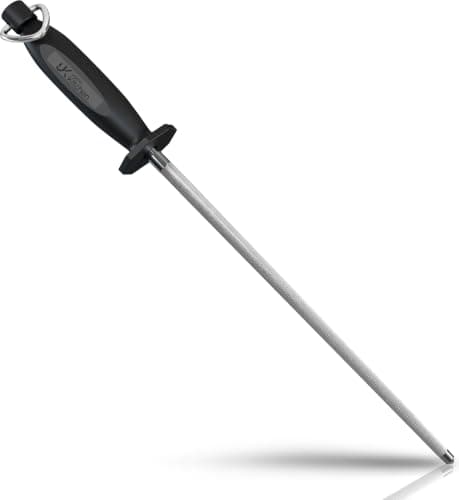
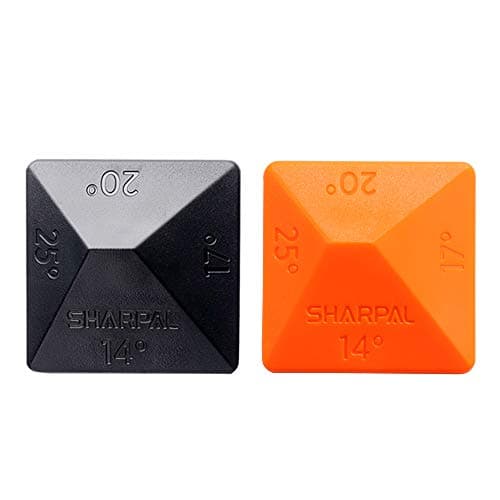
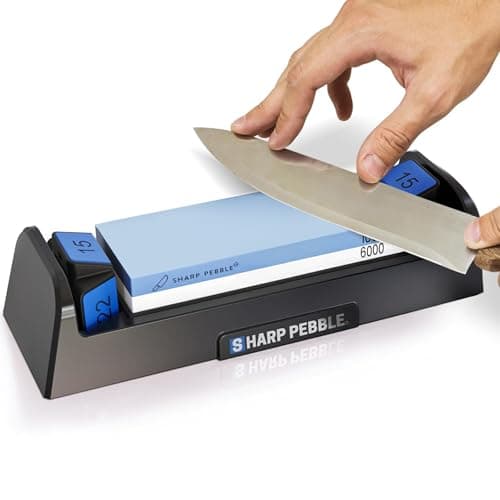
A first sharpening kit is three things: a stone to grind a new edge, a rod to keep it, and something that fixes your angle. That is the whole list. It costs less than most twelve-piece bundles and it does more, because the pieces a bundle adds are the ones a beginner does not use.
The kit-selling logic is that more items look like more value. What actually happens is that a beginner opens a box containing four grits, a strop, a compound and a flattening stone, has no idea which of them to touch first, and puts the lot back in the cupboard. Meanwhile the one thing that determines whether their first attempt works — holding a consistent angle — is either missing or is a loose plastic wedge that falls off the spine.
So the four picks below are ranked by how much of a working starter setup each one actually delivers, not by piece count. The first two are the stone half of the kit, and the last two are the pieces you add to complete it. Read the "best for" line on each card: they are not four alternatives, they are the parts of one purchase.
The two builds we would actually buy
The guided build: the Sharp Pebble kit plus a rod. The guides are in the hardware, so your first knife comes out sharp rather than rounded, and the rod keeps it that way. This is the right answer for most people asking this question.
The learning build:the KING stone, plus the SHARPAL angle guide, plus a rod. It costs about the same, the stone is better, and you will learn faster because the guide is a reference you consult rather than a rail you lean on — but your first two or three knives will be worse.
Either way, do not skip the rod. Almost every "kit" on the market is a stone bundle with accessories, and the accessory that would actually change your outcomes over the next year is the one they leave out.
What the big bundles are selling you
A twelve-piece kit typically adds a coarse stone, an extra-fine stone, a leather strop, polishing compound, a flattening stone and a honing guide jig. Every one of those is a real tool. None of them belongs in a first purchase:
- An 8000-grit stone is a polishing step for an edge you can already produce. Until you can raise a burr at 1000, it does nothing.
- A strop and compoundrefine an apex you have already sharpened. Cheap, genuinely useful, and pointless first — sharpening vs stropping explains the order.
- A honing guide jig in most bundles is designed for chisels and plane irons, not kitchen knives, and will not hold a curved blade.
- A flattening stoneyou will need eventually, because water stones dish. Not in month one — see how to flatten a whetstone for when it becomes relevant.
The grit question, honestly
The standard recommendation is a 1000/6000 combination stone, and both stones on this page are that. It is worth knowing the counter-argument: on a knife that is genuinely blunt, 1000 grit takes a long time to raise a burr, and raising a burr is the moment freehand sharpening starts to make sense. A 400/1000 combination gets a first-timer there much faster. If the knives you are learning on have been dull for a year, that is the better first stone — our beginner stone guide makes that case in full, and whetstone grits explained decodes the numbering.
What we would skip entirely
Skip the pull-through sharpener that gets bundled into cheap "complete" kits. The carbide slot tears metal rather than grinding it and imposes its own fixed angle, so it undoes the thing you bought a stone to learn. Skip the electric sharpener as a first purchase too, for a different reason: it works, but it removes far more steel than anything else and it will not teach you anything. The electric sharpener roundup is there if you decide you would rather not learn at all, which is a legitimate choice honestly made.
Learn on the right knife
Not your best one. A plain-edge Western stainless knife around 55–58 HRC with no full bolster is the easiest thing in any kitchen to sharpen, and it is the knife to make your mistakes on. Hard Japanese steel resists abrasion and punishes a wandering angle; a full bolster keeps the heel off the stone entirely. The easiest knives to sharpen covers what to practise on, and how to sharpen kitchen knives walks the motion step by step.
How we picked
We did not lab-test these knives
Everyone in this category says they tested twenty knives in a professional kitchen. We have not hands-on tested any of these, and we say so. What we did instead: compiled the published specifications — steel type and hardness (HRC), edge angle, blade geometry, weight and build — applied established sharpening standards, ran the value math (spec quality ÷ live price), and scored each product against a published rubric. The scores are judgments from documented research — not measurements we took, because we do not have a test lab and we will not pretend we do. Where a number came from someone else's work, we name them in Sources.