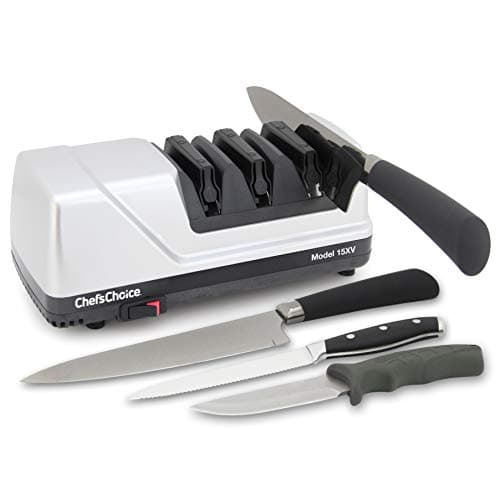
An electric sharpener is the most reliable way for a beginner to get a genuinely sharp edge, and the most expensive way to own knives over a decade. Both halves of that are true and most reviews only tell you the first. Motorized abrasive wheels hold the angle for you, which removes the single hardest part of sharpening, and they remove considerably more steel than a stone does to achieve the same result. Whether that trade is right for you depends far more on which knives you own than on which machine you buy.
We have not lab-tested these. What we did instead is what our method pagedescribes: compiled the published specifications — abrasive type, number of stages, the angle each machine grinds, whether that angle is fixed or adjustable — applied established sharpening standards, and weighed all of it against the live price. If you want the broader field including manual and guided options, see best knife sharpeners. If you would rather learn to do it properly, the whetstone roundup is where to go.
How we ranked these
Five criteria, applied in this order. Edge quality— what the machine can actually produce, which comes down to abrasive material and whether there is a fine or stropping stage after the coarse one. Angle control— whether the machine imposes a fixed angle and, critically, which one; a 20-degree-only machine will regrind a Japanese knife to the wrong geometry every time you use it. Speed — how many passes to restore a genuinely dull edge. Build— motor, housing, and whether the guides stay in alignment. And value, which is spec quality divided by the live price rather than a gut feeling about the brand.
The thing to understand before you buy one
Every electric sharpener works by grinding. It does not realign a rolled edge the way a honing rod does — it removes metal to create a fresh apex, and it does so faster and less selectively than a stone. On a $30 stamped knife that is completely fine and arguably ideal: you will get a working edge in ninety seconds, forever. On a $180 forged German knife it is acceptable if you use it sparingly and hone between sharpenings. On a hard Japanese knife ground at 15 degrees, a fixed 20-degree machine is actively destructive — it grinds away the thin, keen geometry you paid for and replaces it with a thicker Western edge. Check the angle before you check anything else, and read knife sharpening angles if that distinction is new to you.
The short answer
Quick picks
| # | Knife | Best for | Score | Price |
|---|
| 01 | Chef'sChoice 15XV EdgeSelect (Trizor XV)The one to buy if you own Western knives and want them sharper than they left the factory. Three stages of 100% diamond abrasive, and it converts a 20-degree German edge to a 15-degree Trizor XV edge - the only machine here that makes your knives keener rather than just restoring them. | Best overall (15-degree convert) | | $165.99·Amazon |
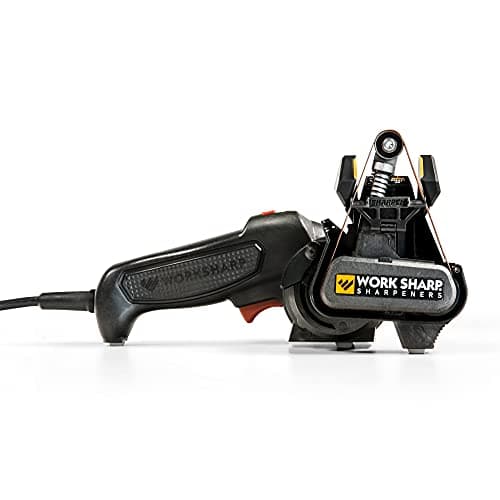
| 02 | Work Sharp MK2 Electric Knife SharpenerThe flexible one. Adjustable abrasive belts and two speeds mean it handles kitchen knives, pocket knives and garden tools on the same machine - and unlike wheel-based sharpeners, a belt follows a curved or recurved edge instead of fighting it. | Best beyond the kitchen | | $89.95·Amazon |
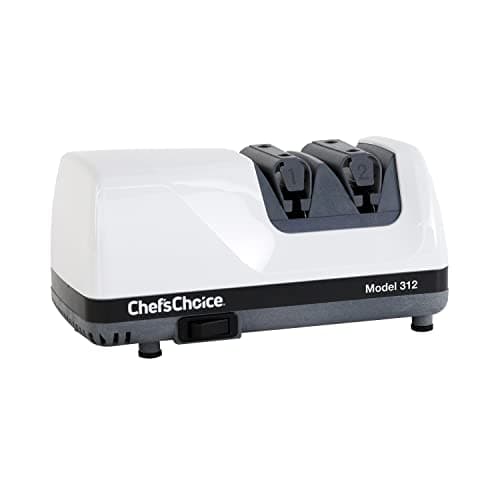
| 03 | Chef'sChoice Diamond UltraHone (Model 312)The sensible middle. Two stages of 100% diamond and automatic knife guides at a considerably lower outlay than the 15XV, built to maintain a traditional 20-degree Western edge rather than convert it - stage one cuts the first bevel on fine diamond, stage two completes the second on micron-size diamond. | Best for German edges | | $94.95·Amazon |
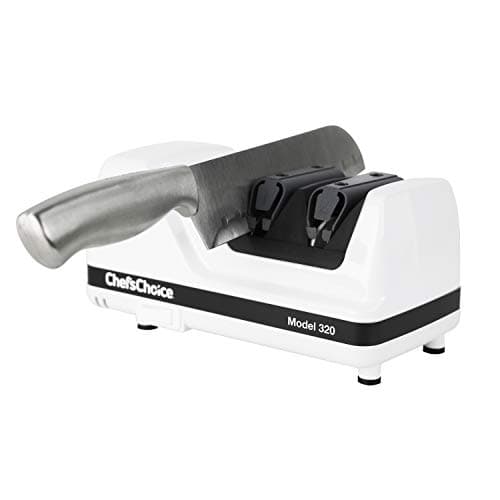
| 04 | Chef'sChoice FlexHone/Strop Electric SharpenerThe one with a real stropping stage. Diamond abrasives do the cutting and a flexible stropping stage removes the burr, which is the step most machines skip and the reason most machine edges feel harsh rather than keen. | Best finish (real strop) | | $114.99·Amazon |
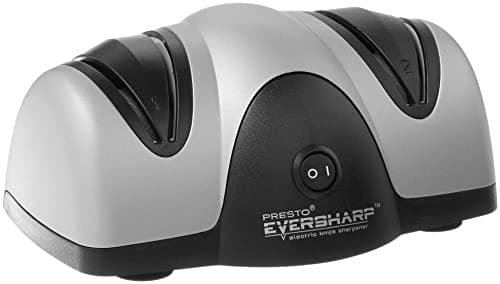
| 05 | Presto 08800 EverSharp Electric Knife SharpenerThe budget answer, and an honest one. Two stages, sapphirite wheels, no angle choices and no pretensions - it will make a dull stamped knife cut again for a fraction of what anything else here costs. | Best budget pick | | $47.99·Amazon |
#ad · Live prices from the Amazon Product API, as of October 18, 2026. Where we have no verified live price, we show none — a gap beats a number that has rotted.
In detail
The picks, in full
Best overall (15-degree convert)
Chef'sChoice 15XV EdgeSelect (Trizor XV)
3 stages, 100% diamond abrasivesConverts 20 deg to 15 deg per sideStropping/polishing final stageSpring guides, metal housing
The one to buy if you own Western knives and want them sharper than they left the factory. Three stages of 100% diamond abrasive, and it converts a 20-degree German edge to a 15-degree Trizor XV edge - the only machine here that makes your knives keener rather than just restoring them.
- Edge quality
- 9
- Angle control
- 9
- Speed
- 8
- Build
- 8
- Value
- 7
Pros
- +The keenest edge of any machine here, by a clear margin
- +The 15-degree conversion is a real upgrade for German knives, not a marketing line
- +Third stage strops rather than grinds, so the finish is genuinely fine
- +Built to survive years of use, unlike most plastic-bodied sharpeners
Cons
- −The most expensive option here by a wide margin
- −Conversion means removing a lot of steel on the first pass - it is a one-way decision
- −Overkill if you own three inexpensive stamped knives
Don't buy this if…
…you own Japanese knives that are already ground at 15 degrees - you would be paying for a conversion you do not need, and a stone would serve you better.
Best beyond the kitchen
Work Sharp MK2 Electric Knife Sharpener
Flexible abrasive belt systemTwo speeds, guided angleHandles kitchen, pocket and outdoor bladesReplaceable belts
The flexible one. Adjustable abrasive belts and two speeds mean it handles kitchen knives, pocket knives and garden tools on the same machine - and unlike wheel-based sharpeners, a belt follows a curved or recurved edge instead of fighting it.
- Edge quality
- 8
- Angle control
- 8
- Speed
- 8
- Build
- 8
- Value
- 8
Pros
- +A belt conforms to curved and recurved edges that wheels handle badly
- +Genuinely useful beyond the kitchen, which few sharpeners are
- +Two speeds give some control over how aggressive it is
- +Belts are consumable and cheap to replace, so the machine does not degrade
Cons
- −Belts wear out and are an ongoing cost the wheel-based machines do not have
- −Less precise than a fixed-angle wheel system on a straight kitchen edge
- −Aggressive in the wrong hands - easy to remove more steel than you meant to
Don't buy this if…
…you only ever sharpen straight-edged kitchen knives - a fixed-angle wheel machine gives a more consistent result for less money.
Best for German edges
Chef'sChoice Diamond UltraHone (Model 312)
100% diamond, both stages20-degree class edges2-stage bevel then ultra-honeStraight and serrated
The sensible middle. Two stages of 100% diamond and automatic knife guides at a considerably lower outlay than the 15XV, built to maintain a traditional 20-degree Western edge rather than convert it - stage one cuts the first bevel on fine diamond, stage two completes the second on micron-size diamond.
- Edge quality
- 8
- Angle control
- 9
- Speed
- 8
- Build
- 7
- Value
- 7
Pros
- +Diamond in both stages cuts modern high-alloy stainless properly
- +Maintains the factory Western angle instead of regrinding it keener
- +Automatic knife guides position and stabilise the blade for you
- +Noticeably cheaper than the flagship for most of the everyday capability
Cons
- −No conversion to a keener angle, so no upgrade to edge geometry
- −Two stages, so there is no separate stropping stage to finish on
- −Plastic housing feels less durable than the metal-bodied models
Don't buy this if…
…your knives are Japanese or already ground at 15 degrees - this is built around the 20-degree class.
Best finish (real strop)
Chef'sChoice FlexHone/Strop Electric Sharpener
100% diamond abrasivesFlexible stropping/honing stageMulti-stageHandles straight and serrated
The one with a real stropping stage. Diamond abrasives do the cutting and a flexible stropping stage removes the burr, which is the step most machines skip and the reason most machine edges feel harsh rather than keen.
- Edge quality
- 8
- Angle control
- 8
- Speed
- 7
- Build
- 8
- Value
- 7
Pros
- +The stropping stage genuinely refines the edge rather than just grinding it
- +Diamond cutting stage handles hard stainless without glazing
- +Copes with serrated edges better than most electrics
- +A more polished result than machines in the same price band
Cons
- −Slower than a two-stage machine because you are running an extra pass
- −Fixed Western angle - no help for Japanese geometry
- −Older design; the housing and controls feel dated
Don't buy this if…
…you want the fastest possible turnaround - the extra stage is the whole point and it costs you time.
Best budget pick
Presto 08800 EverSharp Electric Knife Sharpener
2-stage, sapphirite wheelsFixed angle guidesLightweight plastic bodyInterlocking blade guides
The budget answer, and an honest one. Two stages, sapphirite wheels, no angle choices and no pretensions - it will make a dull stamped knife cut again for a fraction of what anything else here costs.
- Edge quality
- 6
- Angle control
- 9
- Speed
- 7
- Build
- 6
- Value
- 9
Pros
- +By far the cheapest way to get a working edge with zero skill
- +Small, light and easy to store
- +Fast - a dull knife is usable again in under a minute
- +The value math is the strongest here by a wide margin
Cons
- −Sapphirite wheels are less capable than diamond on hard modern stainless
- −Removes a lot of steel relative to the edge it produces
- −No fine or stropping stage, so the edge is workmanlike rather than keen
- −Plastic construction will not last like the metal-bodied machines
Don't buy this if…
…you own knives you care about - this is the right tool for inexpensive stamped blades and the wrong one for a forged or Japanese knife.
Diamond or sapphirite: the abrasive decides the ceiling
Diamond is harder than every carbide in every kitchen knife steel, so it cuts modern high-alloy stainless cleanly and keeps cutting as it wears. Sapphirite and ceramic abrasives are softer, cut more slowly on hard steel, and can glaze over. On a soft stamped knife you will barely notice; on a 60+ HRC Japanese blade or a modern powder steel the difference is obvious. If the machine will ever see a hard knife, pay for diamond — the same logic that makes diamond stones the fast option on a bench.
Fixed angle is the feature and the trap
The reason these machines work for beginners is that the guides hold the angle so you cannot. The reason they wreck good knives is exactly the same: the guides hold theirangle, not your knife's. Run a 15-degree Japanese gyuto through a 20-degree machine and it grinds the shoulders of your bevel back until the edge is a 20-degree edge, permanently and without asking. There is no setting to prevent it and no way to undo it short of a full reprofile on a stone. Match the machine to the knives, or buy an adjustable one.
How much steel are you actually losing?
More than a stone and much more than a rod, though the internet exaggerates it. A stone removes what is needed to reach a fresh apex; a motorized wheel removes that plus whatever the extra revolutions take while you finish the pass. The practical consequences are cumulative rather than dramatic: a knife sharpened electrically every few weeks for a decade will visibly lose blade height, and a full bolster will start to protrude at the heel. Mitigate it the same way professionals do — hone weekly so you sharpen rarely. See sharpening vs honing and how often to sharpen. The full answer, mechanism by mechanism, is in do electric knife sharpeners ruin knives.
What never goes in an electric sharpener
Serrated knives, unless the machine has a stage explicitly designed for them — otherwise the wheels flatten the teeth into a jagged straight edge and the knife is finished. Single-bevel Japanese knives, which need one face ground and the other only deburred. Ceramic blades, which will shatter. Scissors and shears. And any knife with a full bolster running to the heel, which physically cannot reach the wheels there. More on the serrated question in how to sharpen a serrated knife.
Technique still matters, slightly
Even a guided machine can be used badly. Pull at a steady, moderate pace — dragging slowly heats the edge and dwelling in one spot creates a hollow. Use equal passes on each side or you will grind the apex off-center. Start in the coarse stage only if the knife is genuinely dull; if it merely needs refreshing, the fine stage alone is enough and removes far less steel. And clean the wheels occasionally, because packed swarf is what turns a sharp machine into a slow one.
What we would skip
Skip any electric sharpener that does not state its grinding angle. If a listing will not tell you whether it is 15 or 20 degrees per side, it is because the number is not a selling point, and you cannot match it to your knives. Skip the very cheapest single-stage machines, which have coarse wheels and no finishing stage — they leave a toothy, weak edge that fails quickly and cost you steel to get. And skip an electric sharpener entirely if the only knives you own are Japanese; a beginner whetstone costs less, removes less steel and respects the geometry you paid for.
How we picked
We did not lab-test these knives
Everyone in this category says they tested twenty knives in a professional kitchen. We have not hands-on tested any of these, and we say so. What we did instead: compiled the published specifications — steel type and hardness (HRC), edge angle, blade geometry, weight and build — applied established sharpening standards, ran the value math (spec quality ÷ live price), and scored each product against a published rubric. The scores are judgments from documented research — not measurements we took, because we do not have a test lab and we will not pretend we do. Where a number came from someone else's work, we name them in Sources.
Questions
Frequently asked
Do electric sharpeners ruin knives?+
They do not ruin a knife in one use, but they remove more steel than a stone and they impose their own angle. Used on the right knives, occasionally, they are fine. Used weekly on an expensive Japanese blade, they will shorten its life and change its geometry.
Can I sharpen Japanese knives in an electric sharpener?+
Only in one that grinds at 15 degrees per side or is adjustable. A fixed 20-degree machine will regrind a Japanese edge to a Western angle permanently.
How often should I use an electric sharpener?+
As rarely as the knife allows. Hone weekly with a rod to keep the edge aligned, and reach for the machine only when honing stops working — typically every few months for a home cook.
Is diamond worth paying extra for?+
Yes, if you own any hard or high-alloy stainless. Diamond outcuts every carbide in kitchen steel; softer abrasives slow down and glaze on the same blades.
Can an electric sharpener handle a serrated knife?+
Only if it has a stage specifically built for serrations. A standard sharpening wheel flattens the teeth and destroys the edge. Most serrated knives are best treated as semi-disposable.
Electric or whetstone?+
Electric for speed, consistency and zero skill; whetstone for a keener edge, less metal loss and full control of the angle. Many people sensibly own a rod plus one of the two.
Receipts
Sources
We do not run a testing lab, and we do not pretend to. Where a spec or a measured number came from someone else's work — a manufacturer's page, a published standard — we name them and link them. Where we could not verify something, we say so on the page rather than quietly leaving it out. Read our full method.