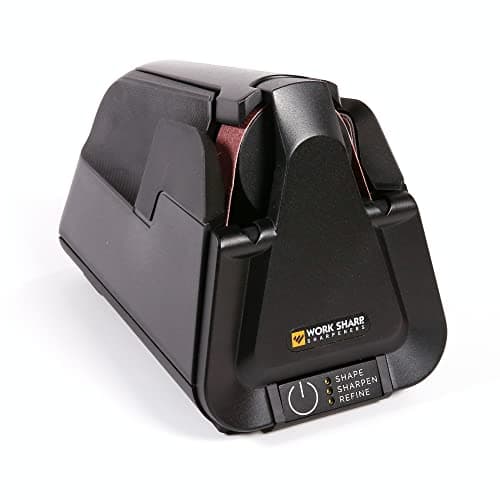
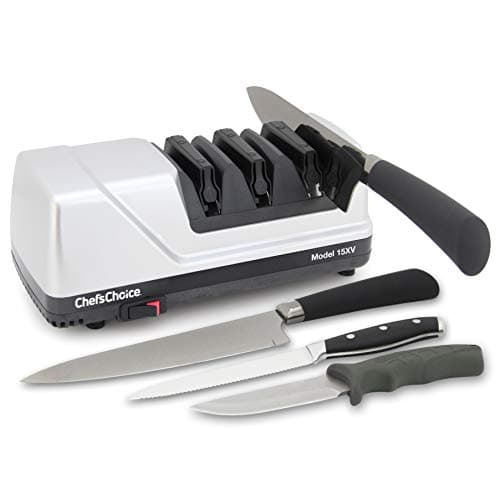
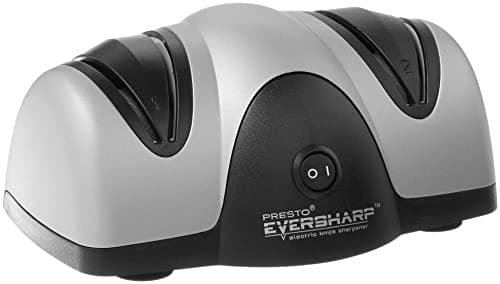
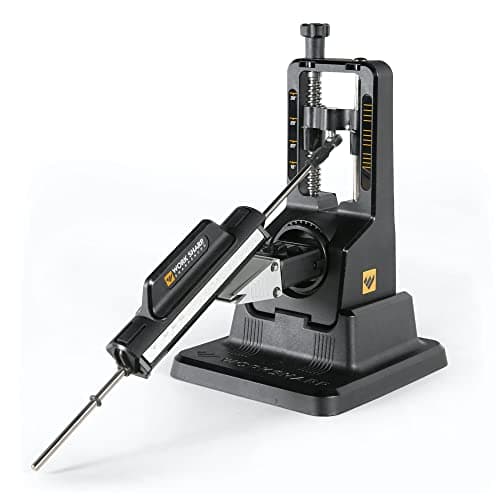
No — but they shorten the life of a knife, and on a thin or hard blade that cost is real enough that we would reach for the Work Sharp Precision Adjust instead. That manual clamped system is the top pick below and the right answer for most people asking this question, because it produces a comparable edge while removing a fraction of the steel. If you specifically want an electric unit, the Work Sharp Culinary E5 is the one we would choose. If your knives are a drawer of inexpensive stamped blades you want working again tonight, almost any electric sharpener is fine and the question does not really apply to you.
The reason "ruin" is the wrong word is that an electric sharpener does exactly what it says: it grinds steel off the edge until a new apex appears. So does a whetstone. The difference is quantity. A motorised abrasive wheel spinning against a blade removes far more metal per sharpening than a hand-held stone does, partly because it is faster and partly because it has no feedback — you cannot feel a burr forming through a motor. Do that a few times a year for a decade and the blade is measurably narrower, the profile has changed, and on a tapered forged knife the bolster eventually stops the heel reaching the wheels at all.
What actually goes wrong, in order of how often it happens
1. The angle is the machine's, not the knife's.This is the most common real damage and almost nobody notices it. Most electric sharpeners have fixed guide slots at around 20 degrees per side. Put a Japanese knife ground at 15 degrees through one and it is reprofiled to 20: still sharp, permanently blunter in geometry than it was. The Chef'sChoice Trizor 15XV is the notable exception, built around a 15-degree geometry, and it converts Western knives to 15 rather than the reverse. For the full picture see our sharpeners for Japanese knives roundup.
2. Too much metal, too fast. Every sharpening is a withdrawal from a finite account. A coarse electric stage on a knife that only needed a fine pass takes years off it in ninety seconds. The discipline is to use the coarse stage only when the edge is genuinely damaged, and the fine or honing stage the rest of the time — which is exactly the instruction people skip.
3. Heat and shock at the apex.Fast wheels generate friction heat, and hard brittle steel does not like shock. On a 60–61 HRC Japanese edge the result can be micro-chipping rather than a clean bevel. On a soft 55 HRC stamped Western knife this is essentially a non-issue.
4. The bolster problem, long term. On a forged knife with a full bolster, repeated grinding slowly creates a step at the heel because the bolster blocks the last half-inch of edge. This happens on stones too; it happens faster when more metal comes off each time. Our easiest-knives-to-sharpen guide covers which knives are built to avoid it.
Which knives tolerate an electric sharpener
Yes, comfortably:inexpensive stamped Western knives in soft steel — Victorinox Fibrox, Mercer Millennia, Dexter Sani-Safe. These are 53–58 HRC at around 20 degrees, which is exactly what a standard electric unit is built for, and they are cheap enough that trading blade life for convenience is rational.
With care: forged German knives like the Wusthof Classic. They will take it, but they are ground near 14 degrees so a 20-degree machine will reprofile them, and they are expensive enough that metal loss matters.
No: hard Japanese knives, thin gyutos, single-bevel knives, serrated blades and anything with a scalloped or granton edge. A single-bevel knife has a completely different geometry that a two-slot machine cannot produce — see single bevel versus double bevel. For serrated edges, read how to sharpen a serrated knife instead; a standard sharpener will grind the teeth flat.
How the picks below are scored. This page compares three electric units against the manual clamped system that competes with them, so the rubric is built around the question being asked: metal conservation (how little steel a sharpening costs you), edge quality, angle control, ease of use and value. Ranked strictly by the resulting average. Published specifications are unchanged from the roundups that established them.
How to use an electric sharpener without doing damage
If you own one already, four rules get most of the blade life back.
Use the coarse stage almost never. Coarse is for a chipped or genuinely blunt edge, which is perhaps once a year. For a knife that is simply dulling, go straight to the fine or honing stage. Most of the metal people lose to an electric sharpener is lost to stage one on knives that did not need it.
Count your passes and stop early. The instinct is to keep going until the knife feels sharp; the better instinct is to do the recommended number of passes, test on paper, and only then do more. See how to tell if a knife needs sharpening for tests that do not involve your thumb.
Hone between sharpenings instead. A honing rod realigns a rolled edge in fifteen seconds and removes essentially no metal. Used before each session it can cut how often the machine comes out by half or more. Start with do you need a honing rod.
Keep the wrong knives out of it. Serrated, single-bevel, hard Japanese, and anything you would be upset to replace. Those go on a stone or into a clamped system.
Electric, manual guided, or a stone?
| Electric | Clamped manual system | Whetstone |
|---|
| Metal removed per sharpening | Most | Less | Least |
| Skill required | None | A little | Real practice |
| Time per knife | About a minute | Five to ten minutes | Ten to twenty minutes |
| Angle set by | The machine | You, within 15–30° | Your hands |
| Best edge achievable | Good | Very good | Best |
| Right for | Cheap stamped knives, a whole drawer at once | Mixed collections, knives you care about | Enthusiasts, hard Japanese steel |
The honest summary is that an electric sharpener is a good purchase for a specific household: inexpensive knives, no interest in learning, and a real preference for a job that takes sixty seconds. For everyone else, the clamped manual system at the top of this page does the same job better and does not raise the question in the title. Our full sharpener roundup covers every family, and the electric roundup ranks the machines against each other on their own terms.
Signs a knife has already been over-sharpened
Hold the blade up and look at the profile against a straight edge. Three things are worth checking: whether the blade has become visibly narrower from spine to edge compared with a sibling knife, whether there is a step or recurve near the heel where a bolster has blocked the abrasive, and whether the tip has lost its point and become rounded. None of these are repairable at home, and all three are gradual rather than sudden.
If you see them, the knife is not unusable — it is just older than its age. The relevant question becomes how long a knife should last and what shortens it, which we cover in how long does a chef knife last.