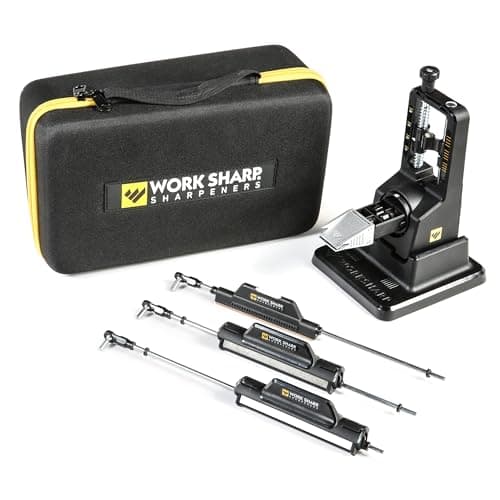
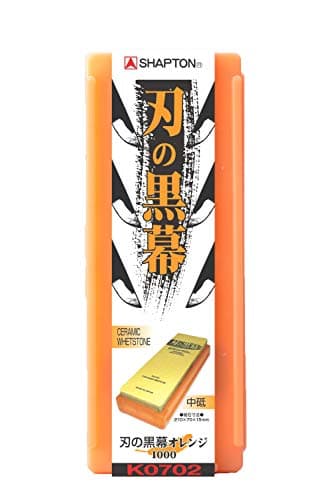
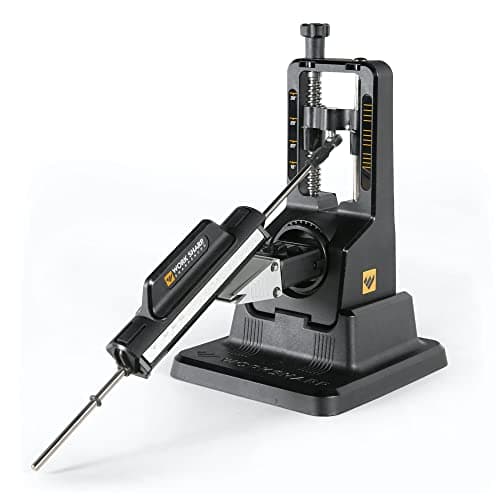
Buy the Work Sharp Precision Adjust if you want one device that will sharpen a Japanese knife correctly without years of practice. It is the pick for anyone who owns a Shun, a MAC, a Global, a Tojiro or any other knife ground near 15 degrees and does not trust their hands on a stone. A clamp holds the blade while you set the angle anywhere from 15 to 30 degrees, which means the knife gets the angle the maker ground rather than the angle the gadget was built for. If you already sharpen freehand and want the best possible edge, skip to the Shapton Kuromaku 1000 instead — a hard splash-and-go ceramic stone is the correct tool for hard steel, and it is third here only because it asks for skill the clamped systems do not.
The reason this page needs to exist is one number. Western and German knives are ground at roughly 20 degrees per side; Japanese knives are ground at roughly 15, and some lower — Global publishes a factory edge between 10 and 15 degrees. Almost every pull-through sharpener, and a great many electric ones, has a fixed guide set for the Western angle. Run a 15-degree Japanese knife through a 20-degree sharpener and it does not fail to sharpen it; it reprofiles it, grinding away the keen edge you paid for and replacing it with a blunter one. The knife will feel sharp for a week and will never cut like it did again, and nothing on the box warns you.
The second number is hardness. Japanese knives run harder — Shun publishes around 60–61 HRC for the Classic line, MAC around 59 — and hard steel is brittle. It chips where a softer Western edge would roll. That matters for sharpener choice because aggressive, fast-cutting devices generate heat and shock at the apex, which is exactly what a brittle edge dislikes. It is also why a honing rod does comparatively little on a hard knife: there is less to realign, because the edge broke rather than bent. For that side of the problem see our honing rods for Japanese knives roundup — rods are deliberately not ranked on this page, because they remove no metal and a sharpener does.
A caveat worth stating before the list: not every knife sold as Japanese is hard. The Global G-2 publishes Rockwell C56–58, which is the German band, on a 10–15 degree grind. That combination means it needs the narrow angle and tolerates faster abrasives better than a Shun does. Our Shun versus Global comparisoncovers why "Japanese" is not a specification, and it changes which of the picks below is right for you.
How these are scored. This lineup spans three sharpening families (clamped guided systems, bench water stones, electric), and the rubrics on our family-specific roundups cannot be compared across them. Every pick here is scored on one rubric built for this question — angle suitability, edge quality, hard-steel safety, ease of use and value — and ranked strictly by the resulting average, with the house tiebreak (at an equal average, the cheaper product ranks first).
What makes a sharpener wrong for a Japanese knife
Three things, in order of how much damage they do.
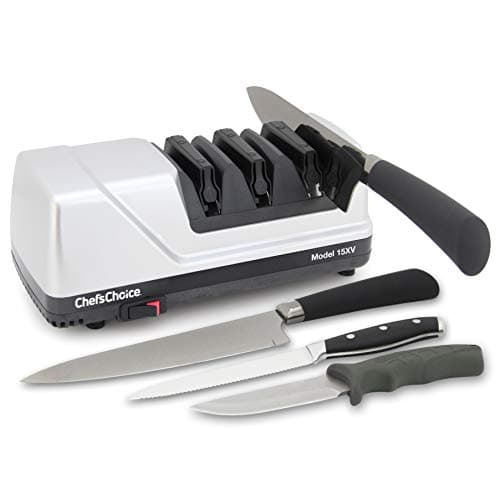
A fixed Western angle. This is the big one and it is invisible. A pull-through or electric sharpener with carbide or ceramic slots set for 20 degrees per side will grind a 15-degree Japanese edge back to 20. You get a working edge and you have permanently thrown away the geometry that made the knife cut better than a German one. Check the specification before you buy: if a device does not state its angle, assume Western.
Aggression. Carbide pull-throughs scrape metal off in visible curls and are the single worst thing you can do to a hard thin blade — they tear rather than abrade, and they chip brittle steel. Electric units with fast wheels are a milder version of the same problem. The reason every stone on this page scores highest on hard-steel safety is that abrasion at hand speed does not shock the apex.
Clamping and heat. Minor by comparison, but real: a clamp tightened hard on a thin spine will mark it, and any sharpening that gets a blade hot enough to notice has gone too far. Neither is a reason to avoid a guided system; both are reasons to be unhurried with one.
The angles, and where to find yours
| Knife | Published factory edge | Set your sharpener to |
|---|
| Shun Classic (VG-MAX, ~60–61 HRC) | ~16° per side, double bevel | 15–16° |
| MAC Chef Series (~59 HRC) | ~15° | 15° |
| Global G-2 (CROMOVA 18, C56–58) | Between 10° and 15° | 15° (do not chase 10° freehand) |
| Wusthof Classic (for comparison) | ~14° per side (PEtec) | 15° |
| Victorinox Fibrox (for comparison) | ~20° per side | 20° |
Note the surprise in that table: Wusthof's PEtec grind is narrower than Shun's, so "Japanese means 15 and German means 20" is a rule of thumb rather than a fact. The practical advice is to set 15 degrees for anything thin and keen and 20 for anything stamped and Western, and to read the maker's page before assuming. Our angle guide covers how much precision actually matters — the short version is that consistency matters more than hitting an exact number.
Stone or guided system? The honest answer
A whetstone gives the best edge, removes the least steel, and costs the least. It also asks you to hold an angle freehand for several minutes, which most people cannot do on their first ten attempts — and a drifting angle rounds the apex, which is why so many people conclude their stone does not work. A clamped guided system holds the angle for you, produces a more consistent result immediately, and uses consumable rods rather than a stone you can flatten forever.
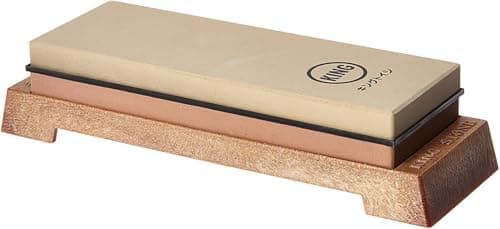
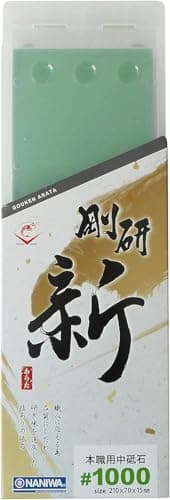
So: if you enjoy the process, or you want the best possible edge and are willing to be bad at it for a while, buy the Shapton or the King and read our step-by-step stone guide. If you want your knives correctly sharp this weekend, buy the Work Sharp Precision Adjust. Both are legitimate; the clamped system is the one we recommend more often, because an unmaintained Japanese knife is worse than a maintained Victorinox.
What to use between sharpenings
Not a grooved steel rod. A traditional ridged honing steel is designed to catch and realign a soft Western edge; on a 60 HRC Japanese knife the ridges can snap the apex rather than straighten it. The right maintenance tool for hard steel is a fine ceramic rod — 1200 grit or finer — which lightly abrades as well as realigning, so it genuinely refreshes the edge rather than only pushing it back into line.
That is a separate category with its own page: best honing rods for Japanese knives. Read honing versus sharpening first if the distinction is new, because the single most common mistake in this whole category is honing constantly and calling it sharpening. And see grooved versus smooth steels for why the rod that came with your knife block may be the wrong one.
Three things to stop doing to a Japanese knife
Stop using a carbide pull-through. The little V-shaped slot in a cheap handheld sharpener scrapes metal off and sets a Western angle. It is the fastest way to destroy a thin keen edge.
Stop putting it in the dishwasher. Both Kai and Global rule it out on their own care pages. See our dishwasher guide for what actually happens in there.
Stop cutting on glass, stone or ceramic boards. Board hardness is the biggest single determinant of how fast an edge dulls, and it matters more for brittle steel than for soft. Our board roundup ranks on exactly that.