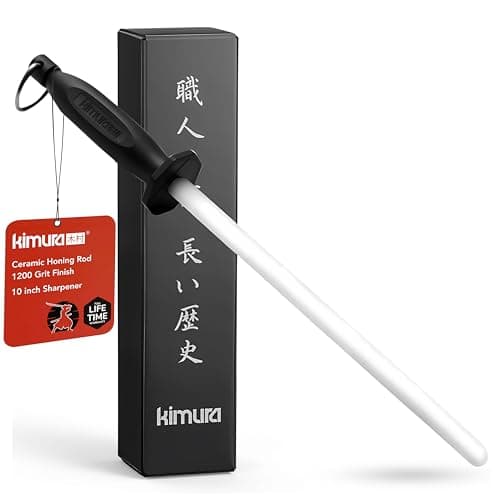
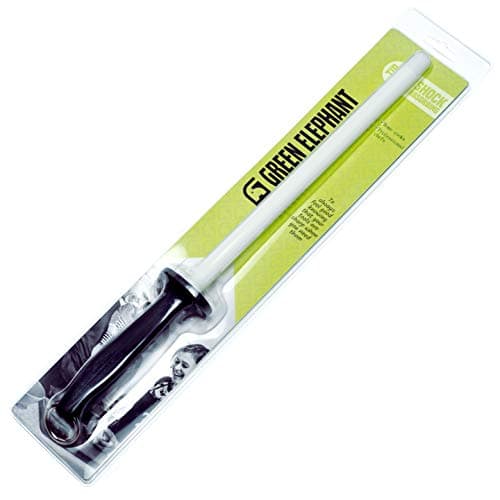
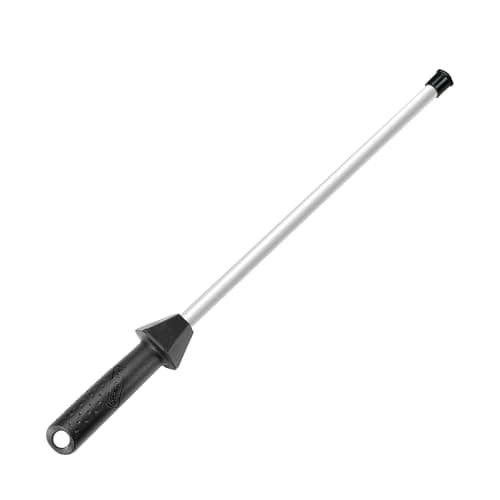
If you own a gyuto, a Shun, a MAC or a Global and you have been running it along the steel rod that came with your old knife block, stop. The advice to hone every knife on a steel rod comes out of Western professional kitchens running steel at 55–58 HRC, and it does not survive the trip to a blade at 61.
The reason is mechanical. A rod fixes a rollededge — an apex that deflected sideways instead of losing metal. Soft steel rolls readily. Hard steel is more brittle: it rolls much less and, at the margin, fractures instead. So there is less bent metal for a rod to straighten, and the longitudinal ridges on a traditional steel rod now have something hard and brittle to catch on. The tool that felt miraculous on a Wusthof is, on a hard Japanese edge, at best doing nothing and at worst taking small bites out of your apex.
Ceramic solves it by changing the mechanism entirely. There are no ridges to catch, and instead of bending metal a ceramic rod removes an extremely small amount of it — which works regardless of whether the edge rolled. That is why every serious Japanese-knife retailer sells ceramic rods and why all four picks here are ceramic. We ranked them on how well the surface suits hard steel, grit and the finish it leaves, working length, build, and value against the live price.
The rod we would tell you to skip
Skip the diamond rod, and skip it specifically here. On a soft Western knife a diamond rod is an aggressive but defensible occasional tool. On a 61 HRC Japanese edge it is the worst combination available: the steel is brittle, the abrasive cuts hard and fast, and the geometry you are cutting into is a thin 15-degree bevel with very little metal behind it. You can take a genuinely damaging amount off a Japanese edge in a few passes. If your Japanese knife needs metal removed, it needs a stone, where you can see and control what you are doing.
The second skip is the ridged steel rod already in your block. It is not junk — it is the right tool for a different knife. Keep it for the Western blades in the drawer and buy a ceramic rod for the Japanese ones. Two rods sounds excessive until you notice they cost less together than one of the knives they maintain.
Grit, and what the numbers mean on a rod
Rod grit works the opposite way round from stone grit in one important respect: on a stone you progress through grits, while on a rod you pick one and live with it. Lower numbers (around 1200) remove slightly more and do more for an edge that has started to fade. Higher numbers (1500, 3000) remove less and refine more, which suits a very hard, very keen edge that mostly needs its apex tidied rather than rebuilt.
One caution that applies across this whole category: grit numbers are not comparable across abrasive types. A 1200-grit ceramic rod, a 1200-grit diamond rod and a 1200-grit Japanese water stone are not doing the same thing at the same rate. Whetstone grits explained sets out why the scales diverge. Compare rods to rods and nothing else.
Angle: 15 degrees, and be shallow if you miss
Japanese knives are typically ground near 15 degrees per side against roughly 20 for Western blades, so the rod should sit closer to the blade than the Western habit tells you. The good news is that honing angle is far more forgiving than sharpening angle, because a rod removes essentially nothing. The bad news is that the forgiving direction is shallow: too flat and you simply miss the apex, too steep and you round it over. What angle to hone a knife at covers how to find 15 degrees without measuring it, and our sharpeners for Japanese knives roundup covers the metal-removing half of the job, where the angle is far less forgiving.
Light hands, and fewer strokes than you think
Hard steel wants less of everything. Five light alternating passes per side is a full session, and the weight of the knife is close to the right pressure. Heavy pressure on a brittle apex against a hard ceramic surface is exactly the situation where a hard knife chips, and a chip needs a stone to remove. If five passes have not brought the bite back, the edge is worn rather than rolled and a rod is the wrong tool for what is happening — the two-test diagnostic separates the two cases in ten seconds.
Keep the rod clean
Ceramic works by very light abrasion, and abrasion loads the surface with steel particles. A rod that has stopped working is usually a rod that needs washing rather than replacing: warm water, dish soap, a scouring pad, and the grey streaks come off. Do this every few months and the rod lasts effectively forever, barring the one thing that kills ceramic rods, which is a hard floor.
How we picked
We did not lab-test these knives
Everyone in this category says they tested twenty knives in a professional kitchen. We have not hands-on tested any of these, and we say so. What we did instead: compiled the published specifications — steel type and hardness (HRC), edge angle, blade geometry, weight and build — applied established sharpening standards, ran the value math (spec quality ÷ live price), and scored each product against a published rubric. The scores are judgments from documented research — not measurements we took, because we do not have a test lab and we will not pretend we do. Where a number came from someone else's work, we name them in Sources.