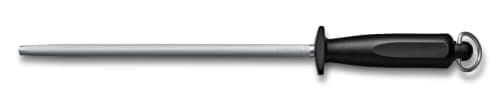
"My knife is dull" describes two completely different conditions with two completely different fixes. If the apex has rolled— bent sideways under normal use — thirty seconds on a rod brings it back. If it has worn— abraded away until the apex is a rounded surface rather than a line — no rod on earth will help and you need a stone. Buying the wrong one is the most common way people conclude that honing rods are a scam.
Test one: the paper test (five seconds)
Hold a sheet of printer paper by one corner so it hangs. Slice down through it from heel to tip with almost no pressure.
- Cuts cleanly and quietly— the knife is sharp. Nothing to do.
- Cuts but crackles, snags or tears in places— the edge is probably rolled, and rolled in patches. Hone it.
- Skates off the edge of the paper or crumples it— the apex is gone. Sharpen it.
Test two: the tomato test (the one that actually diagnoses)
Rest the edge on the taut skin of a tomato with no downward pressure at all and draw it backwards, once.
- It bites immediately and slices in— sharp.
- It bites but tears the skin rather than parting it cleanly, with juice — this is the signature of a misaligned edge. The metal is there, it is just not in line. Hone it.
- It slides across the skin without catching, and you have to press to start the cut— the apex has rounded off. Honing will do nothing. Sharpen it.
The tomato test is the more useful of the two because that middle result — bites but tears — is the one that maps cleanly onto "rolled". That is the whole diagnosis, and everything below is what to do with it.
The confirming test: hone first, then retest
If the two tests disagree, or you are not sure what you felt, there is a tiebreaker that costs nothing: hone the knife, then run the tests again. Ten light alternating passes on a rod is enough. If the bite comes back, the edge was rolled and you have already fixed it. If nothing changes, the edge is worn and you now know with certainty that a stone is the answer. This is the cheapest diagnostic in the kitchen and it is the reason a rod is worth owning even before you own a stone.
Look down the edge in bright light
The visual check catches things the cutting tests do not. Hold the knife under a bright light with the edge pointing up at you and look straight down it, then tilt it slowly.
- A continuous thin bright linemeans the apex is reflecting light because it has been rounded flat — a worn edge, needing a stone.
- Bright points at intervals are chips. No rod fixes a chip; the whole edge has to be ground back level with the deepest notch.
- Nothing visible at allis what a genuinely sharp edge looks like — there is no surface up there to catch the light.
Why knives go dullcovers the four distinct failure modes — rolling, abrasion, chipping and corrosion — and what causes each one.
What the answer tells you about your habits
If your knife keeps coming up rolled, that is normal and you simply need to hone more often — ideally before any long prep session. If it keeps coming up worn faster than every few months, something is abrading it, and the usual suspect is the board. Glass, stone, ceramic and steel surfaces destroy an edge in a fraction of the time wood or end-grain does; the cutting board guide covers what that costs you. If it keeps coming up chipped, the knife is probably harder than the work you are giving it — bones, frozen food and hard squash are chip sources on a 61 HRC blade.
Frequency, once you know which is which
For a home cook: hone weekly or before any long session, sharpen every three to six months. Those are starting numbers, not rules — the honest trigger is exactly the one this page describes. When honing no longer restores the bite, it is time for the stone, whether that is six weeks or a year. How often should you sharpen knives puts intervals against different kinds of use.
Do not use your thumb
The old test of running a thumb across the edge tells an experienced hand something real and tells everyone else nothing, at meaningful risk. The paper test gives you better information, and the tomato test gives you the actual diagnosis. Neither one costs you a fingertip.
How we picked
We did not lab-test these knives
Everyone in this category says they tested twenty knives in a professional kitchen. We have not hands-on tested any of these, and we say so. What we did instead: compiled the published specifications — steel type and hardness (HRC), edge angle, blade geometry, weight and build — applied established sharpening standards, ran the value math (spec quality ÷ live price), and scored each product against a published rubric. The scores are judgments from documented research — not measurements we took, because we do not have a test lab and we will not pretend we do. Where a number came from someone else's work, we name them in Sources.