Skip to content
The Edge Bench

Stones, sharpeners & how-to · Sharpening

Honing rods: steel vs ceramic vs diamond

They look interchangeable and they are not. One realigns, one lightly sharpens, one removes real metal — and using the wrong one on hard steel does damage you cannot undo.

By Stephen V.Updated How we review
#ad

We earn a commission when you buy through our Amazon links, at no extra cost to you. It never changes a verdict, and we say so when the cheaper knife is the better buy. How this works.

A honing rod is the most misunderstood tool in a kitchen. Most people call it a "sharpening steel", which is exactly backwards: a traditional ridged steel rod does not sharpen at all. It realigns — it pushes an edge that has folded over microscopically back into line, which restores cutting performance without removing meaningful metal. That is why ten seconds of honing can make a knife feel new, and also why honing eventually stops working and a stone becomes necessary.

The confusion matters because the three common rod materials do genuinely different things, and the wrong one on the wrong steel causes damage rather than maintenance.

Rod typeWhat it doesRemoves metal?Right for
Ridged steelRealigns a rolled edgeAlmost noneWestern steel, 55–58 HRC
Smooth steelRealigns very gently, burnishesNoneSofter steels, delicate edges
CeramicRealigns and lightly abradesA very small amountHarder steel, 58–62 HRC
DiamondCuts steel — this is sharpeningYes, meaningfullyFast touch-ups, very hard or worn edges

Ridged steel: the default, and why it fails on Japanese knives

A traditional steel rod has fine longitudinal ridges. Drawn along a soft edge at the right angle, those ridges catch the folded-over apex and stand it back up. On German or Swiss steel at 55–58 HRC, which rolls readily under normal use, this is exactly the right tool and it works spectacularly well.

Take the same rod to a Japanese blade at 60–62 HRC and the mechanism fails. Hard steel does not roll much — it fractures. There is little folded edge to realign, and the aggressive ridges can chip the brittle apex instead. That is the origin of the widely repeated advice not to use a steel on Japanese knives, and it is correct as far as it goes.

Ceramic: the answer for hard steel

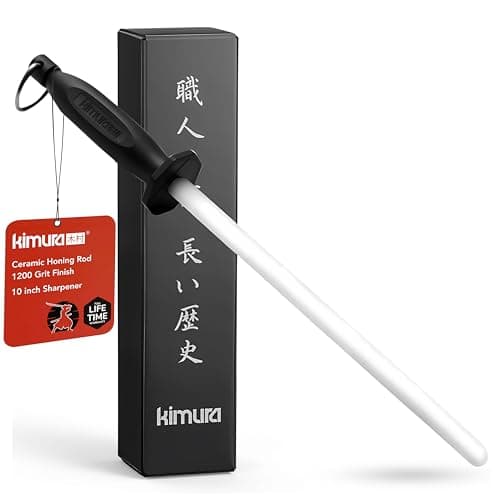
A fine ceramic rod (commonly around 1200 grit) has no ridges — it works by very light abrasion. On hard steel it does two useful things at once: it straightens what little deflection there is, and it refreshes the apex by removing a tiny amount of metal, which is effectively a very light sharpening pass. It is gentle enough not to chip a hard edge and effective enough to extend the interval between stone sessions substantially.

If you own Japanese knives and want a rod at all, this is the one. Ceramic rods are also brittle — dropping one on a tile floor usually ends it — and they load up with steel over time, which is fixed with a scouring pad and some cleaner.

Diamond: this is not honing

A diamond-coated rod is a sharpening tool in a rod-shaped package. Industrial diamond cuts steel of any hardness, and it removes real metal on every pass. Used deliberately — a few light strokes to bring back a tired edge in seconds — it is genuinely useful, particularly on very hard steels a ceramic rod struggles with, and on badly worn edges.

Used as a daily honing rod, it is destructive. Someone who "steels" their knife twenty times before every meal with a diamond rod is grinding the blade away, and a knife treated that way visibly narrows over a few years. Diamond rods also usually come in coarser grits than a finished edge wants, so the edge they leave is aggressive rather than refined — fine for a working kitchen, less ideal for clean slicing.

Length, and the one technique rule that matters

The rod must be longer than the blade you are honing, so an 8-inch chef's knife wants a 10-inch rod or more. Anything shorter forces you to hone in sections, which is where inconsistent angles come from.

Speed is not the point. The single most common error is honing fast and hard, which is where the theatrical restaurant flourish comes from and which achieves nothing except an inconsistent angle. Slow, light strokes at a consistent angle — matched to how the knife was ground — do the work. Full method in how to use a honing steel, and the angle question in knife sharpening angles.

The short answer

Quick picks

#KnifeBest forScorePrice
01
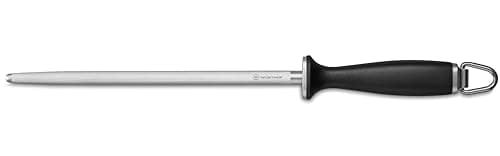
Wusthof Wusthof 10" Honing Steel
Wusthof 10" Honing Steel

The right rod for the overwhelming majority of kitchens, because the overwhelming majority of kitchen knives are Western steel that rolls. Fine-cut carbon steel, long enough for an 8-inch blade in one stroke, magnetic so it holds what it lifts.

Best for Western and German steel
8.2
$85.00Amazon
02
Messermeister Messermeister 12" Ceramic Rod
Messermeister 12" Ceramic Rod

The rod to own if any of your knives are hard Japanese steel. Fine 1200-grit ceramic realigns and lightly abrades rather than catching the edge on ridges, which is both safer on a brittle apex and more useful, because it genuinely refreshes rather than only straightening.

Best for hard Japanese steel
8.2
Check price →
03
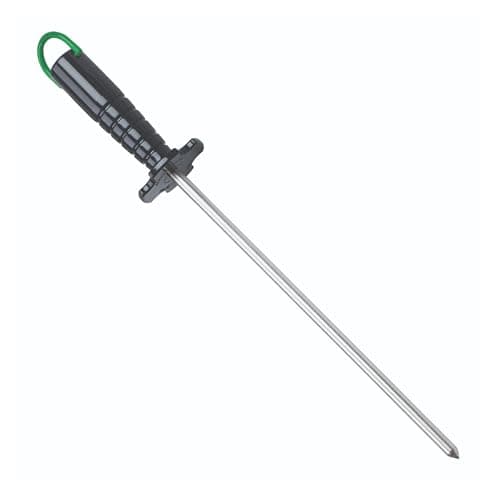
DMT DMT 12" Diamond Steel, Extra-Fine (DS2E)
DMT 12" Diamond Steel, Extra-Fine (DS2E)

Not a honing rod at all - a sharpening tool shaped like one, and useful precisely because of that. A few deliberate strokes restore a tired edge in seconds on steel of any hardness. Extra-fine grit keeps the result usable rather than coarse, but it still removes real metal every pass.

Best for fast touch-ups on any steel
8.4
$48.98Amazon

#ad · Live prices from the Amazon Product API, as of Sep 2, 2026. Where we have no verified live price, we show none — a gap beats a number that has rotted.

In detail

The picks, in full

01
Wusthof Wusthof 10" Honing Steel

Best for Western and German steel

Wusthof 10" Honing Steel

Fine-cut carbon steel10 in, magneticRealigns, not sharpensGerman-made
8.2/10

The right rod for the overwhelming majority of kitchens, because the overwhelming majority of kitchen knives are Western steel that rolls. Fine-cut carbon steel, long enough for an 8-inch blade in one stroke, magnetic so it holds what it lifts.

Edge & steel
8
Sharpness
7
Handling
8
Build
9
Value
9

Pros

  • Exactly matched to how softer Western steel fails
  • Long enough to hone an 8-inch blade in a single stroke
  • Magnetic rod retains the fine particles it lifts
  • Removes essentially no metal, so the knife does not wear

Cons

  • Wrong tool for hard Japanese steel - the ridges can chip a brittle apex
  • Does nothing at all for a genuinely blunt edge
  • Needs a consistent angle, which takes a little practice

Don't buy this if…

your knives are Japanese at 60+ HRC - a ceramic rod is the correct tool and this one risks chipping the edge.

$85.00View on Amazon

Price as of Sep 2, 2026. Prices change — Amazon's at checkout is the one that counts.

#ad · we may earn a commission from this link to Wusthof 10" Honing Steel

02
Messermeister Messermeister 12" Ceramic Rod

Best for hard Japanese steel

Messermeister 12" Ceramic Rod

1200-grit ceramic12 inHones and lightly sharpensSuits hard Japanese steel
8.2/10

The rod to own if any of your knives are hard Japanese steel. Fine 1200-grit ceramic realigns and lightly abrades rather than catching the edge on ridges, which is both safer on a brittle apex and more useful, because it genuinely refreshes rather than only straightening.

Edge & steel
9
Sharpness
9
Handling
8
Build
7
Value
8

Pros

  • Safe on 60+ HRC edges where a ridged steel is not
  • Lightly abrades, so it extends the interval before stone work
  • 12 inches covers any kitchen blade in one stroke
  • Works on softer Western steel too - it is the more universal rod

Cons

  • Ceramic is brittle and a drop onto a hard floor usually ends it
  • Loads up with steel over time and needs cleaning
  • Slower than a steel rod on a badly rolled soft edge

Don't buy this if…

you are hard on kitchen tools - a dropped ceramic rod is a broken ceramic rod, and a steel one is essentially indestructible.

Check price on Amazon →

No buyable offer at the last price check (Sep 2, 2026). We show nothing rather than a stale number.

#ad · we may earn a commission from this link to Messermeister 12" Ceramic Rod

03
DMT DMT 12" Diamond Steel, Extra-Fine (DS2E)

Best for fast touch-ups on any steel

DMT 12" Diamond Steel, Extra-Fine (DS2E)

Monocrystalline diamond surface12 in, extra-fine gritRemoves metal - this is sharpeningWorks on any hardness
8.4/10

Not a honing rod at all - a sharpening tool shaped like one, and useful precisely because of that. A few deliberate strokes restore a tired edge in seconds on steel of any hardness. Extra-fine grit keeps the result usable rather than coarse, but it still removes real metal every pass.

Edge & steel
9
Sharpness
9
Handling
8
Build
9
Value
7

Pros

  • Cuts steel of any hardness, including edges ceramic struggles with
  • Restores a tired edge in seconds rather than minutes
  • Extra-fine grit leaves a more usable edge than coarser diamond rods
  • Effectively immune to the wear that eventually flattens a steel rod

Cons

  • Removes real metal - daily use visibly narrows a blade over years
  • Not a substitute for a stone when an edge is genuinely blunt
  • Easy to over-use because it feels effective every time

Don't buy this if…

you want something to use before every meal - that is a honing job, and this tool will grind your knives away doing it.

$48.98View on Amazon

Price as of Sep 2, 2026. Prices change — Amazon's at checkout is the one that counts.

#ad · we may earn a commission from this link to DMT 12" Diamond Steel, Extra-Fine (DS2E)

Which rod should you own?

If all your knives are Western (Victorinox, Wusthof, Zwilling, Mercer, Made In): a ridged steel rod, at least 10 inches. It is the correct tool, it costs little, and it will outlive you.

If any of your knives are Japanese at 60+ HRC (Shun, MAC, Tojiro, Misen): a fine ceramic rod. It is safe on hard edges and it also works perfectly well on your softer knives, so it is the single-rod answer for a mixed kitchen.

If you want speed above all: an extra-fine diamond rod, used deliberately and infrequently. Treat it as a two-minute sharpening session, not a daily ritual.

What no rod can do

None of these will bring back a genuinely blunt edge, remove a chip, or fix an edge that has been rounded over by years of pull-through sharpening. Those need a stone, a guided system, or a professional service. The rod extends the interval between those sessions; it does not replace them.

A useful mental model: honing is what you do weekly, sharpening is what you do a few times a year. If honing has stopped producing an improvement, that is the signal to sharpen — sharpening vs honing covers the distinction properly.

Care for the rod itself

Steel rods accumulate fine metal particles; a magnetic one holds them, and a wipe with a damp cloth clears them. Ceramic rods discolor gray as they load with steel and can be cleaned with a scouring pad and a mild abrasive cleaner — a gray rod is not worn out, it is dirty. Diamond rods need only rinsing, and should never be scrubbed aggressively, which can strip the diamond coating. Store all three where they cannot rattle against other metal.
How we picked

We did not lab-test these knives

Everyone in this category says they tested twenty knives in a professional kitchen. We have not hands-on tested any of these, and we say so. What we did instead: compiled the published specifications — steel type and hardness (HRC), edge angle, blade geometry, weight and build — applied established sharpening standards, ran the value math (spec quality ÷ live price), and scored each product against a published rubric. The scores are judgments from documented research — not measurements we took, because we do not have a test lab and we will not pretend we do. Where a number came from someone else's work, we name them in Sources.

Questions

Frequently asked

Does a honing steel actually sharpen a knife?
A ridged steel rod does not — it realigns an edge that has folded over. Ceramic rods lightly abrade, so they do a small amount of genuine sharpening. Diamond rods sharpen properly and remove real metal every pass.
Can I use a honing steel on a Japanese knife?
Not a ridged steel rod — hard steel does not roll much and the ridges can chip a brittle apex. A fine ceramic rod is the correct tool, and a whetstone is the proper maintenance.
How often should I hone a knife?
For softer Western steel, roughly every few uses or once a week for a home cook — it takes seconds. Hard Japanese steel needs it far less often. See how often to sharpen knives.
Is a diamond rod better than a ceramic one?
Different, not better. Diamond cuts steel and restores a tired edge quickly, at the cost of removing metal. Ceramic realigns and refreshes gently, so it can be used far more often. Most kitchens are better served by ceramic.
What length honing rod do I need?
Longer than your longest blade. A 10-inch rod covers an 8-inch chef's knife in one stroke; 12 inches covers a bread knife or slicer too. Honing in sections invites inconsistent angles.

Keep reading

Receipts

Sources

We do not run a testing lab, and we do not pretend to. Where a spec or a measured number came from someone else's work — a manufacturer's page, a published standard — we name them and link them. Where we could not verify something, we say so on the page rather than quietly leaving it out. Read our full method.