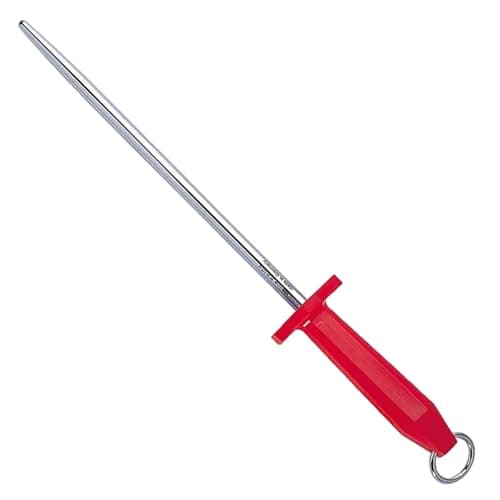
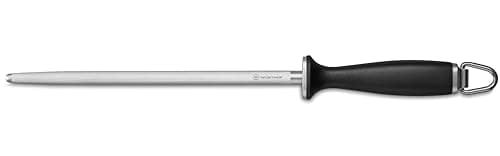
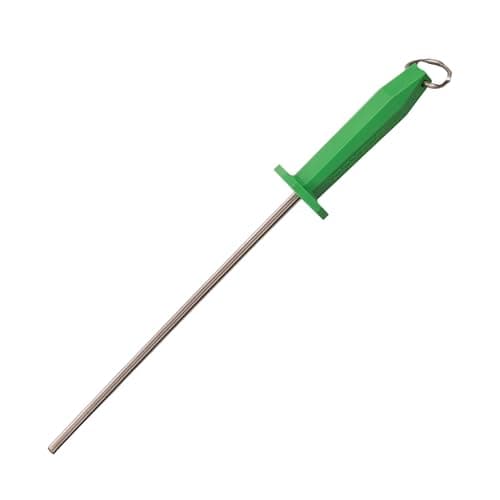
A ridged steel rod has fine longitudinal grooves running its length. A smooth one is polished. They look nearly identical on a shelf, they cost about the same, and there is a long-running disagreement about which one you should own that most buying guides paper over by recommending the ridged one because it is what everybody sells.
The honest version: ridged rods work faster and smooth rods are gentler, and which of those you want depends entirely on how often you hone. If you reach for the rod once a fortnight and expect a visible improvement each time, the ridges are doing you a favour. If you hone before every session the way a working cook does, the edge never gets far enough out of line to need them — and a smooth rod does the same job with less chance of doing harm.
| Grooved / fine-cut | Smooth / polished |
|---|
| Action | Catches and levers the rolled apex upright | Burnishes the apex straight |
| Speed | Faster — fewer passes to feel a change | Slower — more passes for the same result |
| Metal removed | Almost none, but not literally none | None |
| Risk on a keen edge | Can leave a slightly toothy, coarser apex | Essentially none |
| Best for | Occasional honing, softer Western steel | Frequent honing, finer or harder edges |
One note before the picks: these three are scored against each other on this page's rubric, which weights gentleness heavily because that is the axis the page is about. The same rods are scored differently in our best honing steels roundup, which uses a general-purpose rubric. Neither set of numbers is wrong; they answer different questions, and reading one across to the other is the mistake.
What the grooves actually do
A fine-cut rod's ridges give the rolled apex something to catch against. Instead of sliding along a slick surface, the bent metal meets a series of edges that lever it upright, which is why a ridged rod produces a felt change in fewer passes. The cost is that anything which catches metal also, marginally, moves it: a ridged steel is not purely non-destructive, and on a fine apex it leaves a slightly toothier finish than a polished rod does. For a Western kitchen knife cutting through skin and fibre, a bit of tooth is arguably useful. For a knife you want to push-cut cleanly, it is not.
A polished rod has nothing to catch with, so it works purely by pressure — burnishing the apex back into line. It is slower and it is genuinely non-destructive. F. Dick, who make both, describe the distinction in exactly those terms: the fine cut gives light abrasion and a hint of tooth, the polished surface has no abrasion and burnishes the edge as smooth as possible.
Where the disagreement comes from
Two groups of people give different advice because they are describing different habits. Home cooks who hone occasionally get a better result from ridges, because by the time they reach for the rod the edge needs more moving than burnishing will do. Professionals and keen sharpeners who steel the blade constantly need almost nothing moved, so they see only the downside of the ridges — and the strongest version of that argument, made by serious sharpening writers, is that a smooth steel is simply superior because it is virtually non-destructive.
Both are right about their own situation. What we would not do is present the professional position as the universal one, because "hone constantly" is the premise it rests on, and most people reading this will not.
The combination rod
A third option exists: rods with a fine-cut surface on one half and a polished surface on the other, so you can use the ridged side occasionally and the smooth side daily. F. Dick make one, and so do several other makers. It is a genuine answer rather than a marketing split, and it is worth knowing about — we have not picked one here because the combination rods we could verify as live and in stock did not offer a better value case than either single-surface rod above.
Neither is right for hard Japanese steel
This whole comparison is a Western-steel question. Above roughly 60 HRC the edge barely rolls, so there is little for either surface to realign, and the brittleness that comes with hardness makes ridges an active risk. Ceramic is the answer there, and it is a different mechanism rather than a third kind of steel — the Japanese-knife rod roundup covers it, and honing rod materials compares all three surfaces at once.
How to tell which one you already own
Run a fingernail along the rod, across its length rather than along it. A fine-cut rod catches audibly and you can feel the ridges as distinct lines; a polished rod feels like glass. If it catches hard enough to feel coarse rather than fine, you have a coarse or "regular cut" butcher's steel, which is more aggressive than anything on this page and is a poor match for a kitchen knife.