Skip to content
The Edge Bench

Stones, sharpeners & how-to · Sharpening

The best guided knife sharpening systems, ranked

Clamp-and-rod kits that hold the angle for you - whetstone-quality edges without the years of freehand practice, ranked from a $40 pocket kit to a $245 machinist's setup.

By Stephen V.Updated How we review
#ad

We earn a commission when you buy through our Amazon links, at no extra cost to you. It never changes a verdict, and we say so when the cheaper knife is the better buy. How this works.

A guided sharpening system is the honest middle path. A pull-through sharpener is fast and crude; a whetstone gives the best edge and takes months to learn. A guided system clamps the blade, fixes the angle mechanically, and lets you produce a genuinely sharp, repeatable edge on your first evening — because the one variable beginners cannot control, angle consistency, is taken out of your hands entirely.

We ranked these on edge quality, how wide an angle range they cover, how much abrasive progression comes in the box, how easy the clamp is to live with, and value. If you are not sure a guided system is the category you want, our knife sharpener roundup weighs electric, pull-through and guided against each other, and the whetstone list is the freehand alternative. One thing every system here gets right that most pull-throughs do not: you choose the angle, so a keen 15-degree Japanese edge stays a 15-degree edge.

The short answer

Quick picks

#KnifeBest forScorePrice
01
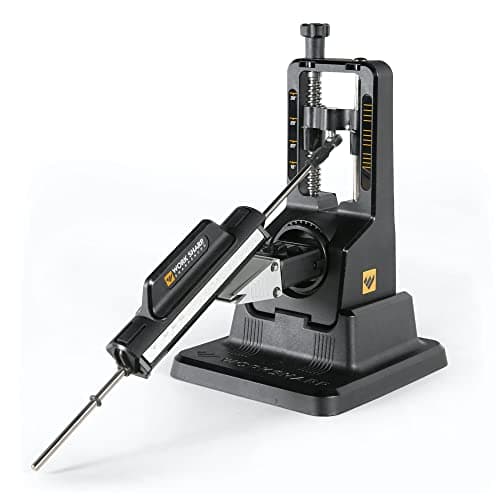
Work Sharp Work Sharp Precision Adjust Knife Sharpener
Work Sharp Precision Adjust Knife Sharpener

The system to buy first. Adjustable from 15 to 30 degrees in single-degree steps, with a rotating Tri-Brasive handle carrying medium diamond, fine diamond and ceramic - everything a kitchen needs, at a price that does not require you to be sure you will love this.

Best overall guided system
8.6
$69.95Amazon
02
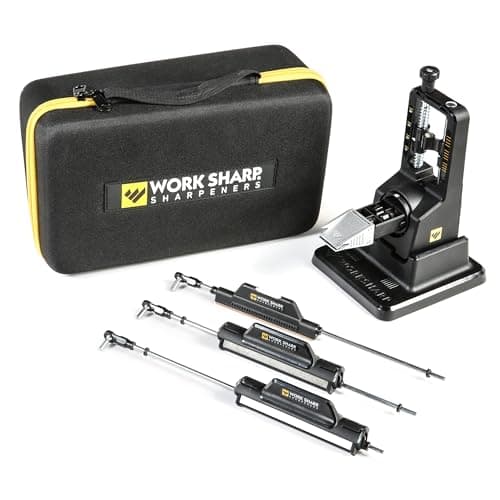
Work Sharp Work Sharp Precision Adjust Elite
Work Sharp Precision Adjust Elite

The same proven mechanism with the abrasives it should have shipped with. Seven abrasives instead of three, plus a leather strop and a carry case - the version to buy if you already know you will sharpen everything in the house.

Best upgrade pick
8.3
$129.95Amazon
03
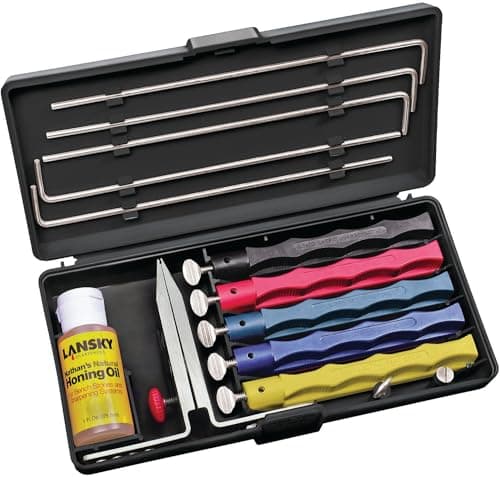
Lansky Lansky Deluxe 5-Stone Sharpening System
Lansky Deluxe 5-Stone Sharpening System

The budget clamp system that has been doing this for decades. Four preset angles, five hones from extra coarse 70 through ultra fine 1000, honing oil and a case - crude next to the modern kits, and it still puts a real edge on a knife for very little money.

Best budget clamp system
7.6
$44.74Amazon
04
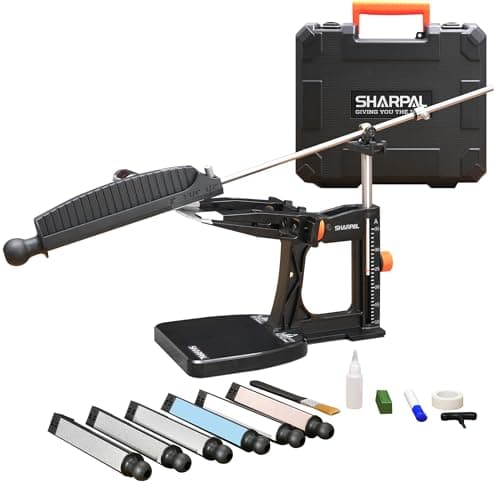
Sharpal SHARPAL 202H Precision Sharpening System
SHARPAL 202H Precision Sharpening System

The widest angle range here by a distance. Adjustable from 10 to 35 degrees with seven abrasives - four diamond plates from 220 to 1000, two whetstones at 3000 and 6000, and a leather strop - on an all-metal frame. If you own an unusually keen blade, this is the system that can match it.

Best angle range
8.1
$152.99Amazon
05
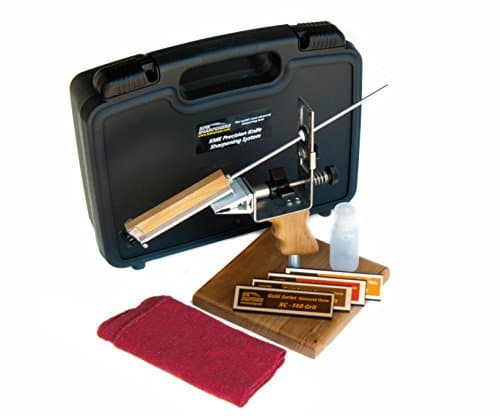
KME KME Precision Knife Sharpener System
KME Precision Knife Sharpener System

The one people keep for twenty years. A machined, rod-guided vise with continuous angle adjustment from 17 to 30 degrees, four Gold Series diamond hones from 140 to 1500, and a neoprene-lined clamp that will not mark a blade. It is a serious tool at a serious price.

Best premium system
7.7
$244.90Amazon
06
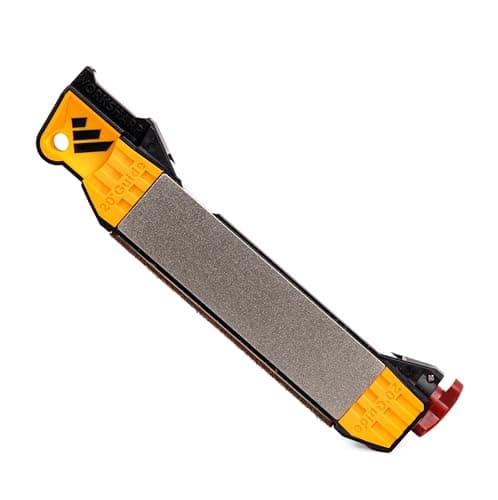
Work Sharp Work Sharp Guided Field Sharpener
Work Sharp Guided Field Sharpener

Not a bench system, and that is the point. Five surfaces - 220 and 600 grit diamond plates, two ceramic rods and a leather strop - with molded 20 and 25 degree guides, in a 4.6 oz block that lives in a drawer or a pack. The right answer for touch-ups rather than restoration.

Best portable option
8.2
$39.95Amazon

#ad · Live prices from the Amazon Product API, as of Sep 2, 2026. Where we have no verified live price, we show none — a gap beats a number that has rotted.

In detail

The picks, in full

01
Work Sharp Work Sharp Precision Adjust Knife Sharpener

Best overall guided system

Work Sharp Precision Adjust Knife Sharpener

15-30 deg, 1 deg incrementsMedium + fine diamond, ceramicRotating Tri-Brasive handleClamp-and-rod design
8.6/10

The system to buy first. Adjustable from 15 to 30 degrees in single-degree steps, with a rotating Tri-Brasive handle carrying medium diamond, fine diamond and ceramic - everything a kitchen needs, at a price that does not require you to be sure you will love this.

Edge quality
9
Ease of use
8.5
Speed
7
Versatility
9
Value
9.5

Pros

  • Angle range covers Japanese 15 deg and Western 20-25 deg edges properly
  • Three abrasives in one rotating handle - no fumbling with loose plates
  • Produces a repeatable edge on the first attempt
  • The cheapest way here into whetstone-quality results

Cons

  • Plastic body flexes slightly compared with metal systems
  • No strop in the base kit, so the final polish is limited

Don't buy this if…

you want an all-metal build or a full grit progression out of the box - the Elite and the KME cover that.

$69.95View on Amazon

Price as of Sep 2, 2026. Prices change — Amazon's at checkout is the one that counts.

#ad · we may earn a commission from this link to Work Sharp Precision Adjust Knife Sharpener

02
Work Sharp Work Sharp Precision Adjust Elite

Best upgrade pick

Work Sharp Precision Adjust Elite

15-30 deg, 1 deg incrementsSeven abrasivesLeather strop includedCarry case
8.3/10

The same proven mechanism with the abrasives it should have shipped with. Seven abrasives instead of three, plus a leather strop and a carry case - the version to buy if you already know you will sharpen everything in the house.

Edge quality
9.5
Ease of use
8.5
Speed
6.5
Versatility
9
Value
8

Pros

  • Full grit progression means a genuinely polished finish, not just sharp
  • Leather strop takes the edge the last step a diamond plate cannot
  • Same 1-degree angle control as the base model
  • Case keeps a fiddly kit of plates together

Cons

  • Roughly double the base model for the same core mechanism
  • More steps means a longer session per knife

Don't buy this if…

you only sharpen a couple of kitchen knives - the base Precision Adjust does that job for far less.

$129.95View on Amazon

Price as of Sep 2, 2026. Prices change — Amazon's at checkout is the one that counts.

#ad · we may earn a commission from this link to Work Sharp Precision Adjust Elite

03
Lansky Lansky Deluxe 5-Stone Sharpening System

Best budget clamp system

Lansky Deluxe 5-Stone Sharpening System

17 / 20 / 25 / 30 deg presetsFive hones: 70, 120, 280, 600, 1000Alumina oxide ceramicHoning oil + storage case
7.6/10

The budget clamp system that has been doing this for decades. Four preset angles, five hones from extra coarse 70 through ultra fine 1000, honing oil and a case - crude next to the modern kits, and it still puts a real edge on a knife for very little money.

Edge quality
8
Ease of use
7.5
Speed
7
Versatility
6.5
Value
9

Pros

  • Full coarse-to-fine progression included at a low price
  • Extra coarse 70 grit repairs a badly damaged edge
  • Preset angles are simple - no measuring, no setup
  • Long-established design with cheap replacement hones

Cons

  • Fixed presets only, so no 15 degree setting for hard Japanese edges
  • Small clamp struggles with tall chef's knife blades
  • Oil is messier than water or dry diamond

Don't buy this if…

your main knives are Japanese - 17 degrees is the keenest it offers and the clamp suits pocket knives better than an 8-inch chef's knife.

$44.74View on Amazon

$76.2241% off

Price as of Sep 2, 2026. Prices change — Amazon's at checkout is the one that counts.

#ad · we may earn a commission from this link to Lansky Deluxe 5-Stone Sharpening System

04
Sharpal SHARPAL 202H Precision Sharpening System

Best angle range

SHARPAL 202H Precision Sharpening System

10-35 deg adjustableDiamond 220/325/600/1000Whetstone 3000/6000 + stropAll-metal frame, carry case
8.1/10

The widest angle range here by a distance. Adjustable from 10 to 35 degrees with seven abrasives - four diamond plates from 220 to 1000, two whetstones at 3000 and 6000, and a leather strop - on an all-metal frame. If you own an unusually keen blade, this is the system that can match it.

Edge quality
9.5
Ease of use
7.5
Speed
6
Versatility
10
Value
7.5

Pros

  • 10-35 degree range covers everything from razor-keen to a heavy outdoor edge
  • Seven abrasives take an edge from repair to polished in one kit
  • All-metal build resists the flex that limits plastic systems
  • Edge-to-clamp distance stays fixed, which keeps blades of different widths consistent

Cons

  • A lot of setup and a lot of steps for a weeknight touch-up
  • Priced well above the Work Sharp that covers most kitchen needs

Don't buy this if…

you only sharpen kitchen knives at 15-20 degrees - you are paying for range you will never use.

$152.99View on Amazon

$179.9915% off

Price as of Sep 2, 2026. Prices change — Amazon's at checkout is the one that counts.

#ad · we may earn a commission from this link to SHARPAL 202H Precision Sharpening System

05
KME KME Precision Knife Sharpener System

Best premium system

KME Precision Knife Sharpener System

17-30 deg, continuous adjustDiamond hones 140/300/600/1500Rotating, neoprene-lined clampBase included
7.7/10

The one people keep for twenty years. A machined, rod-guided vise with continuous angle adjustment from 17 to 30 degrees, four Gold Series diamond hones from 140 to 1500, and a neoprene-lined clamp that will not mark a blade. It is a serious tool at a serious price.

Edge quality
10
Ease of use
8
Speed
6.5
Versatility
8
Value
6

Pros

  • Machined build and spherical rod guide give unusually precise, repeatable angles
  • Rotating clamp means you flip the system, not the knife
  • Diamond hones cut every steel including hard powder alloys
  • Neoprene jaws protect the blade finish

Cons

  • Costs several times what a competent kitchen system costs
  • Clamp is happier with pocket and hunting knives than tall chef's blades

Don't buy this if…

this is for a drawer of kitchen knives - the Work Sharp gets you most of the way for a fraction of the outlay.

$244.90View on Amazon

Price as of Sep 2, 2026. Prices change — Amazon's at checkout is the one that counts.

#ad · we may earn a commission from this link to KME Precision Knife Sharpener System

06
Work Sharp Work Sharp Guided Field Sharpener

Best portable option

Work Sharp Guided Field Sharpener

20 and 25 deg molded guides220 + 600 grit diamond platesTwo ceramic rodsLeather strop, 4.6 oz
8.2/10

Not a bench system, and that is the point. Five surfaces - 220 and 600 grit diamond plates, two ceramic rods and a leather strop - with molded 20 and 25 degree guides, in a 4.6 oz block that lives in a drawer or a pack. The right answer for touch-ups rather than restoration.

Edge quality
7.5
Ease of use
9
Speed
8.5
Versatility
7
Value
9

Pros

  • Complete coarse-to-strop progression in something pocket-sized
  • Molded angle guides make consistency easy without a clamp
  • Ceramic rod handles serrated edges most systems ignore
  • Cheapest entry here by a wide margin

Cons

  • Only 20 and 25 degrees, so no keen 15 degree Japanese setting
  • Hand-held guides are less precise than a clamped blade

Don't buy this if…

you need to restore a badly dulled or chipped kitchen knife - this is a maintenance tool, not a repair tool.

$39.95View on Amazon

Price as of Sep 2, 2026. Prices change — Amazon's at checkout is the one that counts.

#ad · we may earn a commission from this link to Work Sharp Guided Field Sharpener

What a guided system actually fixes

Every sharpening method removes steel until two bevels meet in a line. The only thing that separates a keen edge from a rounded one is whether you held the same angle on every stroke. Freehand sharpening is the skill of doing that with your hands; a guided system does it with a clamp and a rod. That is why a beginner with a $70 guided kit routinely produces a keener edge than the same beginner with a $70 whetstone — not because the abrasive is better, but because the geometry is no longer negotiable. What you give up is speed and a certain amount of satisfaction, and you inherit a setup ritual: clamp the blade, set the angle, work through the grits, flip, repeat.

Angle range is the spec that matters most

Check the range against the knives you own before anything else. Western and German blades are usually ground around 20 degrees per side and are happy anywhere from 18 to 25. Japanese blades are ground closer to 15, and a system whose keenest setting is 17 degrees — like the Lansky — will quietly re-profile them thicker every time you use it. The Work Sharp systems reach 15, the Sharpal goes down to 10, and the KME stops at 17. If your knife collection came from our Japanese roundup, that single number decides the purchase. Our angle explainercovers how to find your knife's factory angle.

Clamp size: the limitation nobody mentions

Most guided systems were designed around pocket and hunting knives, and it shows. A tall 8-inch chef's knife blade is wider than many clamps like, which can mean re-clamping partway along the blade and a visible transition where the two setups met. The systems here handle kitchen knives to different degrees — the Sharpal is explicitly built for long blades, the Work Sharp units cope well, and the Lansky is the most cramped. If your entire collection is kitchen cutlery, this is worth more attention than the abrasive spec.

Guided system, whetstone, or electric?

Buy a guided system if you want a whetstone-quality edge without the learning curve, and you do not mind spending ten minutes per knife. Buy a whetstone if the process appeals to you and you want the best possible edge and total control. Buy an electric sharpener if you want a sharp knife in under a minute and accept that it removes more metal than either alternative. All three are legitimate; the wrong one is the one that ends up unused in a cupboard, which is usually the one that asked more of you than you wanted to give.

What we would skip

Skip the cheap clamp systems that sell for under about twenty dollars with a plastic frame and unbranded stones — the clamp flexes under stroke pressure, which defeats the only thing you are buying. Skip any system whose angle markings are printed on a sticker rather than machined or molded. And skip buying a guided system as well as a whetstone "to have both": pick the workflow you will actually follow, and put the rest of the money into a honing steel, which does more for your day-to-day sharpness than any second sharpener will.

How we picked

We did not lab-test these knives

Everyone in this category says they tested twenty knives in a professional kitchen. We have not hands-on tested any of these, and we say so. What we did instead: compiled the published specifications — steel type and hardness (HRC), edge angle, blade geometry, weight and build — applied established sharpening standards, ran the value math (spec quality ÷ live price), and scored each product against a published rubric. The scores are judgments from documented research — not measurements we took, because we do not have a test lab and we will not pretend we do. Where a number came from someone else's work, we name them in Sources.
Questions

Frequently asked

Is a guided sharpening system better than a whetstone?
It is more reliable, not better. A skilled freehand sharpener on a good stone can match or beat any of these. A guided system gets you 90% of that result on your first attempt, which for most people is the more useful trade.
Will a guided system work on my 8-inch chef's knife?
Usually, but clamp width is the constraint - tall kitchen blades are wider than many systems were designed for. The Sharpal and the Work Sharp units handle chef's knives comfortably; the Lansky is happier with smaller blades.
What angle should I set for kitchen knives?
Match the factory grind: roughly 20 degrees per side for German and Western knives, about 15 for most Japanese blades. Changing the angle means grinding away a lot more steel the first time. See knife sharpening angles.
How long does a guided system take per knife?
Expect five to fifteen minutes for a full progression on a dull knife, and a couple of minutes for a touch-up. That is slower than an electric and faster than learning freehand.
Do I still need a honing steel?
Yes. Sharpening restores an edge; honing keeps a restored edge straight between sharpenings, and doing it regularly is what stops you needing the system every month. See how to use a honing steel.

Keep reading

Receipts

Sources

We do not run a testing lab, and we do not pretend to. Where a spec or a measured number came from someone else's work — a manufacturer's page, a published standard — we name them and link them. Where we could not verify something, we say so on the page rather than quietly leaving it out. Read our full method.