Skip to content
The Edge Bench

Roundups & reviews · Chef Knives

Shun vs Global: two Japanese knives that share almost nothing

Both are famous, both are Japanese, and their published specifications disagree about what that means. One runs 60-61 HRC behind 68 layers of Damascus; the other runs German-band hardness on a six-ounce one-piece steel body.

By Stephen V.Updated How we review
#ad

We earn a commission when you buy through our Amazon links, at no extra cost to you. It never changes a verdict, and we say so when the cheaper knife is the better buy. How this works.

Buy the Shun Classic 8" if you want the sharpest cut and will maintain it on a stone. Buy the Global G-2 if weight is your problem and you have held one first. Those are genuinely different knives for genuinely different cooks, and the reason is in the numbers rather than in the branding. Shun publishes a VG-MAX core at around 60–61 HRC, clad in 68 layers of Damascus, ground at roughly 16 degrees per side. Global publishes CROMOVA 18 at Rockwell C56–58 with a factory edge between 10 and 15 degrees, on a one-piece stainless body weighing about 6 oz for an 8-inch blade. That is German-band hardness under a Japanese grind — keener than a German knife, softer than a Japanese one, and lighter than either.

This is the most useful thing on the page, so it is going near the top: "Japanese knife" is not a specification. Every guide on this site, including ours, teaches the shorthand that Japanese knives run 60–63 HRC at about 15 degrees and German knives run 56–58 at about 20. The Global breaks that rule on its own product page. Its hardness is in the German band and its grind is in the Japanese one, which means it takes a keen edge easily, gives that edge up faster than a Shun, and is far more tolerant of the honing rod most people already own. Whether that is a flaw or the entire point depends on how you cook.

The third knife here is the MAC Chef Series 8", and it is on the page because it sits exactly between them and because a straight two-way comparison would hide the best answer for a lot of readers. MAC publishes Japanese high-carbon steel at around 59 HRC on a roughly 15-degree edge — the keenness of the Shun camp with a hardness that is a step back from brittle, on a thin light blade. If both of the headline knives have a disqualifying flaw for you (the Shun's chipping risk, the Global's handle), it is probably the knife you want. See our full Japanese chef knife roundup for the rest of the field.

The short answer

Quick picks

#KnifeBest forScorePrice
01
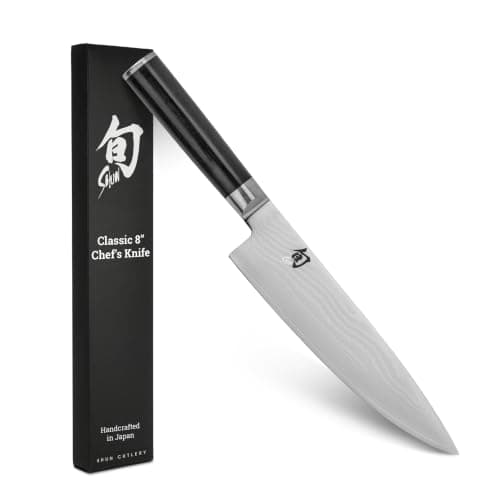
Shun Shun Classic 8"
Shun Classic 8"

The better cutter, unambiguously - thinner stock, harder core, longer between sharpenings. It asks for hand-washing, a whetstone and discipline about what it touches, and it repays all three every time you use it. The highest edge and sharpness scores on this page and the lowest value score.

Best cutting performance
8.4
$139.99Amazon
02
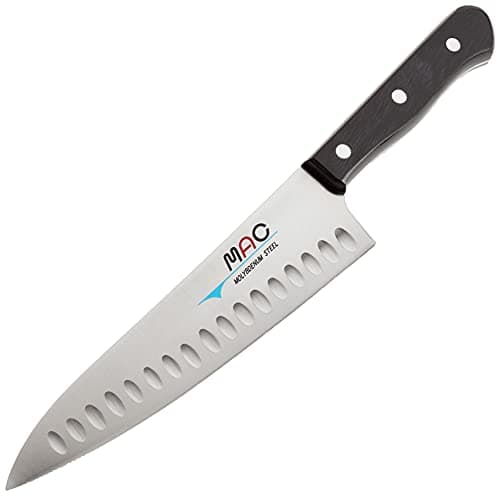
MAC MAC Chef Series 8" (Hollow Edge)
MAC Chef Series 8" (Hollow Edge)

The knife that splits the difference and finishes a tenth of a point behind the Shun: Japanese high-carbon around 59 HRC on a roughly 15-degree edge, thin and light, without the Shun's chipping risk or the Global's handle gamble. The pick if neither headline knife quite works for you.

Best middle ground
8.3
$114.95Amazon
03
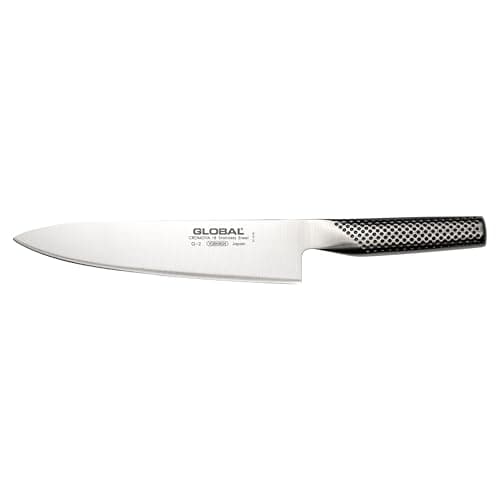
Global Global 8" (20 cm) Chef's Knife, G-2
Global 8" (20 cm) Chef's Knife, G-2

A six-ounce, one-piece Japanese knife with a keen 10-15 degree edge on steel Global rates at only 56-58 HRC - keener than a German knife, softer than a Japanese one, and lighter than either. Superb if the dimpled steel handle fits your hand; a mistake if it does not, and no specification can answer that for you.

Best light one-piece knife
7.9
$105.78Amazon

#ad · Live prices from the Amazon Product API, as of October 9, 2026. Where we have no verified live price, we show none — a gap beats a number that has rotted.

In detail

The picks, in full

01
Shun Shun Classic 8"

Best cutting performance

Shun Classic 8"

VG-MAX core~60-61 HRC~16 deg double bevel68-layer Damascus
8.4/10

The better cutter, unambiguously - thinner stock, harder core, longer between sharpenings. It asks for hand-washing, a whetstone and discipline about what it touches, and it repays all three every time you use it. The highest edge and sharpness scores on this page and the lowest value score.

Edge & steel
10
Sharpness
10
Handling
8
Build
9
Value
5

Pros

  • Cleaner cut through dense produce thanks to much thinner stock
  • Holds a keen edge far longer than either other knife here
  • Light and precise - noticeably less tiring on long prep
  • Kai runs a genuine service and resharpening program

Cons

  • Chips rather than rolls, and a chip needs stone work
  • D-shaped handle is contoured for right-handed use
  • A honing rod does comparatively little at this hardness
  • Damascus cladding shows every fingerprint and water spot

Don't buy this if…

…your kitchen involves bones, frozen food or knives left in a sink - this knife will be chipped inside a year.

Score reproduced verbatim from our Shun versus Wusthof comparison and the full Shun Classic review. Not re-rated here. A 10 on edge and steel against a 5 on value is the most polarised breakdown on this site, and it is accurate: this is the best-cutting knife we have written up and the hardest one to justify financially.

The decision against the Global is mostly about failure mode, and it is worth being precise. At 60–61 HRC a Shun edge does not roll over, it micro-chips, and a chip cannot be steeled back — it needs a stone. At the Global's published 56–58 HRC the edge rolls, which a ceramic rod fixes in fifteen seconds. If you own a whetstone and use it, the Shun is the better knife and the harder steel is simply an advantage. If you do not, the Shun will slowly get worse and the Global will not. Our honing versus sharpening guide is the one to read before you decide which of those describes you.

One more thing the specification sheet will not tell you: the D-shaped PakkaWood handle is contoured for a right hand. It is usable left-handed and it is not comfortable left-handed. See our left-handed knife guide if that applies to you — the Global, being a symmetrical steel cylinder, has no handedness at all, which is a real and under-discussed advantage.

$139.99View on Amazon

$165.7816% off

Price as of October 9, 2026. Prices change — Amazon's at checkout is the one that counts.

#ad · we may earn a commission from this link to Shun Classic 8"

02
MAC MAC Chef Series 8" (Hollow Edge)

Best middle ground

MAC Chef Series 8" (Hollow Edge)

Japanese high-carbon~59 HRC~15 deg edgeHollow-edge, thin blade
8.3/10

The knife that splits the difference and finishes a tenth of a point behind the Shun: Japanese high-carbon around 59 HRC on a roughly 15-degree edge, thin and light, without the Shun's chipping risk or the Global's handle gamble. The pick if neither headline knife quite works for you.

Edge & steel
8
Sharpness
8.5
Handling
8.5
Build
8
Value
8.5

Pros

  • Thin ~59 HRC blade takes a keener edge than a softer German knife
  • Light and agile, so easier on the hand over long prep
  • Hollow-edge dimples help release sticky slices like potato and cucumber
  • A conventional handle, so no hold-it-first gamble and no handedness problem

Cons

  • Harder steel is more brittle, so no bones, frozen food, or careless twisting
  • Keener edge needs honing and ~15-degree sharpening to stay at its best
  • No full bolster or German heft for cooks who like weight behind a cut
  • Plain looks - nothing like the Damascus pattern people buy the Shun for

Don't buy this if…

…you are hard on your knives or want a do-anything blade for bones and frozen food, because a tough German forging survives that abuse better.

Score reproduced from the MAC Chef Series review, which established it. It is on this page as a referee rather than as a contestant: both headline knives have a specific disqualifying risk, and this one has neither. At around 59 HRC it is hard enough to hold a 15-degree edge well and a step back from the hardest steels, which is the band where chipping stops being a routine worry.

The hollow edge — the row of dimples along the blade — is a genuine functional feature rather than decoration: it reduces suction, so slices of potato, cucumber and apple release instead of clinging to the blade. It is the only one of the three knives here with that. It is also the cheapest Japanese knife on this page by a clear margin, which is why it carries the highest value score of the three.

$114.95View on Amazon

Price as of October 9, 2026. Prices change — Amazon's at checkout is the one that counts.

#ad · we may earn a commission from this link to MAC Chef Series 8" (Hollow Edge)

03
Global Global 8" (20 cm) Chef's Knife, G-2

Best light one-piece knife

Global 8" (20 cm) Chef's Knife, G-2

CROMOVA 18, 56-58 HRC10-15 deg factory edge6 oz / 170 gOne-piece steel, sand-filled handle
7.9/10

A six-ounce, one-piece Japanese knife with a keen 10-15 degree edge on steel Global rates at only 56-58 HRC - keener than a German knife, softer than a Japanese one, and lighter than either. Superb if the dimpled steel handle fits your hand; a mistake if it does not, and no specification can answer that for you.

Edge & steel
7
Sharpness
8.5
Handling
7.5
Build
8.5
Value
8

Pros

  • Very light and agile - about 6 oz for an 8-inch blade, the lightest here
  • Keen 10-15 degree factory edge on a thin 2 mm spine
  • Seamless one-piece stainless body: nothing to loosen, swell or trap food
  • Soft enough that a ceramic rod restores the edge - it rolls rather than chips
  • Fully symmetrical handle, so no right-hand bias at all

Cons

  • Published hardness of 56-58 HRC is German-band, not Japanese - edge retention to match
  • The dimpled steel handle divides opinion sharply and gets slick with grease
  • Global's own care page rules out the dishwasher, chopping motions, bones and frozen food
  • No bolster and a very light blade - cooks who like heft will find it insubstantial

Don't buy this if…

…you have not held one - the hollow dimpled steel handle is the entire question with this knife, and no specification on this page can answer it for your hand.

Score reproduced from the full Global G-2 review, which established it. The 7 on edge and steel is not a quality judgment on Global's manufacturing — it is what Global's own published Rockwell figure earns on a rubric where edge retention is the thing being scored. Global rates CROMOVA 18 at 56–58 HRC; that is the same band as a Wusthof Classic.

Two practical consequences. First, this knife is far more forgiving than its reputation: a rolled edge at 57 HRC comes back on a ceramic honing rod, so you can own a Global without owning a whetstone, which is not true of the Shun. Second, the keen 10–15 degree factory grind on soft steel means it arrives extremely sharp and loses that extreme sharpness sooner. People read the first half of that sentence in reviews and the second half in forum complaints; both are the same fact.

The handle is the whole decision and we will not score around it. It is a hollow stainless cylinder, dimpled for grip, filled with sand for balance, seamlessly welded to the blade. Some cooks find it the most comfortable knife they have ever held; others find it cold, slick when greasy, and too thin. There is no published specification that resolves this, so the honest advice is to hold one in a shop before buying — the same conclusion our brands page reached about Global, and the reason this knife is not ranked in our main roundup.

$105.78View on Amazon

$116.319% off

Price as of October 9, 2026. Prices change — Amazon's at checkout is the one that counts.

#ad · we may earn a commission from this link to Global 8" (20 cm) Chef's Knife, G-2

The published specifications, side by side

Every figure in this table comes from the maker's own published material, or from a retailer specification sheet where the maker publishes nothing — and the table says which. Global, in particular, publishes no weight or dimensions for the G-2, so those numbers come from a distributor sheet.

SpecificationShun Classic 8"Global G-2 8"MAC Chef Series 8"
SteelVG-MAX core, 68-layer Damascus claddingCROMOVA 18, one-pieceJapanese high-carbon
Published hardness~60–61 HRCRockwell C56–58 (Global's own figure)~59 HRC
Factory edge~16° per side, double bevelBetween 10° and 15°~15°
WeightLight; heavier than the Global~6 oz / 170 g (retailer sheet)Light, thin stock
HandleD-shaped PakkaWood, right-hand contourOne-piece dimpled steel, sand-filledConventional riveted handle
How the edge failsMicro-chipsRolls overChips, but less readily than the Shun
Honing rod useful?MarginallyYes - this is the fixYes, with a ceramic rod
Made inSeki, JapanNiigata, JapanSeki, Japan
Our score8.47.98.3

Hardness is the whole argument

Three to five Rockwell points does not sound like much and it changes everything about owning the knife. Harder steel holds a fine edge longer because it resists deforming; the same property makes it brittle, so when it does fail it fails by losing a piece rather than by bending. Softer steel bends, and a bent edge is a fifteen-second fix on a rod.

So the Shun gives you weeks between sharpenings and a stone requirement. The Global gives you days between honings and no stone requirement. Neither is better. What is true is that a lot of people buy the Shun for the edge retention and then never buy the stone, which ends with an expensive knife that cuts worse than a maintained Victorinox. Our how-often-to-sharpen guide has the realistic intervals for both.

Weight is the second argument, and it is why Global exists

At roughly 6 oz the G-2 is one of the lightest 8-inch chef's knives sold. That is not a gimmick: for cooks with wrist pain, for long prep sessions, and for anyone who finds a forged German knife tiring, blade weight is the specification that matters most and almost nobody ranks on it. If you have put down a Wusthof because it was heavy, the Global is a more relevant recommendation than any amount of steel talk.

The trade is heft. There is no mass behind the cut, so the knife relies entirely on sharpness, and a dull Global feels useless in a way a dull German knife does not. If you like a knife to fall through an onion under its own weight, this is the wrong knife and the German field is where you should be looking.

What neither brand will tell you about the handles

Both of these knives have unusual handles, and both of those handles are the most common reason people return them. Shun's D-shape is a deliberate asymmetry that fills a right hand beautifully and presents an edge to a left palm. Global's steel cylinder is symmetrical, grippy when dry, and slick when greasy, and it is cold to hold. Neither is a defect; both are preferences that no review can decide for you.

Our rule on this site is that where a specification cannot answer a question, we say so rather than scoring confidently anyway — which is why the Global is not in our main chef knife ranking and why its handling score is 7.5 rather than a 9 or a 5. If you cannot get to a shop, our where-to-buy guide covers which retailers take returns on knives.

Who should buy which

Buy the Shun Classic if you already own and use a whetstone, if you cook a lot of produce and want the cleanest possible cut, and if you are right-handed or willing to live with a right-hand contour. Buy the Global G-2 if blade weight is your limiting factor, if you want a seamless knife with nothing to trap food, or if you want a keen Japanese grind you can maintain on a rod — and only after holding one. Buy the MAC if neither of those descriptions fits cleanly, which for most readers it will not. It is the knife with no disqualifying condition attached.
How we picked

We did not lab-test these knives

Everyone in this category says they tested twenty knives in a professional kitchen. We have not hands-on tested any of these, and we say so. What we did instead: compiled the published specifications — steel type and hardness (HRC), edge angle, blade geometry, weight and build — applied established sharpening standards, ran the value math (spec quality ÷ live price), and scored each product against a published rubric. The scores are judgments from documented research — not measurements we took, because we do not have a test lab and we will not pretend we do. Where a number came from someone else's work, we name them in Sources.

Questions

Frequently asked

Is Global a real Japanese knife brand?
Yes. Global knives are made by Yoshikin in Niigata, Japan, and the G-2 was designed by Komin Yamada in 1985. The confusion comes from the specifications rather than the origin: Global publishes CROMOVA 18 at Rockwell C56–58, which is the hardness band most people associate with German knives, so a Global does not behave the way a 61 HRC Japanese knife behaves.
Which knife is sharper out of the box?
They arrive comparably sharp and for different reasons. Global grinds between 10 and 15 degrees, which is the narrower angle on this page, so a new G-2 is extremely keen. Shun grinds at around 16 degrees on much harder steel, so it is slightly less acute but holds that edge far longer. After a month of real cooking the Shun will be the sharper knife unless you have honed the Global.
Can I put either of these in the dishwasher?
No, and Global says so explicitly — its own care page rules out the dishwasher along with soaking, bleach, frozen food, bones and stone or glass boards. Kai gives the same hand-wash guidance for Shun. See our dishwasher guide for what actually happens to a knife in there.
Is the Global handle really that divisive?
Yes, and it is the single most important thing about the knife. It is a hollow, sand-filled, dimpled stainless cylinder welded seamlessly to the blade. A substantial minority of cooks find it the most comfortable handle made; others find it slippery with greasy hands and too thin to grip securely. We do not score around that uncertainty — we tell you to hold one first.
Do I need a whetstone for a Global?
Less than you do for a Shun. At a published 56–58 HRC the Global's edge rolls rather than chips, and a rolled edge comes back on a ceramic rod. You will still want a stone eventually — honing realigns an edge, it does not create one — but the Global is genuinely livable with a rod alone in a way the Shun is not.

Keep reading

Receipts

Sources

We do not run a testing lab, and we do not pretend to. Where a spec or a measured number came from someone else's work — a manufacturer's page, a published standard — we name them and link them. Where we could not verify something, we say so on the page rather than quietly leaving it out. Read our full method.