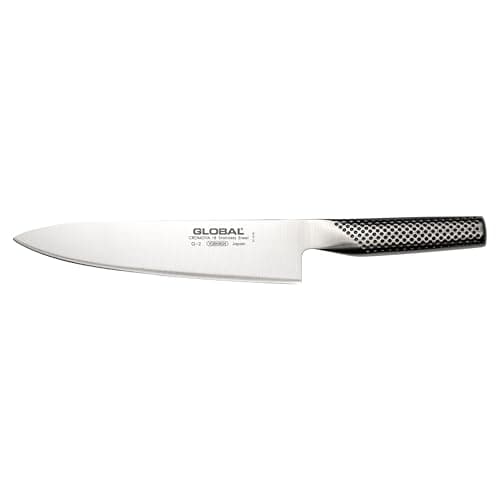
Every guide on this site, including ours, teaches the same shorthand: German knives run soft steel around 56–58 HRC at a wide 20-degree edge, Japanese knives run hard steel around 60–63 HRC at a keen 15. The Global G-2 is the best-known knife that does not fit. Global publishes its CROMOVA 18 steel at Rockwell C56–58 and its factory edge at 10–15 degrees, which is German hardness under a Japanese grind, on a blade that weighs about six ounces. That combination is the whole story of this knife — what it does well, what it asks of you, and why it divides people — and it is worth understanding before the handle argument starts.
We have not cooked with this unit and we do not run a test lab. What follows is compiled from Global's own published specifications and care instructions, a retailer specification sheet for the dimensions Global does not publish, and the value math we apply to every pick, exactly as set out in how we review. Unlike the other single reviews on this site, the G-2 is not ranked in one of our roundups; our best chef knife brandspage lists Global under "brands we deliberately did not rank" and calls the handle a hold-it-first shape. This page is the long version of that sentence.
What you are actually buying
The G-2 is Global's 8-inch (20 cm) chef's knife, the model the brand describes as "the multipurpose workhorse of the kitchen." The range was designed in 1985 by the industrial designer Komin Yamada and is made by Yoshikin in Niigata, Japan, which Global says still crafts them by hand. Three things define it. First, the one-piece stainless construction: blade and handle are a single seamless steel body, with no rivets, no scales and no tang in the Western sense of the word. Second, the hollow handle, which Global fills with sand to set the balance point, and finishes with the signature dimple pattern that is the only thing standing between your grip and polished steel. Third, the edge: Global grinds what it calls a convex edge and states plainly on its care page that the knives are "factory sharpened at an angle between 10 and 15 degrees."
The numbers Global does not publish come from a retailer specification sheet: a 200 mm blade, 325 mm overall, a 2 mm spine and a weight of 6 oz (170 g). Six ounces is light even by Japanese standards — the site's other light gateway knife, the MAC Chef Series 8-inch, is the nearest comparison — and it is a fraction of what a forged German 8-inch with a full bolster weighs. That lightness is not an accident of the hollow handle; it is the design brief, and it is the reason people who like this knife like it so much.
The steel, and why 56–58 HRC matters here
CROMOVA 18 is Global's own designation for a chromium-molybdenum-vanadium stainless steel — the same alloying family as the X50CrMoV15 that Wusthof and Zwilling use, not the VG-10 or VG-MAX family that Shun and most Japanese makers build on. Global says it is ice tempered and hardened to Rockwell C56–58. If the alloy vocabulary is unfamiliar, knife steel types explained covers it; the short version is that this is Western-band hardness in a Japanese-made knife.
That has two consequences the marketing does not spell out. The good one: at 56–58 HRC the edge fails by rollingrather than chipping, which is why Global tells you to keep it aligned with a ceramic or diamond rod between stone sessions — a honing habit does real work on this steel in a way it barely does on a 61 HRC Shun. The less-good one: a 10–15 degree edge on steel this soft is a thin, acute edge on a metal that deforms easily, so it will need that rod more often than a harder Japanese blade at the same angle, and its edge retention is closer to a Wusthof Classic than to a Shun Classic. Anyone who buys a Global expecting the long edge life of hard Japanese steel has bought the wrong knife for the reason they gave; anyone who buys it for a keen, light, forgiving blade that a rod brings back in seconds has bought exactly the right one.
The edge angle, in plain terms
Ten to fifteen degrees per side is as keen as any mainstream factory edge on this site — keener than Shun's stated 16, keener than the MAC's roughly 15, and far keener than a traditional 20-degree German grind. Combined with a 2 mm spine and a convex profile, it means the G-2 wedges very little and pushes through dense vegetables with less effort than a thicker forged blade. It also means the G-2 must never see a fixed 20-degree pull-through sharpener, which would grind a second, blunter bevel onto it within a few uses; our guide to knife sharpening anglesexplains the damage that does. Global's own instruction is a whetstone held at 10–15 degrees, or a ceramic or diamond rod for maintenance, and it warns explicitly against "traditional steels made from other materials" — a ridged steel rod will chew this edge.
The handle, which is the whole decision
Everything above is secondary to this. Global's handle is a hollow stainless tube, filled with sand to set the balance, and covered in a pattern of shallow dimples. People who love it describe a knife that feels like an extension of the hand, light enough to forget, with nothing to catch or swell. People who hate it describe a slim, round, hard handle that gives a pinch grip nothing to lock onto, that turns in the hand when the dimples fill with chicken fat, and that transmits every impact straight into the fingers because there is no wood or polymer to damp it. Both groups are describing the same object accurately. Our knife handle materialsguide puts it in one line: hold one before you commit. That is the advice, and it is why the G-2 is not in our roundups — we cannot rank a knife whose most important property is a fit we cannot assess for you.
Who this knife is for
A cook who prizes lightness and keenness over heft, who already knows the pinch grip and uses a slicing or push-cutting stroke rather than a rock-chop, who hand-washes and dries a knife without thinking about it, and who has held a Global and liked it. It also suits a cook who wants the sharpness of a Japanese grind but has been put off by stories of chipped VG-10 — because at 56–58 HRC this edge rolls and comes back on a rod, which is a genuinely forgiving trait in a knife this keen. If you have smaller hands, the slim handle and the low weight are real advantages; chef knives for small hands explains why light usually wins there.
Who should buy something else
If you want hard steel that holds an edge for months, the G-2's published hardness rules it out — buy from best Japanese chef knives, where every pick sits at 59 HRC or above. If you want a knife with mass and a bolster that steers itself through a rock-chop, the weight that makes the G-2 special is precisely what you will dislike; the forged German field in best German chef knivesis built for that stroke. And if you want a first knife that forgives everything — the dishwasher, the glass board, a twist through a squash — Global's own care page rules out all three, and a Victorinox Fibrox Pro will tolerate what this knife will not.
What Global tells you not to do
The care page is unusually specific, and it is worth reading before buying because it describes the knife's limits more candidly than the product page does. No dishwasher, because the cycle "can damage the sharp edges of the blade." No soaking, and no detergents containing chlorine bleach. No cutting through frozen food or bones. No marble, stone, tile or glass cutting surfaces — see best cutting boards for knives for what to use instead. And, in Global's own words, "do not cut with a chopping (up and down) motion." That last instruction is the tell: this is a slicing knife with a thin, acute edge on soft steel, and Global is asking you to use it like one. A cook who rock-chops with a heavy hand will roll this edge in a week and blame the knife.
Living with it
Hone it with a ceramic or diamond rod, as Global specifies, and never a grooved steel one — our honing rods for Japanese knives roundup covers the right kind, and how to use a honing steelthe method. Because the steel is soft, expect to hone more often than a hard Japanese blade and sharpen less often than you fear; when it does need a stone, hold Global's 10–15 degrees and follow how to sharpen kitchen knives on a whetstone. A guided system with an adjustable angle also works; a fixed-angle pull-through does not. The handle needs no care beyond washing and drying — there is no wood to swell and no rivet to loosen — but dry the blade immediately, because CROMOVA 18 is stainless rather than stain-proof and Global's warranty explicitly excludes rust spots and discoloration, along with chips and broken tips.
On the "Japanese knife" label
We would rather say this plainly than let the shorthand do the work. The G-2 is Japanese in origin, design and manufacture, and it is Japanese in its grind. It is not Japanese in its steel hardness, which is the property that shorthand is usually reaching for when it says "Japanese knife." If you are choosing between Japanese and German on the basis of edge retention and chip resistance, the G-2 sits on the German side of that line with a Japanese edge on top. That is a legitimate and rather clever place to sit; it is just not the place the label implies.