Skip to content
The Edge Bench

Roundups & reviews · Chef Knives

Alternatives to Global knives

Global's G-2 is CROMOVA 18 at 56-58 HRC on a one-piece steel body with a dimpled, sand-filled handle and no join anywhere. Five knives that match the lightness, the symmetry or the Japanese grind - ranked, with the handle question answered.

MAC MAC Chef Series 8" (Hollow Edge)

Our top pick · Closest match overall

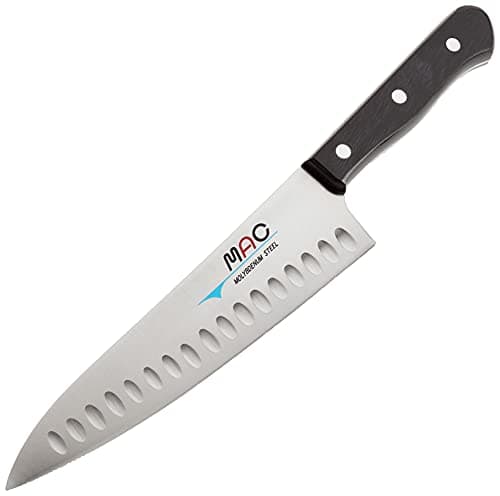
MAC Chef Series 8" (Hollow Edge)

8.7

The closest alternative, and the one to buy if you want the Global character with a harder edge and a normal handle. Japanese high-carbon steel at ~59 HRC with a ~15 degree edge, a thin light blade and hollow-edge dimples, on a conventional symmetrical handle. Harder steel than CROMOVA 18, the same thin push-cutting feel, no grip gamble.

$110.87Amazon

#ad · Full ranking below

By Stephen V.Updated How we review
#ad

We earn a commission when you buy through our Amazon links, at no extra cost to you. It never changes a verdict, and we say so when the cheaper knife is the better buy. How this works.

Buy the MAC Chef Series 8" — it is the closest alternative to a Global, and it is for someone who liked how a Global cuts and wants a harder edge or a normal handle. Japanese high-carbon steel at roughly 59 HRC with a ~15 degree edge, a thin blade and hollow-edge dimples, on a conventional symmetrical handle. It keeps the thin, light, push-cutting character and adds a point or two of hardness. The budget pick is the Victorinox Fibrox Pro 8"— at roughly 7.4 ounces with a textured grip that does not go slippery, it matches the two things most Global owners actually value, lightness and a secure hand, for a small fraction of the money.

Every knife here was in stock and priced at our last price check. We do not print a number in the prose: the Quick Picks table carries the live price and the date we pulled it, with a Check price button on every row.

What Global is actually known for

You cannot pick a sensible alternative without naming what you are replacing. From Global's own published specification for the G-2 8-inch: CROMOVA 18 stainless at 56–58 HRC, a 10–15 degree factory edge, a stated 6 ounces / 170 grams, and a one-piece steel body with a dimpled, sand-filled hollow handle. Three of those are the product.

The one-piece construction is the genuinely unusual one. There is no handle join anywhere on the knife: no rivets, no bolster, no scales, no gap for water or food to get into, and nothing that can loosen. The handle is a hollow steel shell filled with sand to place the balance exactly where Global wants it, which is how a knife this thin ends up feeling planted rather than whippy.

The weightis the second. Six ounces is the lightest chef's knife in our registry by a clear margin — a forged German knife of the same length runs half again as heavy. For long prep sessions and for smaller hands that is a real functional difference, not a preference.

The grindis third: a published 10–15 degrees per side is Japanese territory, narrower than any Western knife, on steel at Western hardness. And the whole knife is completely symmetrical, so handedness is a non-issue — which is precisely the thing people leaving a Shun's D-shaped handle are looking for.

The one thing Global divides people on is that same handle. The dimpled steel grip is loved by the people who like it and reported as slippery when wet by the people who do not, and it is the most common reason someone searches for an alternative rather than a second Global. So the page below scores handle and grip explicitly, and says which picks solve that complaint. Nothing here matches all four properties at once — if you want all four, buy the Global, and our Global G-2 review is where it is judged on its own merits.

The method is on how we review: we have not hands-on tested these knives and we do not claim to have. The scores come from published specifications and from value arithmetic against the live price. Everything sits under the chef knives hub.

The short answer

Quick picks

#KnifeBest forScorePrice
01
MAC MAC Chef Series 8" (Hollow Edge)
MAC Chef Series 8" (Hollow Edge)

The closest alternative, and the one to buy if you want the Global character with a harder edge and a normal handle. Japanese high-carbon steel at ~59 HRC with a ~15 degree edge, a thin light blade and hollow-edge dimples, on a conventional symmetrical handle. Harder steel than CROMOVA 18, the same thin push-cutting feel, no grip gamble.

Closest match overall
8.7
$110.87Amazon
02
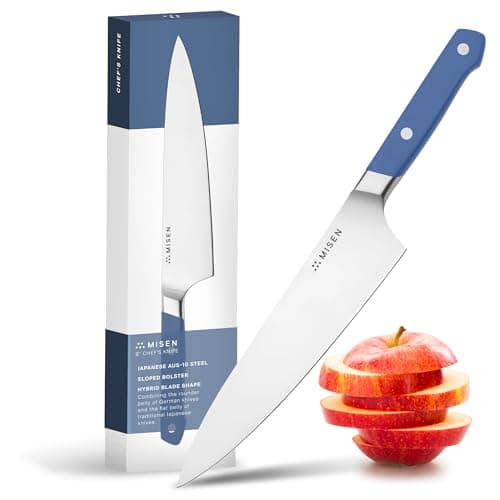
Misen Misen 8" Chef Knife
Misen 8" Chef Knife

The hard-steel upgrade, and the best edge retention on this page. AUS-10 stainless at ~60-61 HRC with a ~15 degree edge, a sloped bolster and a full tang - meaningfully harder than CROMOVA 18 at a mid-market price, with a sloped bolster that keeps the whole edge on a stone. Buy it if the Global's edge going soft is your actual complaint.

Best edge retention
8.7
$99.00Amazon
03
Shun Shun Sora 8"
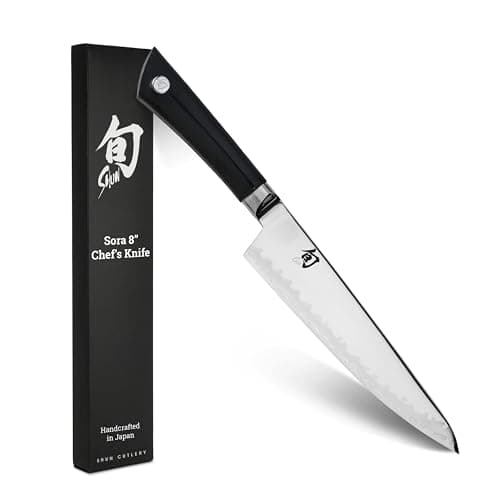
Shun Sora 8"

The alternative for someone who wants a Japanese edge, a symmetrical handle and a low price all at once. A VG10 cutting edge laser-welded to a 420J stainless upper - Kai's Composite Blade Technology - in an 8-inch gyuto profile on a textured polymer handle that is not handed. Harder edge steel than CROMOVA 18, from the company that makes Shun, for less than a Global.

Best cheap Japanese edge
8.4
$87.95Amazon
04
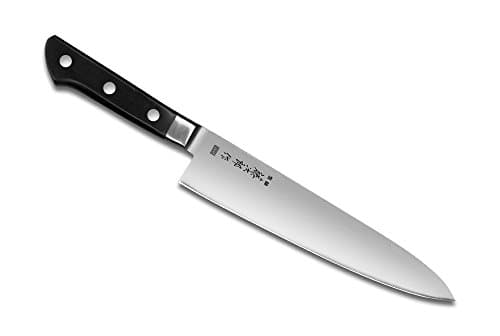
Tojiro Tojiro Professional VG10 Chef Knife 8.2" (210mm)
Tojiro Professional VG10 Chef Knife 8.2" (210mm)

The alternative for someone coming the other way - who wants Japanese steel but misses a Western handle. A VG-10 core clad in stainless in a 210mm gyuto profile with a bolstered Western-style handle, made in Japan. Harder core steel than CROMOVA 18, a thin Japanese grind, and a conventional symmetrical grip with real heft.

Best Western handle on a Japanese blade
7.9
Check price →
05
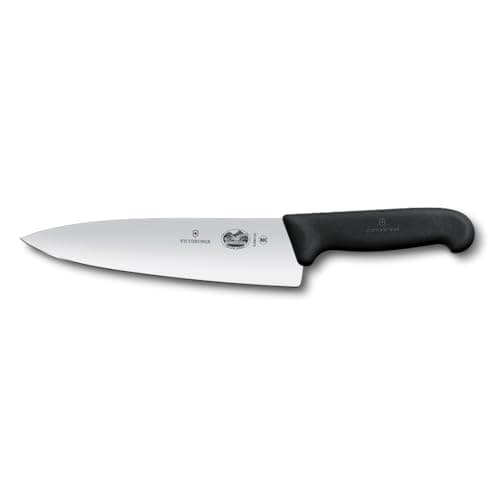
Victorinox Victorinox Fibrox Pro 8"
Victorinox Fibrox Pro 8"

The budget pick, and the knife that answers the question underneath the question. At about 7.4 ounces with a textured handle that keeps its grip when wet, it matches the two things most Global owners actually value - light weight and a secure hand - for a small fraction of the money. It matches nothing else: stamped, mid-50s HRC, a ~20 degree Western edge.

Budget pick
7.9
$48.20Amazon

#ad · Live prices from the Amazon Product API, as of November 12, 2026. Where we have no verified live price, we show none — a gap beats a number that has rotted.

In detail

The picks, in full

01
MAC MAC Chef Series 8" (Hollow Edge)

Closest match overall

MAC Chef Series 8" (Hollow Edge)

Japanese high-carbon~59 HRC~15 deg edgeHollow-edge, thin blade
8.7/10

The closest alternative, and the one to buy if you want the Global character with a harder edge and a normal handle. Japanese high-carbon steel at ~59 HRC with a ~15 degree edge, a thin light blade and hollow-edge dimples, on a conventional symmetrical handle. Harder steel than CROMOVA 18, the same thin push-cutting feel, no grip gamble.

Match on grind
9
Edge retention
8.5
Weight & balance
8.5
Handle & grip
9
Value per dollar
8.5

Pros

  • A published ~59 HRC is a point or two above Global's 56-58, which shows directly in edge retention
  • A ~15 degree edge sits inside Global's own 10-15 degree range, so the cutting feel is recognizably similar
  • Thin, light and agile - the Global's defining character, kept
  • A conventional symmetrical handle: no handedness problem and no dimpled-steel gamble
  • Hollow-edge dimples genuinely help release sticky slices like potato and cucumber

Cons

  • Heavier than the Global's stated 6 ounces, though still light by Western standards
  • A pakkawood-style handle wants hand-washing, where one-piece steel does not care
  • A riveted handle has a join, so it can trap water over decades in a way the Global cannot
  • MAC has nothing like Global's distribution or brand recognition

Don't buy this if…

…the one-piece no-join construction is specifically why you wanted a Global - nothing on this page reproduces that, and the Global is the only knife in our registry built that way.

Re-scored on this page's rubric rather than carried over; it is reviewed in full at our MAC Chef Series review, it is ranked on best professional chef knives, and it appears on alternatives to Shun for the same structural reason: it is the Japanese knife in our registry with the fewest strings attached.

It wins here because it improves on the Global in the one place a Global is genuinely beatable — the heat treatment — without giving up what makes a Global pleasant. CROMOVA 18 at 56–58 HRC is Western-hardness steel carrying a Japanese-angle edge, which is a slightly uncomfortable combination: the grind wants harder steel behind it than the heat treatment provides, so the edge is keen out of the box and needs attention sooner than a 60 HRC blade would. Knife hardness HRC explained covers why a couple of points matter more than they look. MAC runs ~59 on a comparable grind, which is the same idea executed one step harder.

What it cannot reproduce is the construction. A one-piece knife has no join, and that is a real hygiene and durability property rather than a styling one. If that is the Global feature you care about, no alternative here replaces it.

$110.87View on Amazon

Price as of November 12, 2026. Prices change — Amazon's at checkout is the one that counts.

#ad · we may earn a commission from this link to MAC Chef Series 8" (Hollow Edge)

02
Misen Misen 8" Chef Knife

Best edge retention

Misen 8" Chef Knife

AUS-10 stainless~60-61 HRC~15 deg edgeSloped bolster, full tang
8.7/10

The hard-steel upgrade, and the best edge retention on this page. AUS-10 stainless at ~60-61 HRC with a ~15 degree edge, a sloped bolster and a full tang - meaningfully harder than CROMOVA 18 at a mid-market price, with a sloped bolster that keeps the whole edge on a stone. Buy it if the Global's edge going soft is your actual complaint.

Match on grind
8.5
Edge retention
9.5
Weight & balance
8
Handle & grip
8.5
Value per dollar
9

Pros

  • A published ~60-61 HRC is three to five points above Global's band - the biggest hardness jump on this page
  • A ~15 degree edge matches the top of Global's published range
  • The sloped bolster keeps the entire edge in contact with a flat stone, which a full bolster does not
  • Modern handle and balance need no acquired grip, unlike dimpled steel
  • Hard-steel specification at a mid-market price rather than a premium one

Cons

  • Harder steel chips rather than bends - the care rules tighten relative to a Global
  • Heavier than the Global's stated 6 ounces
  • A direct-to-consumer brand without the service network of a Japanese house
  • A riveted handle with a join, where the Global has none

Don't buy this if…

…you are rough on knives - at ~60-61 HRC this is the most chip-prone pick here, and CROMOVA 18 at 56-58 HRC is the more forgiving steel precisely because it is softer.

Re-scored here; it is reviewed in full at our Misen 8" review and the head-to-head is Misen vs Made In.

It ties the MAC on the overall and sits second on a stated tie-break: the MAC is the closer match to how a Global feels, and the Misen is the bigger upgrade to how a Global performs. If your complaint about Global is “I like it but I am sharpening it too often”, this is the answer on the page, and AUS-10 at 60–61 HRC is a genuine generational step up from CROMOVA 18 rather than a marketing one.

The sloped bolster is the underrated detail. Global has no bolster at all, which is one of the quiet reasons its owners find it easy to sharpen; a knife with a full bolster loses the last few millimetres of edge to a flat stone over the years. A sloped bolster keeps that advantage while giving you a finger backstop — full bolster vs half bolster is the mechanism. The trade for the hardness is care: ceramic rods rather than ridged steel ones, and no bones or frozen food. See best ceramic honing rods.

$99.00View on Amazon

Price as of November 12, 2026. Prices change — Amazon's at checkout is the one that counts.

#ad · we may earn a commission from this link to Misen 8" Chef Knife

03
Shun Shun Sora 8"

Best cheap Japanese edge

Shun Sora 8"

VG10 edge, 420J stainless upperComposite Blade Technology8 in. gyuto-style profileTextured polymer handle
8.4/10

The alternative for someone who wants a Japanese edge, a symmetrical handle and a low price all at once. A VG10 cutting edge laser-welded to a 420J stainless upper - Kai's Composite Blade Technology - in an 8-inch gyuto profile on a textured polymer handle that is not handed. Harder edge steel than CROMOVA 18, from the company that makes Shun, for less than a Global.

Match on grind
8.5
Edge retention
8.5
Weight & balance
7.5
Handle & grip
8.5
Value per dollar
9

Pros

  • A genuine VG10 cutting edge, which is harder than CROMOVA 18 and holds a keen edge longer
  • The textured polymer handle is symmetrical and grippy when wet - no handedness, no slippery steel
  • A thin Japanese grind, so the push-cutting feel is in the same family as a Global
  • Made by Kai in Seki, Japan, with Kai's sharpening and service program behind it
  • Typically cheaper than the Global at our last price check

Cons

  • The laser-welded join between the VG10 edge and the 420J body is visible and some buyers dislike it
  • A soft 420J upper means the blade as a whole is less stiff than a monosteel knife
  • No Damascus, no pakkawood - this is Shun's working line and it looks like it
  • Still a hard edge, so ceramic honing rods and soft boards apply

Don't buy this if…

…the knife needs to look good on the counter - the composite weld line and the polymer handle are visibly the budget line, where the Global is a design object people display.

Re-scored here; it is the budget pick on best Shun knives and the entry pick on best Japanese chef knives for beginners.

Composite Blade Technology is the specification to understand before you buy it. Rather than cladding a hard core the whole length of the blade, Kai welds a VG10 strip along the cutting edge to a 420J stainless body: the edge is genuinely hard where it matters, the blade overall is less stiff, and the weld line is visible. That is a real engineering trade rather than a cost cut dressed up, and for someone leaving a Global over edge retention it is the cheapest honest answer on this page.

The handle is the other reason it is here. A textured polymer grip is unglamorous and it is secure with wet hands and completely symmetrical — which is the single most common objection to dimpled steel, solved for very little money.

$87.95View on Amazon

$109.9520% off

Price as of November 12, 2026. Prices change — Amazon's at checkout is the one that counts.

#ad · we may earn a commission from this link to Shun Sora 8"

04
Tojiro Tojiro Professional VG10 Chef Knife 8.2" (210mm)

Best Western handle on a Japanese blade

Tojiro Professional VG10 Chef Knife 8.2" (210mm)

VG-10 core, clad stainless210mm gyuto profileWestern-style handle with bolsterMade in Japan
7.9/10

The alternative for someone coming the other way - who wants Japanese steel but misses a Western handle. A VG-10 core clad in stainless in a 210mm gyuto profile with a bolstered Western-style handle, made in Japan. Harder core steel than CROMOVA 18, a thin Japanese grind, and a conventional symmetrical grip with real heft.

Match on grind
8.5
Edge retention
8
Weight & balance
6.5
Handle & grip
9
Value per dollar
7.5

Pros

  • A VG-10 core is a harder, more edge-retentive steel than CROMOVA 18
  • 210mm is the Japanese equivalent of an 8-inch chef's knife, so nothing has to be re-learned
  • A symmetrical bolstered Western handle - familiar, grippy and not handed
  • Made in Japan with the thin grind that implies
  • A real alternative for anyone who found the Global too light rather than too heavy

Cons

  • Tojiro does not publish a hardness figure for this listing, so we score that as unpublished
  • A bolstered Western handle is much heavier than the Global's stated 6 ounces
  • Plain finish - no Damascus, no design-object appeal
  • Nothing like Global's distribution, and spares are harder to find

Don't buy this if…

…lightness is the Global property you are trying to keep - a Western bolstered handle puts this at the heavy end of this page, which is the opposite of what a Global owner usually wants.

Re-scored here; it is ranked on our Japanese chef knives page and on alternatives to Shun.

It is on this page for a specific and slightly contrarian reader: the person who tried a Global, liked the Japanese grind and disliked how little the knife weighed. That is a real complaint — six ounces feels insubstantial to anyone used to a forged knife — and a VG-10 core in a bolstered Western handle is the way to keep the thin grind and get the heft back. Everyone else on this page should look at the three picks above it first.

The missing hardness figure is the honest caveat. VG-10 is a well-understood steel family and Tojiro does not publish an HRC for this listing, so we score that gap as a gap rather than assuming the generous reading, the same way we handle unpublished figures everywhere on this site.

Check price on Amazon →

No buyable offer at the last price check (November 12, 2026). We show nothing rather than a stale number.

#ad · we may earn a commission from this link to Tojiro Professional VG10 Chef Knife 8.2" (210mm)

05
Victorinox Victorinox Fibrox Pro 8"

Budget pick

Victorinox Fibrox Pro 8"

Stamped X50CrMoV15~55-56 HRC~20 deg/side edgeLight ~7.4 oz, NSF certified
7.9/10

The budget pick, and the knife that answers the question underneath the question. At about 7.4 ounces with a textured handle that keeps its grip when wet, it matches the two things most Global owners actually value - light weight and a secure hand - for a small fraction of the money. It matches nothing else: stamped, mid-50s HRC, a ~20 degree Western edge.

Match on grind
5
Edge retention
6
Weight & balance
9
Handle & grip
9.5
Value per dollar
10

Pros

  • Light at about 7.4 oz - the closest thing on this page to the Global's six ounces
  • The Fibrox handle is the single best wet grip in the category and is completely symmetrical
  • A small fraction of a Global at our last price check
  • Soft steel comes straight back on a ridged honing rod with no technique to learn
  • Swiss made, NSF certified and sold with a lifetime warranty against defects

Cons

  • A ~20 degree per side Western edge against Global's published 10-15 - it will never feel as keen
  • ~55-56 HRC is the softest steel on this page, so honing is a habit rather than a chore
  • Stamped, with a riveted-free molded handle that has a join where the Global has none
  • It is plainly a tool, and anyone shopping Global for the object will be disappointed

Don't buy this if…

…the thin Japanese grind is what you liked about the Global - this is a wide Western edge and no amount of honing changes that. Buy the MAC or the Sora instead.

Re-scored here; it is reviewed in full at our Victorinox Fibrox Pro review, it tops best Victorinox knives, and it is the budget pick on alternatives to Wusthof for the same reason it is here.

It scores lowest on match-on-grind and is still the right recommendation for a sizeable share of readers, which is a result worth stating rather than burying. If you ask most Global owners what they like about the knife, the answers are “it is so light” and “it feels secure in my hand” far more often than “the edge angle is 12 degrees”. This matches both of those, and are expensive chef knives worth it is the longer version of that argument.

What it does not do is cut like a Japanese knife. A wide Western bevel on soft steel is a different experience through a dense sweet potato, and if that experience is what you are replacing then spend the money on one of the four picks above.

$48.20View on Amazon

Price as of November 12, 2026. Prices change — Amazon's at checkout is the one that counts.

#ad · we may earn a commission from this link to Victorinox Fibrox Pro 8"

Which Global property are you replacing?

The thin Japanese grind, with a harder edge. Buy the MAC Chef Series. A published ~59 HRC on a ~15 degree edge is the same idea as a Global executed one step harder, and the handle is conventional.

Edge retention above all.Buy the Misen. AUS-10 at ~60–61 HRC is three to five points above CROMOVA 18, which is the biggest single upgrade available on this page.

A Japanese edge on a tight budget. Buy the Shun Sora. A VG10 cutting edge on a symmetrical polymer handle, typically for less than a Global.

The grind, but with real weight. Buy the Tojiro. VG-10 core, 210mm gyuto, a bolstered Western handle, and the heft a Global deliberately does not have.

Light and secure, at a fraction of the price. Buy the Victorinox and a honing rod. You will not get the grind; you will get the weight and the best wet grip in the category.

The handle is usually the real reason

Global's dimpled, sand-filled steel handle is the most distinctive thing about the knife and the most divisive. It has no join, nothing to loosen and nothing to absorb water, and the sand filling lets Global place the balance precisely. It is also bare steel with a textured pattern, and a significant number of owners report it as slippery with wet or greasy hands. Neither camp is wrong; hands differ.

Four of the five picks here answer that complaint directly. The Victorinox Fibrox handle is the best wet grip in the category at any price. The Shun Sora's textured polymer is secure and unhanded. The MAC and the Tojiro use conventional symmetrical handles. None of them reproduces the one-piece no-join construction, and if that specific property is what you value, the honest answer is that the Global is the only knife in our registry built that way — see knife handle materials for what each option is actually trading.

The hardness mismatch nobody mentions

This is the most useful technical point on the page. Global publishes a 10–15 degree factory edge and 56–58 HRC steel. Those two figures are slightly at odds: a very narrow bevel wants hard steel behind it, because a thin edge on soft steel rolls over sooner. That is why a Global arrives beautifully keen and why its owners find themselves honing it more often than they expected.

Every pick above the Victorinox on this page addresses that by running harder steel at a similar angle — ~59 HRC for the MAC, VG10 for the Sora and Tojiro, ~60–61 HRC for the Misen. That, rather than the handle, is the structural upgrade available in this category, and knife hardness HRC explained is why two or three points of HRC do more for an edge than any amount of finish.

When to just buy the Global

You want the one-piece construction. No join, no rivets, nothing to loosen, nothing to trap water. Nothing on this page reproduces it.

You want six ounces.The Global is the lightest chef's knife in our registry and the closest alternative here is still heavier. For wrist trouble or a long shift that matters — see best knives for arthritis.

You already know the handle suits you. If you have held one and liked it, the main objection this page exists to solve does not apply to you, and the honest advice is to buy another Global.

The care rules follow the hardness, not the badge

Three of the five picks here are harder than the Global, and harder steel chips rather than bends. Hone on ceramic rather than a ridged steel rodfor the Misen and the two VG10 knives — see best ceramic honing rods. Sharpen at the knife's own angle, which for all four Japanese picks is around 15 degrees per side and for the Victorinox is about 20 — best knife sharpeners under $100 is where the adjustable tools live, and knife sharpening angles has the table. Use a wood or soft-plastic board for anything thin and hard — best cutting boards for knives.

How we ranked these

Five metrics, built for the question this page asks. Match on grindscores the published edge angle and blade stock against Global's 10–15 degrees. Edge retentionreads published hardness against Global's 56–58 HRC band, and penalises an unpublished figure rather than assuming one. Weight & balance reads published weight against the stated 6 ounces, which is the Global property owners name most often. Handle & grip is scored explicitly, because the dimpled steel handle is the most common reason people look for an alternative at all. Value per dollaris specification quality against the live price. The overall is the mean of the five to one decimal place; the MAC and the Misen tie on it and the order between them is a stated tie-break explained in the Misen's entry. None of these numbers came from a test lab, because we do not have one, and how we review says so in those words.
How we picked

We did not lab-test these knives

Everyone in this category says they tested twenty knives in a professional kitchen. We have not hands-on tested any of these, and we say so. What we did instead: compiled the published specifications — steel type and hardness (HRC), edge angle, blade geometry, weight and build — applied established sharpening standards, ran the value math (spec quality ÷ live price), and scored each product against a published rubric. The scores are judgments from documented research — not measurements we took, because we do not have a test lab and we will not pretend we do. Where a number came from someone else's work, we name them in Sources.

Questions

Frequently asked

What is the best alternative to a Global knife?
The MAC Chef Series 8". Japanese high-carbon steel at roughly 59 HRC with a ~15 degree edge and a thin light blade keeps the Global's push-cutting character, adds a point or two of hardness, and puts it on a conventional symmetrical handle instead of dimpled steel.
What knives are similar to Global?
Thin, light Japanese blades with narrow grinds and symmetrical handles. In our registry that means the MAC Chef Series, the Misen 8", the Shun Sora and the Tojiro Professional VG10. None of them copies Global's one-piece steel construction, which is unique in our registry.
Are Global knives hard enough?
CROMOVA 18 is published at 56–58 HRC, which is Western-hardness steel carrying a Japanese-angle 10–15 degree edge. That combination is keen out of the box and asks for honing sooner than a 60 HRC blade would. Every Japanese pick on this page runs harder steel at a similar angle.
Is the Global handle slippery?
It divides people, and hands genuinely differ. The dimpled steel grip has no join and nothing to loosen, and a significant number of owners report it as slippery with wet or greasy hands. If that is your concern, the Victorinox Fibrox and Shun Sora handles are the two most secure alternatives here.
Is there a cheaper knife like a Global?
The Shun Sora, for a genuine VG10 Japanese edge on a symmetrical handle, typically below Global money. Cheaper still is the Victorinox Fibrox Pro, which matches the lightness and the grip but not the grind — it is a ~20 degree Western edge on mid-50s steel.
What is CROMOVA 18?
Global's proprietary stainless — chromium, molybdenum and vanadium — published at 56–58 HRC. It is corrosion-resistant and easy to sharpen, and it is softer than the VG-10 and AUS-10 steels used by the Japanese alternatives on this page.
Do Global alternatives need different care?
The harder ones do. At ~60–61 HRC the Misen wants a ceramic honing rod rather than a ridged steel one, soft boards, and no bones or frozen food. The Victorinox at mid-50s HRC is the most forgiving knife on the page.

Keep reading

Receipts

Sources

We do not run a testing lab, and we do not pretend to. Where a spec or a measured number came from someone else's work — a manufacturer's page, a published standard — we name them and link them. Where we could not verify something, we say so on the page rather than quietly leaving it out. Read our full method.