The knife that wins this page is not an 8-inch chef's knife, and that is the whole point of it. If your hands hurt, three things decide how much a knife costs you: how little grip force it takes to hold securely, how little downward pressure it takes to cut, and how much of its weight you are carrying through a hundred repetitions. A chef's knife is the default recommendation everywhere on the internet and it wins none of those three. A shorter, lighter blade with a flat edge and a grippy handle wins all of them.
First, the limits of this page, plainly: we are not clinicians, nothing here is medical or treatment advice, and arthritis is not one condition with one answer — pain in a thumb joint and pain in a wrist point at different tools. An occupational therapist can assess your actual hand and is worth more than any buying guide, including this one. What we can do honestly is the physics: a knife is a lever with an abrasive edge, and every one of the variables that decides how hard you must push is published or measurable. That is what we have ranked, from manufacturers' specifications and the value math, exactly as set out in how we review. We have not cooked with these knives and we do not have a test lab.
The one thing that matters more than the knife
A sharp knife needs dramatically less force than a dull one, and that single variable swamps every other decision on this page. A dull blade does not slide into an onion, so you push harder, and pushing harder is both the pain and the danger — a knife that suddenly skates off a tomato skin under load is how people get cut. Buying any of the knives below and letting it go blunt will leave you worse off than keeping a cheap knife genuinely sharp.
So budget for the edge before the handle. If sharpening sounds like one more painful task, the low-effort route is a honing rod used for ten seconds before each session — it removes no metal and asks almost nothing of your grip; how to use a honing steel has the method and honing rods ranks the field, including angle-guided rods that take the technique out of it. When honing stops working, a local sharpening service is a legitimate answer and costs a few dollars a knife. If you would rather do it yourself with no wrist strain, a clamped guided system holds the angle for you — see best sharpening systems. Pull-through sharpeners are the one shortcut we would steer you away from, for the reasons in do electric knife sharpeners ruin knives.
Three ways a knife asks for less force
1. It cuts straight down instead of rocking.The classic chef's-knife motion is a rock-chop: a curved belly rolled forward through the cut, which means repeated wrist rotation under load. A flat-edged knife — a santoku, and even more so a nakiri — is designed for a push cut, where the edge meets the whole board at once and the wrist barely moves. Same vegetable, different joint doing the work. Chef's knife vs santoku and santoku vs nakiri cover the geometry.
2. It is light, and it is short. Weight you hold is weight you fight, and a longer blade is a longer lever wobbling at the far end of a weak grip. The gap here is not subtle: a forged Wusthof Classic 8-inch is 9.3 oz on the spec sheet, the stamped Wusthof Gourmet is 6.5 oz, and a Victorinox Fibrox Pro 8-inch is about 7.4 oz. A 165mm Japanese nakiri is lighter again and four inches shorter overall.
3. Its handle is wide, textured and not round.A thin or polished round handle has to be gripped tightly to stay oriented, which is precisely the motion that hurts. A wider handle with a matte, slightly tacky surface and a non-circular cross-section stays put in a loose hand — and stays put when wet, which is when accidents happen. This is why the knives below are mostly cheap ones: Victorinox's Fibrox and Mercer's Santoprene handles are designed for commercial kitchens where hands are wet and gloved, and they are better at this job than polished pakkawood at five times the price. If handle circumference is the problem, chef knives for big hands covers the thickest grips we have found and knife handle materials compares the surfaces.
How we ranked these
These five knives are four different blade types, so the rubrics on our dedicated roundups — which judge a santoku against santokus and a bread knife against bread knives — cannot be read across them. This page therefore re-scores every pick on one rubric of its own, and each product body says so. Grip security: handle width, texture and shape, and whether it holds in a loose or wet hand. Force needed: the published edge angle and blade geometry, and whether the cutting motion is a press, a push or a draw. Weight and fatigue: published or retailer-listed weight and overall length. Maintenance ease: how little effort it takes to keep this edge keen, which is the variable that decides whether the knife is still low-force in six months. Value, against the live price. Every rank is strictly the arithmetic mean of those five, which is why the most expensive knife is not at the top and why the chef's knife is not either.
The short answer
Quick picks
| # | Knife | Best for | Score | Price |
|---|
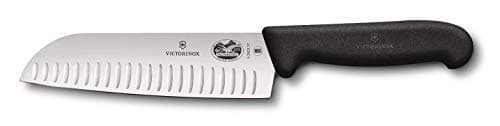
| 01 | Victorinox Fibrox Pro 7" Santoku (Granton)The best low-force knife we can point at, and the reason is that it wins on all three mechanisms at once: a flat edge that push-cuts instead of rocking, a short light blade, and the grippiest handle in the category. It is also one of the cheapest knives here, which is a happy accident rather than a compromise. | Best overall for sore hands | | $50.95·Amazon |
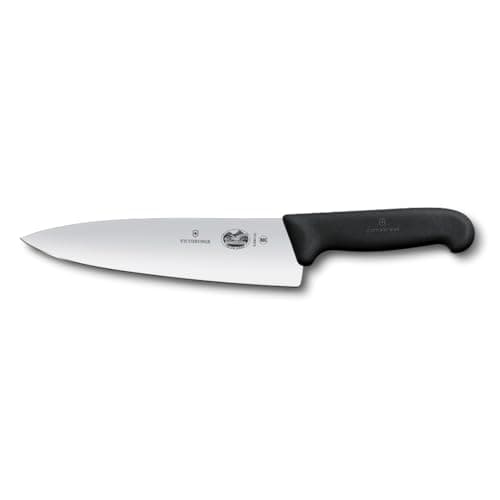
| 02 | Victorinox Fibrox Pro 8"The best one-knife answer if you want a true chef's knife shape. About 7.4 oz, the same textured Fibrox handle, soft forgiving steel and a price that leaves plenty over for a stone or a sharpening service. It asks more of your wrist than the santoku because of the rocking motion, and it does everything. | Best all-purpose pick | | $47.00·Amazon |
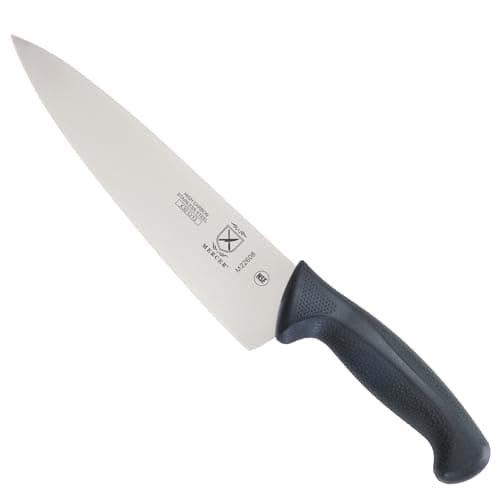
| 03 | Mercer Culinary Millennia 8"The cheapest knife on this page that is genuinely worth owning, and its Santoprene handle is a real alternative to Fibrox rather than a knock-off - slightly softer and tackier in the hand, which some people prefer outright. Buy it to try the category without spending, or to put a decent knife in a second kitchen. | Best on a tight budget | | $29.00·Amazon |
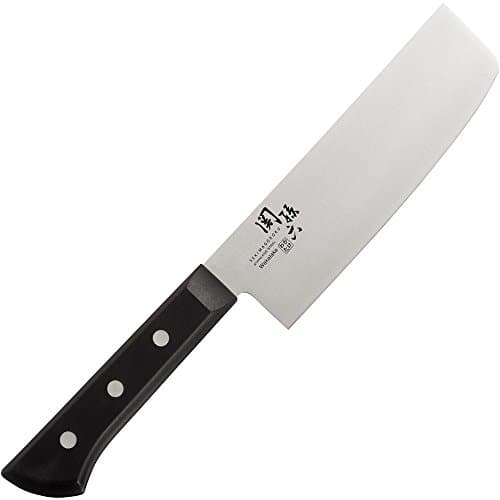
| 04 | Kai Seki Magoroku Nakiri 165mmThe lowest-force cut on this page by a wide margin: a completely flat, thin, 165mm Japanese blade that drops straight through a vegetable in one stroke with no rocking and no sawing. It is here for mechanics, not for comfort - the handle is a basic domestic one and it is the pick that asks you to accept a trade. | Best for vegetable prep | | $18.55·Amazon |
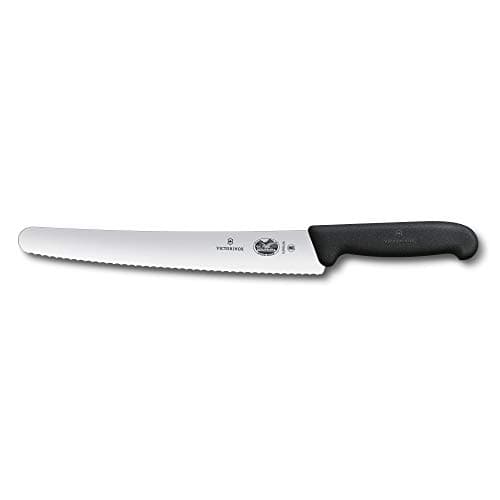
| 05 | Victorinox Fibrox 10.25" Serrated Bread KnifeThe knife most of these guides forget, and mechanically one of the kindest tools in a kitchen: serrations cut on the draw, so a loaf, a squash skin or a tomato needs sawing rather than pressing. The Fibrox handle is the same one that wins above. Its weakness is that you cannot sharpen it at home. | Best for pressing-free cuts | | $55.75·Amazon |
#ad · Live prices from the Amazon Product API, as of October 10, 2026. Where we have no verified live price, we show none — a gap beats a number that has rotted.
In detail
The picks, in full
Best overall for sore hands
Victorinox Fibrox Pro 7" Santoku (Granton)
Stamped X50CrMoV15~55-56 HRCGranton hollow edgeFibrox non-slip handle, NSF
The best low-force knife we can point at, and the reason is that it wins on all three mechanisms at once: a flat edge that push-cuts instead of rocking, a short light blade, and the grippiest handle in the category. It is also one of the cheapest knives here, which is a happy accident rather than a compromise.
- Grip security
- 9.5
- Force needed
- 8.5
- Weight & fatigue
- 9
- Maintenance ease
- 9
- Value
- 9.5
Pros
- +Flat santoku edge push-cuts straight down, so the wrist barely rotates under load
- +Short 7-inch blade is a shorter lever and far easier to control in a loose grip
- +Fibrox handle is textured and wide, and holds when hands are wet or weak
- +Soft steel comes back with a rod rather than a stone, so upkeep is near-effortless
- +Granton scallops help slices release instead of sticking and needing a second pass
Cons
- −Blunt sheepsfoot tip cannot do the fine tip work a chef's knife can
- −Ground near 20 degrees per side, so it is not as keen out of the box as a Japanese edge
- −Softer steel needs honing often - skip that and the force advantage disappears
- −Plain stamped build with no heft or balance to speak of
Don't buy this if…
…you need one knife that also pierces, trims and does detail tip work - this shape deliberately gives that up, and a chef's knife is the compromise pick.
Re-scored on this page's own five-metric rubric, not carried over from our santoku roundup, where it also finishes first against a field of santokus. It leads here because nothing else on the page wins three mechanisms at once: shape, weight and handle. Force needed is 8.5 rather than higher only because the factory grind is a wide Western angle — a harder Japanese santoku arrives keener, and asks a great deal more care in return.
The honest caveat is the tip. A santoku will not pierce or do fine point work, so if this is the only knife in the house you will miss it. The cheap fix is a small paring knife for those jobs, which asks almost nothing of a grip because the loads are tiny — our paring knife roundup has options for a few dollars.
Best all-purpose pick
Victorinox Fibrox Pro 8"
Stamped X50CrMoV15~55-56 HRC~20 deg/side edgeLight ~7.4 oz
The best one-knife answer if you want a true chef's knife shape. About 7.4 oz, the same textured Fibrox handle, soft forgiving steel and a price that leaves plenty over for a stone or a sharpening service. It asks more of your wrist than the santoku because of the rocking motion, and it does everything.
- Grip security
- 9.5
- Force needed
- 7.5
- Weight & fatigue
- 8.5
- Maintenance ease
- 9
- Value
- 9.5
Pros
- +About 7.4 oz, which is two ounces under a forged German knife of the same length
- +Fibrox handle is the most secure grip we know of at any price, wet or dry
- +Does every job - tip work, slicing, chopping - so nothing needs a second knife
- +Soft steel is the easiest kind to bring back, by rod, stone or service
- +NSF certified with a lifetime warranty and made in Switzerland
Cons
- −The curved belly invites a rock-chop, which is repeated wrist rotation under load
- −8 inches is a longer lever than a santoku, so it is harder to steer in a loose grip
- −A ~20-degree edge needs more pressure through dense vegetables than a keen Japanese grind
- −Stamped and bolster-free, so there is no finger guard at the heel
Don't buy this if…
…your pain is in the wrist rather than the fingers - the rocking motion is the thing that hurts, and the santoku above exists to avoid it.
Re-scored on this page's rubric rather than carried over from our full review or from best chef knives. It loses the top spot on force needed and on weight, which are exactly the two metrics a chef's knife cannot win against a shorter flat blade, and it still finishes second because grip security and upkeep are as good as anything made. If you want one knife and one knife only, buy this one and read how to hold a chef's knife — a pinch grip on the blade rather than a fist on the handle moves the work off your fingers and is free.
Best on a tight budget
Mercer Culinary Millennia 8"
Stamped Japanese steel~56 HRCSantoprene gripNSF certified
The cheapest knife on this page that is genuinely worth owning, and its Santoprene handle is a real alternative to Fibrox rather than a knock-off - slightly softer and tackier in the hand, which some people prefer outright. Buy it to try the category without spending, or to put a decent knife in a second kitchen.
- Grip security
- 9
- Force needed
- 7
- Weight & fatigue
- 8.5
- Maintenance ease
- 9
- Value
- 9.5
Pros
- +Santoprene over polypropylene is grippy and slightly yielding, which suits tender joints
- +Light in the hand and genuinely cheap, so it is a low-risk experiment
- +NSF certified, so it meets commercial sanitation standards
- +Soft steel hones back in seconds with no technique and no strain
Cons
- −Basic stamped steel dulls noticeably faster than the Victorinox, so it needs honing more often
- −Same rock-chop wrist motion as any chef's knife, with no mechanism to avoid it
- −Fit and finish are exactly what the price implies, and the handle is slimmer than Fibrox
- −No bolster, no balance, and nothing in the build to keep for twenty years
Don't buy this if…
…sharpening is the part you cannot manage - the knife that holds its edge longest is the one that stays low-force longest, and this is not it.
Re-scored here on this page's rubric; our Millennia reviewjudges it against chef's knives generally. It sits a fifth of a point behind the Victorinox because the handle is slimmer and the steel softer, and it is on the page because for a lot of households the right move is to spend almost nothing finding out whether a grippy light knife helps before committing. If it does, upgrade the knife. If it does not, the problem is the shape or the sharpness, not the handle.
Best for vegetable prep
Kai Seki Magoroku Nakiri 165mm
Japanese stainless, Seki manufacture165mm flat nakiri profileThin blade stockLightweight handle
The lowest-force cut on this page by a wide margin: a completely flat, thin, 165mm Japanese blade that drops straight through a vegetable in one stroke with no rocking and no sawing. It is here for mechanics, not for comfort - the handle is a basic domestic one and it is the pick that asks you to accept a trade.
- Grip security
- 6.5
- Force needed
- 9
- Weight & fatigue
- 9.5
- Maintenance ease
- 7.5
- Value
- 9
Pros
- +Completely flat edge means a pure push cut - the wrist does not rotate at all
- +Thin behind the edge, so it needs the least downward pressure of anything here
- +Lightest and shortest knife on the page, with the least weight to carry
- +Tall blade gives good knuckle clearance, so the guiding hand sits comfortably
Cons
- −Plain, slim domestic handle - nothing like the Fibrox or Santoprene grips above it
- −Vegetable specialist: no tip, and it is wrong for meat, bones or anything round and hard
- −Thin Japanese stock chips if you twist or lever with it
- −Import listings vary and there is no real service network behind it
Don't buy this if…
…grip security is your main problem rather than cutting force - this handle is the weakest here, and a Victorinox is the safer hand.
Re-scored on this page's rubric; our nakiri roundupjudges it against other nakiris. It posts the two best mechanical scores on the page and the worst grip score, and the arithmetic puts it fourth, which is the honest answer: the cut is effortless and the handle is not. It is the best second knife here — pair it with a grippy chef's knife and use the nakiri for the long vegetable sessions where force accumulates. If you want the same flat-edge mechanics with a better handle, Mercer and Zwilling both make nakiris with fuller grips and they are ranked on that roundup.
Best for pressing-free cuts
Victorinox Fibrox 10.25" Serrated Bread Knife
Stamped Swiss stainless10.25 in serrated bladeFibrox non-slip handleNSF certified
The knife most of these guides forget, and mechanically one of the kindest tools in a kitchen: serrations cut on the draw, so a loaf, a squash skin or a tomato needs sawing rather than pressing. The Fibrox handle is the same one that wins above. Its weakness is that you cannot sharpen it at home.
- Grip security
- 9.5
- Force needed
- 9.5
- Weight & fatigue
- 7.5
- Maintenance ease
- 6
- Value
- 8.5
Pros
- +Serrations bite and saw, so cuts happen with almost no downward pressure
- +Long enough to cross a large loaf or a melon in one stroke rather than three
- +Same textured Fibrox handle as the top picks, and it grips when floury or wet
- +Rigid blade tracks straight, so it does not need steering under load
Cons
- −A serrated edge effectively cannot be sharpened at home - when it is gone, you replace it
- −At 10.25 inches plus handle it is a long, awkward object to store safely
- −Only right for crusted, skinned or soft-interior food - it is not a general prep knife
- −Sawing is its own repeated motion, which suits some joints and not others
Don't buy this if…
…a long back-and-forth arm motion is what hurts - in that case the flat-edged picks above, which cut in one downward stroke, are the better mechanics.
Re-scored on this page's rubric; our bread knife roundupjudges it against other serrated knives, where it also finishes first. It ties the nakiri for the best force score and is dragged to fifth by maintenance, because a serrated edge is a long-lived consumable rather than something you keep sharp — how to sharpen a serrated knife explains why. It is on this page because a lot of the jobs that hurt most — crusty bread, winter squash skin, a ripe tomato that a dull straight edge crushes — are jobs serrations do with no pressure at all.
What we would skip, and why
Heavy forged German knives.They are excellent knives and they are the wrong tool here. A forged Wusthof Classic 8-inch is 9.3 oz on the spec sheet against about 7.4 oz for a Victorinox Fibrox Pro of the same length — around two ounces more, held through every repetition. If you want a German knife specifically, Wusthof's stamped Gourmet is 6.5 oz on the same sheet, which is lighter than anything forged; our Gourmet review has the detail and Wusthof vs Henckels covers what else sits at that price.
Hard, thin Japanese knives at 60 HRC and above. They arrive keener than anything on this page, which is genuinely the right direction, but they chip rather than roll if you twist or drop them and they need careful sharpening to stay keen. That is a lot of upkeep to take on, and a chipped edge needs more force, not less. If you still want one, read Japanese vs German and the beginner Japanese roundup first, and plan the maintenance before you buy.
Round, polished and slim handles. A smooth cylindrical handle has to be gripped to stay oriented, which is the exact motion to avoid. That rules out a lot of handsome knives, and it is also why we would not solve this problem with a block set: you end up paying for twelve handles chosen for how they look in a block.
Pull-through sharpeners, for the reason in do electric knife sharpeners ruin knives — they take a lot of metal and impose their own angle. And sharpening nothing at all, which is the most common and most expensive mistake on this page.
The cheap upgrades that matter as much as the knife
A board that does not move.A sliding board means you are gripping the knife harder to compensate. A heavy wood or soft plastic board on a damp cloth or a silicone mat fixes it for a few dollars, and soft boards are also much kinder to the edge, which keeps the knife low-force for longer — best cutting boards for knives explains why board hardness is the biggest single factor in edge life. Never cut on glass, stone or ceramic.
A board at the right height. Cutting on a high counter puts your wrist in extension and makes you push down from the shoulder. A lower surface, or a board on a pulled-out drawer, lets your forearm do the work.
A honing rod next to the board.Ten seconds before you start, every time. It takes almost no grip, removes no metal, and is the single highest-return habit in this whole article — see honing rods and sharpening vs honing for the difference between the two.
Letting something else do the gripping. A Y-peeler instead of a paring knife, kitchen shears instead of a knife for herbs, spatchcocking poultry with shears rather than a heavy blade. None of this is a knife recommendation and all of it reduces force.
Technique changes that cost nothing
A pinch grip— thumb and forefinger on the blade just forward of the handle, remaining fingers loose around the handle — moves control to the strongest part of the hand and needs less squeeze than a fist; how to hold a chef's knife shows it. Let the knife do the travel: a slicing motion forward and down uses the edge's length instead of your shoulder's strength. Cut food into stable flats first— take a slice off a round vegetable so it sits still, and you stop fighting it. Work in short sessions and prep ahead rather than cooking against the clock. And if the knife feels like it needs leaning on, stop and hone it; that feeling is information.
One honest word about knife sets marketed for arthritis
Search this topic and you will meet knives with pistol-grip or right-angled handles sold specifically as arthritis cutlery. Some people genuinely get on with them, and if an occupational therapist has recommended one, follow that advice over ours. What we will not do is rank them, because we have no honest basis for it: we rank from published specifications, those products rarely publish steel, hardness or edge angle, and a knife with a novel handle and an undisclosed edge is a knife we cannot tell you anything useful about. Every pick above is a knife whose specifications its maker states, which is the only way this site makes a recommendation.
How we picked
We did not lab-test these knives
Everyone in this category says they tested twenty knives in a professional kitchen. We have not hands-on tested any of these, and we say so. What we did instead: compiled the published specifications — steel type and hardness (HRC), edge angle, blade geometry, weight and build — applied established sharpening standards, ran the value math (spec quality ÷ live price), and scored each product against a published rubric. The scores are judgments from documented research — not measurements we took, because we do not have a test lab and we will not pretend we do. Where a number came from someone else's work, we name them in Sources.
Questions
Frequently asked
What kind of kitchen knife is easiest to use with arthritis?+
A short, light, flat-edged knife with a wide textured handle — which in practice means a 7-inch santoku or a 165mm nakiri rather than an 8-inch chef's knife. The flat edge push-cuts straight down instead of rocking, so the wrist rotates less, and the shorter blade is easier to steer in a loose grip. Sharpness matters more than any of it: a dull knife needs more force than any handle can give back.
Are expensive knives easier on arthritic hands?+
Usually the opposite. The handles that hold best in a weak or wet hand are commercial ones — Victorinox's Fibrox and Mercer's Santoprene — and they sit on inexpensive knives. Premium knives tend to be heavier, harder to sharpen, or fitted with smooth rounded handles that have to be gripped. See
are expensive chef knives worth it.
Should I buy an electric knife instead?+
For carving a roast or slicing bread, an electric knife genuinely removes the effort, and plenty of people with hand pain use one happily. It is a different product category from anything we rank and we have no published specifications to score it on, so we will not pretend to a ranking. For everyday prep it is not a substitute — a sharp light knife on a stable board is.
Does a heavier knife cut with less effort?+
Only for a narrow set of jobs. Mass helps when you want the blade to carry itself through something dense — a winter squash, a chicken joint — which is why a
cleaver works the way it does. For ordinary prep, weight you hold is weight you fight, and the force saved is less than the fatigue added.
How often should I sharpen if my hands hurt?+
Hone before every session — ten seconds, no metal removed, almost no grip needed — and sharpen properly when honing stops reviving the edge, which for soft Western steel in a home kitchen is typically every few weeks to a few months.
How often to sharpen knives has the cadence and
how to tell if a knife needs sharpening has the test. If the sharpening itself is the painful part, use a service.
Is a santoku really better than a chef's knife for sore hands?+
For chopping and slicing, in our assessment yes — it is shorter, lighter and designed for a push cut rather than a rocking motion. The trade is the blunt tip: a santoku cannot pierce or do fine point work, so most people want a small paring knife alongside it.
Chef's knife vs santoku compares them properly.
Are these knives dishwasher safe?+
Victorinox lists its Fibrox Pro knives as dishwasher safe, which matters if unloading a machine is easier for you than washing by hand. We would still wash and dry them by hand, because the cycle is hard on any fine edge —
can you put knives in the dishwasher sets out the four mechanisms involved.
Receipts
Sources
- Victorinox — Fibrox Pro 8" Chef's Knife 5.2063.20 (stamped blade, Fibrox non-slip handle, NSF certification, lifetime warranty, Swiss manufacture, dishwasher-safe statement)
- Victorinox — Fibrox Pro 7" Santoku 5.2523.17 (Granton hollow edge, flat santoku profile, Fibrox handle)
- Mercer Culinary — Millennia 8" Chef's Knife product page (Santoprene over polypropylene handle, NSF certification, Japanese steel)
- KAI — Seki Magoroku brand pages (165mm flat nakiri profile, Japanese stainless, Seki manufacture)
- Cutlery and More — Wusthof Classic 8" (9.3 oz / 265 g) and Wusthof Gourmet 8" (6.5 oz / 186 g) spec sheets, used for the weight comparison in "what we would skip"
We do not run a testing lab, and we do not pretend to. Where a spec or a measured number came from someone else's work — a manufacturer's page, a published standard — we name them and link them. Where we could not verify something, we say so on the page rather than quietly leaving it out. Read our full method.