A bread knife is the least glamorous and most under-bought knife in a kitchen, and it is the cheapest meaningful upgrade most people can make. A serrated edge does not press through material the way a straight edge does — each tooth concentrates force on a tiny point, pierces the crust, and the gullets between the teeth saw the rest apart with almost no downward pressure. That is why a razor-sharp chef's knife still crushes a sourdough and a mediocre serrated knife does not.
It is also the category where our value scoring is least controversial, because a serrated edge effectively cannot be sharpened at home — see how to sharpen a serrated knife — so you are buying a long-lived consumable rather than an heirloom. Scores here are judgments from published specifications and value math, not lab measurements; the method page explains exactly what we do and do not do.
How we ranked these
Edge and steel from published alloy and hardness, though it matters less here than anywhere else. Sharpness, meaning serration pattern and how aggressively the teeth bite a hard crust. Handling— length, blade rigidity and whether the handle keeps your knuckles clear. Build. And value, which in a category where a $16 knife performs close to a $180 one does more work than usual.
Length is the spec that decides everything
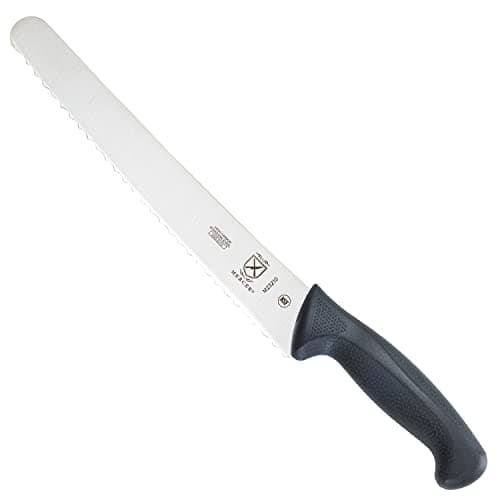
Buy a bread knife longer than the widest thing you cut. For a round sourdough or a watermelon that means nine inches at an absolute minimum and ten inches comfortably. The common mistake is buying an eight-inch bread knife to match a block set, which then saws in multiple passes instead of crossing the loaf once — and multiple passes is exactly the crushing you bought serrations to avoid. Rigidity matters alongside it: a whippy thin blade wanders as it descends through a tall loaf.
Wavy, pointed or double serrated?
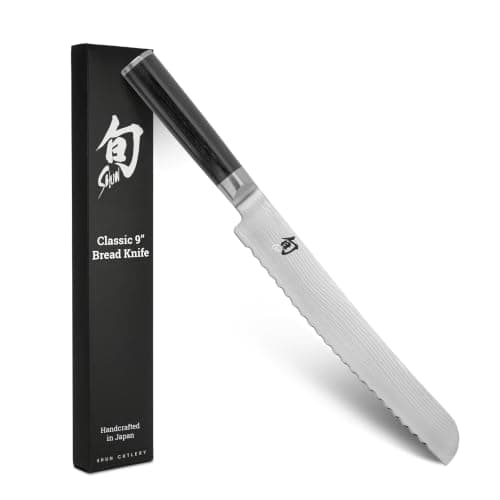
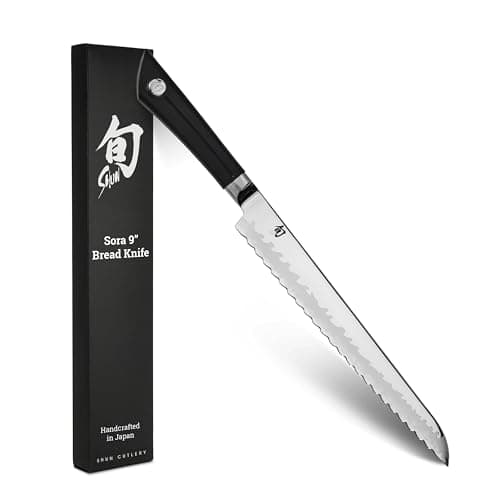
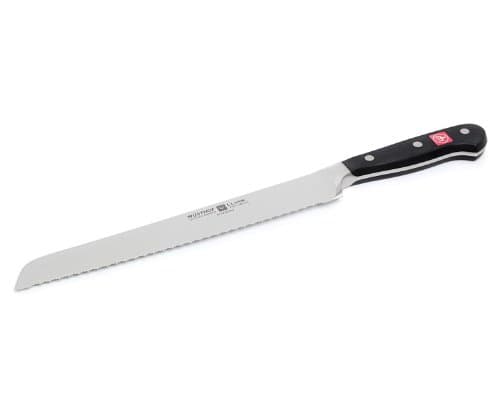
Wavy or scallopedserrations have rounded gullets and relatively blunt points. They are the most common pattern, saw cleanly and are gentle on a soft interior — the sensible default. Pointed serrations bite harder into a tough crust and can tear soft crumb. Double serrated— small teeth cut into larger ones — grip most aggressively and are the usual choice on premium German knives, at the cost of being genuinely unsharpenable. In practice, length and blade rigidity make more difference to your result than any of these patterns.
Why a cheap bread knife is genuinely defensible
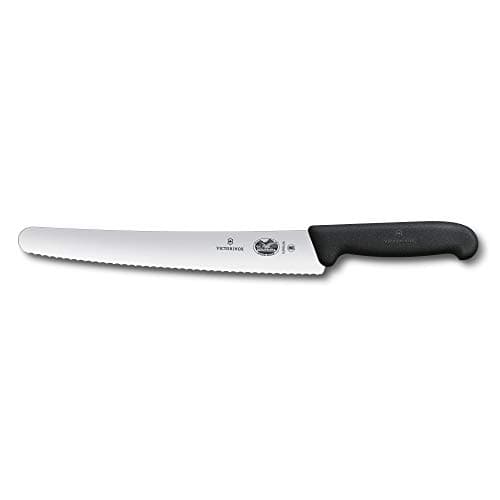
A serrated edge cannot practically be sharpened at home, and even professional restoration is slow and often uneconomic. So you are not buying an heirloom that improves with maintenance — you are buying a long-lived consumable. What premium steel buys you is more years before the teeth round off, and on a knife used a few times a week that is a long time either way. The Mercer at the bottom of the price range will very likely still be cutting bread in a decade. Spend the difference on the knife you use every day — see best chef knives.
Offset handles
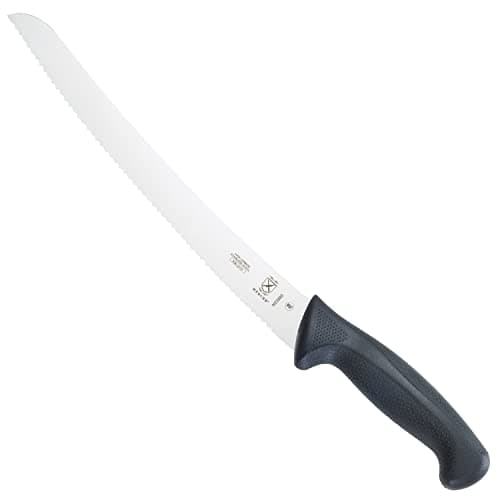
Some bread knives raise the handle above the blade line so your knuckles clear the board entirely. That is genuinely useful if you slice a lot of loaves flat on a surface, and irrelevant if you cut against a board edge or hold the loaf. None of our picks are offset because the trade — awkward storage, odd balance, limited choice — is not worth it for most kitchens. The curved Mercer above solves most of the same problem more elegantly.
What else a bread knife is quietly the best tool for
Ripe tomatoes, where a slick skin defeats a straight edge unless it is freshly sharpened. Citrus, for the same reason. Layer cake and delicate pastry, where sawing beats pressing. Melon and hard squash skin. Crackling and the crust on a roast. If you have ever wondered why your bread knife is the one that always seems to be out, this is why — chef's knife vs bread knife covers the mechanics.
Technique, briefly
Let the blade do the work. Long strokes, almost no downward pressure, and let the serrations saw rather than pressing them into the loaf. Pressing is what compresses a soft crumb and produces the squashed slices people blame on the knife. Start the cut with the heel of the blade and draw back toward yourself to break the crust, then continue with the full length. And cut on wood or plastic — the points take the impact on a hard board and blunt first.
Making one last
Do not use it as a general knife: every cut a straight edge could have made is wear you did not need to spend. Store it where nothing contacts the edge, which for a ten-inch blade usually means a magnetic strip or an edge guard rather than a crowded drawer — see best knife storage. Never run it through a pull-through or standard electric sharpener, which flattens the teeth into a ragged straight edge and finishes the knife permanently.
What we would skip
The Wusthof Classic double-serrated, as above — superb, and the weakest value case on this page given the edge is a consumable. Beyond our picks: skip any bread knife under nine inches, which will not cross a round loaf in one stroke. Skip bread knives sold as part of a large block set, which are usually the shortest and cheapest piece in the box. And skip the adjustable bread-slicing guides sold alongside them — a long enough knife and a steady hand solve the same problem for less.
How we picked
We did not lab-test these knives
Everyone in this category says they tested twenty knives in a professional kitchen. We have not hands-on tested any of these, and we say so. What we did instead: compiled the published specifications — steel type and hardness (HRC), edge angle, blade geometry, weight and build — applied established sharpening standards, ran the value math (spec quality ÷ live price), and scored each product against a published rubric. The scores are judgments from documented research — not measurements we took, because we do not have a test lab and we will not pretend we do. Where a number came from someone else's work, we name them in Sources.