Skip to content
The Edge Bench

Roundups & reviews · Chef Knives

The best Japanese chef knives for beginners

Hard steel is a commitment, not just a purchase. These are the Japanese knives that reward a first-time owner instead of punishing one — and what changes about how you use them.

By Stephen V.Updated How we review
#ad

We earn a commission when you buy through our Amazon links, at no extra cost to you. It never changes a verdict, and we say so when the cheaper knife is the better buy. How this works.

The first Japanese knife is where most people either fall in love with cutting or quietly ruin an expensive blade. The difference is almost never the knife — it is whether anyone told them what changes. Harder steel at 60–61 HRC holds a keener edge for far longer than a German knife, and in exchange it chips instead of rolling, dislikes bone and frozen food, and needs a stone rather than a rod. None of that is difficult. All of it is different.

So this list is not simply the cheapest Japanese knives. It is ranked on how forgiving each one is of a first-time owner: hardness at the lower end of the Japanese range where possible, a bolster or handle shape that is comfortable without training, and a price that does not make a learning chip feel catastrophic. If you have not yet decided between families at all, read Japanese vs German chef knives first — that decision comes before this one.

How we ranked these

We do not test knives and we have no lab — our method is published. Scores come from published steel and hardness, ground edge angle, handling, build and value against the live price. On this page an extra weighting applies to chip tolerance (lower hardness inside the Japanese band scores better here, not worse) and to handle shapes that do not require an acquired grip.

Five things that change when you buy Japanese

1. No bones, no frozen food, no hard boards. A hard, thin edge that meets a chicken bone chips. Keep a cheap Western knife for rough work — this is the single most important habit, and it is why we suggest a Japanese knife as a second blade rather than an only one.

2. Push and pull, do not rock. Japanese profiles are flatter than German ones, so the rocking motion many home cooks learn does not suit them. A forward push cut or a drawing pull cut works with the geometry instead of against it. See how to hold a chef knife.

3. A steel rod is the wrong tool. Ridged steel rods are designed to straighten soft steel that has rolled. Hard steel does not roll much, and an aggressive rod can chip the apex. A fine ceramic rod is acceptable; a whetstone is correct.

4. Sharpen at the angle it came with.Roughly 15° per side, sometimes less. Running a Japanese knife through a Western pull-through sharpener set near 20° quietly regrinds it into a worse knife. Detail in knife sharpening angles.

5. Hand-wash and dry immediately.Even "stainless" Japanese cores are less corrosion-resistant than a German knife, and clad blades can spot at the seam. Thirty seconds of care, every time.

The short answer

Quick picks

#KnifeBest forScorePrice
01
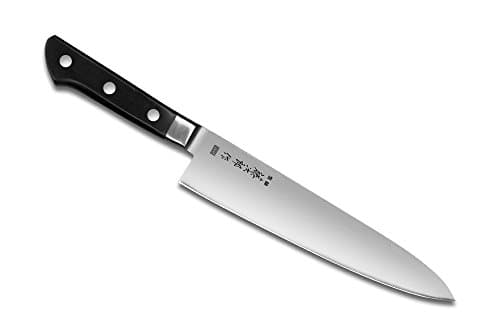
Tojiro Tojiro Professional VG10 Chef Knife 8.2" (210mm)
Tojiro Professional VG10 Chef Knife 8.2" (210mm)

The knife the Japanese-knife community has recommended as a first blade for twenty years, and the reason is the trade it makes: a genuine VG-10 core and a thin Japanese grind in a plain, tough, western-handled package with no Damascus premium attached. It is the cheapest honest route into hard steel.

Best first Japanese knife
8.6
$139.00Amazon
02
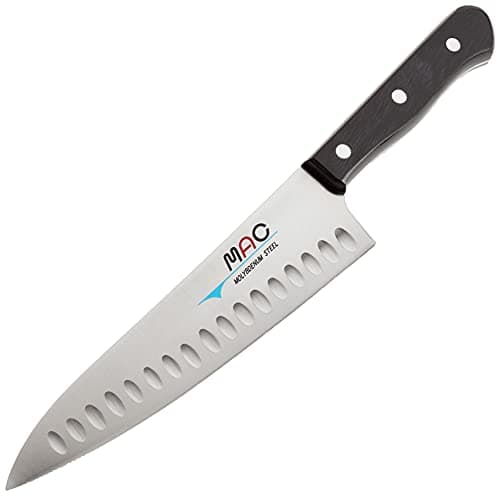
MAC MAC Chef Series 8" (Hollow Edge)
MAC Chef Series 8" (Hollow Edge)

The most forgiving knife in this roundup, because 59 HRC sits at the softer end of the Japanese band - keen and thin, but a little more willing to bend than chip when a beginner makes a beginner's mistake. The thin stock is what you are really buying.

Most forgiving Japanese steel
8.4
$114.95Amazon
03
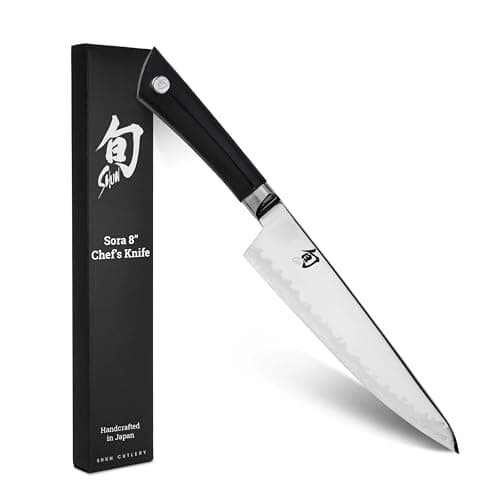
Shun Shun Sora 8" Chef's Knife
Shun Sora 8" Chef's Knife

Shun's entry line, and a clever piece of engineering for exactly this buyer: a VG10 cutting edge welded to a 420J stainless upper blade, so you get the Japanese edge steel where it matters and a tougher, cheaper alloy everywhere else. The Kai service network comes with it.

Best Japanese brand-name entry point
8.0
$109.95Amazon
04
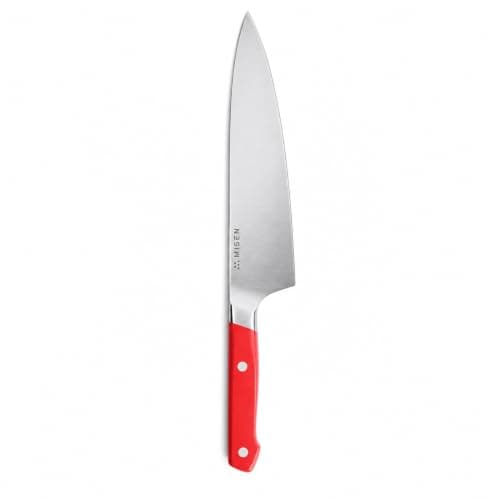
Misen Misen 8" Chef Knife
Misen 8" Chef Knife

The Japanese-steel knife with a Western brain: AUS-10 at 60-61 HRC and a roughly 15-degree edge, but a sloped bolster and a modern handle that ask nothing of you. If you want the hard-steel cutting experience without a Japanese handle shape, this is the shortest path.

Best hard steel in a Western package
8.4
Check price →
05
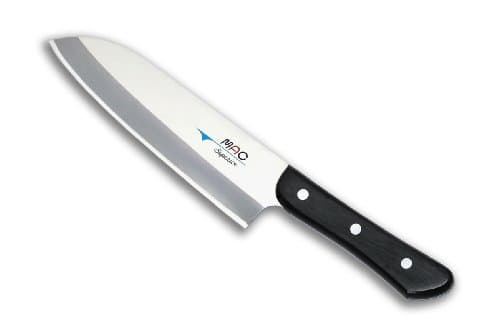
MAC MAC Superior 6.5" Santoku
MAC Superior 6.5" Santoku

The alternative shape, and a genuinely good first Japanese knife if your cooking is vegetable-led. Shorter and flatter than a gyuto, so it is easier to control while you learn a push cut, with the same thin Japanese stock and keen grind.

Best shape for vegetable-heavy cooking
8.4
$57.25Amazon

#ad · Live prices from the Amazon Product API, as of Sep 2, 2026. Where we have no verified live price, we show none — a gap beats a number that has rotted.

In detail

The picks, in full

01
Tojiro Tojiro Professional VG10 Chef Knife 8.2" (210mm)

Best first Japanese knife

Tojiro Professional VG10 Chef Knife 8.2" (210mm)

VG-10 core, clad stainless210mm gyuto profileWestern-style handle with bolsterMade in Japan
8.6/10

The knife the Japanese-knife community has recommended as a first blade for twenty years, and the reason is the trade it makes: a genuine VG-10 core and a thin Japanese grind in a plain, tough, western-handled package with no Damascus premium attached. It is the cheapest honest route into hard steel.

Edge & steel
9
Sharpness
9
Handling
8
Build
7
Value
10

Pros

  • Real VG-10 core rather than an unnamed 'high-carbon' steel
  • Western handle needs no acquired grip - it feels familiar immediately
  • Plain finish means you pay for steel, not cladding
  • Cheap enough that a learning chip is annoying rather than devastating

Cons

  • Fit and finish is functional - the spine and choil are not rounded like premium knives
  • Hard core still chips on bone or frozen food
  • Wants a stone from day one

Don't buy this if…

you want a knife that looks like a special object - this is the sensible, unglamorous choice and it looks it.

$139.00View on Amazon

Price as of Sep 2, 2026. Prices change — Amazon's at checkout is the one that counts.

#ad · we may earn a commission from this link to Tojiro Professional VG10 Chef Knife 8.2" (210mm)

02
MAC MAC Chef Series 8" (Hollow Edge)

Most forgiving Japanese steel

MAC Chef Series 8" (Hollow Edge)

Japanese high-carbon~59 HRC~15 deg edgeHollow-edge, thin blade
8.4/10

The most forgiving knife in this roundup, because 59 HRC sits at the softer end of the Japanese band - keen and thin, but a little more willing to bend than chip when a beginner makes a beginner's mistake. The thin stock is what you are really buying.

Edge & steel
9
Sharpness
9
Handling
9
Build
8
Value
7

Pros

  • Lower hardness than most Japanese knives - meaningfully more chip-tolerant
  • Very thin behind the edge, which is where the cutting feel comes from
  • Hollow-edge dimples help slices release
  • Plain build with no cosmetic premium

Cons

  • Still hard enough that a ridged steel rod is the wrong maintenance
  • Thin stock is wrong for squash and hopeless on bone
  • Anonymous looks

Don't buy this if…

you want the maximum edge retention hard steel can offer - 59 HRC trades a little of that for durability, deliberately.

$114.95View on Amazon

Price as of Sep 2, 2026. Prices change — Amazon's at checkout is the one that counts.

#ad · we may earn a commission from this link to MAC Chef Series 8" (Hollow Edge)

03
Shun Shun Sora 8" Chef's Knife

Best Japanese brand-name entry point

Shun Sora 8" Chef's Knife

VG10 edge, 420J stainless upperComposite Blade Technology8 in. gyuto-style profileTextured polymer handle
8.0/10

Shun's entry line, and a clever piece of engineering for exactly this buyer: a VG10 cutting edge welded to a 420J stainless upper blade, so you get the Japanese edge steel where it matters and a tougher, cheaper alloy everywhere else. The Kai service network comes with it.

Edge & steel
8
Sharpness
9
Handling
8
Build
7
Value
8

Pros

  • VG10 at the edge where it counts, tougher steel behind it
  • Textured polymer handle is grippier when wet than premium Pakkawood
  • Backed by Kai's sharpening and service program
  • Priced well below the Classic line

Cons

  • Visible weld line between the two steels divides opinion aesthetically
  • Handle feels distinctly less premium than the Classic
  • Composite construction is harder to thin dramatically over many years of sharpening

Don't buy this if…

the look of a knife matters to you - the two-tone blade is the most divisive thing on this page.

$109.95View on Amazon

Price as of Sep 2, 2026. Prices change — Amazon's at checkout is the one that counts.

#ad · we may earn a commission from this link to Shun Sora 8" Chef's Knife

04
Misen Misen 8" Chef Knife

Best hard steel in a Western package

Misen 8" Chef Knife

AUS-10 stainless~60-61 HRC~15 deg edgeSloped bolster, full tang
8.4/10

The Japanese-steel knife with a Western brain: AUS-10 at 60-61 HRC and a roughly 15-degree edge, but a sloped bolster and a modern handle that ask nothing of you. If you want the hard-steel cutting experience without a Japanese handle shape, this is the shortest path.

Edge & steel
9
Sharpness
9
Handling
8
Build
8
Value
8

Pros

  • Genuine hard-steel edge retention at an accessible price
  • Sloped bolster keeps the full edge sharpenable
  • Familiar Western handle and balance
  • Well-documented specification from the maker

Cons

  • 60-61 HRC is at the chippy end for a first hard-steel knife
  • Needs a stone, not a rod
  • Heavier than the Japanese-made picks here

Don't buy this if…

you are worried about chipping - the MAC or the Tojiro are the safer first hard-steel knives.

Check price on Amazon →

No buyable offer at the last price check (Sep 2, 2026). We show nothing rather than a stale number.

#ad · we may earn a commission from this link to Misen 8" Chef Knife

05
MAC MAC Superior 6.5" Santoku

Best shape for vegetable-heavy cooking

MAC Superior 6.5" Santoku

High-carbon Japanese stainless~59-61 HRCThin blade stock, keen grindPakkawood handle
8.4/10

The alternative shape, and a genuinely good first Japanese knife if your cooking is vegetable-led. Shorter and flatter than a gyuto, so it is easier to control while you learn a push cut, with the same thin Japanese stock and keen grind.

Edge & steel
9
Sharpness
9
Handling
9
Build
8
Value
7

Pros

  • Short and flat - the easiest profile on which to learn push cutting
  • Blunt tip is safer near a guiding hand while technique is forming
  • Thin stock gives the clean Japanese cut on vegetables
  • Light enough for long prep without fatigue

Cons

  • No point, so it cannot pierce or do fine tip work
  • Too short to break down anything large
  • Pakkawood handle needs hand-washing and drying

Don't buy this if…

this will be your only knife - a santoku's lack of reach and point will start to annoy you within a month.

$57.25View on Amazon

Price as of Sep 2, 2026. Prices change — Amazon's at checkout is the one that counts.

#ad · we may earn a commission from this link to MAC Superior 6.5" Santoku

What we would skip

Skip the cheap marketplace "Japanese Damascus" knives entirely as a first hard-steel purchase. Not because they are all bad — some cut acceptably — but because the whole point of a first Japanese knife is learning what hard steel does, and you cannot learn that from a blade whose actual hardness nobody will state. Skip single-bevel traditional knives (yanagiba, deba, usuba) as a first purchase too: they are specialist tools, they sharpen completely differently, and most are handed. See single bevel vs double bevel.

And skip carbon steel — not stainless-clad carbon, but true carbon-steel knives — until you have lived with a hard stainless blade for a year. They take the finest edge available and they rust visibly within minutes of contact with an onion if you do not dry them.

Buy the stone with the knife

This is the part people defer and should not. A hard Japanese blade will stay usably sharp longer than a German one, but when it does go, no rod will save it. A 1000/6000 combination whetstone plus twenty minutes of practice on a cheap knife is all the skill required, and it is a skill you keep. If freehand genuinely does not appeal, a guided angle systemset to 15° is a legitimate alternative. What is not legitimate is a Western pull-through sharpener.

Gyuto or santoku for a first knife?

A gyuto (the Japanese chef's knife) replaces a Western chef's knife outright and is the safer choice if it will be your main blade. A santoku is shorter, flatter and easier to control, and it is the better choice as a vegetable-first second knife. Both are covered in santoku vs gyuto, and the Western comparison lives in chef's knife vs gyuto.

What to expect in the first month

The first cut will be noticeably cleaner than whatever you were using — that is the thin stock, not just the sharpness. Around week two you will probably nick the edge on something, and that is normal; a small roll or micro-chip is fixable on a stone. What you want to avoid is the big chip, which comes from bone, frozen food or the blade falling into a sink. Keep a second cheap knife within reach for exactly those jobs and the transition is painless.

How we picked

We did not lab-test these knives

Everyone in this category says they tested twenty knives in a professional kitchen. We have not hands-on tested any of these, and we say so. What we did instead: compiled the published specifications — steel type and hardness (HRC), edge angle, blade geometry, weight and build — applied established sharpening standards, ran the value math (spec quality ÷ live price), and scored each product against a published rubric. The scores are judgments from documented research — not measurements we took, because we do not have a test lab and we will not pretend we do. Where a number came from someone else's work, we name them in Sources.
Questions

Frequently asked

Are Japanese knives good for beginners?
They are, provided you accept the maintenance. The knife will cut better from day one; what changes is that you need a stone rather than a rod, and you must keep it away from bone and frozen food. A beginner willing to do those two things is well served by a Japanese knife.
What is the difference between a gyuto and a Japanese chef knife?
There is none — gyuto is the Japanese name for a chef's knife. The shape was adopted from Western cutlery and executed with thinner stock, harder steel and a keener grind.
Do I need a whetstone for a Japanese knife?
Effectively yes. Hard steel does not respond to a ridged honing rod the way soft steel does, and a Western pull-through sharpener regrinds the edge to the wrong angle. A 1000/6000 combination stone or a guided system set to 15° is the right kit.
Will a Japanese knife chip?
If it meets bone, frozen food, a glass or stone board, or a hard fall — yes. Under normal vegetable and boneless-protein work on wood or plastic, no. Keeping a cheap Western knife for rough jobs solves this completely.
Are Japanese knives worth the extra money for a home cook?
If you cook regularly and will maintain them, yes — the cut is genuinely cleaner and the edge lasts longer. If you cook occasionally and own no stone, a softer Western knife that gets honed will serve you better. See best chef knives for home cooks.

Keep reading

Receipts

Sources

We do not run a testing lab, and we do not pretend to. Where a spec or a measured number came from someone else's work — a manufacturer's page, a published standard — we name them and link them. Where we could not verify something, we say so on the page rather than quietly leaving it out. Read our full method.