A professional knife is optimized for eight hours of repetitive prep by someone who hones it every service and has it ground properly every few weeks. A home knife is used for twenty minutes, three or four times a week, on wildly varied jobs — an onion, then a chicken thigh, then a butternut squash, then something frozen that should not be — by someone who owns no stone and will not buy one. Ranking knives for the first situation and handing the list to the second is how people end up with an expensive blade that has been dull for a year.
So this list is scored for the home reality. Steel that rolls rather than chips, because a rolled edge comes back with a rod and a chip does not. Grips that stay secure with wet hands, because that is a safety property and home kitchens have no towel discipline. Weight that suits occasional use rather than eight-hour endurance. And prices that leave room for the honing rod and a decent board, which will do more for your cutting than the next $100 of knife.
How we ranked these
No lab, no hands-on testing, and we say so — the method is published. Scores come from published steel and hardness, ground edge angle, handling, build, and value against the live price, with the home-use weighting described above applied consistently across every pick.
The three things that actually decide this
1. Can you bring the edge back?Western steel at 55–58 HRC rolls over under normal use, and ten seconds on a honing rodstraightens it. Steel at 60–63 HRC does not roll, it micro-chips, and no rod fixes that — it needs a stone. If you are not going to learn a stone, softer steel is not a compromise, it is the correct engineering choice.
2. Does the handle stay put when wet? Textured synthetic handles (Fibrox, Santoprene, Delrin) hold on with wet or greasy hands. Polished wood and smooth steel look better and get slippery. Every serious injury statistic about kitchen knives involves either a dull blade or a hand that slipped.
3. Will it survive the jobs you will actually give it? Home cooking hits bones, joints, frozen corners and the occasional plate. That is the environment German and Swiss steel was built for. A hard Japanese blade in the same kitchen will be beautiful for three months and chipped by year one unless you keep a second knife for rough work.
The short answer
Quick picks
| # | Knife | Best for | Score | Price |
|---|
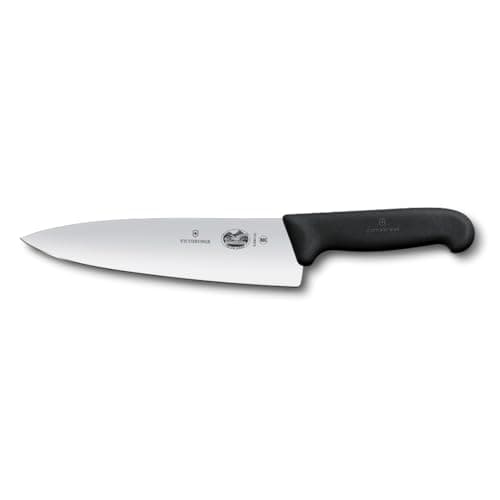
| 01 | Victorinox Fibrox Pro 8"Designed for exactly the constraints a home kitchen imposes. Soft enough that a honing rod genuinely restores the edge, textured enough that wet hands do not slip, light enough that occasional users do not fatigue, and cheap enough that nobody agonizes over using it on a chicken carcass. | Best overall for home kitchens | | $45.78·Amazon |
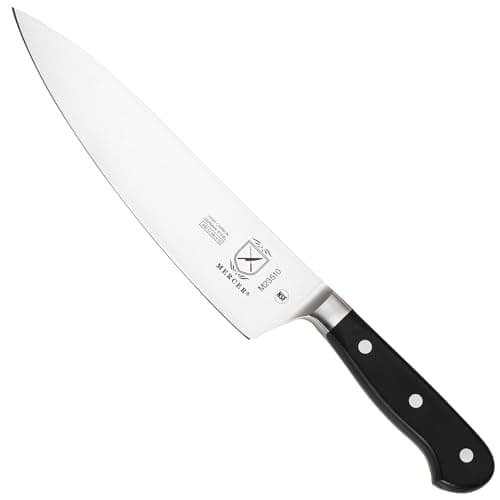
| 02 | Mercer Renaissance 8"The upgrade for a home cook who wants a forged knife with real heft but does not want to pay Solingen prices for it. Forged X50CrMoV15 at about 58 HRC with a full bolster - the German experience, at a price that leaves budget for a rod and a proper board. | Best forged upgrade | | $51.45·Amazon |
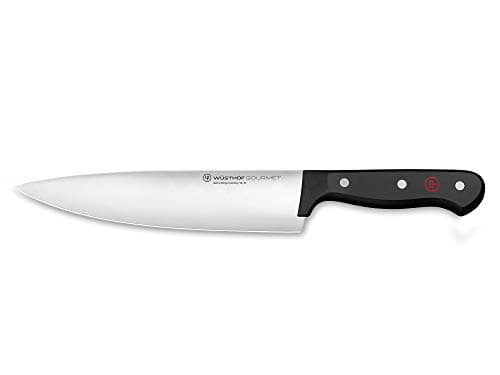
| 03 | Wusthof Gourmet 8"Solingen manufacture without the forged premium: precision-stamped X50CrMoV15 at around 56 HRC, at roughly 6.4 oz. For a home cook who wants the Wusthof name and service network but finds the Classic heavy, this is the version that suits smaller hands and shorter sessions. | Best lightweight German | | $69.98·Amazon |
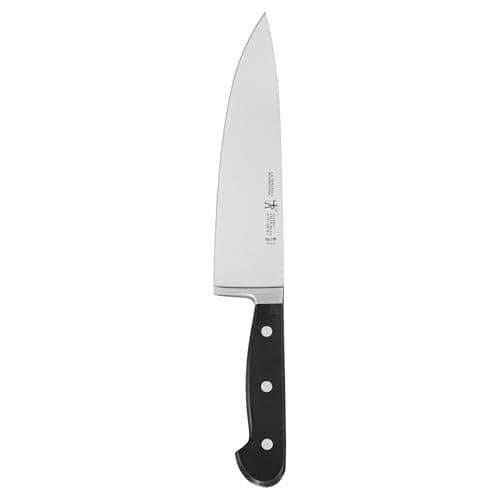
| 04 | HENCKELS Classic 8"The traditional-looking German knife at a home-cook price. Stainless at around 56 HRC with a full bolster and a riveted handle - the familiar silhouette, made to a price point below Zwilling, which is exactly the trade a lot of home kitchens want. | Best traditional look on a budget | | $79.95·Amazon |
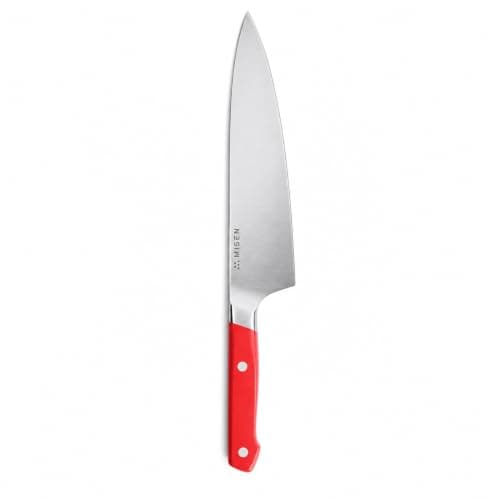
| 05 | Misen 8" Chef KnifeThe pick for a home cook who is ready to step up to hard steel and knows what that costs in maintenance. AUS-10 at 60-61 HRC with a roughly 15-degree edge and a sloped bolster - a genuinely keen knife at a price that does not feel reckless if you chip it learning. | Best first hard-steel knife | | $99.00·Amazon |
#ad · Live prices from the Amazon Product API, as of October 18, 2026. Where we have no verified live price, we show none — a gap beats a number that has rotted.
In detail
The picks, in full
Best overall for home kitchens
Victorinox Fibrox Pro 8"
Stamped X50CrMoV15~55-56 HRC~20 deg/side edgeLight ~7.4 oz
Designed for exactly the constraints a home kitchen imposes. Soft enough that a honing rod genuinely restores the edge, textured enough that wet hands do not slip, light enough that occasional users do not fatigue, and cheap enough that nobody agonizes over using it on a chicken carcass.
- Edge & steel
- 7
- Sharpness
- 8
- Handling
- 9
- Build
- 7
- Value
- 10
Pros
- +A rod, not a stone, keeps this cutting - no new skill required
- +Best wet grip here by a clear margin
- +Light enough that infrequent users stay comfortable
- +Cheap enough to use without ceremony on rough jobs
Cons
- −Needs honing often - if you never do it, it will feel dull within weeks
- −No heft for people who like a knife to feel substantial
- −Widest edge angle in this roundup
Don't buy this if…
…you want a knife that feels like an object rather than a tool - this one is pure function.
Best forged upgrade
Mercer Renaissance 8"
Forged X50CrMoV15~58 HRCFull bolster, full tangTaper-ground
The upgrade for a home cook who wants a forged knife with real heft but does not want to pay Solingen prices for it. Forged X50CrMoV15 at about 58 HRC with a full bolster - the German experience, at a price that leaves budget for a rod and a proper board.
- Edge & steel
- 8
- Sharpness
- 8
- Handling
- 7
- Build
- 8
- Value
- 10
Pros
- +Genuine forged weight and balance for rock-chopping
- +Same steel family as knives costing several times more
- +Delrin handle survives dishwasher abuse better than wood would
- +Still soft enough to be maintained with a rod
Cons
- −Handle is functional rather than shaped for comfort
- −Full bolster complicates heel sharpening in the long run
- −Finish quality is visibly below the Solingen names
Don't buy this if…
…you find heavy knives tiring - forged heft is the entire reason to choose this over the Victorinox.
Best lightweight German
Wusthof Gourmet 8"
Precision-stamped in SolingenX50CrMoV15, ~56 HRC~6.4 ozRiveted synthetic handle
Solingen manufacture without the forged premium: precision-stamped X50CrMoV15 at around 56 HRC, at roughly 6.4 oz. For a home cook who wants the Wusthof name and service network but finds the Classic heavy, this is the version that suits smaller hands and shorter sessions.
- Edge & steel
- 7
- Sharpness
- 8
- Handling
- 9
- Build
- 7
- Value
- 8
Pros
- +Noticeably lighter than the forged Classic
- +Made in Solingen with the same steel alloy as the flagship line
- +Backed by Wusthof's service and sharpening network
- +Soft enough to maintain with a rod
Cons
- −Stamped, so no bolster and less balance than the Classic
- −Softer than the forged line, so it needs honing more often
- −Priced above specification-equivalent stamped knives on the name
Don't buy this if…
…you want the heft that made you consider Wusthof in the first place - this is deliberately the light option.
Best traditional look on a budget
HENCKELS Classic 8"
German-engineeredStainless steel, ~56 HRCTraditional riveted handleFull bolster
The traditional-looking German knife at a home-cook price. Stainless at around 56 HRC with a full bolster and a riveted handle - the familiar silhouette, made to a price point below Zwilling, which is exactly the trade a lot of home kitchens want.
- Edge & steel
- 7
- Sharpness
- 7
- Handling
- 8
- Build
- 8
- Value
- 8
Pros
- +Classic riveted-handle look at a fraction of flagship pricing
- +Full bolster gives a comfortable, safe pinch grip
- +Soft steel is forgiving of everything a home kitchen does
- +Widely available and easy to replace
Cons
- −Henckels International sits below Zwilling in materials and finish
- −Riveted handle has seams that need proper cleaning
- −Edge retention is the weakest of the German picks here
Don't buy this if…
…you are expecting Zwilling quality from the Henckels name - they are different tiers under one parent company.
Best first hard-steel knife
Misen 8" Chef Knife
AUS-10 stainless~60-61 HRC~15 deg edgeSloped bolster, full tang
The pick for a home cook who is ready to step up to hard steel and knows what that costs in maintenance. AUS-10 at 60-61 HRC with a roughly 15-degree edge and a sloped bolster - a genuinely keen knife at a price that does not feel reckless if you chip it learning.
- Edge & steel
- 9
- Sharpness
- 9
- Handling
- 8
- Build
- 8
- Value
- 8
Pros
- +Holds a keen edge far longer than any Western steel here
- +Sloped bolster keeps the whole edge sharpenable
- +Priced well below Japanese-brand equivalents at similar hardness
- +Full tang with a balanced, modern handle
Cons
- −60-61 HRC chips - it is not the knife for bones or frozen food
- −Wants a stone; a rod does little at this hardness
- −Sharper edge is less forgiving of poor knife technique
Don't buy this if…
…you have no intention of buying a whetstone - this knife's advantage disappears the moment the edge goes.
What we would skip
Skip the colored non-stick knife sets that dominate the cheap end of home cutlery. The coating exists to disguise soft, thin stamped steel; it chips into food, it prevents honing from working properly, and the blades behind it are worse than a plain Victorinox costing the same. Skip "ceramic" kitchen knives as a primary blade too — they hold an edge remarkably well and shatter if dropped, which in a home kitchen is a matter of when.
And skip the 15-piece block as your route into a knife lineup. See are knife sets worth it for the arithmetic, and the best kitchen knives for what to buy instead.
Buy the rod at the same time
Whichever knife you choose here, the accessory that changes your experience most is a honing rod, not a second knife. Most of the time a home knife "feels dull" the edge has simply rolled over microscopically, and ten seconds of correct rod work stands it back up. That is a weekly habit worth building. Two or three times a year it will need actual sharpening — a stone, a guided system, an electric sharpener, or a local service.
The board matters more than people think
Glass, granite, marble and ceramic boards destroy an edge faster than anything else a home kitchen does. Bamboo is harder than most people realize and abrasive with it. End-grain wood and soft polyethylene are the two surfaces that let an edge survive. If you have spent money on a knife and cut on glass, you have wasted it — see the best cutting boards for knives.
What size, and does one knife cover it?
Eight inches is the default for a reason: long enough to cross most vegetables in one stroke, short enough to control on a home-sized board. Six inches suits small hands and small boards; ten inches is a professional's reach and feels enormous at home. Full detail in chef knife sizes, and knives for small hands if grip is the constraint.
If most of your cooking happens in one long session at the weekend rather than every evening, the ranking changes: best knives for meal prep weights weight, wet grip and mid-session upkeep above outright sharpness.
How we picked
We did not lab-test these knives
Everyone in this category says they tested twenty knives in a professional kitchen. We have not hands-on tested any of these, and we say so. What we did instead: compiled the published specifications — steel type and hardness (HRC), edge angle, blade geometry, weight and build — applied established sharpening standards, ran the value math (spec quality ÷ live price), and scored each product against a published rubric. The scores are judgments from documented research — not measurements we took, because we do not have a test lab and we will not pretend we do. Where a number came from someone else's work, we name them in Sources.
Questions
Frequently asked
What chef knife should a home cook buy first?+
An 8-inch knife in softer Western steel with a textured handle. It covers almost every job, it survives mistakes, and a honing rod keeps it cutting without any new skill. Spend the money you save on a rod and a wood or plastic board.
Do home cooks need a Japanese knife?+
Need, no. A hard Japanese blade cuts more cleanly and stays sharp longer, but it demands stone sharpening and careful use. It is an excellent second knife once you have a forgiving first one — or a great first knife if you are genuinely willing to learn a stone.
How much should a home cook spend on a chef knife?+
Enough to clear the coated-stamped-steel floor, and not much more. The performance curve climbs steeply through the low and mid range and flattens well before the flagship tier — which is the argument in
are expensive chef knives worth it.
How often does a home cook need to sharpen?+
Hone weekly if you cook a few times a week; sharpen properly two or three times a year. The exact cadence depends on the steel and what you cut —
how often to sharpen knives has the detail.
Is a santoku better than a chef's knife for home cooking?+
For vegetable-heavy cooking on a small board, often yes — it is shorter, flatter and easier to control. It loses reach and the piercing tip. Many home kitchens are best served by owning both; see
chef's knife vs santoku.
Receipts
Sources
We do not run a testing lab, and we do not pretend to. Where a spec or a measured number came from someone else's work — a manufacturer's page, a published standard — we name them and link them. Where we could not verify something, we say so on the page rather than quietly leaving it out. Read our full method.