Skip to content
The Edge Bench

Decision guides · Buying Guides

The best knives for meal prep

Batch cooking is a volume problem, not a technique problem. Five knives ranked on how well they hold up through two hours of repetitive prep - and why the answer is two knives, not one.

By Stephen V.Updated How we review
#ad

We earn a commission when you buy through our Amazon links, at no extra cost to you. It never changes a verdict, and we say so when the cheaper knife is the better buy. How this works.

Buy the Victorinox Fibrox Pro 8". For meal prep specifically it is the best knife on this page, because the thing that goes wrong during two hours of batch cooking is not sharpness — it is your hand and your grip. A light knife with a handle that still works when it is wet, in steel soft enough to straighten on a rod halfway through the session, beats a heavier and keener knife that tires you out and needs a stone when it fades. The rest of this page is about the second knife you should own, which is the one that actually changes how fast a prep session goes.

Meal prep is a different problem from cooking dinner. Cooking dinner is one onion, one pepper, one chicken breast— nothing about the knife matters much. Meal prep is four pounds of vegetables and six chicken breasts in one sitting, which is a stamina problem. Over a two-hour session, three things decide whether you enjoy it: how heavy the knife is, whether the handle stays secure as your hands get wet and starchy, and whether the edge can be brought back in fifteen seconds without stopping to find a stone. Outright sharpness matters far less than any of those, which is why this page ranks in a different order from our general chef knives ranking.

The second thing to say up front: the real meal-prep upgrade is not a better chef's knife, it is a second knife. Specifically a tall flat blade for vegetables alongside your curved chef's knife. A nakiri or santoku push-cuts straight down through a pile of carrots and cabbage without the rocking motion a curved blade needs, and over a hundred cuts that difference is enormous. Both are on this list.

We have not hands-on tested these knives and we say so — how we review sets out what the scores are built from: published steel, hardness, geometry, weight and handle material, plus value arithmetic against the live price. The Quick Picks table carries the live price and the date we pulled it; no number is printed in this prose.

The short answer

Quick picks

#KnifeBest forScorePrice
01
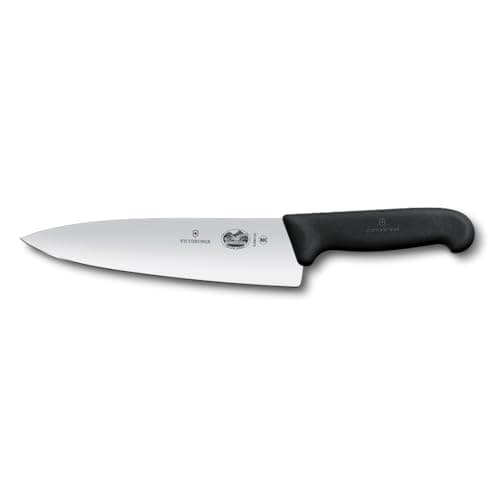
Victorinox Victorinox Fibrox Pro 8"
Victorinox Fibrox Pro 8"

The best meal-prep knife, and it is not close. Around 7.4 ounces, stamped Swiss X50CrMoV15 at roughly 55-56 HRC, NSF certified, with a textured Fibrox handle that is the only grip here that stays secure with wet and starchy hands. Light enough for two hours, soft enough to straighten on a rod mid-session.

Best overall for batch prep
8.8
$46.87Amazon
02
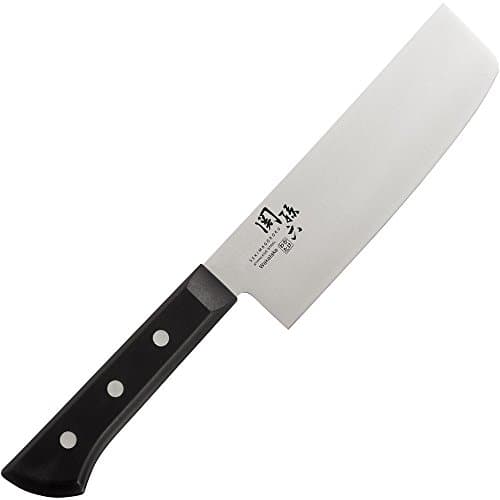
Kai Kai Seki Magoroku Nakiri 165mm
Kai Seki Magoroku Nakiri 165mm

The single biggest speed upgrade on this page, and the cheapest. A 165mm Japanese nakiri with a tall, thin, perfectly flat edge made in Seki - it push-cuts straight down through a pile of vegetables with no rocking at all. Buy it as the second knife alongside the Victorinox and your prep sessions get visibly faster.

Best for vegetable volume
8.4
$18.55Amazon
03
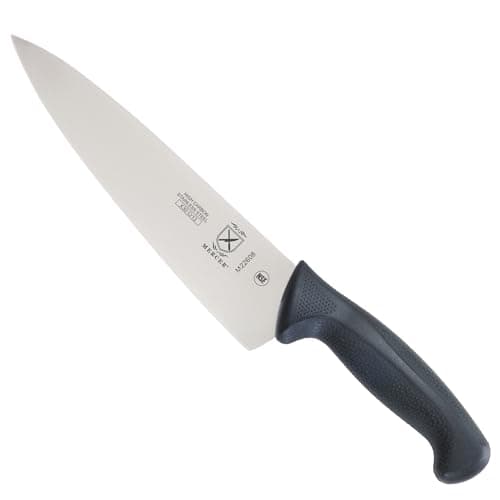
Mercer Culinary Mercer Culinary Millennia 8"
Mercer Culinary Millennia 8"

The pick if you want two identical chef's knives so one is always sharp. Stamped high-carbon Japanese steel at roughly 56 HRC, Santoprene grip, NSF certified - it is the culinary-school standard and it is cheap enough to buy in pairs. The moulded finger guard is the one thing to check against your grip first.

Best for buying two
8.6
$30.98Amazon
04
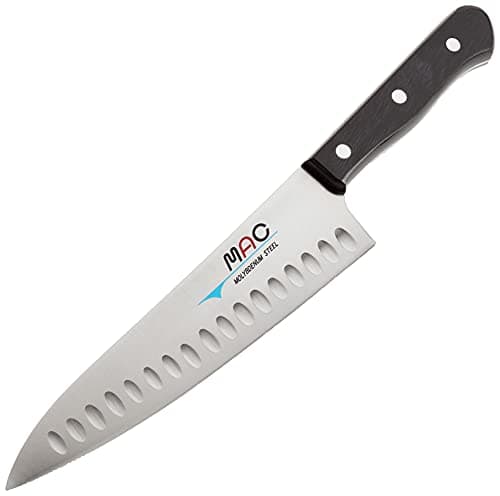
MAC MAC Chef Series 8" (Hollow Edge)
MAC Chef Series 8" (Hollow Edge)

The upgrade pick, and the right one if you would rather prep faster than prep cheaper. Japanese high-carbon at roughly 59 HRC on a ~15 degree edge, thin, light, with a hollow edge that stops wet potato and cucumber clinging to the blade - which is a real annoyance when you are slicing four pounds of it.

Best upgrade
7.9
$119.95Amazon
05
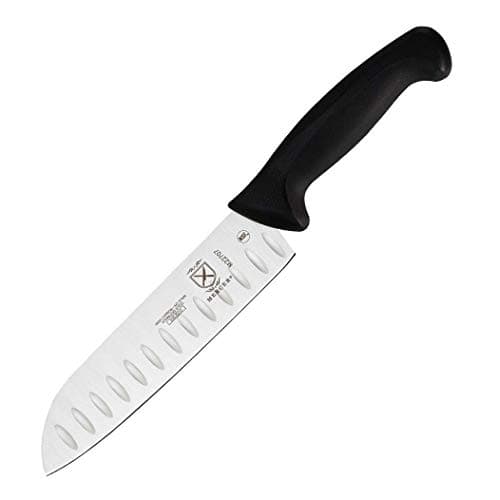
Mercer Culinary Mercer Culinary Millennia 7" Santoku (Granton)
Mercer Culinary Millennia 7" Santoku (Granton)

The cheapest way to add a flat-profile second knife, and a reasonable alternative to the Kai nakiri if you want the same Santoprene handle on both knives. Stamped high-carbon Japanese steel, Granton hollow edge, NSF certified. It keeps a little more tip than a nakiri does, which makes it marginally more versatile.

Best cheap second knife
7.9
$27.99Amazon

#ad · Live prices from the Amazon Product API, as of October 17, 2026. Where we have no verified live price, we show none — a gap beats a number that has rotted.

In detail

The picks, in full

01
Victorinox Victorinox Fibrox Pro 8"

Best overall for batch prep

Victorinox Fibrox Pro 8"

Stamped X50CrMoV15~55-56 HRCLight ~7.4 ozNSF certified, Swiss made
8.8/10

The best meal-prep knife, and it is not close. Around 7.4 ounces, stamped Swiss X50CrMoV15 at roughly 55-56 HRC, NSF certified, with a textured Fibrox handle that is the only grip here that stays secure with wet and starchy hands. Light enough for two hours, soft enough to straighten on a rod mid-session.

Prep stamina
9.5
Grip security
10
Edge upkeep
9
Versatility
8.5
Value
7

Pros

  • Lightest full-size chef's knife here, which is the property that matters at hour two
  • Fibrox grip stays secure when your hands are wet, greasy or coated in starch
  • Soft steel comes back on a honing rod in seconds without stopping the session
  • Cheap enough that a second one as a backup is a reasonable idea
  • NSF certified, so it survives being scrubbed and sanitised repeatedly

Cons

  • ~20 degrees per side is a wide edge and will never feel keen
  • Needs honing as a habit rather than occasionally
  • No heft - if you like weight falling through food, this is the wrong knife
  • Curved belly means vegetables still need a rocking motion, which the nakiri below fixes

Don't buy this if…

…you want a knife that feels substantial in the hand - this one is deliberately light, and lightness is the whole reason it wins here.

Re-scored on this page's rubric — Prep stamina, Grip security, Edge upkeep, Versatility, Value — rather than carried over from our overall ranking or best under $50, where it also wins against different fields. It is reviewed in full at our Victorinox Fibrox Pro review.

Prep stamina gets a 9.5 on weight alone: at around 7.4 ounces it is roughly two ounces lighter than a forged German 8-inch, and two ounces repeated across several hundred cuts is the difference between finishing a session and abandoning it. Grip security takes the only 10 on this page. If you want to understand why we weight that so heavily, it is because the single most dangerous moment in meal prep is a wet hand on a smooth handle at the end of a long session, and that is a design property, not a care instruction.

$46.87View on Amazon

Price as of October 17, 2026. Prices change — Amazon's at checkout is the one that counts.

#ad · we may earn a commission from this link to Victorinox Fibrox Pro 8"

02
Kai Kai Seki Magoroku Nakiri 165mm

Best for vegetable volume

Kai Seki Magoroku Nakiri 165mm

Japanese stainless, Seki manufacture165mm nakiri profileThin blade stockLightweight handle
8.4/10

The single biggest speed upgrade on this page, and the cheapest. A 165mm Japanese nakiri with a tall, thin, perfectly flat edge made in Seki - it push-cuts straight down through a pile of vegetables with no rocking at all. Buy it as the second knife alongside the Victorinox and your prep sessions get visibly faster.

Prep stamina
9
Grip security
7
Edge upkeep
8
Versatility
8
Value
10

Pros

  • A flat edge push-cuts with no rocking, which over hundreds of cuts is a genuine time saving
  • Tall blade gives real knuckle clearance and scoops a pile of prep off the board in one motion
  • Thin blade stock is what actually stops a knife wedging in a dense carrot or sweet potato
  • Extremely light - the least tiring knife here for repetitive vegetable work
  • Japanese manufacture at a price that makes it an easy second knife

Cons

  • No tip worth speaking of - it cannot core, trim or do fine point work
  • Flat edge is poor at rock-chopping herbs
  • Inexpensive handle and finish with no real warranty or service network
  • Not a substitute for a chef's knife, so it only makes sense as a second purchase

Don't buy this if…

…you want a substantial knife with a warranty and service network - this is an inexpensive domestic tool, not a premium purchase.

Re-scored here; it is the Japanese budget pick in our best nakiri knives ranking and is also ranked in best knives for cutting vegetables, which is the page to read if vegetables are the whole job rather than part of a batch.

Versatility is an 8 and not lower because a nakiri does more than its reputation suggests — it is excellent at everything that involves a straight downward cut, which is most of meal prep. It is an 8 and not higher because it cannot do point work at all. That is exactly why this page recommends it as the second knife: the Victorinox handles the tip jobs, the nakiri handles the volume. Chef knife vs nakiri is the shape-by-shape version of that argument.

$18.55View on Amazon

Price as of October 17, 2026. Prices change — Amazon's at checkout is the one that counts.

#ad · we may earn a commission from this link to Kai Seki Magoroku Nakiri 165mm

03
Mercer Culinary Mercer Culinary Millennia 8"

Best for buying two

Mercer Culinary Millennia 8"

Stamped Japanese steel~56 HRCSantoprene gripNSF certified
8.6/10

The pick if you want two identical chef's knives so one is always sharp. Stamped high-carbon Japanese steel at roughly 56 HRC, Santoprene grip, NSF certified - it is the culinary-school standard and it is cheap enough to buy in pairs. The moulded finger guard is the one thing to check against your grip first.

Prep stamina
9
Grip security
8
Edge upkeep
8.5
Versatility
8.5
Value
9

Pros

  • Cheap enough to own two, which solves the mid-session dull-knife problem completely
  • Marginally harder published steel than the Victorinox at roughly 56 HRC
  • Santoprene over polypropylene survives being washed constantly
  • NSF certified and standard issue at many culinary programmes

Cons

  • The moulded finger guard interferes with a pinch grip up on the blade
  • Lighter and thinner than the Victorinox, so it flexes more in heavy work
  • Grip is good but not as secure as Fibrox when genuinely wet
  • No published edge angle, so our upkeep score reads the steel family

Don't buy this if…

…you hold a knife in a pinch grip with thumb and forefinger on the blade - the moulded guard sits in exactly that spot.

Re-scored here; it is also ranked on best chef knives under $50 and best chef knives for culinary school, and reviewed in full at our Mercer Millennia review.

It finishes second on the page and it is here for a specific tactic rather than for its own merits: at this price you can own two, keep one freshly sharpened, and swap halfway through a long session instead of stopping. Professional kitchens do a version of this routinely. It is a better answer to “my knife goes dull during prep” than buying a knife three times as expensive, and how often to sharpen knives explains why the edge fades in the first place.

$30.98View on Amazon

Price as of October 17, 2026. Prices change — Amazon's at checkout is the one that counts.

#ad · we may earn a commission from this link to Mercer Culinary Millennia 8"

04
MAC MAC Chef Series 8" (Hollow Edge)

Best upgrade

MAC Chef Series 8" (Hollow Edge)

Japanese high-carbon~59 HRC~15 deg edgeHollow-edge, thin blade
7.9/10

The upgrade pick, and the right one if you would rather prep faster than prep cheaper. Japanese high-carbon at roughly 59 HRC on a ~15 degree edge, thin, light, with a hollow edge that stops wet potato and cucumber clinging to the blade - which is a real annoyance when you are slicing four pounds of it.

Prep stamina
8.5
Grip security
7
Edge upkeep
7.5
Versatility
9
Value
7.5

Pros

  • A keener, thinner blade means less force per cut, which is itself a stamina advantage
  • Hollow-edge dimples genuinely reduce sticking on wet starchy slices
  • Holds its edge far longer than the mid-50s HRC knives, so no mid-session fade
  • Light for a premium knife and easy on the hand over long sessions

Cons

  • Hard steel chips rather than rolls - no bones, no frozen food, no scraping the board with the edge
  • Needs a ~15 degree sharpening setup rather than a pull-through
  • Smooth handle is less secure than Fibrox or Santoprene when wet
  • Several times the price of the knife that wins this page

Don't buy this if…

…your prep involves frozen portions, bones or scraping the board edge-down - the harder steel punishes exactly that and the Victorinox shrugs it off.

Re-scored here; it is judged against the premium Japanese field at Shun vs Tojiro and reviewed in full at our MAC Chef Series review.

It drops to fourth on a meal-prep rubric despite being a better knife than the three above it, which is the honest result rather than a mistake. Edge upkeep is a 7.5 because hard steel cannot be rescued on a rod — when it fades you need a stone, and that is a session-ending problem rather than a fifteen-second one. Grip security is a 7 because the handle is smooth. Both of those are properties that only show up under volume, and volume is what this page is about.

$119.95View on Amazon

Price as of October 17, 2026. Prices change — Amazon's at checkout is the one that counts.

#ad · we may earn a commission from this link to MAC Chef Series 8" (Hollow Edge)

05
Mercer Culinary Mercer Culinary Millennia 7" Santoku (Granton)

Best cheap second knife

Mercer Culinary Millennia 7" Santoku (Granton)

Stamped high-carbon Japanese steelSantoprene/polypropylene gripGranton hollow edgeNSF certified
7.9/10

The cheapest way to add a flat-profile second knife, and a reasonable alternative to the Kai nakiri if you want the same Santoprene handle on both knives. Stamped high-carbon Japanese steel, Granton hollow edge, NSF certified. It keeps a little more tip than a nakiri does, which makes it marginally more versatile.

Prep stamina
8.5
Grip security
8
Edge upkeep
8
Versatility
6.5
Value
8.5

Pros

  • The least expensive flat-profile knife worth owning for volume vegetable work
  • Keeps more usable tip than a nakiri, so slightly more versatile
  • Granton scallops reduce sticking on potato and cucumber
  • Same grip and certification as the Millennia chef's knife, so the pair feels consistent

Cons

  • Softer and less keen than the Kai nakiri, with a wider Western edge angle
  • Shorter and less tall than a nakiri, so less in one pass and less knuckle clearance
  • Thin stamped blade with very little heft
  • Still a second knife, not a substitute for a chef's knife

Don't buy this if…

…you are buying only one knife - a flat blade with a short tip is a specialist, and the curved 8-inch comes first.

Re-scored here; it is the budget pick in best santoku knives. It ties the MAC on this rubric at 7.9, and under our tie-break rule the cheaper knife is listed first — so the MAC appears above it on the strength of versatility while the santoku takes grip and upkeep. Both results are in the table.

Pick between this and the Kai nakiri on handle rather than on blade. If you have bought the Millennia chef's knife, this gives you two knives with the same grip and the same upkeep routine, which is genuinely worth something during a long session. If you want the better cutting edge, the Kai wins. For what the scallops are and are not doing, see why knives have holes in the blade.

$27.99View on Amazon

Price as of October 17, 2026. Prices change — Amazon's at checkout is the one that counts.

#ad · we may earn a commission from this link to Mercer Culinary Millennia 7" Santoku (Granton)

The two-knife meal-prep setup

If you take one thing from this page, take this. A curved 8-inch chef's knife plus a tall flat vegetable knife covers a full batch-cooking session better than any single knife at any price. The chef's knife does protein, point work, anything that needs a tip, and anything round that needs a rocking cut. The flat blade does the volume: carrots, cabbage, peppers, squash, potatoes, all push-cut straight down with no wrist rotation. That division is not a luxury, it is how professional kitchens are organised, and the whole second knife costs less than most people spend on the first one.

A third knife earns its place only if you prep a lot of fruit or do a lot of trimming: a small paring knife for coring, hulling and peeling, which a chef's knife does badly. Best paring knives ranks those, and what knives a kitchen actually needs is the argument against buying a fourth.

The board matters more than the fifth-best knife

Two hours of repetitive cutting is also two hours of your edge hitting a surface, and the surface decides how long the edge lasts. A glass, stone, ceramic or bamboo board will visibly dull a knife in a single long session. End-grain wood or a soft plastic board will not. If you are deciding between spending money on a better knife or a better board, and your current board is glass or bamboo, buy the board — best cutting boards for knives has the detail, and why knives go dull explains the mechanism.

Board size is a meal-prep-specific point that nobody mentions. A small board forces you to clear it every thirty seconds, which is most of the wasted time in a prep session. A big board lets prepped food pile at the back while you keep cutting at the front. For batch work the board should be bigger than feels necessary.

Hone mid-session, do not sharpen mid-session

A knife does not go blunt during a prep session — its edge rolls over sideways. That is a different problem with a fifteen-second fix: a few passes on a honing rod stands the edge back up. Doing this once an hour during a long session is the single biggest difference between cutting that feels easy and cutting that feels like work, and it is the main reason this page ranks soft forgiving steel above hard premium steel. Sharpening vs honing is the distinction, how to use a honing steel is the technique, and best honing rods ranks the tools. Hard Japanese steel like the MAC does not respond to this, which is the quiet cost of buying up.

Three things that make a prep session slower than a dull knife

Clearing the board constantly. Covered above: get a bigger board, and use a sheet tray or a mixing bowl at the back of the counter so prepped food leaves the board immediately.

Washing the same knife between tasks.This is where the second knife quietly pays for itself again — vegetables on one, protein on the other, and you wash twice at the end instead of six times during.

A knife you do not trust. If the handle slips when your hands are wet you will cut slower and more carefully, which is the correct response and also the expensive one. This is the reason grip security is weighted as heavily as it is on this page, and the reason the cheapest knife on it wins.

How we ranked this page

Five metrics chosen for volume rather than for refinement. Prep staminareads weight, balance and blade height — how the knife feels at hour two rather than minute one. Grip security is specifically about a wet, greasy or starchy hand. Edge upkeep rewards steel you can straighten on a rod without stopping. Versatility asks how much of a mixed session one knife covers. Valueis spec quality against the live price. The overall is the mean, to one decimal place, and ties break in favour of the cheaper knife. None of it comes from a lab, because we do not have one — see how we review.
How we picked

We did not lab-test these knives

Everyone in this category says they tested twenty knives in a professional kitchen. We have not hands-on tested any of these, and we say so. What we did instead: compiled the published specifications — steel type and hardness (HRC), edge angle, blade geometry, weight and build — applied established sharpening standards, ran the value math (spec quality ÷ live price), and scored each product against a published rubric. The scores are judgments from documented research — not measurements we took, because we do not have a test lab and we will not pretend we do. Where a number came from someone else's work, we name them in Sources.

Questions

Frequently asked

What is the best knife for meal prep?
The Victorinox Fibrox Pro 8". For batch cooking specifically, light weight, a handle that stays secure when wet, and steel soft enough to straighten on a honing rod mid-session matter more than outright sharpness — and it wins all three.
How many knives do I need for meal prep?
Two. A curved 8-inch chef's knife for protein and point work, and a tall flat vegetable knife — a nakiri or santoku — for volume. A small paring knife is a worthwhile third if you prep a lot of fruit. Nothing beyond that earns its place.
Is a nakiri or a santoku better for meal prep?
A nakiri, marginally, because it is taller and perfectly flat, so it takes more in one pass and clears your knuckles better. A santoku keeps a little more usable tip. Both beat a curved chef's knife for high-volume vegetable work. See santoku vs nakiri.
Why does my knife go dull halfway through meal prep?
Usually it has not gone dull — the edge has rolled over sideways, which a honing rod fixes in fifteen seconds. If honing does not help, the edge is genuinely worn and needs a stone. A hard board (glass, stone, ceramic, bamboo) makes this happen several times faster.
Should I buy an expensive knife for meal prep?
Not as the first purchase. A keener knife needs less force per cut, which is a real stamina benefit, but hard steel cannot be rescued on a rod mid-session and premium handles are usually less secure when wet. Buy a second knife and a better board before buying a better knife.
Do I need a separate knife for raw meat?
Not for safety — washing between tasks handles that. But owning two knives means you wash twice at the end instead of six times during, which is a genuine time saving in a batch session. If you portion a lot of raw protein, a stiff boning knife is the better second purchase: see best boning knives.
What size cutting board for meal prep?
Bigger than feels necessary. Most wasted time in a prep session is clearing the board, and a large board lets prepped food pile at the back while you keep cutting at the front. Avoid glass, stone, ceramic and bamboo, all of which dull an edge quickly.

Keep reading

Receipts

Sources

We do not run a testing lab, and we do not pretend to. Where a spec or a measured number came from someone else's work — a manufacturer's page, a published standard — we name them and link them. Where we could not verify something, we say so on the page rather than quietly leaving it out. Read our full method.