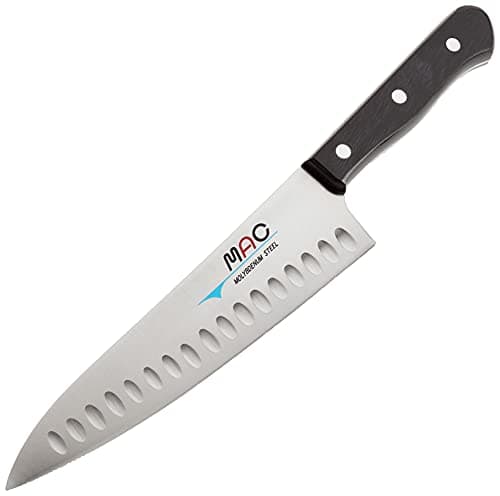
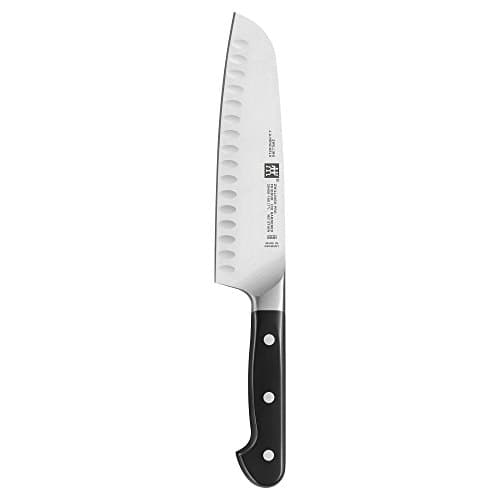
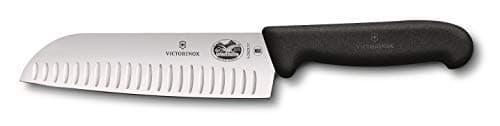
They are not holes. They are shallow oval dimples ground into both faces of the blade — a Granton edge, also sold as a hollow edge, a kullenschliff or a scalloped edge — and they do one job: break the suction that makes a wet slice cling to the steel. If a knife in your drawer has a row of ovals above the cutting edge, that is what you are looking at, and it is a surface feature rather than anything structural. If a knife has actual holes you can see through, it is a different thing entirely, and the last section of this page covers those.
The mechanism is simple. A thin slice of something wet — potato, cucumber, roast beef, smoked salmon — forms a near-continuous film of liquid between itself and the flat of the blade. Atmospheric pressure then holds the two together, which is why the slice follows the knife up instead of falling away. Scalloping the face removes most of that contact area and lets air in behind the slice, so it releases. That is the whole claim, and it is a real one.
What the scallops are notdoing is worth stating just as plainly, because the category is full of claims that do not hold up. They do not make the knife sharper — the cutting edge is identical. They do not make the blade thinner behind the edge, which is the property that actually decides whether a knife wedges in a dense vegetable (see blade grinds explained). They do not meaningfully reduce the weight of the blade. And no maker we cite publishes a measurement of how much the scallops help, so neither will we — the mechanism is sound, the magnitude is not something we can honestly quantify. Everything on this site is judged from published specifications; see how we review.
The terminology, which is a mess on purpose
Granton edge is the original: a British manufacturer, Granton, patented the scalloped blade and the name became the generic term in professional kitchens, particularly for long slicing knives used on cooked meat.
Hollow edgeis what most German and American makers call the same feature today — Zwilling and Wusthof both use it. Confusingly, “hollow ground” means something completely different: a concave cross-sectional grind, which is about geometry rather than release. A knife can be hollow ground, hollow edged, both or neither.
Kullenschliff (German, roughly “groove grind”) and kullens are the same scallops under the German name.
Granton vs hollow edge: no practical difference worth choosing between. Granton tends to describe scallops that alternate and run close to the edge; hollow edge often describes larger ovals set further up the face. Both do the same thing by the same mechanism, and the marketing names are not reliable indicators of either pattern.
Where the feature genuinely earns its place
Long slicing knives for cooked meat.This is the original use and still the best one. A twelve-inch slicer taking thin cuts off a ham or a brisket is the worst case for suction — large wet surface, thin flexible slice — and the scallops help most there. Our brisket page explains why we cannot currently point you at a dedicated granton slicer.
Santokus and nakiris. A tall flat blade doing long sessions of starchy vegetable prep sticks constantly, which is why so many santokus are sold scalloped.
Where it does almost nothing: paring knives, boning knives, bread knives and anything used on dry food. If a knife is scalloped and is none of the above, treat the feature as cosmetic and judge the knife on its steel, geometry and handle instead.
The other holes: handles, butcher knives and cheese knives
A hole in the handleis a hanging hole, and that is all it is — commercial kitchens hang knives on hooks or racks, and foodservice lines (Victorinox's Fibrox, Mercer's Millennia, Dexter's Sani-Safe) often include one. It has no effect on how the knife cuts.
Butcher and ham knives are the classic Granton application: long, thin, flexible blades taking thin cuts off a wet joint, where the suction problem is at its worst. If you have seen the feature on an old trade knife, that is why.
Cheese knives with large holes you can see throughare a different design altogether. Those are not scallops; the blade is genuinely perforated, because soft cheese does not just stick to steel, it adheres over the whole face and smears. Perforation removes enough surface that the cheese releases. Nobody makes a chef's knife this way, because a blade with holes through it is weaker and harder to clean.
Decorative dimpling exists too, on inexpensive knives where the pattern is rolled or stamped rather than ground, set too far up the blade to influence anything a slice touches. There is no reliable way to tell from a product photograph, which is one reason this page ranks knives rather than patterns.
Should the scallops change what you buy?
Only at the margin. The properties that decide whether a knife is good are the steel and its hardness, how thin the blade is behind the edge, the edge angle, and whether the handle suits your hand — in roughly that order. A Granton edge is a nice-to-have that genuinely improves one specific annoyance, and it is cheap for a maker to add, which is why you find it on both thirty-dollar and three-hundred-dollar knives. Buy the better knife; if it happens to be scalloped, good.
If sticking is your actual complaint, two other things help as much and cost nothing. Cut a little faster, so the slice separates before the film forms. And keep the knife sharp — a dull blade compresses a slice against the face, which increases contact and makes it stick harder. Why knives go dull and how to use a honing steel cover the cheaper fix.
Does a hollow edge affect sharpening?
Barely, and only at the end. The scallops sit above the bevel, so ordinary sharpening never reaches them. Over many years of removing metal, a heavily sharpened blade will eventually work its way up into the scallop row — which on most knives is decades away and on a cheap knife is longer than the knife will last. They are no obstacle on a stone, in a guided system or on a honing rod, and how to sharpen kitchen knives applies unchanged. The one thing to know: do not try to hone into a scallop looking for a burr. There is nothing there.