Buy the Mercer Millennia 6-inch stiff boning knife for trimming, about fourteen dollars, and the Victorinox Swiss Classic carving set for slicing. A packer brisket asks for two completely different blades and almost every “best brisket knife” list pretends it is one. Trimming a cold raw fat cap is short-blade work that wants rigidity so you can feel the fat-to-meat boundary. Slicing a rested, hot, 14-pound cooked brisket against the grain is long-blade work that wants reach and a blade that will not tear. This page is for anyone cooking brisket at home who does not want to buy four knives to find that out.
One thing stated up front, because it is the honest version: we do not rank a dedicated 12-inch granton brisket slicer, because there is not one in our verified product registry. A long granton slicer is the ideal tool for the slicing half of this job, and the best we can point you at is the slicing knife in a carving set, which is shorter and usually has no granton scallops. We would rather say that than promote a carving knife into something it is not. Everything below is scored on five metrics: how well it fits the job it is here for, control, how secure the grip is with rendered fat on your hands, how maintainable the edge is, and value. Published specifications and value math only — see how we review. We have not cooked with these knives and we have no test lab.
Why trimming and slicing want opposite blades
Trimming is a feel job. You are cutting a hard, cold, slippery fat cap down to a quarter inch, finding the deckle and the silverskin, and the information you need comes up the blade into your hand. A stiff blade transmits that; a flexible one dulls it into guesswork. Six inches is plenty, and a shorter blade is easier to steer around a curved cap.
Slicing is a geometry job. Against-the-grain slices of a cooked flat want to be made in a single draw, because a second pass through hot, loose, rendered muscle tears it. That needs blade length— more than the width of the cut — and a straight or hollow-ground edge that releases rather than grabs. A boning knife cannot do it and a chef's knife is usually an inch or two too short. These are not the same knife, and anyone selling you one knife for both is selling you a compromise at both ends.
The short answer
Quick picks
| # | Knife | Best for | Score | Price |
|---|
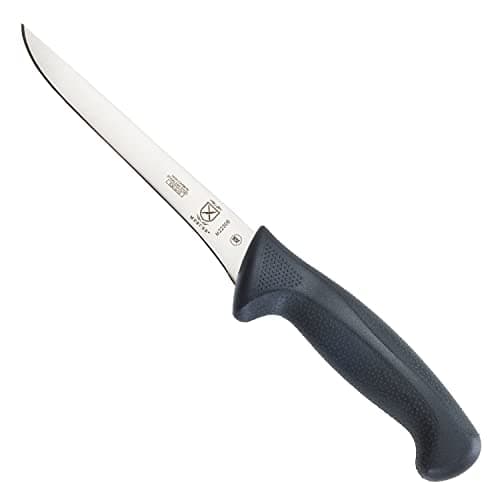
| 01 | Mercer Culinary Millennia 6" Stiff Boning Knife (M22306)The best trimming knife here and the cheapest knife on the page, which is the whole argument. One piece of high-carbon Japanese steel, stamped, with a textured Santoprene handle, a protective finger guard and NSF certification - and it is the only pick that puts the word stiff on the label, which is the single most useful thing a listing in this category can do. | Best overall (trimming) | | $13.99·Amazon |
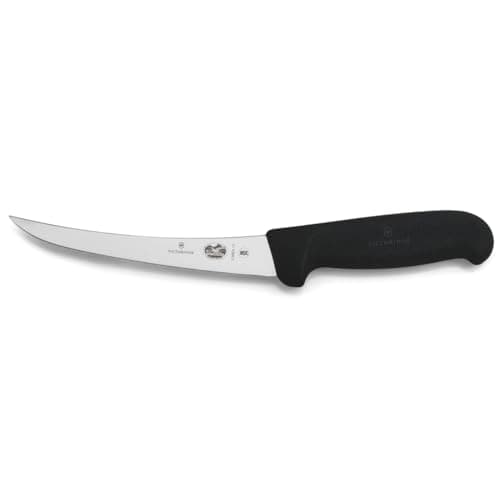
| 02 | Victorinox Fibrox 6" Curved Boning Knife, Semi-Stiff (5.6603.15)The better object, one tiebreak behind. A 5.9-inch curved semi-stiff blade at 3.4 ounces with the best wet grip of anything on this page, Swiss made, dishwasher safe and lifetime warranted. Buy this one instead of the Mercer if you also joint chickens, because semi-stiff is the band that does both and stiff is not. | Best if you also do poultry | | $32.42·Amazon |
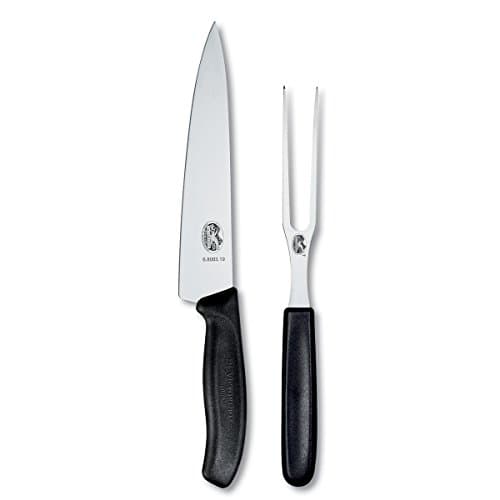
| 03 | Victorinox Swiss Classic 2-Piece Carving SetThe slicing half of the answer, and the honest one. A proper slicing blade and fork from the brand professional kitchens trust, light enough to control over a hot brisket and cheap enough that a tool used a few times a year is not an indulgence. It is not a 12-inch granton brisket slicer, and we are not going to call it one. | Best for slicing the cooked brisket | | $66.99·Amazon |
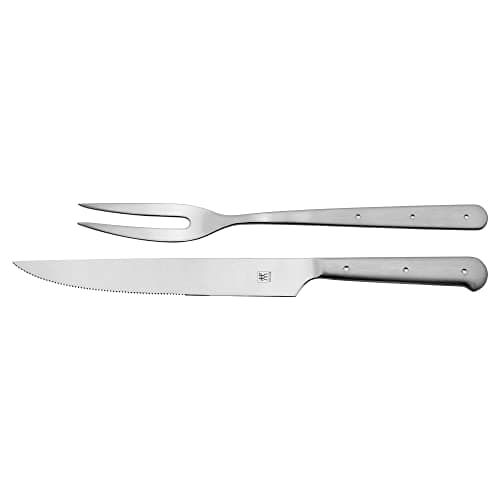
| 04 | Zwilling Porterhouse 2-Piece Carving SetThe same job in a presentation box, which is the reason to buy it - a stainless carving knife and fork from a Solingen name, boxed in red, which makes it the pick if this is a gift for someone who smokes meat rather than a tool for your own pit. | Best as a gift | | $59.76·Amazon |
#ad · Live prices from the Amazon Product API, as of October 18, 2026. Where we have no verified live price, we show none — a gap beats a number that has rotted.
In detail
The picks, in full
Best overall (trimming)
Mercer Culinary Millennia 6" Stiff Boning Knife (M22306)
6 in stiff bladeHRC 53-54NSF certifiedFinger guard
The best trimming knife here and the cheapest knife on the page, which is the whole argument. One piece of high-carbon Japanese steel, stamped, with a textured Santoprene handle, a protective finger guard and NSF certification - and it is the only pick that puts the word stiff on the label, which is the single most useful thing a listing in this category can do.
- Job fit
- 9.5
- Control
- 8.5
- Grip when greasy
- 9
- Edge maintenance
- 8
- Value
- 9.5
Pros
- +Stiff is the correct band for a raw fat cap: everything the edge touches comes straight into your hand
- +Mercer states the stiffness in the product name rather than leaving you to infer it from a model number
- +The protective finger guard is a genuine safety feature on a pointed knife working on cold slippery fat
- +Textured Santoprene stays secure with fat on your hands
- +One-piece construction, NSF certified, limited lifetime warranty, at the lowest price here
Cons
- −Mercer's published hardness for the Millennia line, HRC 53-54, is the softest steel on this page - it takes an edge in minutes and gives it up as quickly
- −Mercer's own use-and-care guidance rules out the dishwasher, so this is a hand-wash knife despite the plastic handle
- −A stiff blade is the wrong tool for poultry and fish, so it is a specialist rather than a default
- −Stamped with no bolster - fine at the price, but there is less stock behind the edge than a forged blade
Don't buy this if…
…you want one boning knife for brisket AND chicken - buy the semi-stiff Victorinox below, which is the compromise band and still inexpensive.
Re-scored on this page's rubric, not carried over from our boning knife roundup, where it is the budget pick in a field judged across fish, poultry and red meat. Here the job is one cold fat cap and the stiff band is simply correct, so it takes job fit outright. It ties the Victorinox below at 8.9 on the arithmetic and sits above it on the house cheaper-first tiebreak, at roughly half the price.
The soft steel is the real trade and it cuts both ways: it will not hold an edge through a whole brisket trim without a touch-up, and it comes back on a rod in seconds with no technique. How to use a honing steel is the ten-second habit that makes this knife work.
Best if you also do poultry
Victorinox Fibrox 6" Curved Boning Knife, Semi-Stiff (5.6603.15)
5.9 in curved bladeSemi-stiff3.4 ozSwiss made
The better object, one tiebreak behind. A 5.9-inch curved semi-stiff blade at 3.4 ounces with the best wet grip of anything on this page, Swiss made, dishwasher safe and lifetime warranted. Buy this one instead of the Mercer if you also joint chickens, because semi-stiff is the band that does both and stiff is not.
- Job fit
- 8
- Control
- 8.5
- Grip when greasy
- 9.5
- Edge maintenance
- 8.5
- Value
- 10
Pros
- +The Fibrox TPE handle is the most secure grip here with rendered fat on your hands
- +Semi-stiff covers brisket trimming and chicken jointing in one knife, which stiff does not
- +3.4 ounces, so a long trim does not tire your hand
- +Rated dishwasher safe by Victorinox and backed by a lifetime warranty - the only pick here that is
- +Cheap enough to be a non-decision, and standard issue in professional kitchens
Cons
- −Semi-stiff is a compromise by definition: on a cold fat cap it tells you slightly less than a stiff blade does
- −Victorinox publishes no stiffness rating, steel designation, hardness or edge angle for it
- −Costs roughly double the Mercer for a knife that is marginally less correct for this one job
- −Stamped blade and molded handle, with the looks that implies
Don't buy this if…
…brisket and red meat are all you trim - the stiff Mercer is the right band and costs half as much.
Re-scored here; it wins our boning roundup outright and wins best knife for breaking down a chicken as well, because poultry is exactly where semi-stiff belongs. On brisket it ties the Mercer on the arithmetic and loses the cheaper-first tiebreak. If you are buying one boning knife for a kitchen that cooks more than brisket, buy this one and ignore the ranking order — the half-point of job fit is worth less than the versatility.
$32.42·View on Amazon$40.0019% off
Price as of October 18, 2026. Prices change — Amazon's at checkout is the one that counts.
#ad · we may earn a commission from this link to Victorinox Fibrox 6" Curved Boning Knife, Semi-Stiff (5.6603.15)
Best for slicing the cooked brisket
Victorinox Swiss Classic 2-Piece Carving Set
Slicing knife + forkSwiss stainlessDishwasher-safe handles2-piece set
The slicing half of the answer, and the honest one. A proper slicing blade and fork from the brand professional kitchens trust, light enough to control over a hot brisket and cheap enough that a tool used a few times a year is not an indulgence. It is not a 12-inch granton brisket slicer, and we are not going to call it one.
- Job fit
- 8
- Control
- 8.5
- Grip when greasy
- 8.5
- Edge maintenance
- 8
- Value
- 9.5
Pros
- +A dedicated slicing blade is longer and narrower than a chef's knife, which is what lets you cross a flat in one draw
- +Light and easy to steer over a hot, awkward cut of meat
- +Grippy handles stay secure with greasy hands
- +The fork is not decoration here - holding a brisket steady while you slice is half the job
- +Cheap enough that a few-times-a-year tool makes sense
Cons
- −Shorter than a dedicated brisket slicer, so a very wide packer still needs two passes
- −No granton scallops, so hot rendered meat sticks to the blade more than it would on a hollow-ground slicer
- −Softer steel needs a hone before you start slicing
- −Utilitarian looks - this is a tool, not a centerpiece
Don't buy this if…
…you slice big packer briskets regularly and want the right tool - a dedicated 12-inch granton slicer is the correct answer and it is not something we currently rank.
Re-scored here; it is the value pick in our carving set guide, which judges these sets as a table-and-occasion purchase rather than a barbecue tool. On this page it is the best slicing option we can verify, with the limitation stated in its own cons rather than buried. If you are choosing between this and a long bread knife you already own: use this. Serrations tear hot brisket.
Best as a gift
Zwilling Porterhouse 2-Piece Carving Set
Carving knife + forkStainless steelRed presentation boxGift set
The same job in a presentation box, which is the reason to buy it - a stainless carving knife and fork from a Solingen name, boxed in red, which makes it the pick if this is a gift for someone who smokes meat rather than a tool for your own pit.
- Job fit
- 7.5
- Control
- 8
- Grip when greasy
- 7.5
- Edge maintenance
- 7.5
- Value
- 7.5
Pros
- +Arrives looking like a present with no further effort
- +Fills a real gap - most kitchens own no slicing knife at all
- +A recognised Solingen name at a mid-band price
- +Gets used in front of people, which is what makes it a good gift
Cons
- −You are paying something for the box, which is the point and still true
- −Same length limitation as every carving slicer - it is not a 12-inch brisket slicer
- −Zwilling publishes no steel designation, hardness or edge angle for the Porterhouse line
- −Used two or three times a year in most households
Don't buy this if…
…this is for your own kitchen - the Victorinox set above does the same job for the same money without the packaging.
Re-scored here; it is the gift-boxed pick in knife gifts under $150. It finishes last on this page because every metric except presentation is matched or beaten by the Victorinox set at a similar price, and presentation is not one of this page's five metrics. As a gift for someone with a smoker it is the best thing here; as equipment it is not.
What we do not rank, and why we are telling you
The correct slicing tool for a packer brisket is a 12-inch granton-edge slicer: long enough to cross the flat in one draw, narrow, and scalloped so hot meat releases instead of clinging. We do not have one in our verified registry, so we do not rank one, and the carving-set slicers above are a real but imperfect substitute. This site only recommends products whose specifications the maker publishes and whose listings we have verified, and the honest consequence is occasionally a gap like this one. If you already own a long granton slicer, you own the right tool and nothing on this page improves on it.
Trimming: the part the knife actually changes
Trim cold — straight out of the fridge — because warm fat smears and slides and cold fat cuts. Take the fat cap down to about a quarter inch, remove the hard deckle fat that will not render, and square the edges so nothing thin burns. A stiff 6-inch blade does all of it; the finger guard on the Mercer earns its place here, because the surface you are working on is cold, wet and curved.
Expect to touch the edge up partway through. Trimming a whole brisket is thirty minutes of continuous contact with fat, silverskin and the occasional bone fragment, and the soft steels on this page roll long before they dull. Ten seconds on a rod, and continue — how often to sharpen knives has the cadence for soft Western steel, and why knives go dull explains why fat and connective tissue are harder on an edge than muscle is.
Slicing: against the grain, in one pull, on a board with a moat
The flat and the point run their grain in different directions, so most people separate them before slicing and turn one ninety degrees. Slice the flat pencil-thick against the grain and the point thicker for burnt ends. The two things that ruin it are a second pass through the same cut, which tears, and a board with no channel, which puts you in a puddle of rendered fat. Any large wooden or composite board with a juice groove is the right tool — our cutting board guide ranks boards on hardness and edge impact.
Do not use a serrated bread knife. Serrations saw, and sawing hot loose muscle shreds the slice face — the reason is the same one that makes a serrated edge good on tomatoes and bad here, set out in serrated vs straight edge knives.
One knife, if you insist
If you will only buy one thing: buy the stiff boning knife and slice with the longest straight-edged knife you already own. Trimming is the half where the right blade changes the outcome — a bad trim ruins the cook, whereas a slightly short slicer just means two passes and slightly worse-looking slices. If you want one knife that handles protein generally rather than brisket specifically, best chef knives for cutting meat is the page for that.
How we picked
We did not lab-test these knives
Everyone in this category says they tested twenty knives in a professional kitchen. We have not hands-on tested any of these, and we say so. What we did instead: compiled the published specifications — steel type and hardness (HRC), edge angle, blade geometry, weight and build — applied established sharpening standards, ran the value math (spec quality ÷ live price), and scored each product against a published rubric. The scores are judgments from documented research — not measurements we took, because we do not have a test lab and we will not pretend we do. Where a number came from someone else's work, we name them in Sources.
Questions
Frequently asked
What knife do you use to trim a brisket?+
A 6-inch stiff boning knife. Stiffness is what lets you feel the boundary between the fat cap and the meat, and six inches is easier to steer around a curved cap than a long blade. Trim the brisket cold, straight from the fridge.
What knife do you use to slice a brisket?+
A long straight-edged slicing knife — ideally a 12-inch granton slicer, which is not something we currently rank. The carving-set slicers above are the best verified option here. Slice against the grain in a single draw; a second pass through the same cut tears hot brisket.
Can I use a bread knife to slice brisket?+
You can and it will look worse. Serrations saw rather than slice, and hot rested brisket has no structure to hold together while being sawn. A dull straight edge is better than a sharp serrated one here.
Do I need an electric knife for brisket?+
No. Electric knives genuinely remove effort on a roast and plenty of people like them for brisket, but they are a different product category from anything we rank and we have no published specifications to score them on, so we will not pretend to a ranking.
Should I buy a stiff or a flexible boning knife for brisket?+
Stiff. Flexible blades exist to follow a fish rib cage, and that compliance is exactly what you do not want when you are judging fat depth by feel. Semi-stiff is the compromise if the same knife also has to joint chickens — our
boning knife roundup ranks all three bands.
How sharp does a brisket knife need to be?+
Sharp enough that the trimming knife parts cold fat without pressure, which is less sharp than people think and more often than they expect — fat and silverskin roll an edge quickly. Hone before you start and again halfway through;
how to tell if a knife needs sharpening has the test.
Receipts
Sources
- Mercer Culinary — Millennia 6" stiff boning knife M22306 (one-piece high-carbon Japanese steel, Santoprene/polypropylene handle, finger guard, NSF certification, published HRC 53-54 for the line)
- Mercer Culinary — use and care (hand-wash guidance for Mercer cutlery)
- Victorinox — Fibrox 6" curved boning knife 5.6603.15 (curved 5.9 in blade, TPE Fibrox handle, Swiss manufacture, dishwasher safe, lifetime warranty)
- Victorinox — Swiss Classic range (slicing knife and fork, Swiss stainless, dishwasher-safe handles)
- Zwilling — US product catalogue (Porterhouse carving set, stainless construction, presentation packaging)
We do not run a testing lab, and we do not pretend to. Where a spec or a measured number came from someone else's work — a manufacturer's page, a published standard — we name them and link them. Where we could not verify something, we say so on the page rather than quietly leaving it out. Read our full method.