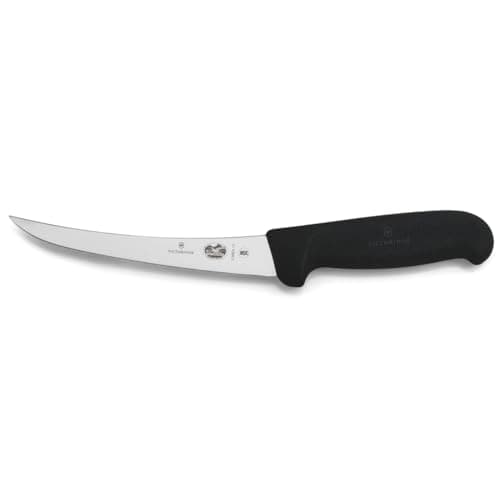
If you buy one knife for meat, buy the Victorinox Fibrox 6" curved semi-stiff boning knife. It is the pick for anyone who breaks down whole chickens, trims a pork shoulder, or removes silverskin from a roast — which is most of what "cutting meat" means in a home kitchen. It is also the cheapest knife on this page. A chef's knife is the wrong shape for almost all of that work: it is long, broad and curved for board work, and the jobs meat actually demands are following a bone with a short pointed blade, portioning raw muscle, splitting cartilage, and slicing cooked meat in long clean strokes.
That is the honest framing, and it is why this page is not a list of five chef's knives. "Best knife for cutting meat" is three separate questions:
- Breaking down and trimming raw meat — a short, pointed, curved boning knife. Semi-stiff for poultry and general work, stiff for red meat, flexible for fish.
- Portioning raw muscle and general butchery— a long, flat-ish, tough-steeled chef's or butcher's knife that you can hone hard and often.
- Bone, joints and cartilage— a Western meat cleaver with mass and a deliberately obtuse edge. Not a chef's knife, and not a Chinese vegetable cleaver, which looks identical and chips on bone.
- Slicing cooked meat — a long, narrow, straight carving blade that crosses a roast in one stroke without sawing.
One warning before the picks, because it is the most common way people damage a knife on meat: hard Japanese steel and bone do not mix. A Shun Classicat 60–61 HRC will chip on a chicken joint, and Kai's own care guidance says to keep it off bone. Every pick on this page is soft, tough Western or commercial steel in the 53–58 HRC band, which rolls under impact instead of fracturing and comes straight back on a steel. That is not a compromise here; it is the correct specification. See high-carbon versus stainless for the metallurgy.
How these are scored. This lineup spans four knife types, so the per-type rubrics on our dedicated roundups cannot be compared across it. Every pick is scored here on one rubric built for this page — job fit, edge maintenance, grip security, durability and value — and ranked strictly by the resulting average, with the house tiebreak (at an equal average, the cheaper knife ranks first). Published specifications are unchanged from the roundups that established them.
The specification that decides a meat knife is not hardness
It is edge toughness, and it runs in the opposite direction to the specification most knife marketing pushes. Meat work means impact: a knife hits bone, cartilage, a frozen edge, a plate. Hard steel is strong in a straight cut and brittle under impact, so at 60–63 HRC the edge fractures and loses a piece. Soft steel at 53–58 HRC bends instead, and a bent edge is realigned in seconds on a steel. That is why commercial butchery runs on Dexter and Victorinox rather than on Shun.
The second specification is grip, and in this category it is a safety requirement rather than a comfort one. Your hands will be coated in fat and water. Textured TPE (Victorinox Fibrox), Santoprene (Mercer) and Dexter's Sani-Safe polypropylene are all engineered for exactly that. Smooth polymer and polished wood are not, which is a genuine mark against the two Wusthof picks here despite them being the best-made objects on the page. Our handle materials guide covers the full range.
Third is blade geometry, and it is the one that makes a chef's knife the wrong default. A chef's knife has a tall, broad, curved blade — all of which help on a cutting board and none of which help when you are tracing a shoulder blade or sliding under a skin. A boning knife is short, narrow and pointed so it can go where your hand takes it. Blade grinds explained covers how the cross-section changes what a blade can do.
Which blade for which job
| Job | Blade you want | Our pick |
|---|
| Jointing a chicken, trimming silverskin, removing fat caps | 6" curved semi-stiff boning | Victorinox Fibrox 5.6603.15 |
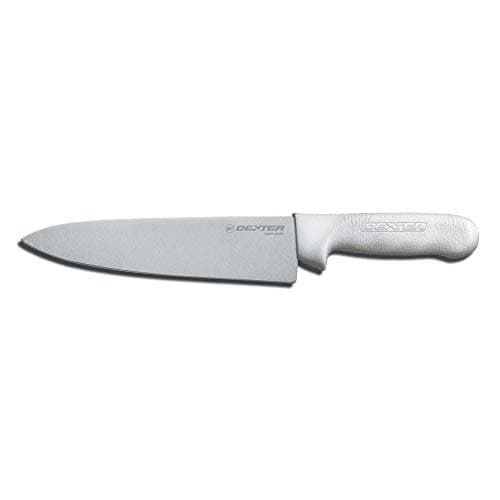
| Portioning raw muscle, cubing stew meat, slicing raw steak | 8" commercial chef / butcher | Dexter-Russell Sani-Safe 8" |
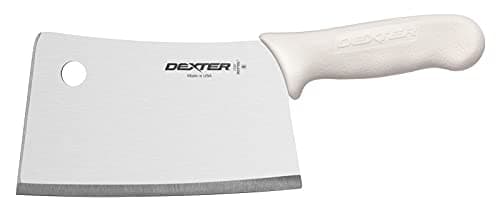
| Splitting joints, chopping through ribs and cartilage | Western meat cleaver with mass | Dexter-Russell S5387PCP 7" |
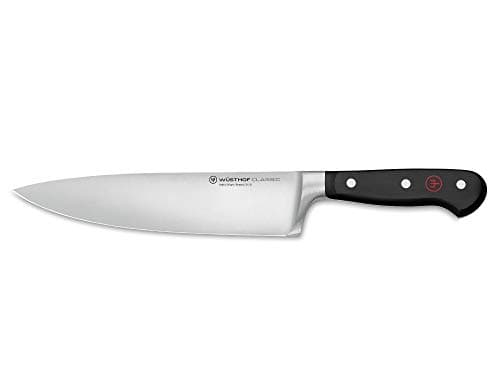
| One knife for meat and everything else | Forged 8" chef | Wusthof Classic 8" |
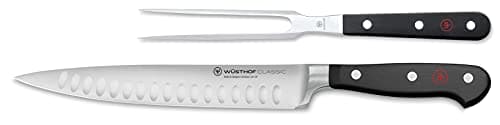
| Carving a roast, turkey or ham at the table | Long narrow straight carver + fork | Wusthof Classic 2-piece carving set |
| Filleting fish, skinning | Flexible blade | See our boning knife roundup |
Why the cleaver is not optional if you cook bone-in
The temptation is to use a heavy chef's knife on a chicken joint, and it is how most chipped knives get chipped. A Western meat cleaver works because of two things a chef's knife does not have: mass, which does the work instead of your arm, and a deliberately obtuse edge angle that is ground to survive impact rather than to slice cleanly. Using a thin, keen blade for the same job puts all the force into an edge that was designed for produce.
The trap is that "cleaver" names two unrelated tools that photograph identically. A Chinese vegetable cleaver, or caidao, is thin and light and ground near 15–16 degrees; Shun says in as many words that its vegetable cleaver is not for joints or bones. Our cleaver roundup separates the two families properly, and chef knife versus cleaver covers whether you need one at all — for a lot of households, poultry shears are the cheaper answer.
Keeping a meat knife sharp, which matters more here than anywhere else
Cutting raw protein is the fastest way to dull a knife that does not involve bone: fat and connective tissue load the edge, and a dull blade on wet meat slips, which is how people cut themselves. Every knife on this page is soft enough that a honing rod is the primary maintenance tool and a stone is the occasional one. Hone before each session, not after a month.
Start with how to use a honing steel if the technique is new, and our stone roundupfor the every-few-months job. One specific warning for this category: do not use a 15-degree pull-through sharpener on a 20-degree commercial knife, or the reverse — you will grind the edge to the sharpener's angle rather than the knife's. Our angle guide covers how to tell which you have.
What we would actually buy
For most home kitchens: the Victorinox boning knife, full stop, and keep using the chef's knife you already own for board work. That is one inexpensive purchase and it covers the large majority of real meat tasks. Add the Dexter cleaver only if you buy bone-in cuts or break down whole birds regularly, and add a carving set only if you host — in which case read our carving set guide first, because there are far cheaper sets that carve just as well.