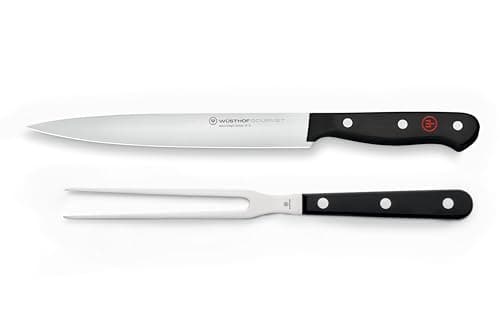
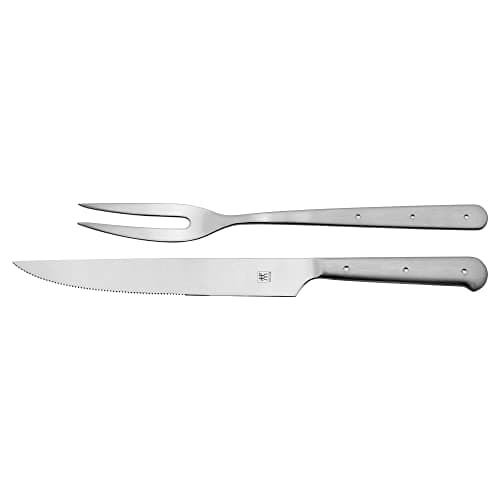
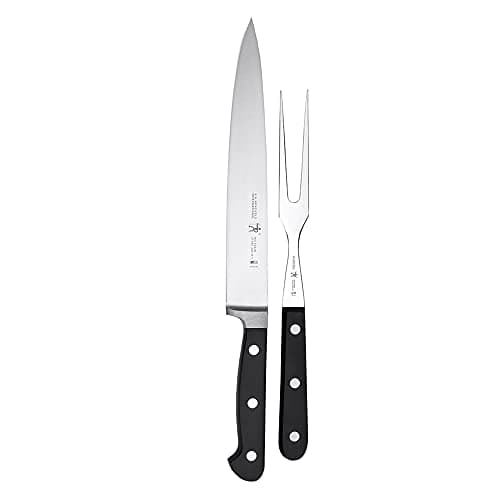
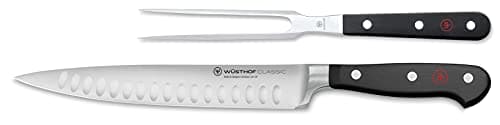
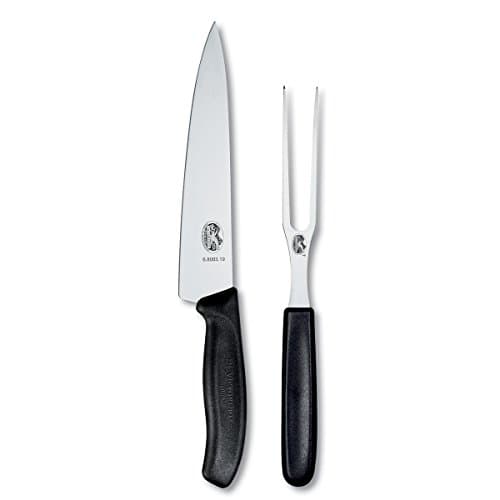
A carving set is two things: a long, narrow, slightly flexible blade that slices a roast in one clean pass instead of sawing it into shreds, and a two-pronged fork that holds the meat still without shredding it. That is genuinely useful on a holiday table — a chef's knife is too short and too tall to carve a turkey neatly. It is also, honestly, a tool most households use two or three times a year.
That frequency is why our ranking leads with value rather than pedigree. A forged Solingen carving set is a lovely object, and it spends 362 days a year in a drawer. We ranked these on blade quality and edge, build, how the fork and handle feel in use, how the set presents when it comes to the table, and value — with the last one weighted more heavily than it would be for an everyday knife. If you want an everyday blade instead, our chef knife roundup is the right page, and if this is a present rather than a purchase, see the best knife gifts.
What actually makes a carving knife work
Three things. Length: a carving blade wants to cross the whole roast in a single stroke, which means 8 to 12 inches. Sawing back and forth is what tears a turkey breast into ragged slices. Narrowness: a thin, low blade slides between muscle groups where a tall chef's knife wedges and splits. A little flex: a slicing knife that gives slightly follows the contour of a bone instead of fighting it. Some carving knives add a Granton or hollow edge — the row of oval dimples — which breaks the suction that makes wet slices cling to the blade. That is a real, useful feature on ham and roast beef, and it does nothing for sharpness.
The fork matters more than people expect
A carving fork is not a serving fork. Two long, widely spaced tines hold a roast still with minimal puncturing, and a guard keeps your hand behind the blade line if the knife slips — which is the most likely knife accident of the entire year, because you are carving in front of guests, slightly rushed, on a hot bird that will not sit still. If a set skips the guard or ships a short, closely-spaced fork, that is a genuine reason to pass on it.
Do you actually need a carving set?
If you carve one bird a year, no. A sharp 10-inch chef's knife or a bread knife will get you through it, and the meat tastes the same. A carving set earns its keep if you host regularly, if you cook whole roasts more than a few times a year, or if the carving happens at the table as part of the occasion. This is the same reasoning we apply to specialist blades throughout the site — see chef's knife vs utility knife for the general version of the argument. If you buy one, spend at the low end unless the object itself matters to you.
Sharpen it before the day, not on it
The single most common carving-set failure is a knife that has sat in a drawer for eleven months coming out dull on the one day it matters. Sharpen it the week before — on a stone from our whetstone roundup or with a guided system— and give it a few passes on a honing steel just before you carve. A long thin blade shows dullness more obviously than any other knife in the house, because ragged slices are visible to everyone at the table.
Storage between holidays
A carving knife spends most of its life in storage, which is where its edge usually dies — knocking against other blades in a drawer. Keep it in the set's own case if it came with one, or use an edge guard; our knife storage roundup covers the cheap options. Wipe it dry before it goes away, because a knife put away damp for eleven months is a knife with spotting on it in November.
What we would skip
Skip electric carving knives unless mobility makes a manual blade difficult — they tear more than they slice and they are loud at the exact moment you want the room to be pleasant. Skip decorative carving sets with antler or resin handles sold on looks alone; the blades are usually an afterthought. And skip any set where the fork has short, closely spaced tines and no guard.
How we picked
We did not lab-test these knives
Everyone in this category says they tested twenty knives in a professional kitchen. We have not hands-on tested any of these, and we say so. What we did instead: compiled the published specifications — steel type and hardness (HRC), edge angle, blade geometry, weight and build — applied established sharpening standards, ran the value math (spec quality ÷ live price), and scored each product against a published rubric. The scores are judgments from documented research — not measurements we took, because we do not have a test lab and we will not pretend we do. Where a number came from someone else's work, we name them in Sources.