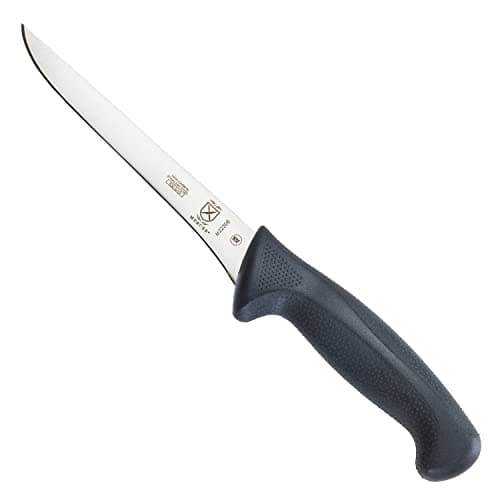
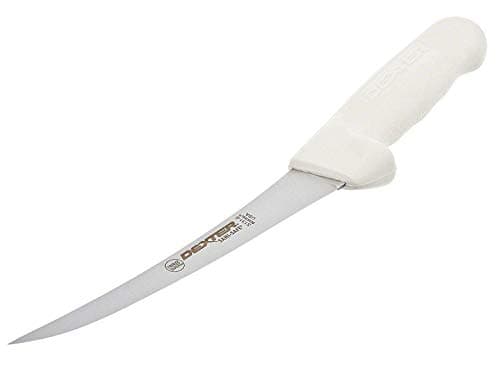
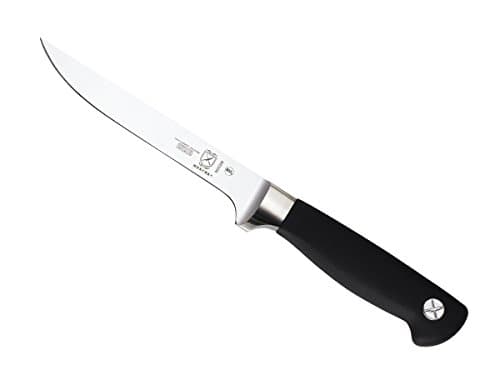
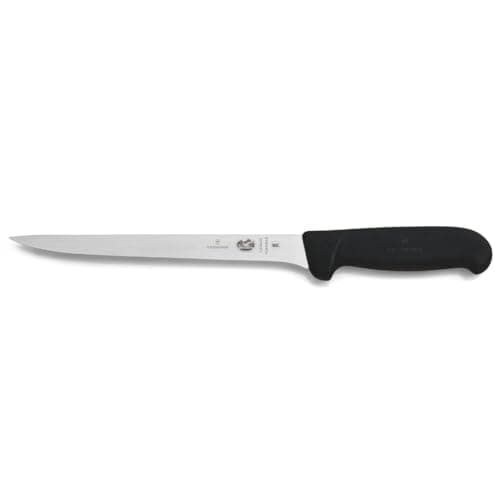
A boning knife is a narrow, pointed blade between five and seven inches long whose entire purpose is to travel along a bone without cutting into it. It is the only knife in a normal kitchen designed to be steered by feel rather than pressure, and it is the one most people own without ever choosing: it arrives in a block set, sits unused for a decade, and gets blamed for being a bad knife when the real problem is that it was never the right one for the job at hand.
The specification that decides whether it is the right one is flex— how far the blade bends under load. Not steel, not hardness, not country of manufacture, and certainly not the word on the listing. A stiff blade and a flexible blade of identical length and identical steel do different work, and using one for the other's job is frustrating in one direction and genuinely unsafe in the other. Flex is also the specification marketplace listings are most likely to omit, which is why this page ranks on it. If you are not yet sure you need a boning knife at all, what knives a kitchen actually needs makes the case for three, and a boning knife is not one of them.
The three flex bands, and what each one is for
Stiff.Almost no give. This is the band for red meat and heavy trimming — separating a pork shoulder, breaking down a primal, popping a joint, pushing through cartilage and connective tissue where you need the blade to go exactly where you aim it. A stiff blade transmits what the edge is touching straight to your hand, which is the whole reason butchers use one. It is the worst choice for fish, because it cannot follow a curve.
Semi-stiff. A small amount of controlled give near the tip. This is the broadest band and the right default for a home cook, because it is competent at the two jobs most people actually have: taking a chicken apart and trimming silverskin off a tenderloin. It bends enough to follow a rib cage and stays rigid enough that you are not fighting it on a joint. If you buy one boning knife, buy this one.
Flexible.Noticeable bend along most of the blade. This is the band for fish, poultry skin, and any job where the blade needs to ride along a hard surface and take everything off it without gouging. A flexible blade is how you get a clean fillet and how you skin a breast without leaving half of it behind. It is also the band that feels alarming the first time you use it on something dense, because the blade deflects rather than cuts — and a deflecting blade near a hand you are using to hold the meat is the most common way people cut themselves in this category.
"Boning knife" and "fillet knife" are not reliable labels
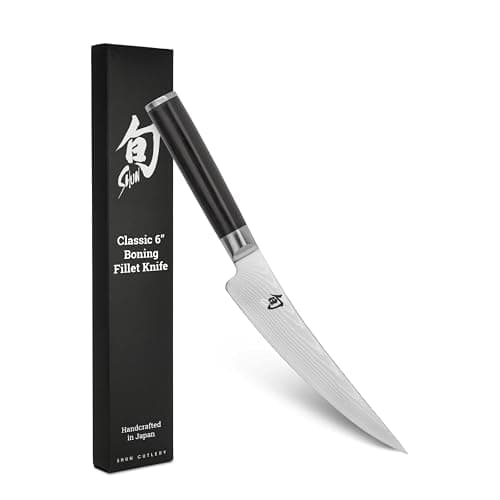
A true fillet knife is a longer, thinner, more flexible blade — usually seven to nine inches — built for one job on one animal. A boning knife is shorter and stiffer. In practice the two words get printed on whatever a catalog wants to sell, and plenty of products carry both. The most expensive knife on this page is sold as a "Boning & Fillet Knife" and is described in its own maker's specifications as rigid, which is precisely the property a fillet knife must not have. That is not dishonesty on Shun's part — the page says "rigid" in plain sight — but it does mean the category name on the listing tells you nothing, and only the published flex tells you what you are buying.
How the ranking works
All seven knives are scored on the same five metrics and ranked by the arithmetic mean of those scores to one decimal place. Blade geometryis curve, width, taper and point — how well shaped the blade is for getting between meat and bone. Flex suitability asks two things: is the stiffness matched to a clearly defined job, and does the maker publish it at all? Edge maintenance is how easily the edge comes back after the incidental bone contact this work guarantees. Grip security is the metric nobody prints on a box and everybody should read: this is a pointed knife used on wet, greasy protein, often angled toward the hand holding the meat. Value is what it costs against what it does.
Two knives tie at 8.6. Where the average is equal, this site's house rule is that the cheaper knife ranks first — the same tiebreak used in our steak knife roundup and our utility knife roundup. Read the column you care about rather than the average: on blade geometry alone the order is almost exactly reversed, and the two knives at the bottom of this page are the two best-made objects on it. Our method is set out at how we review, and every specification below is sourced at the foot of the page.
Most kitchens do not need one
Our standing position is that a kitchen needs three knives — an 8-inch chef's knife, a paring knife and a serrated bread knife — and a boning knife is not one of them. It is a specialist tool, and the honest test is behavioral rather than aspirational: in the last year, how many whole chickens did you break down, and how many whole fish did you fillet? If your meat work is mostly portioning and trimming rather than jointing, our best knives for cutting meat page covers which blade does which job. If the answer to both is zero or one, a boning knife will live in your drawer next to the utility knife that came with your block set, and the money is better spent on a decent stone, which improves every knife you already own rather than adding one you will not use.
The reason to buy one anyway is specific and worth stating plainly, because it is a real saving rather than a hobby: whole chickens cost substantially less per pound than parts, and whole fish less than fillets. If you buy protein that way, a boning knife pays for itself quickly and is genuinely the only tool that does the job — a chef's knife is too tall and too stiff to travel a rib cage, and a paring knife is too short to reach along one. That is a narrower case than most roundups in this category make, and it is the true one.
Flex is the whole decision, and most listings hide it
Everything else on this page — forged or stamped, German or Japanese, 53 HRC or 58 — changes how a knife feels and how often you sharpen it. Flex changes what it can do. A stiff blade cannot follow a curve; a flexible blade cannot be driven through cartilage. Neither is better; they are different tools with the same silhouette, and the silhouette is what a product photo shows you.
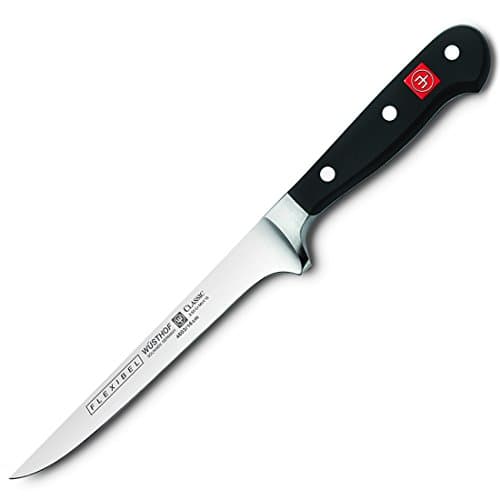
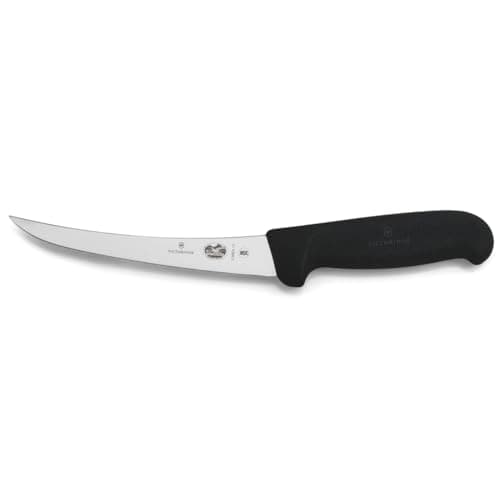
So read the model designation, not the title. Dexter puts an F in S131F for flexible. Mercer prints "Stiff" and "Flexible" in the product name. Wusthof and Shun both state the characteristic in their specifications — Wusthof flexible, Shun rigid. Victorinox distinguishes its boning blades by SKU rather than by a stiffness field on the product page, which is why our top pick loses half a point on flex suitability despite being the right blade for most people. If a listing does not tell you the flex in words you can point at, assume it does not know, and buy something that does.
Curve, width and point: what the geometry is doing
A curved boning blade is not styling. The curve lets the edge stay in contact with a bone as your wrist rotates, so a single sweeping cut can follow a femur or a rib without the heel or the tip lifting away. That is why every knife on this page except the dedicated fillet knife is curved.
Narrowness does the second half of the work. A boning knife is thin front to back because it has to enter a gap that the animal, not you, decided the width of. And the point matters more here than on any other kitchen knife: it starts every cut, and a rounded or damaged tip makes the knife useless for its actual job long before the edge is worn out. If you want the wider vocabulary for what a blade profile is doing, blade grinds explained and the paring knife roundup cover the same ideas at the other end of the size range.
Grip security is the specification nobody prints
This is the only knife in a domestic kitchen that is routinely used with the point angled back toward the hand holding the work, on raw protein, with fat on your fingers. That makes handle material a safety question rather than a comfort one, and it is the reason the professional standard in this category is textured thermoplastic rather than wood.
Victorinox's Fibrox TPE and Mercer's Santoprene are the two grips on this page designed for exactly that problem; Dexter's textured polypropylene is a step behind them; Wusthof's smooth polymer and Shun's D-shaped PakkaWood are beautiful, hard wearing, and slicker when wet. That is a real trade and not a criticism of how the knives are made — knife handle materialssets out what each one is good at. Mercer's finger guard on the Millennia is the only dedicated safety feature on this page, and on a stiff pointed knife it earns its place.
What boning work does to an edge
Bone is harder than any kitchen knife edge, and no matter how good your technique you will touch it. That single fact should shape what you buy and how you maintain it. A softer stamped blade at HRC 53-54 rolls when it hits bone and comes back with a few passes on a steel; a harder blade at 58 HRC with a keener angle chips instead, and a chip is a sharpening job rather than a honing one. High-carbon vs stainless steel explains the underlying trade, and why knives go dullcovers what "rolled" and "chipped" actually mean at the edge.
The practical consequence is that expensive is not automatically better here. On a chef's knife you use every day, edge retention is worth paying for. On a boning knife used a dozen times a year against bone, a cheap blade you can restore in two minutes is arguably the more rational purchase — which is a large part of why the ranking above came out the way it did. How to sharpen kitchen knives covers the routine, and knife care and maintenance covers the rest of keeping one alive. Note that only the two Victorinox knives here are rated dishwasher safe by their makers; Mercer, Wusthof and Shun all want these hand washed.
Two claims to distrust
The first is the word "fillet" on a listing. It is used as a synonym for "boning" across most of this category, including on the most expensive knife here, which its maker describes as rigid. If you are buying for fish, the only claim that matters is a stated flexible blade, and preferably a blade over seven inches. Everything else is a boning knife with a marketing department.
The second is a Damascus layer count offered as a performance figure. The 69 layers on the Shun are cladding wrapped around a VG-MAX cutting core — the core does the cutting and the count is a pattern specification. Damascus steel knives, explained sets out what the cladding genuinely contributes. The Shun is superb because of its core and its 16-degree grind; it is beautiful because of the cladding. Those are two separate facts and only one of them cuts.
If you buy one thing from this page
Buy the semi-stiff Victorinox, break down a chicken with it, and see whether you do it again. It costs less than a supermarket roast, it is the right band for the job most people actually have, and if it turns out you are a person who breaks down whole birds every week you will know exactly which direction to upgrade in — stiffer for red meat, longer and more flexible for fish. If it goes back in the drawer, you have learned the thing this page exists to tell you at the lowest possible price. That is the same argument our knife set roundupmakes about block sets: the specialist knives you inherit are almost never the specialist knives you would have chosen. And wherever it ends up living, give it a home — knife storage matters more for a pointed thin blade than for anything else in your kitchen.
Because the right flex band depends entirely on what you are cutting, we also rank these knives by task: a curved semi-stiff blade is the pick for poultry in best knife for breaking down a chicken, while a stiff blade is the correct band for a raw fat cap in best knives for brisket.
If your shortlist has come down to the two cheap foodservice brands rather than the whole field, the pair comparison is Victorinox vs Dexter-Russell— it scores the Victorinox flexible fillet above against Dexter's Sani-Safe narrow fillet on this page's rubric, and the tiebreaker is whether the knife ever leaves the kitchen, because only one of them ships with a sheath.