Skip to content
The Edge Bench

Decision guides · Buying Guides

The best steak knives, ranked

One decision settles this category before you look at a single set: serrated or straight edge. Six sets scored on the same five metrics - and the cheapest set on the page ties the most expensive.

By Stephen V.Updated How we review
#ad

We earn a commission when you buy through our Amazon links, at no extra cost to you. It never changes a verdict, and we say so when the cheaper knife is the better buy. How this works.

A steak knife is the only knife in your kitchen you buy for other people to use. You choose it, and then you hand it to a guest who has no idea what it is made of, who will saw at a ribeye on a hard ceramic plate, scrape the plate clean with the edge, and possibly put it in the dishwasher afterward. Every specification that matters for a chef's knife — thinness behind the edge, hardness, how keen a bevel it will hold — is worth less here than one blunt question: what survives that?

Which is why the whole category resolves into a single decision, and almost every roundup you will read buries it under brand names. Serrated or straight edge. A serrated steak knife keeps cutting for years without any maintenance at all, because the points of the serrations do the work and they sit protected below the contact surface of the plate. It is also, for practical purposes, unsharpenable at home — when it finally goes, it goes. A straight edge cuts more cleanly through meat fibers instead of tearing them, and you can put it on a stone in ten years and have it back. It also dulls on the plate, so somebody has to actually do that. Serrated vs straight edge covers the mechanism properly. Everything below follows from which of those two people you are.

So the list is deliberately three of each. Three plain-edge sets, three serrated, all six scored on the same five metrics: cut quality, edge maintenance, table manners, durability and value. The ranking is the order those averages fall out in, not an order we chose first and justified afterward. Read the metric you care about rather than the average — a serrated set scores badly on edge maintenance by definition, and that is the tool doing its job, not a fault.

One result is worth flagging before you scroll. The cheapest set on this page and the most expensive one tie, at 7.8, for exactly opposite reasons: a Swiss workhorse that scores nearly full marks on durability and value and poorly on everything to do with the edge and the table, and a Japanese set that inverts that line for line. Where two sets tie, we rank the cheaper one first. That is a house rule, not a judgment about the knives — if the arithmetic cannot separate them, the reader keeps the money.

A last note on where this sits. Our own knife sets guide calls steak knives filler, and that stands: in a fifteen-piece block, the steak knives are cheap fill wrapped around three knives that do real work. That is an argument against buying them inside a block, not against owning them. Bought deliberately, as a set chosen for your table and your dishwasher, they are one of the few kitchen purchases where guests actually notice the difference.

The short answer

Quick picks

#KnifeBest forScorePrice
01
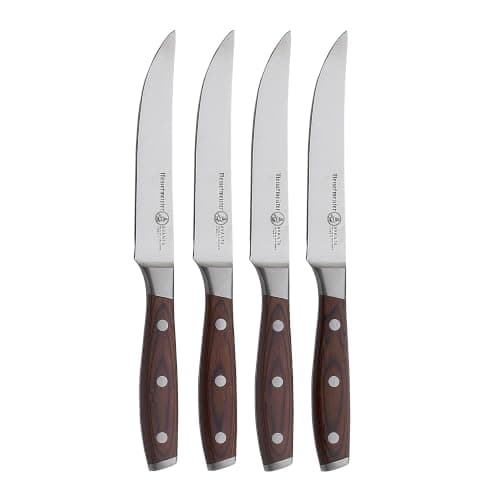
Messermeister Messermeister Avanta Pakkawood 4-Piece Fine Edge Steak Knife Set
Messermeister Avanta Pakkawood 4-Piece Fine Edge Steak Knife Set

First because it loses fewer points than anything else here. A 5-inch plain edge ground at 15 degrees in German X50 stainless at 57 HRC, full tang, triple-riveted into Brazilian brown pakkawood - a knife you can put on a stone in a decade rather than replace, in the bracket where almost everything else is stamped, hollow-handled and serrated.

Best overall
8.4
$79.95Amazon
02
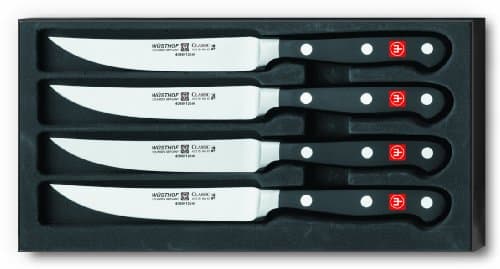
Wusthof Wusthof Classic 4-Piece Steak Knife Set
Wusthof Classic 4-Piece Steak Knife Set

The best-cutting straight edge here, and the second most expensive way to own one. Precision-forged in Solingen from a single piece of X50CrMoV15 at 58 HRC, finished with Wusthof's PEtec edge at 14 degrees per side - keener than most chef knives sold today - with a full tang, full bolster and POM handles built to not fade.

Best premium German
8.1
$325.00Amazon
03
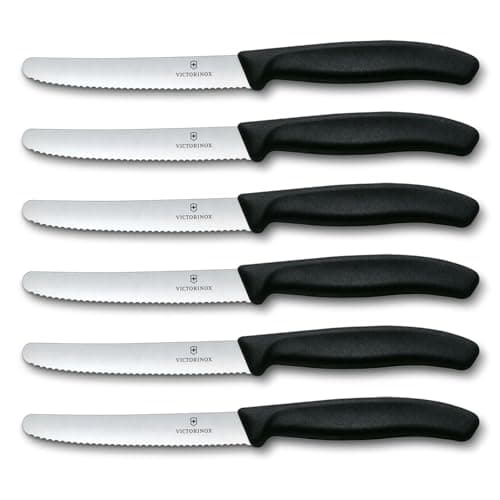
Victorinox Victorinox Swiss Classic 6-Piece Steak Knife Set
Victorinox Swiss Classic 6-Piece Steak Knife Set

Six dishwasher-safe serrated knives for less than one knife from the two sets above, and the reason it ties the most expensive set on this page is arithmetic, not flattery: it scores near the top on durability and value and near the bottom on everything to do with the edge and the table. Round tips, 4.5-inch serrated blades, polypropylene handles, and a lifetime warranty behind Swiss Classic cutlery made in Switzerland.

Best value
7.8
$59.95Amazon
04
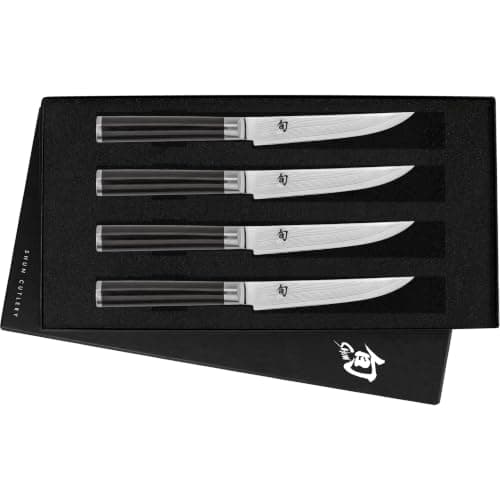
Shun Shun Classic 4-Piece Steak Knife Set
Shun Classic 4-Piece Steak Knife Set

Tied with the cheapest set on this page, and the tie tells you everything about the category. A VG-MAX cutting core clad in 34 layers of stainless Damascus per side, ground to a 16-degree fine edge, in D-shaped ebony-finished pakkawood - the sharpest geometry and the most beautiful object here, scored down hard on the two metrics a steak knife is actually judged on: what it costs per place setting, and how it copes with the way guests use it.

Best Japanese
7.8
$379.95Amazon
05
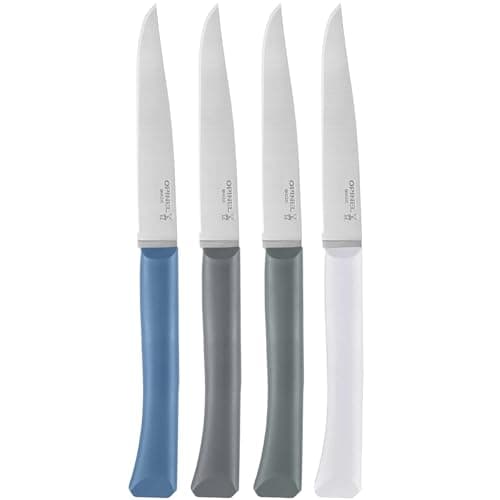
Opinel Opinel Bon Appetit+ Serrated Steak Knives, Set of 4
Opinel Bon Appetit+ Serrated Steak Knives, Set of 4

The set that solves the problem most steak knives create: it looks like tableware and it goes in the dishwasher. A 4-inch micro-serrated Sandvik 12C27 Mod blade in a fiber-reinforced polymer handle, made in Chambery. The compromise is length and permanence - it is the shortest blade here and the serrations are the end of the story.

Best for the table
7.7
$72.00Amazon
06
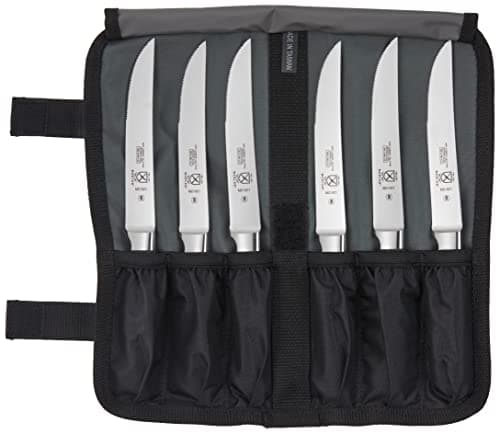
Mercer Culinary Mercer Culinary Genesis 7-Piece Forged Steak Knife Set
Mercer Culinary Genesis 7-Piece Forged Steak Knife Set

Six forged, taper-ground serrated 5-inch knives and a heavy-duty storage roll - the seventh piece is the roll, not a knife. Forged high-carbon German steel at 15 degrees and around 56 HRC, NSF certified, on Santoprene handles. It is the most knife-per-dollar on this page and it looks exactly like what it is: professional catering equipment.

Best for a full table
7.4
$99.00Amazon

#ad · Live prices from the Amazon Product API, as of Sep 2, 2026. Where we have no verified live price, we show none — a gap beats a number that has rotted.

In detail

The picks, in full

01
Messermeister Messermeister Avanta Pakkawood 4-Piece Fine Edge Steak Knife Set

Best overall

Messermeister Avanta Pakkawood 4-Piece Fine Edge Steak Knife Set

5 in fine (plain) edgeGerman X50, 57 HRC15 degree edgeFull tang pakkawood
8.4/10

First because it loses fewer points than anything else here. A 5-inch plain edge ground at 15 degrees in German X50 stainless at 57 HRC, full tang, triple-riveted into Brazilian brown pakkawood - a knife you can put on a stone in a decade rather than replace, in the bracket where almost everything else is stamped, hollow-handled and serrated.

Cut quality
8.5
Edge maintenance
9
Table manners
8.5
Durability
7
Value
9

Pros

  • A plain edge you can genuinely resharpen - the single largest practical difference on this page
  • Full tang and triple rivets in a bracket where most sets are stamped with hollow handles
  • 5 inches of blade slices a thick cut in one pass, unlike the 4-inch table knives it competes against
  • Messermeister's Knife for Life warranty backs it

Cons

  • Messermeister says hand wash only and explicitly not the dishwasher - pakkawood will not survive the cycle
  • The steel is German but assembly is in China, which is not what the brand name suggests
  • 57 HRC is mid-range hardness, so it reaches the stone sooner than the 58 HRC German and the Japanese sets below

Don't buy this if…

nobody in your house will ever sharpen anything - an unsharpened plain edge ends up worse than a serrated one you never have to touch.

$79.95View on Amazon

Price as of Sep 2, 2026. Prices change — Amazon's at checkout is the one that counts.

#ad · we may earn a commission from this link to Messermeister Avanta Pakkawood 4-Piece Fine Edge Steak Knife Set

02
Wusthof Wusthof Classic 4-Piece Steak Knife Set

Best premium German

Wusthof Classic 4-Piece Steak Knife Set

4.5 in plain edgeX50CrMoV15, 58 HRC14 degree PEtec edgeFull tang, full bolster
8.1/10

The best-cutting straight edge here, and the second most expensive way to own one. Precision-forged in Solingen from a single piece of X50CrMoV15 at 58 HRC, finished with Wusthof's PEtec edge at 14 degrees per side - keener than most chef knives sold today - with a full tang, full bolster and POM handles built to not fade.

Cut quality
9.5
Edge maintenance
9.5
Table manners
8.5
Durability
8
Value
5

Pros

  • A 14-degree-per-side plain edge is keener geometry than most German chef knives carry
  • Precision-forged from one piece with a full bolster and triple-riveted full tang
  • POM handles are chosen specifically to resist fading and discoloration over years of washing
  • Made in Solingen with a limited lifetime warranty

Cons

  • Costs more per knife than a genuinely good 8-inch chef's knife - you are buying the forge, not a better cut of steak
  • Wusthof says wash by hand and towel-dry immediately, so it is not a dishwasher set
  • The full bolster adds weight at the heel that some people find clumsy in a table knife

Don't buy this if…

you seat six or eight - at this price, doubling the set costs about what a very good chef's knife and a whetstone cost together.

$325.00View on Amazon

Price as of Sep 2, 2026. Prices change — Amazon's at checkout is the one that counts.

#ad · we may earn a commission from this link to Wusthof Classic 4-Piece Steak Knife Set

03
Victorinox Victorinox Swiss Classic 6-Piece Steak Knife Set

Best value

Victorinox Swiss Classic 6-Piece Steak Knife Set

4.5 in serratedRound tipStamped stainlessDishwasher safe
7.8/10

Six dishwasher-safe serrated knives for less than one knife from the two sets above, and the reason it ties the most expensive set on this page is arithmetic, not flattery: it scores near the top on durability and value and near the bottom on everything to do with the edge and the table. Round tips, 4.5-inch serrated blades, polypropylene handles, and a lifetime warranty behind Swiss Classic cutlery made in Switzerland.

Cut quality
7.5
Edge maintenance
6.5
Table manners
6
Durability
9.5
Value
9.5

Pros

  • Six knives at a per-knife price nothing else here comes close to
  • Dishwasher safe polypropylene, so nobody has to be trusted with them
  • The rounded tip is the safest thing on this page to hand a child or a crowded table
  • Swiss Classic cutlery is made in Switzerland and carries Victorinox's lifetime warranty

Cons

  • Serrated: you will not resharpen these at home, and when the serrations finally go, they are done
  • The round tip cannot pierce or trim - it slices and nothing else
  • Black polypropylene reads as steakhouse service, not as tableware you set out for guests

Don't buy this if…

the table setting matters to you - these are honest tools, and they look exactly like honest tools.

$59.95View on Amazon

Price as of Sep 2, 2026. Prices change — Amazon's at checkout is the one that counts.

#ad · we may earn a commission from this link to Victorinox Swiss Classic 6-Piece Steak Knife Set

04
Shun Shun Classic 4-Piece Steak Knife Set

Best Japanese

Shun Classic 4-Piece Steak Knife Set

4.75 in fine edgeVG-MAX core69-layer Damascus16 degree per side
7.8/10

Tied with the cheapest set on this page, and the tie tells you everything about the category. A VG-MAX cutting core clad in 34 layers of stainless Damascus per side, ground to a 16-degree fine edge, in D-shaped ebony-finished pakkawood - the sharpest geometry and the most beautiful object here, scored down hard on the two metrics a steak knife is actually judged on: what it costs per place setting, and how it copes with the way guests use it.

Cut quality
9.5
Edge maintenance
8.5
Table manners
9.5
Durability
7
Value
4.5

Pros

  • The keenest edge geometry on the page, on the hardest and finest-grained steel here
  • A plain edge, so it can be resharpened rather than replaced
  • Damascus cladding and a D-shaped pakkawood handle make it the one set here that reads as tableware
  • Handcrafted in Japan with a limited lifetime warranty

Cons

  • By some distance the highest price per knife on this page
  • Hard, keen Japanese steel is the least forgiving thing you can hand a guest who scrapes a ceramic plate
  • Pakkawood handles mean hand washing, on a knife that will be used at every steak dinner

Don't buy this if…

your guests are the plate-scraping kind - the hardest steel here is also the least tolerant of the way most people actually use a steak knife.

$379.95View on Amazon

Price as of Sep 2, 2026. Prices change — Amazon's at checkout is the one that counts.

#ad · we may earn a commission from this link to Shun Classic 4-Piece Steak Knife Set

05
Opinel Opinel Bon Appetit+ Serrated Steak Knives, Set of 4

Best for the table

Opinel Bon Appetit+ Serrated Steak Knives, Set of 4

4 in micro-serratedSandvik 12C27 ModPolymer handleDishwasher safe
7.7/10

The set that solves the problem most steak knives create: it looks like tableware and it goes in the dishwasher. A 4-inch micro-serrated Sandvik 12C27 Mod blade in a fiber-reinforced polymer handle, made in Chambery. The compromise is length and permanence - it is the shortest blade here and the serrations are the end of the story.

Cut quality
7.5
Edge maintenance
6.5
Table manners
8.5
Durability
9
Value
7

Pros

  • Genuinely dishwasher safe, with no wood or exposed tang to ruin in the cycle
  • The slimmest, least utilitarian-looking set here that is not in the premium bracket
  • Micro-serrations keep cutting for years without any maintenance at all
  • Made in France with a limited lifetime warranty

Cons

  • 4 inches is the shortest blade on this page - it is a table knife that handles steak, not a dedicated steak knife
  • Micro-serrated, so there is no resharpening it when it finally goes
  • Costs close to the same per knife as the full-tang, plain-edge, forged-steel winner

Don't buy this if…

you serve thick or bone-in cuts - a short micro-serrated blade runs out of length exactly when you need it.

$72.00View on Amazon

Price as of Sep 2, 2026. Prices change — Amazon's at checkout is the one that counts.

#ad · we may earn a commission from this link to Opinel Bon Appetit+ Serrated Steak Knives, Set of 4

06
Mercer Culinary Mercer Culinary Genesis 7-Piece Forged Steak Knife Set

Best for a full table

Mercer Culinary Genesis 7-Piece Forged Steak Knife Set

Six 5 in serratedForged German steel15 degree, ~56 HRCStorage roll included
7.4/10

Six forged, taper-ground serrated 5-inch knives and a heavy-duty storage roll - the seventh piece is the roll, not a knife. Forged high-carbon German steel at 15 degrees and around 56 HRC, NSF certified, on Santoprene handles. It is the most knife-per-dollar on this page and it looks exactly like what it is: professional catering equipment.

Cut quality
8
Edge maintenance
6.5
Table manners
5.5
Durability
8
Value
9

Pros

  • Six forged knives plus a professional storage roll, which is more equipment per dollar than anything else here
  • Taper-ground serrated edges on forged rather than stamped blades - unusual at this price
  • NSF certified, with non-slip Santoprene handles built for wet commercial hands
  • The roll is genuinely useful if the set lives in a drawer or travels

Cons

  • Santoprene handles look like a restaurant line, which is the wrong note on a laid table
  • Mercer recommends hand washing with warm water and drying immediately, despite the commercial build
  • Serrated, so the edges are maintenance-free and also permanent - there is no bringing them back

Don't buy this if…

the set is going on a nicely laid table - this is catering equipment that happens to be excellent, and it reads that way.

$99.00View on Amazon

Price as of Sep 2, 2026. Prices change — Amazon's at checkout is the one that counts.

#ad · we may earn a commission from this link to Mercer Culinary Genesis 7-Piece Forged Steak Knife Set

Serrated or straight: the only decision that matters

Everything else on this page is detail. A serrated steak knife cuts by tearing: the points of the serrations concentrate force at a few spots, punch through the surface of a cut, and the scallops between them drag through the fibers. It works on a crusted steak the way a saw works on wood, it works when the edge is nowhere near sharp, and the points sit slightly below the highest contact surface of the blade, so a plate does far less damage to them than it does to a straight edge. That is the whole appeal — a serrated steak knife is effectively maintenance-free for years.

The bill comes due at the end. Sharpening a serrated edge means addressing each individual gullet with a tapered rod, one at a time, and even done properly it is a holding action rather than a restoration — how to sharpen a serrated knife walks through what is actually possible. On a set of six inexpensive table knives, almost nobody does it. So a serrated set is a purchase with an expiry date attached, and you are buying years of zero effort in exchange for eventually replacing them.

A straight edge does the opposite. It severs fibers rather than tearing them, which is why a plain-edge cut through a medium-rare steak leaves a cleaner face and loses less juice to the plate. It also dulls, because a table knife spends its life meeting ceramic. The compensation is that a straight edge is a knife like any other: it goes on the same stone as your chef's knife, at the angle its maker ground it to, and comes back. If you already own a stone — and if you have read our sharpening stone roundup, you probably do — a plain-edge set is the obvious choice, and the three plain-edge sets above all reward it. If you do not own one and never will, buy serrated and stop thinking about it.

What forged and full tang actually buy you at this size

On a chef's knife, forged construction and a full tang buy you balance and heft — a heavy bolster and a thick spine change how the knife moves through a board. Stamped vs forged and full tang vs partial tang cover the difference in full. On a 4-to-5-inch table knife the case is different, and it is mostly about the handle joint.

Steak knives fail at the handle far more often than at the blade. They get twisted against a bone, dropped, soaked in a sink, and put through heat cycles. A full tang running the length of the handle with rivets through it is a mechanical joint; a partial tang glued or pressed into a hollow handle is a bet. That is why the Messermeister set wins here despite having the softest steel of the three plain-edge picks: at that price it gives you a full tang and three rivets, which is the part of a steak knife that actually breaks. Forging matters less than the joint at this length, which is also why a stamped, dishwasher-safe Victorinox survives a decade of abuse that would ruin a prettier knife.

The dishwasher question decides your handle

Be honest about this before you look at anything else, because it eliminates half the market in one move. Pakkawood, ebony and any natural or resin-impregnated wood handle needs hand washing and immediate drying; the heat and the long soak of a dishwasher cycle will swell, crack or dull it, and the manufacturers of both wood-handled sets above say so on their own product pages. Polypropylene, POM, Novodur and fiber-reinforced polymer do not care.

The trap is that steak knives are the knives most likely to end up in a dishwasher against your wishes, because they are handed to guests, cleared by whoever is clearing, and look disposable next to a chef's knife. If the answer to "will these definitely be hand washed" is anything other than an unhesitating yes, buy a polymer handle. Our knife care guide goes further into what a dishwasher actually does to an edge and a handle, and it is worse than most people assume.

Blade length and tip shape

Steak knife blades cluster between about 4 and 5 inches, and the difference is real. Four inches is a table knife length: fine for a sirloin or a filet, short enough that a thick bone-in cut takes several passes. Five inches slices most cuts in one draw, which is the entire point of a dedicated steak knife rather than the table knife it replaces. Nothing on this page is long enough to carve with — that is a different tool, and our carving set roundup covers it.

Tip shape is the other divide. A pointed tip trims fat and lifts bone; a rounded tip does neither, and is markedly safer at a crowded table, around children, and in a drawer full of hands. Victorinox sells both profiles for exactly this reason. Neither is better in the abstract — decide whether anyone at your table needs to trim, and choose accordingly.

How many knives you actually need

Buy for your table, not for a hypothetical dinner party. Four is right for most households and is the standard set size for a reason. Six starts to make sense when you regularly seat six, and a six-knife set from a value brand costs less than a four-knife set from a premium one — which is a genuine argument for going down a bracket rather than down a count.

The one thing not to do is buy steak knives inside a big block set to "get them included." They are the cheapest components in the block, they inflate the piece count that the price is justified by, and they are usually the worst steak knives the brand makes. Our block set roundup says the same thing from the other direction. Buy the block for the chef's knife, or buy no block at all, and buy steak knives separately when you want them.

Two claims to distrust

The first is "never needs sharpening." It is marketing shorthand for "serrated," and what it actually means is "cannot practically be sharpened." Those are not the same promise. A serrated steak knife will cut acceptably for a very long time and then be finished; a straight edge will fade sooner and can be brought back indefinitely. Choose which failure mode you prefer, and treat the phrase as a description rather than a benefit.

The second is a Damascus layer count used as a quality number. The cladding layers on a Damascus-clad blade are a pattern; the cutting is done by the core steel, and 69 layers is not seven times better than 10 — Damascus steel knives, explained sets out what the cladding does and does not contribute. The Shun set above is genuinely excellent because of its VG-MAX core and its 16-degree grind, and it is beautiful because of the cladding. Those are two separate facts, and only the first one cuts.

If you buy one thing from this page

Decide the dishwasher question, then the sharpening question, and the set picks itself. A household that hand washes and owns a stone should buy a plain edge and keep it for twenty-five years. A household that does not should buy the best serrated set it can stand to look at and never think about it again. The only genuinely bad outcome is a plain-edge set nobody sharpens, which is a worse knife than the cheapest serrated one here within about two years. If you are not sure which household you are, how often to sharpen knives gives you a realistic sense of the commitment, and the cutting board guide explains the surface issue that applies just as much to a dinner plate.
How we picked

We did not lab-test these knives

Everyone in this category says they tested twenty knives in a professional kitchen. We have not hands-on tested any of these, and we say so. What we did instead: compiled the published specifications — steel type and hardness (HRC), edge angle, blade geometry, weight and build — applied established sharpening standards, ran the value math (spec quality ÷ live price), and scored each product against a published rubric. The scores are judgments from documented research — not measurements we took, because we do not have a test lab and we will not pretend we do. Where a number came from someone else's work, we name them in Sources.

Questions

Frequently asked

Are serrated or straight-edge steak knives better?
Neither, and the honest answer depends on one thing: whether anyone will ever sharpen them. Serrated knives cut well for years with zero maintenance and then cannot practically be brought back. Straight-edge knives cut more cleanly through meat fibers, dull faster against a plate, and can be resharpened indefinitely on an ordinary stone. If you own a whetstone, buy a plain edge. If you do not and never will, buy serrated — serrated vs straight edge covers the mechanism.
Can steak knives go in the dishwasher?
It depends entirely on the handle, and the makers say so on their own product pages. Polypropylene, POM and fiber-reinforced polymer handles are dishwasher safe. Pakkawood, ebony and other wood or resin-impregnated handles are not — Messermeister explicitly says hand wash only and not the dishwasher, and Wusthof says wash by hand and towel-dry immediately. Since steak knives are the knives most likely to be cleared by someone else, assume the dishwasher will happen and choose the handle accordingly.
How do you sharpen serrated steak knives?
One gullet at a time, with a tapered ceramic or diamond rod sized to fit the scallops, working only the beveled side and then knocking the burr off the flat side. It is slow, fiddly, and on a set of six table knives most people never do it — which is why we score serrated sets low on edge maintenance rather than pretending the option is practical. How to sharpen a serrated knife walks through what actually works.
What blade length should a steak knife be?
Between about 4 and 5 inches, and the choice is practical. Four inches is a table-knife length that handles a filet or a sirloin and needs more than one pass on a thick bone-in cut. Five inches slices most steaks in a single draw, which is the reason to own a dedicated steak knife at all. Nothing in this range is a carving knife.
Do I need steak knives if I already own a good knife set?
Only if you eat steak often enough to notice. The steak knives bundled into a large block set are usually the cheapest pieces in it and exist largely to raise the piece count — our knife sets guide makes that case in detail. Buying a dedicated set of four later is both cheaper and better than paying for a bigger block to get them included.
Why does the cheapest set tie the most expensive one?
Because the rubric averages five metrics and the two sets are near-opposites on every one of them. The Victorinox set takes almost full marks on durability and value and scores poorly on cut quality, edge maintenance and table manners; the Shun set does the reverse. Both land on 7.8. That is not a claim they are equivalent knives — it is a signal to read the metric you care about instead of the average, which is true of every score on this site.
How are these scored if you have not tested them?
We compile each maker's published specifications — blade length, steel and hardness, edge angle, edge type, tang and handle construction, stated care instructions and country of manufacture — apply established cutlery standards to what those specifications imply, and run the value math against a live price refreshed daily. We do not have a test lab and we do not claim measured sharpness results. The full method is at how we review, and every specification above is sourced below.

Keep reading

Receipts

Sources

We do not run a testing lab, and we do not pretend to. Where a spec or a measured number came from someone else's work — a manufacturer's page, a published standard — we name them and link them. Where we could not verify something, we say so on the page rather than quietly leaving it out. Read our full method.