Skip to content
The Edge Bench

Roundups & reviews · Chef Knives

The best utility knives, ranked

The knife every block set includes and almost nobody reaches for. Here is the version that earns its place, the versions that do not, and the honest case for skipping the category.

By Stephen V.Updated How we review
#ad

We earn a commission when you buy through our Amazon links, at no extra cost to you. It never changes a verdict, and we say so when the cheaper knife is the better buy. How this works.

A utility knife is a 4 to 6 inch blade that lives between a paring knife and a chef's knife, and for most people it is the least-used knife they own. That is not a slight on the tools below — several of them are beautifully made. It is a statement about geometry: a good 8-inch chef's knife already does almost everything a 5-inch knife does, slightly less conveniently, and a paring knife already does the in-hand work. The middle is a narrower gap than the marketing suggests, which is why the utility knife is the blade that block sets pad themselves out with.

So this page starts from a different question than most roundups. Not "which utility knife is best?" but "does this knife do anything the two knives you already own cannot?" That question is the first of five scored metrics — job fit, cut quality, edge maintenance, handling and value— and scoring it rather than burying it in prose is what makes the ranking below come out the way it does. If you are not yet sure you want one at all, chef's knife vs utility knife answers the prior question in full, and this page will not try to talk you out of that answer.

The category is really three different knives

"Utility knife" covers three tools with different jobs, and mixing them up is how people end up disappointed.

The first is the serrated round-tip knife— sold as a utility knife, a sandwich knife or a tomato knife depending on the catalog. It saws through tomato skin, a crusty roll, a wedge of hard cheese or citrus rind without needing to be especially sharp, and it does that at the table as happily as on a board. This is the one version of the category that genuinely does something a chef's knife and a paring knife both do badly, and it is also, by some distance, the cheapest.

The second is the plain-edge Western utility knife: a scaled-down chef's knife, usually forged, usually with a bolster. It slices cleanly and sharpens like any other straight edge. It is also the most duplicated knife in this list, because everything it does well, your chef's knife does well.

The third is the Japanese petty— a thin, light 120 to 150 mm blade that is the knife Japanese professionals actually reach for between the big knife and the fine in-hand work. A petty is not a small chef's knife; it is a precision tool, and it is the one plain-edge shape in this category with a real argument for existing alongside a good gyuto.

How the ranking works, and why the cheap knife wins

All six knives are scored on the same five metrics, and the ranking is the arithmetic mean of those scores, to one decimal place — not an order we picked and then justified. Because job fit is scored, a knife that solves a problem nothing else in your drawer solves scores well even when it is stamped, plastic-handled and cheap; and a forged German blade with a lifetime warranty loses points for being a smaller, less-capable version of a knife the same reader already owns.

Two picks tie at 8.3. Where the average is equal, this site's house rule is that the cheaper knife ranks first, so the Mercer takes second and the MAC third — the same tiebreak used in our steak knife roundup. Read the metric you care about rather than the average: if cut quality is your priority the order is almost exactly reversed, and the two knives at the bottom of this page are the two best-made objects on it. Our method is set out at how we review, and every specification below is sourced at the foot of the page.

The short answer

Quick picks

#KnifeBest forScorePrice
01
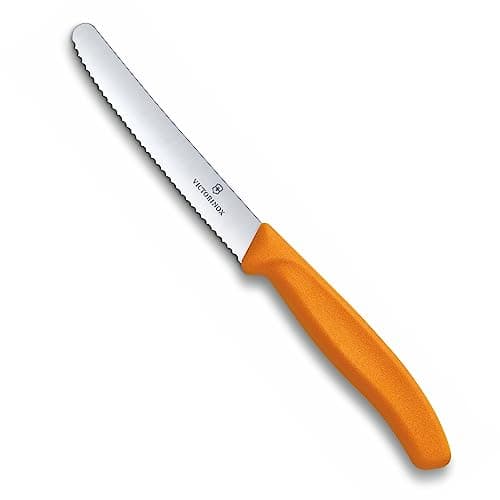
Victorinox Victorinox Swiss Classic Tomato and Table Knife (6.7836)
Victorinox Swiss Classic Tomato and Table Knife (6.7836)

Sold on Amazon as a 4.5-inch serrated utility knife; Victorinox itself calls it a tomato and table knife, which is the more honest description and the reason it wins. A 4.3-inch wavy edge on a one-ounce polypropylene handle, made in Switzerland, dishwasher safe and covered by Victorinox's lifetime warranty. It is the only knife here that does a job your chef's knife and paring knife both do badly, and it costs less than a takeout lunch.

Best overall
8.8
$18.63Amazon
02
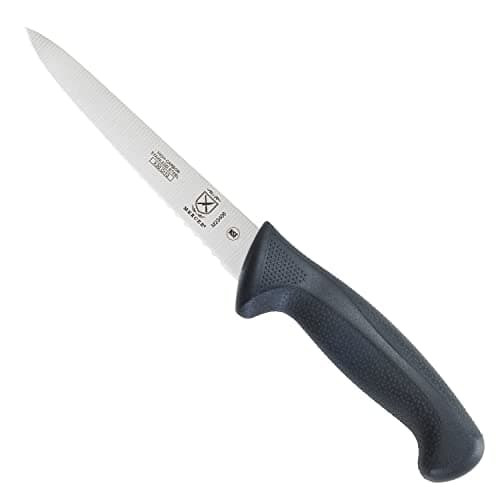
Mercer Culinary Mercer Culinary Millennia 6" Wavy Edge Utility Knife (M23406)
Mercer Culinary Millennia 6" Wavy Edge Utility Knife (M23406)

The serrated utility knife scaled up to sandwich size. One-piece high-carbon Japanese steel at HRC 53-54 ground to 15 degrees, in a 6-inch wavy edge with Mercer's textured Santoprene handle and NSF certification - the restaurant-supply answer, at roughly the price of the Victorinox. The extra inch and a half is the difference between slicing a tomato and slicing a whole filled roll.

Best for sandwich work
8.3
$15.99Amazon
03
MAC MAC Professional Series 5" Paring/Utility Knife (PKF-50)
MAC Professional Series 5" Paring/Utility Knife (PKF-50)

The petty, and the best-cutting small knife on this page. A 4.94-inch blade just 2.0 mm thick weighing 2.3 ounces, in MAC's molybdenum high-carbon steel hardened to 57-61 HRC and made in Seki City. Thin is the whole point: a 2 mm blade wedges far less than a forged Western knife of the same length, which is what makes a petty feel like a different tool rather than a shrunken one.

Best Japanese petty
8.3
$74.95Amazon
04
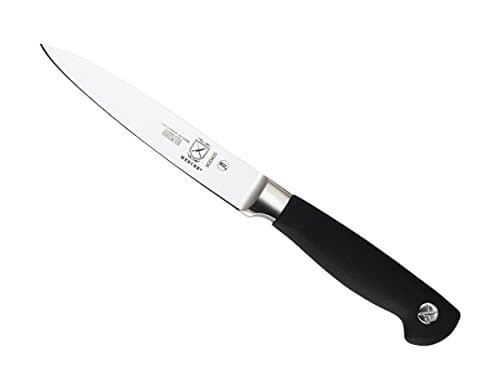
Mercer Culinary Mercer Culinary Genesis 5" Utility Knife (M20405)
Mercer Culinary Genesis 5" Utility Knife (M20405)

If you want the classic plain-edge Western utility knife, buy this one and stop looking. Precision forged from high-carbon German cutlery steel at HRC 56 plus or minus 1, ground to 15 degrees, with a bolster and the same Santoprene handle as the Millennia, NSF certified - the same construction story the knives at the bottom of this page tell, at a fraction of the price.

Best plain edge
8.2
$24.29Amazon
05
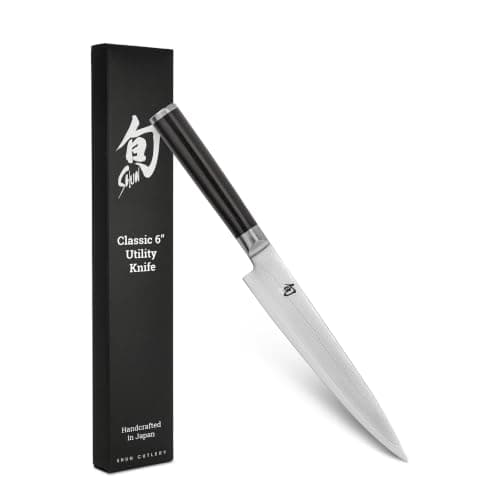
Shun Shun Classic 6" Utility Knife (DM0701)
Shun Classic 6" Utility Knife (DM0701)

The best-cutting knife on this page and the second-worst value, for the same reason. A 6-inch blade around a VG-MAX core clad in 34 layers of stainless Damascus each side, ground to 16 degrees, on a D-shaped ebony-finished PakkaWood handle, 2.7 ounces, handcrafted in Seki City. Shun describes it as being for precise small work - trimming broccoli and green beans, thin-skinned vegetables, meats and cheeses - and it is superb at exactly that.

Best premium
7.8
$93.98Amazon
06
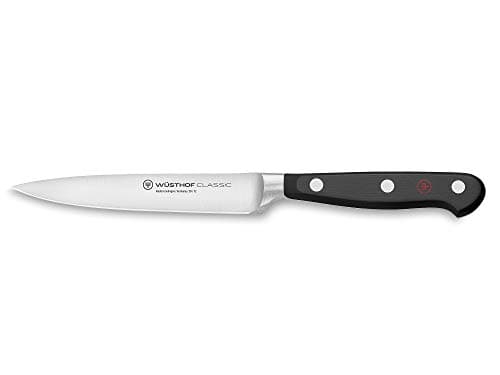
Wusthof Wusthof Classic 4.5" Utility Knife (4066)
Wusthof Classic 4.5" Utility Knife (4066)

Impeccably made and the hardest purchase on this page to justify. A 4.7-inch forged Solingen blade at 58 HRC with Wusthof's 14-degree-per-side edge, a bolster for balance, the triple-riveted Classic handle and a limited lifetime warranty. Wusthof says it is for mincing shallots, onions and herbs and cutting vegetables or small meats - all things a Wusthof chef's knife does better, which is the problem.

Skip - see below
7.2
$95.00Amazon

#ad · Live prices from the Amazon Product API, as of Sep 2, 2026. Where we have no verified live price, we show none — a gap beats a number that has rotted.

In detail

The picks, in full

01
Victorinox Victorinox Swiss Classic Tomato and Table Knife (6.7836)

Best overall

Victorinox Swiss Classic Tomato and Table Knife (6.7836)

4.3 in wavy edge1 ozSwiss madeDishwasher safe
8.8/10

Sold on Amazon as a 4.5-inch serrated utility knife; Victorinox itself calls it a tomato and table knife, which is the more honest description and the reason it wins. A 4.3-inch wavy edge on a one-ounce polypropylene handle, made in Switzerland, dishwasher safe and covered by Victorinox's lifetime warranty. It is the only knife here that does a job your chef's knife and paring knife both do badly, and it costs less than a takeout lunch.

Job fit
9.5
Cut quality
8
Edge maintenance
8
Handling
8.5
Value
10

Pros

  • The wavy edge bites soft skins - tomatoes, peppers, crusty rolls - without crushing what is under them, which is Victorinox's own stated purpose for it
  • One ounce and a round tip make it the only knife here that is genuinely pleasant to hand across a table
  • Dishwasher safe per Victorinox, so it survives the way most households actually treat a cheap knife
  • Swiss made with a lifetime warranty at a price that makes replacing it a non-decision

Cons

  • A wavy edge cannot be honed and is a nuisance to sharpen properly - in practice this is a knife you replace rather than maintain
  • The round tip removes the piercing and detail work a pointed utility knife can do
  • Victorinox publishes no steel designation or hardness for it, so the geometry is less verifiable than the forged knives further down
  • Lightweight polypropylene feels exactly as cheap as it is, which bothers some people more than it should

Don't buy this if…

you want a knife for board work or precision cuts - this is a soft-skin and table knife, and its round tip and short blade make it clumsy at everything else.

$18.63View on Amazon

Price as of Sep 2, 2026. Prices change — Amazon's at checkout is the one that counts.

#ad · we may earn a commission from this link to Victorinox Swiss Classic Tomato and Table Knife (6.7836)

02
Mercer Culinary Mercer Culinary Millennia 6" Wavy Edge Utility Knife (M23406)

Best for sandwich work

Mercer Culinary Millennia 6" Wavy Edge Utility Knife (M23406)

6 in wavy edgeHRC 53-5415 degree edgeNSF certified
8.3/10

The serrated utility knife scaled up to sandwich size. One-piece high-carbon Japanese steel at HRC 53-54 ground to 15 degrees, in a 6-inch wavy edge with Mercer's textured Santoprene handle and NSF certification - the restaurant-supply answer, at roughly the price of the Victorinox. The extra inch and a half is the difference between slicing a tomato and slicing a whole filled roll.

Job fit
8.5
Cut quality
8
Edge maintenance
7.5
Handling
8
Value
9.5

Pros

  • Six inches of wavy edge saws a filled roll or a large tomato in one pass, which the 4.3-inch Victorinox cannot
  • The raised Santoprene handle is the best wet grip on this page and is why these knives are everywhere in professional kitchens
  • NSF certified and built as one piece of steel, so there is no handle joint to fail
  • Mercer publishes hardness and edge angle for it, which most knives at this price do not

Cons

  • HRC 53-54 is the softest steel here - it takes an edge easily and gives it up just as fast
  • Mercer's own use-and-care page says its cutlery should never go in a dishwasher, so this is a hand-wash knife despite the plastic handle
  • A wavy edge on a 6-inch blade is even harder to sharpen properly than a short one
  • At six inches it starts overlapping a small chef's knife, which weakens the case for owning both

Don't buy this if…

you want one knife for both sandwiches and precision board work - the wavy edge tears through soft skins beautifully and is imprecise at anything requiring a clean line.

$15.99View on Amazon

Price as of Sep 2, 2026. Prices change — Amazon's at checkout is the one that counts.

#ad · we may earn a commission from this link to Mercer Culinary Millennia 6" Wavy Edge Utility Knife (M23406)

03
MAC MAC Professional Series 5" Paring/Utility Knife (PKF-50)

Best Japanese petty

MAC Professional Series 5" Paring/Utility Knife (PKF-50)

4.94 in blade2.0 mm thick2.3 ozSeki City, Japan
8.3/10

The petty, and the best-cutting small knife on this page. A 4.94-inch blade just 2.0 mm thick weighing 2.3 ounces, in MAC's molybdenum high-carbon steel hardened to 57-61 HRC and made in Seki City. Thin is the whole point: a 2 mm blade wedges far less than a forged Western knife of the same length, which is what makes a petty feel like a different tool rather than a shrunken one.

Job fit
8.5
Cut quality
9
Edge maintenance
8.5
Handling
9
Value
6.5

Pros

  • A 2.0 mm blade is roughly half the spine thickness of a forged Western utility knife and it shows on anything with skin or fiber
  • At 2.3 ounces it disappears in the hand, which is the point of a petty and the opposite of a scaled-down chef's knife
  • MAC's steel is unusually easy to sharpen for its hardness - the brand's own claim, and consistent with how molybdenum steels behave
  • The added bolster gives it more balance than most knives this light

Cons

  • MAC publishes dimensions and blade thickness for this model but no steel designation or edge angle, so its geometry is less verifiable than the German knives here
  • Costs three to four times the two knives above it for a job most home cooks do not do often
  • A thin, hard blade at this price is a poor candidate for casual treatment - no dishwasher, no prying, no frozen food
  • Plain edge means it will not do the soft-skin and crusty-roll job the two wavy-edge knives above it own

Don't buy this if…

you do not already own a chef's knife you love - a petty is a second knife for people who do a lot of board work, not a first purchase.

$74.95View on Amazon

Price as of Sep 2, 2026. Prices change — Amazon's at checkout is the one that counts.

#ad · we may earn a commission from this link to MAC Professional Series 5" Paring/Utility Knife (PKF-50)

04
Mercer Culinary Mercer Culinary Genesis 5" Utility Knife (M20405)

Best plain edge

Mercer Culinary Genesis 5" Utility Knife (M20405)

5 in forged bladeHRC 56 +/- 115 degree edgeNSF certified
8.2/10

If you want the classic plain-edge Western utility knife, buy this one and stop looking. Precision forged from high-carbon German cutlery steel at HRC 56 plus or minus 1, ground to 15 degrees, with a bolster and the same Santoprene handle as the Millennia, NSF certified - the same construction story the knives at the bottom of this page tell, at a fraction of the price.

Job fit
7
Cut quality
8
Edge maintenance
8.5
Handling
8.5
Value
9

Pros

  • Forged German steel with a bolster at a price most brands charge for stamped, which is the whole argument for the Genesis line
  • HRC 56 is the easy-sharpening sweet spot - it comes back on a stone in a couple of minutes and forgives a beginner
  • A published 15 degree edge angle is keener than the German standard and closer to the Japanese knives above
  • Santoprene grip, taper-ground edge and NSF certification make it a working knife rather than block filler

Cons

  • It duplicates your chef's knife more than any other knife on this page - that is the plain-edge utility knife's structural problem, not Mercer's
  • Mercer's use-and-care page rules out the dishwasher for all its cutlery
  • Forged weight in a 5-inch blade makes it feel dense in the hand next to the MAC, which does similar work at a third of the weight
  • The blade is too short and too low for real board work - your knuckles hit the board on a full chop

Don't buy this if…

you keep a sharp 8-inch chef's knife - this is the knife that most obviously repeats what you already have, however well it is made.

$24.29View on Amazon

Price as of Sep 2, 2026. Prices change — Amazon's at checkout is the one that counts.

#ad · we may earn a commission from this link to Mercer Culinary Genesis 5" Utility Knife (M20405)

05
Shun Shun Classic 6" Utility Knife (DM0701)

Best premium

Shun Classic 6" Utility Knife (DM0701)

6 in bladeVG-MAX core16 degree edge2.7 oz
7.8/10

The best-cutting knife on this page and the second-worst value, for the same reason. A 6-inch blade around a VG-MAX core clad in 34 layers of stainless Damascus each side, ground to 16 degrees, on a D-shaped ebony-finished PakkaWood handle, 2.7 ounces, handcrafted in Seki City. Shun describes it as being for precise small work - trimming broccoli and green beans, thin-skinned vegetables, meats and cheeses - and it is superb at exactly that.

Job fit
7.5
Cut quality
9.5
Edge maintenance
7.5
Handling
9
Value
5.5

Pros

  • A 16 degree edge on a VG-MAX core is the keenest published geometry here and the difference is visible on a ripe tomato
  • 2.7 ounces with a full composite tang, so it handles like a precision tool rather than a small heavy knife
  • The D-shaped handle is comfortable for left- and right-handed users, which Shun states explicitly
  • The Damascus cladding adds stain resistance and helps food release - a real function, not only a pattern

Cons

  • Costs more than most people's chef's knife, for a knife that is the third or fourth most-used blade in a kitchen
  • Hard, keen Japanese steel chips if you treat it like a utility knife - no bones, no frozen food, no dishwasher
  • Requires a whetstone and the willingness to hold 16 degrees, which is a real commitment on a knife you use occasionally
  • The 34-layer cladding count is a pattern specification, not a performance one - the core does the cutting

Don't buy this if…

this would be your first Japanese knife - the money belongs in a gyuto or a chef's knife you will use daily, not in the knife that supports it.

$93.98View on Amazon

$119.9822% off

Price as of Sep 2, 2026. Prices change — Amazon's at checkout is the one that counts.

#ad · we may earn a commission from this link to Shun Classic 6" Utility Knife (DM0701)

06
Wusthof Wusthof Classic 4.5" Utility Knife (4066)

Skip - see below

Wusthof Classic 4.5" Utility Knife (4066)

4.7 in blade58 HRC14 degree edgeHand wash only
7.2/10

Impeccably made and the hardest purchase on this page to justify. A 4.7-inch forged Solingen blade at 58 HRC with Wusthof's 14-degree-per-side edge, a bolster for balance, the triple-riveted Classic handle and a limited lifetime warranty. Wusthof says it is for mincing shallots, onions and herbs and cutting vegetables or small meats - all things a Wusthof chef's knife does better, which is the problem.

Job fit
6.5
Cut quality
8.5
Edge maintenance
8.5
Handling
8
Value
4.5

Pros

  • A precision-forged Solingen blade at 58 HRC with a 14 degree edge per side is a genuinely fine piece of cutlery
  • The bolster and triple-riveted handle give it the balance and durability the Classic line is known for
  • Limited lifetime warranty from a maker that honors it
  • Holds an edge noticeably longer than the softer Mercer steels above it

Cons

  • It costs roughly four times the Mercer Genesis to do the same job with the same construction story
  • Wusthof's own care guidance is hand wash and dry immediately, no soaking, no abrasive sponges
  • At 4.7 inches it is caught between a paring knife and a chef's knife rather than replacing either
  • Nothing about it addresses the soft-skin and crusty-bread job that is the strongest reason to own a utility knife at all

Don't buy this if…

you are choosing between this and putting the money toward a Wusthof Classic chef's knife - the chef's knife is the purchase that changes how you cook, and this is the one that sits in the block.

$95.00View on Amazon

Price as of Sep 2, 2026. Prices change — Amazon's at checkout is the one that counts.

#ad · we may earn a commission from this link to Wusthof Classic 4.5" Utility Knife (4066)

The honest case for buying none of them

Our position on this site is that a kitchen needs three knives — an 8-inch chef's knife, a paring knife and a serrated bread knife — and a utility knife is not one of them. It is the fourth knife at best. If your chef's knife is dull, a new utility knife will feel like a revelation for about a month and then go dull too; the thing that actually changed was sharpness, not length. A decent stone costs less than most of the knives on this page, and it improves every blade you own rather than adding one.

The reason to buy one anyway is specific: you do a lot of medium-scale work that is awkward for an 8-inch blade and too big for a 3-inch one. Sandwiches. Tomatoes. Sectioning citrus. Portioning cheese. Trimming a small joint. Cooking in a cramped kitchen where a full-size knife has nowhere to go. If two or three of those describe your week, the right knife here is the cheapest thing on the page and you should stop reading and buy the first pick.

Serrated or plain edge is the real decision

Everything else on this page — steel, hardness, forging, country of origin — matters less than this one choice, because it decides what the knife is for.

A wavy or serrated edge bites into a slick or tough skin instead of sliding off it, so it cuts tomatoes, peppers, citrus and crusty bread with almost no downward pressure and stays useful long after it has technically gone dull — the scallops hide the dullness. Serrated vs straight edge knives covers the mechanism. The trade is that you cannot hone it, sharpening it properly means working scallop by scallop with a tapered rod, and sharpening a serrated knife is a slower job than most people will ever do. In practice a cheap serrated knife is a consumable, which is itself an argument for buying a cheap one rather than an expensive one.

A plain edge slices cleanly, sharpens like any other straight blade, and is the right answer if you own a stone and enjoy using it. It is also, unavoidably, a shorter version of your chef's knife. That is why the two plain-edge Western knives on this page score lowest on job fit despite being the best built: the better your chef's knife, the less a plain-edge utility knife has left to do.

Blade height, not length, is why it never replaces a chef's knife

Most people assume the difference between a utility knife and a chef's knife is length. It is mostly height. A chef's knife is tall enough that your knuckles clear the board with the edge down; a utility knife is not, so a full chopping stroke drives your fingers into the cutting surface. That single fact explains why a utility knife feels natural in the hand and awkward on the board, and it is why no amount of sharpness makes one a substitute. If small hands or a small kitchen are your reason for wanting a shorter blade, the right answer is a 6-inch chef's knife rather than a utility knife — our chef knife size guide and best knives for small hands both cover that path.

Where the petty fits

The Japanese petty is the one shape in this category that is not a compromise. It is thin — the MAC above is 2.0 mm at the spine, where a forged Western utility knife is typically around twice that — and thinness is what stops a blade wedging as it passes through dense food. A petty is a genuine second knife for someone who already owns a good gyuto or chef's knife and does a lot of detail work: shallots, garlic, herbs, trimming, peeling on the board rather than in the hand.

It is also the shape most likely to be bought for the wrong reason. If you do not already have a knife you love doing the heavy work, a petty will not fill that gap; our Japanese chef knife roundup is the right starting point instead. And a petty is not a paring knife — in-hand peeling and coring belongs to a 3 to 3.5 inch blade, which is what the paring knife roundup ranks.

What decides how a utility knife ages

Two things, and neither is the steel. The first is whether the maker allows a dishwasher. Only the Victorinox on this page is rated dishwasher safe by its manufacturer; Mercer's own use-and-care page says its cutlery should never be washed in one, Wusthof asks for hand washing and immediate drying, and a hard Japanese blade in a dishwasher is simply a bad idea. On a knife you use casually and put away wet, that instruction predicts its condition in five years better than any hardness number.

The second is what you cut on. Board hardness is the single largest determinant of edge life on any knife, and utility knives get used on the worst surfaces in the house — countertops, plates, the edge of a sink. A cheap knife used that way is a rational purchase. An expensive one used that way is not. Knife care and maintenance covers the routine that keeps any of them alive.

Two claims to distrust

The first is the word "utility" on the listing. Our top pick is sold on Amazon as a 4.5-inch serrated utility knife and by Victorinox as a 4.3-inch tomato and table knife. Neither is dishonest; they are marketing the same object to two audiences. But it means the category label tells you almost nothing, and the specification — blade length, edge type, tip shape — tells you everything. Read the maker's page, not the marketplace title.

The second is a Damascus layer count offered as a performance figure. The 34 layers each side on the Shun are cladding wrapped around a VG-MAX cutting core; the core does the cutting, and the count is a pattern specification. Damascus steel knives, explained sets out what the cladding does contribute. The Shun is excellent because of its core and its 16-degree grind. It is beautiful because of the cladding. Those are two separate facts and only one of them cuts.

If you buy one thing from this page

Buy the cheap serrated one, use it for a month, and see whether you reach for it. That is the whole test, and it costs almost nothing to run. If it lives on your board, you have learned that you are a utility knife person and can upgrade deliberately — probably to a petty, not to a bigger Western utility knife. If it stays in the drawer, you have learned the thing this page exists to tell you, and you have saved the difference between the top and the bottom of this ranking. That is the same argument our knife set roundup makes about block sets in general: the knives you inherit are not the knives you would have chosen.

How we picked

We did not lab-test these knives

Everyone in this category says they tested twenty knives in a professional kitchen. We have not hands-on tested any of these, and we say so. What we did instead: compiled the published specifications — steel type and hardness (HRC), edge angle, blade geometry, weight and build — applied established sharpening standards, ran the value math (spec quality ÷ live price), and scored each product against a published rubric. The scores are judgments from documented research — not measurements we took, because we do not have a test lab and we will not pretend we do. Where a number came from someone else's work, we name them in Sources.

Questions

Frequently asked

What is a utility knife actually for?
Medium-scale work that is awkward for an 8-inch chef's knife and too big for a paring knife: tomatoes, sandwich assembly, sectioning citrus, portioning cheese and trimming small cuts of meat. Victorinox describes its version as slicing soft-skinned fruits and vegetables "without crushing the core," which is the job in one phrase.
Do I need a utility knife if I have a chef's knife and a paring knife?
Probably not. Those two cover the range on either side of it, and chef's knife vs utility knife sets out where the remaining gap is real. Buy one deliberately if you do a lot of sandwich, tomato and cheese work — not because a block set included one.
Should a utility knife be serrated or plain edge?
Serrated if you want a knife you never think about: it handles soft skins and crusty bread and hides its dullness in the scallops. Plain edge if you own a stone and want clean slices. The catch is that a serrated edge is a genuine nuisance to sharpen, so a cheap serrated knife is effectively a consumable, while a plain-edge one duplicates your chef's knife.
What is the difference between a utility knife and a petty knife?
A petty is the Japanese version and it is much thinner — the MAC in this list is 2.0 mm at the spine, where a forged Western utility knife is often around twice that. In practice the petty is a precision tool for someone who already owns a good chef's knife, and the Western utility knife is a smaller general-purpose blade.
Is a utility knife the same as a tomato knife or a sandwich knife?
Usually, yes. Our top pick is listed on Amazon as a serrated utility knife and by Victorinox as a tomato and table knife — the same object under two names. Read the blade length, edge type and tip shape rather than the category label.
Can I put a utility knife in the dishwasher?
Only the Victorinox here is rated dishwasher safe by its maker. Mercer's use-and-care page says its cutlery should never go in a dishwasher, Wusthof asks for hand washing and immediate drying, and a hard Japanese blade should never see one. Knife care and maintenance explains what a cycle does to an edge.
Why does the cheapest knife rank first?
Because job fit is a scored metric, and the cheapest knife is the only one that does something your chef's knife and paring knife both do badly. The forged knives lower down are better made and cut better; they also repeat a knife you already own, which is what the rubric is designed to catch. If cut quality is what you care about, read that column and the order is close to reversed.
How are these scored if you have not tested them?
We compile each maker's published specifications — blade dimensions, steel and hardness, edge angle, construction, handle material, stated care instructions and country of manufacture — apply established cutlery standards to what those specifications imply, and run the value math against a live price refreshed daily. We do not have a test lab and we do not claim measured sharpness results. The method is at how we review, and every specification above is sourced below.

Keep reading

Receipts

Sources

We do not run a testing lab, and we do not pretend to. Where a spec or a measured number came from someone else's work — a manufacturer's page, a published standard — we name them and link them. Where we could not verify something, we say so on the page rather than quietly leaving it out. Read our full method.