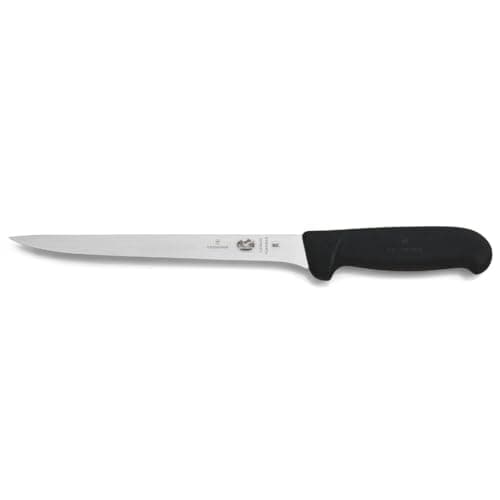
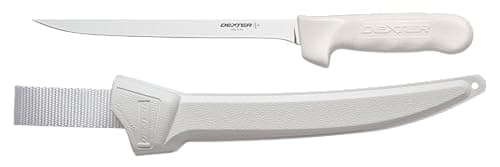
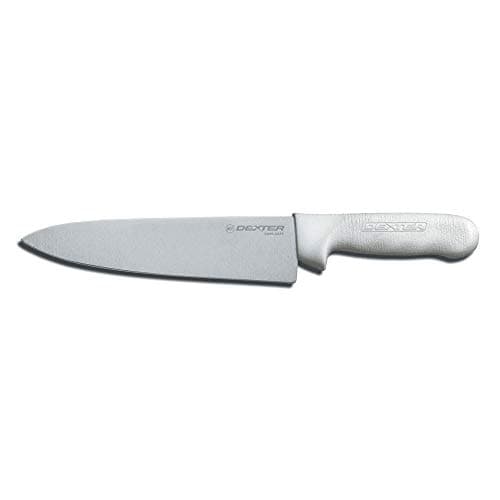
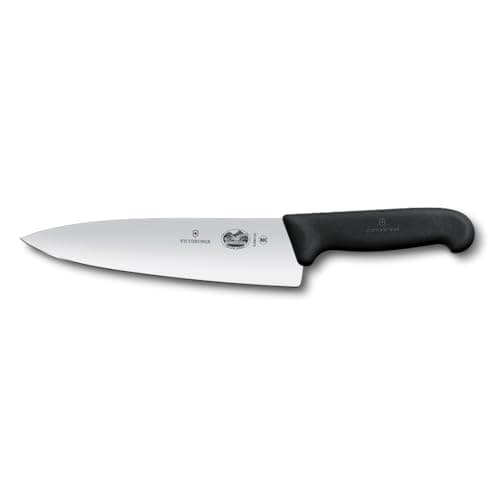
Victorinox wins both halves of this comparison narrowly: 8.5 to 8.1 on the 8-inch chef's knife, and 8.4 to 8.3 on the flexible fillet. Neither margin is big enough to be the whole decision. These are the two brands that actually stock working kitchens — Swiss stamped Fibrox on one side, American high-carbon Sani-Safe on the other — and they are both cheap, both NSF certified, and both built to be used rather than admired. The reason to pick Victorinox is the handle and the grind; the reason to pick Dexter-Russell is that it is built to be scrubbed, bleached and replaced, and it is made in the United States.
Two rubrics, one page.The list below runs in score order, but the scores come from two different rubrics: the two chef's knives are rated on our five-metric chef-knife rubric, and the two fillet knives on the fillet rubric from best boning knives. A chef-knife average and a fillet-knife average are not the same measurement and we are not going to pretend otherwise — so compare withinthe job rather than down the column. The chef's knives are 01 and 04 (8.5 against 8.1); the fillet knives are 02 and 03 (8.4 against 8.3). The chef-knife scores are reproduced verbatim from best professional chef knives, which already ranks both knives against each other on that rubric; the Victorinox fillet is reproduced from the boning roundup; the Dexter fillet is the one new set of numbers here, scored on the same five fillet metrics from its published specification.
Everything is judged from published specifications and the value math, not from cooking — see how we review. We do not have a test lab and we do not claim one.
The honest summary of the brand difference
Victorinoxmakes stamped Swiss knives in X50CrMoV15 at roughly 55-56 HRC, ground at about 20 degrees per side, on the Fibrox handle — a textured thermoplastic shape that is, by some distance, the best wet grip in the budget category. The knives are light (the 8-inch chef's knife is around 7.4 ounces), NSF certified, dishwasher-rated, and sold with a lifetime warranty against defects.
Dexter-Russell is a Massachusetts maker with a 200-year lineage in butchery and foodservice. The Sani-Safe line is high-carbon DEXSTEEL on a textured polypropylene handle designed around sanitation: no gaps at the collar, a surface you can scrub, NSF certified, made in the USA. It is the knife you find in meat rooms and fish houses rather than on a home magnetic rail.
Both brands are soft-steel brands, which is the point. Soft steel dulls sooner and comes straight back on a honing rod with no technique to learn, which is exactly the right property for a knife that gets used for eight hours and sharpened by whoever is on shift. If you want the mechanism, it is in sharpening vs honing, and the hardness argument is in what HRC means for knives. Neither of these is a knife you buy for edge retention.
Where the chef's knife comparison is actually decided
Handling and value. The Victorinox takes a 9.5 for handling against the Dexter's 8.5, and a 10 for value against 9.5, and those two gaps are the whole four-tenths of a point between them. The Fibrox handle is grippier and the blade is lighter; the Dexter is a touch more blade-forward and a touch more deliberate in the hand, which butchers tend to like and home cooks tend not to notice until an hour in.
The one place the Dexter clearly wins is raw protein. On best chef knives for cutting meat the Sani-Safe 8-inch takes the top slot at 8.8 on that page's job-specific rubric, because the handle is designed to stay safe when it is covered in fat and the blade is built to be sharpened aggressively and often. If most of what you cut is meat and fish, buy the Dexter and ignore the four-tenths.
And where the fillet comparison is decided: the sheath
Both fillet knives are 8-inch flexible blades on grippy, washable handles, and both are cheap enough to be bought as tools. The Victorinox is lighter (around 3 ounces) with a straight flexible blade and a dishwasher rating. The Dexter is sold with a protective sheath, which on a fillet knife is not an accessory — a long, thin, flexible blade is the knife most likely to be carried to a dock or a camp and the knife most likely to be ruined in a drawer. If the knife is leaving the kitchen, that sheath is worth more than a tenth of a point.
So which brand, in one paragraph
Buy Victorinoxif you want one chef's knife for general cooking, if comfort over a long prep session matters, or if the fillet knife will live in a kitchen drawer. Buy Dexter-Russell if most of what you cut is raw meat and fish, if the handle needs to be scrubbed and sanitized rather than babied, if US manufacture matters to you, or if the fillet knife is going to travel and wants a sheath. The spread between these two brands is four-tenths of a point on one job and one-tenth on the other; the spread between either of them and a knife that does not grip when wet is far larger.
Victorinox vs Dexter-Russell: which lasts longer?
Neither will outlive the other in any way you will notice, because both are soft-steel knives whose life is decided by how they are stored and sharpened rather than by the alloy. Both are stamped or stamped-equivalent blades with molded handles, both are NSF certified, both are built to be replaced rather than restored, and both will take decades of honest use if they are not left in a sink or thrown in a drawer loose. The honest answer to how long a knife lasts is in how long does a chef knife last, and the two things that actually shorten it are a hard cutting board and bad storage — best cutting boards for knives and best knife storage.
What about Mercer? Mercer vs Victorinox vs Dexter
Mercer Culinary is the third brand in this bracket and the question comes up constantly in autocomplete, so: we have run that comparison properly at Victorinox vs Mercerrather than folding a third brand into this page and doing all three badly. The short version is that Mercer's Millennia line competes directly with the Fibrox on price and grip, the Renaissance line competes with forged German knives, and neither displaces the Victorinox at the top of best professional chef knives, which ranks all three.
How to sharpen either brand (and what not to use)
Both brands are ground at roughly 20 degrees per side on soft steel, which makes them the easiest knives in the kitchen to maintain. A honing rod, used weekly, does most of the work: soft steel rolls before it wears, and standing the edge back up is a ten-second job rather than a sharpening session. See how to use a honing steel and best honing steels.
When honing stops working, a 1000-grit stone or a pull-through set for a Western edge will restore it in minutes — best sharpening stones for beginners and best knife sharpeners cover both routes, and easiest knives to sharpenexplains why these two brands are at the top of that list. The one thing not to do with the flexible fillet knives is freehand them on a stone while they flex under the pressure — a guided clamp holds the angle the blade will not.
If you are stocking a kitchen rather than buying one knife
Both brands sell the rest of the kit at the same prices, and a working kitchen is better served by three cheap knives than by one expensive one. The pages that cover that properly are what knives a kitchen actually needs, best kitchen knives for the cross-type lineup, and best knives for meal prep if the constraint is volume rather than variety. Victorinox also makes the santoku that wins is a santoku knife worth it, which is the page to read if the second knife is for vegetable work rather than protein. If you are buying for a culinary program with a kit list, best chef knives for culinary school is the page written for that.