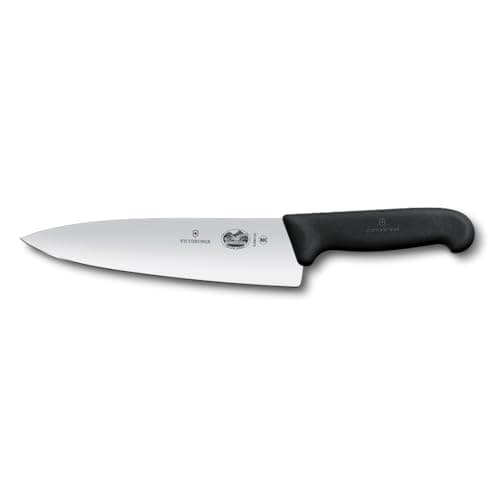
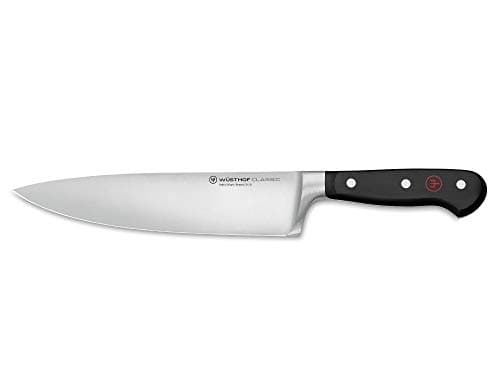
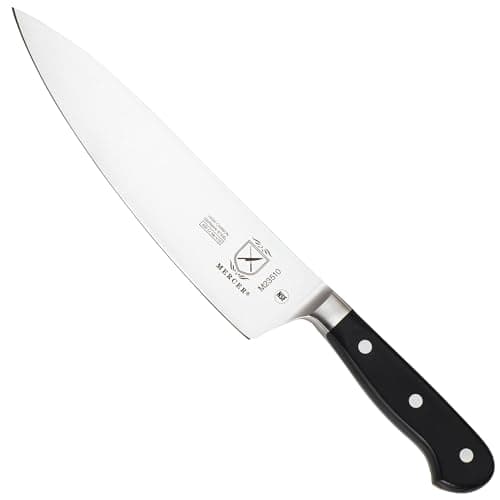
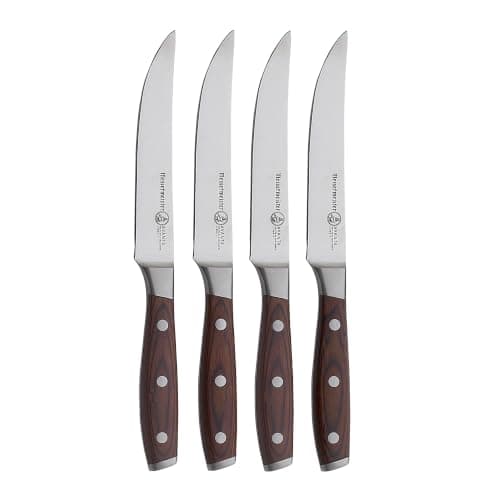
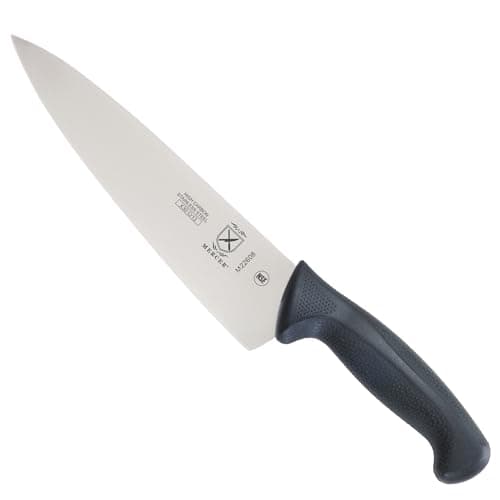
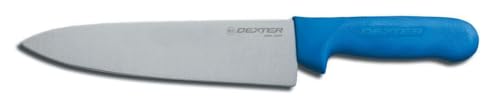
Buy the Dexter-Russell Sani-Safe 8" cook's knife — it is the closest alternative to a Cutco and it matches the two properties Cutco owners name first. Dexter publishes a proprietary DEXSTEEL high-carbon stainless blade that resharpens easily, a textured slip-resistant polypropylene handle, NSF certification, and manufacture in Southbridge, Massachusetts, where the company says it has made cutlery for over two hundred years. It is American-made, dishwasher-tolerant, grippy when wet and inexpensive — the same brief Cutco writes, answered through retail instead of through a sales visit. The budget pick is the Mercer Millennia 8", which costs the least on this page and carries a molded finger guard on a textured Santoprene grip.
Every knife here was in stock and priced at our last price check. We do not print a number in the prose, for Cutco or for anything we rank: the Quick Picks table carries the live price and the date we pulled it, with a Check price button on every row.
What Cutco is actually known for
You cannot pick a sensible alternative without naming what you are replacing, and with Cutco that is less about the blade than people assume. From Cutco's own published product pages: 440A high-carbon stainless steel, a highly engineered thermo-resin handle, American manufacture at the company's factory in Olean, New York, and The Forever Guarantee — under which, in Cutco's words, performance is guaranteed and that includes free sharpening. A nominal return shipping and handling fee applies. The table knives carry Cutco's Double-D edge; the chef's knives, including the 9-1/2" French Chef, carry a straight edge.
The guarantee is the product. This is the honest reading of the brand and the thing most comparison pages get wrong. A knife you can mail back to an American factory for the rest of your life and have returned sharp, free, is a genuinely different proposition from a knife with a lifetime warranty against manufacturing defects. Nobody on the list below offers it. If that service is why you own Cutco, no alternative replaces it and the rest of this page is academic.
The steel is ordinary, and that is deliberate.440A is a soft, very corrosion-resistant stainless — the same design philosophy as the Swiss and American foodservice knives on this list, and a long way from the 60–61 HRC Japanese steels we rank elsewhere. Soft steel rolls its edge rather than chipping it, survives a dishwasher, and comes back quickly on an abrasive. Cutco does not publish a Rockwell figure for it, so we do not either. Knife steel types explained puts 440A in context against the rest of the category.
The Double-D edge is real engineering with one real cost. It is a recessed serration: the cutting points sit back from the leading line of the blade, so the parts doing the work are not the parts hitting the board, which is why a Cutco table knife still cuts a steak years later with no maintenance. The cost is that you cannot restore it at home. A plain edge you can bring back on a stone in five minutes; a Double-D edge goes back to Olean. That is the trade, and whether it is a good one depends entirely on whether you would rather maintain a knife or mail it. Serrated vs straight edge knives covers the mechanism.
The price is a distribution decision, not a materials one. Cutco sells direct, at its own published prices, with no retail discounting. That is why a single table knife costs what a four-piece German steak set costs at retail, and it is the reason this page exists at all: the people searching for Cutco alternatives are almost always people who have just been quoted a set price and want to know what the same money buys elsewhere.
The method is on how we review: we have not hands-on tested these knives and we do not claim to have, and we have not tested a Cutco either. Every Cutco claim above is from Cutco's own published product pages, cited in Sources. Everything sits under the chef knives hub.
Which Cutco property are you replacing?
American manufacture. Buy the Dexter-Russell. Dexter publishes manufacture in Southbridge, Massachusetts, and it is the only domestically-made knife in our registry.
A handle that grips when your hands are wet.Buy the Victorinox Fibrox Pro. The best wet grip in the category at any price, and the closest functional match to Cutco's thermo-resin.
Table knives you never have to think about.Buy the Messermeister Avanta set — with the honest caveat that a plain edge is a knife you maintain and a Double-D edge is a knife you do not.
A real step up in the steel. Buy the Wusthof Classic, or the Mercer Renaissance for the same published hardness and construction at a fraction of the price.
The cheapest sensible exit. Buy the Mercer Millennia and spend the difference on a honing rod and a board.
The Double-D edge, explained properly
This is the single most misunderstood thing about Cutco, and it deserves a straight explanation rather than either marketing or scorn.
A Double-D edge is a recessed serration. On a conventional serrated knife the points of the scallops are the leading edge, so they take the impact of the board and wear. On a Double-D, the cutting points are set back behind the blade's leading line, which means the sharpest parts of the edge largely avoid contacting the cutting surface at all. That is why a Cutco table knife can genuinely sit in a drawer for fifteen years and still cut a steak: the geometry protects the working surfaces from the thing that dulls knives.
The cost is maintenance access. You cannot restore a recessed serration on a flat stone, a pull-through sharpener or a honing rod — the abrasive cannot reach the parts that cut. Cutco's answer is its own factory service, and under The Forever Guarantee that service is free, with a nominal shipping and handling fee. That is a coherent system rather than a flaw: the edge is designed not to need attention, and when it does, it goes home.
Every alternative on this page takes the opposite position. A plain edge dulls faster and you fix it yourself, with a tool you own, in minutes, forever, at zero marginal cost. If you will do that, plain wins on cutting quality by a clear margin. If you will not, the recessed serration is the better engineering for your kitchen and we are not going to pretend otherwise. Sharpening vs honing is the distinction worth understanding before you decide which camp you are in.
440A, and why soft steel is not a criticism
440A is a soft, highly corrosion-resistant stainless. Cutco does not publish a Rockwell figure for it, so neither do we, but the class behaves predictably: it rolls its edge rather than chipping, it shrugs off acids and dishwashers, and it comes back fast on an abrasive. That is exactly the design philosophy behind the Victorinox, the Dexter and the Mercer Millennia on this page, all of which sit in the mid-50s HRC or are unpublished and behave the same way.
The trade is edge retention. A 58 HRC forged German blade like the Wusthof or the Mercer Renaissance holds a keen edge noticeably longer; a 60–61 HRC Japanese blade longer again, while becoming chip-prone and demanding in exchange. Knife hardness HRC explained covers why two or three points of hardness do more for an edge than any amount of finish, and Japanese vs German chef knives is the same argument at the category level. Nobody on this page is softer than Cutco in a way that matters.
When to just buy the Cutco
You will never sharpen anything. The Forever Guarantee and the recessed edge are built exactly for this household, and no plain-edge knife on this page serves it better. Mail it in, get it back sharp, repeat for decades.
You already own the set and something broke. The guarantee covers performance for the life of the product. Use it. Replacing a working Cutco because a comparison page scored something higher is how you spend money to get less.
American manufacture plus a service contract is the specific thing you want. The Dexter matches the factory and the Wusthof matches the steel, but nothing on this page matches both the domestic plant and the free lifetime sharpening. That combination is Cutco's actual product and it is not available elsewhere in our registry.
If you are replacing a whole set
Most people searching this query were quoted a set, not a knife, so here is the structural answer. A kitchen needs three knives and a way to maintain them: a chef's knife, a serrated bread knife, a paring knife, and a honing rod. Everything past that is specialization. What knives does a kitchen actually need makes the case in full, and are knife sets worth it is the honest arithmetic on blocks and sets.
Built from this page, that comes to the Dexter or the Victorinox as the chef's knife, a bread knife from best bread knives, a paring knife from best paring knives, and a rod from best honing steels— and the total will not approach what a direct-sales set costs. The Mercer Renaissance or the Wusthof Classic is the version of that plan for someone who wants forged weight.
How we ranked these
Five metrics, built for the question this page asks. Match on steel & edgescores published steel and hardness against Cutco's 440A high-carbon stainless, and penalizes an unpublished figure rather than assuming one — two picks here lose points on exactly that. Sharpenability & service is scored explicitly, because the thing being replaced is a maintenance arrangement as much as a knife: a plain edge you can restore yourself scores high, and nothing scores full marks because nothing on this page offers free lifetime factory sharpening. Handle & gripis its own metric because thermo-resin is one of Cutco's two signature properties. Build & originreads construction and published country of manufacture, which is Cutco's other signature property and the reason the Dexter leads this page. Value per dollar is specification quality against the live price. The overall is the mean of the five to one decimal place. No Cutco figure was invented, no maker claim was upgraded to a measurement, and how we review says all of this in those words.