HRC is the hardness of the blade steel on the Rockwell C scale, and it tells you one thing with real precision: how the edge will fail. Soft steel in the mid-50s rolls over sideways and a honing rod stands it back up in fifteen seconds. Hard steel at 60 and above holds a keener edge much longer and then chips, which needs metal removed on a stone. Higher is not better. Higher is a different trade, and which end of it you want is a fact about your kitchen rather than about the knife.
If you want the short version: 54-56 HRC is forgiving foodservice steel, 57-59 is the forged German middle, 60 and above is hard Japanese steel with rules attached. The rest of this page is what each of those means when you are actually cutting, and how to read the number off a listing without being misled.
What the scale actually is
Rockwell hardness is measured by pressing an indenter into the steel under a set load and measuring how deep it goes. The C scale— a diamond cone under 150 kilograms-force — is the one used for hardened tool and knife steels, which is why you see “HRC” rather than any of the other Rockwell scales. A shallower indentation means a higher number.
Two things follow that are worth internalising. First, it is a measurement of the steel after heat treatment, not of the steel type. The same alloy can be taken to different hardnesses by different makers, which is why the same steel name appears on knives that behave differently: X50CrMoV15 is roughly 55-56 HRC in a stamped Victorinox and roughly 58 in a forged Wusthof. Heat treatment is the variable, and knife steel types explained is the page on what the alloy names mean.
Second, the published number is nominal. Makers publish a target figure or a range for a product line, not a measured value for the individual knife in the box, and almost none of them publish their tolerance. Treat a published 58 as “this line is aimed at 58”, and treat the difference between a published 57 and a published 58 as noise.
The bands, and what each one is like to own
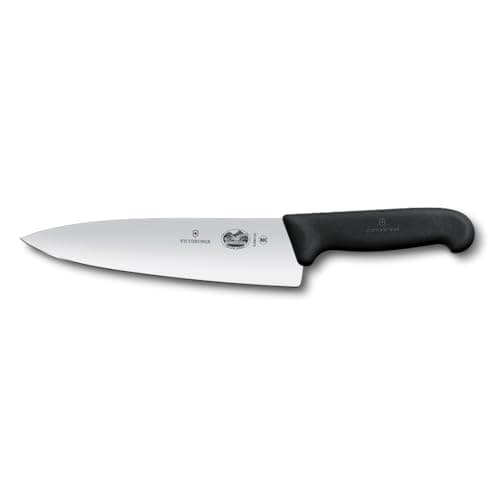
54-56 HRC — forgiving. Foodservice stamped knives live here: Victorinox publishes roughly 55-56 for the Fibrox line, Mercer publishes roughly 56 for Millennia. The edge does not last especially long, and that barely matters, because it fails by rolling rather than breaking. Three passes on a honing rod and it cuts again. This steel tolerates a chicken bone, a frozen edge, a bamboo board and a dishwasher-shaped mistake, and it is genuinely the right choice for a first knife or a knife you share with a household. It is also the band where everything in best chef knives under $50 sits.
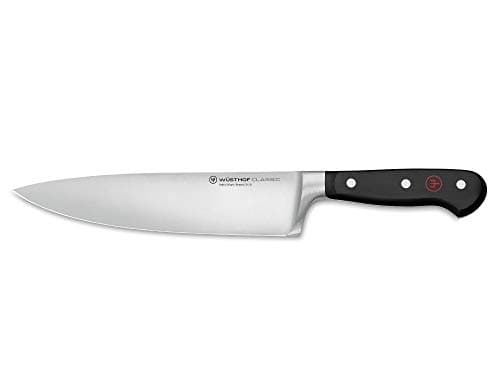
57-59 HRC — the forged German middle. Wusthof Classic at roughly 58, Zwilling Professional S at roughly 57, Mercer Renaissance at roughly 58. Noticeably better edge retention than the band below, still tough enough that chipping is unusual rather than expected, and still responsive to a honing rod. This is the broadest sweet spot in kitchen cutlery and the reason German knives have the reputation they do. It is also where best German chef knives operates.
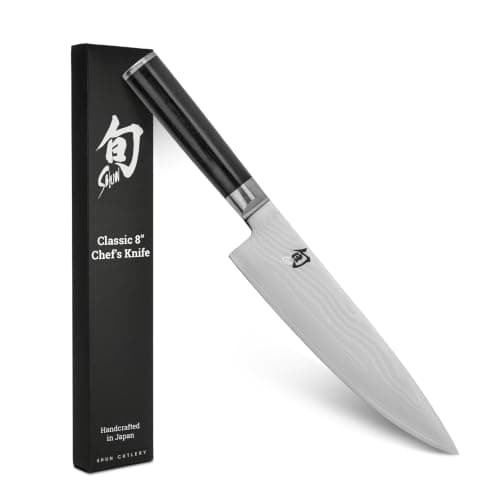
60+ HRC — hard Japanese, with conditions.Shun Classic at roughly 60-61, most VG-10 and VG-MAX cored knives in the same territory. The edge is keener out of the box, it stays keen for far longer, and it is brittle: a bone, a frozen portion, a twist in a squash or a careless knock against another knife in a drawer takes a chip out rather than bending the edge. A honing rod does not fix a chip. This band is wonderful if you are willing to accept rules, and a bad gift for someone who has not agreed to them — see best Japanese chef knives for beginners.
Above 63 HRC exists in specialist Japanese single-bevel and powdered-steel knives and is outside anything we rank. If you are looking at one you already know more than this page will tell you.
Why higher is not better
Hardness buys edge retention and costs toughness, and those two are genuinely in tension in steel — it is not a marketing trade-off, it is metallurgy. A harder edge can be taken to a finer apex and holds that apex longer against abrasion. The same hardness means the steel cannot deform to absorb a shock, so it fractures instead.
The practical consequence is that the failure modes are not equally bad. A rolled edge is a fifteen-second fix on a rod. A chipped edge is a stone, a coarse grit, a rebuilt bevel and possibly an hour — see how to fix a chipped knife. So a hard knife is not simply “better but more delicate”; it is better on the metric you notice while cutting and much worse on the metric you notice when something goes wrong.
Hardness also interacts with edge angle, and this catches people out. A hard blade can hold a narrow 15-degree-per-side bevel because the thin apex is strong enough to survive. A soft blade ground that narrow would roll immediately, which is why soft Western knives are ground at around 20 degrees. So when you compare a 56 HRC knife at 20 degrees with a 61 HRC knife at 16 degrees, you are comparing two different packages, and most of the difference you feel is the angle rather than the number. Knife sharpening anglesis the page on that, and sharpening a hard knife at a soft knife's angle is one of the most common ways people ruin an expensive edge.
How to read HRC off a listing without being fooled
A single number with no steel name is close to useless.“58 HRC” attached to an unnamed “high-carbon stainless” tells you nothing about corrosion resistance, carbide structure or how the edge will actually behave. The steel name and the hardness are a pair; either alone is marketing.
A suspiciously high number on a cheap knife is the classic tell.Listings claiming 62 or 67 HRC at a budget price, often with “Damascus” in the title, are making a claim nobody can check and that would be a bad idea even if true. Hardness that high in a kitchen knife at that price is not a feature, it is a flag.
No number at all is not automatically bad.Several makers we rate publish a steel family and no hardness figure: Dexter-Russell publishes DEXSTEEL without a number, Kai does not publish one for the Seki Magoroku range, Mercer publishes hardness on some lines and not others. That is a gap in the information rather than evidence of a bad knife — and where we do not have the number, our scores read the steel family and the geometry instead and we say so. We will not invent a figure.
A range is more honest than a point.“55-56 HRC” is a maker telling you where the line lands. “Exactly 60.5 HRC” on a mass-produced knife is a maker telling you a story.
What hardness should you actually buy?
Your first good knife: 55-58. Forgiving enough that nothing you do is irreversible, sharp enough that you will notice the difference from whatever you own now. Almost everybody should start here, and a large number of people should stay.
A shared household kitchen: 55-58, firmly.You do not control who uses the knife or what they cut with it, and a chipped edge is somebody else's afternoon.
You already sharpen on stones and cook carefully: 60+. This is the band where hard steel pays for itself, because you can restore it and you will not abuse it. If you do not yet sharpen, best sharpening stones for beginners is the prerequisite, not the follow-up.
A gift for someone whose habits you do not know: 55-58, always. Hard steel comes with rules the recipient has not agreed to. We make the same argument at best knife sets for a wedding registry.
Hardness and sharpening: the part that costs people money
The number changes how you sharpen, not just how often.
Mid-50s steelis the easiest thing in the world to maintain. A honing rod handles almost everything; a 1000-grit stone a few times a year handles the rest. It also forms a burr quickly, which makes it the right steel to learn freehand sharpening on — easiest knives to sharpen explains why.
60+ steelis slower on a stone, needs a finer finishing grit to get the full benefit, and does not respond usefully to a steel honing rod — a ceramic rod at a light touch, or nothing. Most importantly it has to be sharpened at its own ground angle. Run a 16-degree Japanese bevel through a pull-through sharpener set for a 20-degree Western edge and you will grind the shoulders off a very expensive knife. That specific mistake is in knife sharpening mistakes, and the best sharpeners for Japanese knives lists the tools that can hold the angle.
Three things HRC does not tell you
Corrosion resistance.That is chromium content and carbide structure, not hardness. A hard carbon-steel blade will rust in an afternoon; a soft stainless one will not. This is why a steel name matters alongside the number — why does my knife rust covers the mechanism and high carbon vs stainless the trade.
How thin the blade is behind the edge. This is the single most underrated spec in kitchen cutlery and it is what actually decides whether a knife wedges in a dense carrot. A thick 61 HRC blade will wedge where a thin 56 HRC blade glides. Blade grinds explained is the page on geometry, which matters more than hardness for how a knife feels in food.
Whether the knife fits your hand. No number on a listing predicts this, and it is the thing most likely to make you stop using an expensive knife. Knife handle materials and how to choose a chef knife are the pages for that.
How we scored these three
Five metrics built for this question. Published spec clarity rewards a maker that publishes both a named steel and a hardness figure or range, and penalises vagueness regardless of how good the knife is. Edge retention and toughness are the two halves of the hardness trade, scored against each other deliberately. Ease of upkeep asks what it takes to restore the edge after a normal failure. Valueis spec quality against the live price. The overall is the mean to one decimal place — and on a page about a trade-off, the mean is less informative than the columns, which is why each product body reads them out. These are judgments from published specifications, not measurements; we do not own a hardness tester, and how we review says so.