Skip to content
The Edge Bench

Decision guides · Buying Guides

How to tell if a knife is good quality

Price is the worst signal in this category. Here is what a listing has to tell you before a knife is worth your money - and the claims that are pure decoration.

By Stephen V.Updated How we review
#ad

We earn a commission when you buy through our Amazon links, at no extra cost to you. It never changes a verdict, and we say so when the cheaper knife is the better buy. How this works.

A good knife is one whose maker tells you what it is made of. That single test — is there a named steel and a published hardness on this listing — eliminates most of what is sold on Amazon and costs you nothing to apply. Price does not work as a signal in this category: the Victorinox that professional kitchens buy costs less than a lot of knives that will disappoint you, and a two-hundred-dollar “Damascus” knife with no named core steel is worse value than a thirty-dollar Mercer. What follows is the order to check things in.

This page is deliberately about judging a listing in front of you, including knives we do not rank. If what you want is a recommendation, our best chef knives ranking is shorter than this and how to choose a chef knife is the page on which knife suits you. This one is the skill that outlasts both.

The six checks, in order of how much they tell you

1. Is there a named steel?Not “high-carbon stainless steel”, which describes roughly every kitchen knife ever made and commits the maker to nothing. A name: X50CrMoV15, VG-10, AUS-8, 1.4116, SG2, DEXSTEEL. A maker who names the alloy is a maker who is prepared to be held to it. A maker who does not is usually buying whatever was cheapest that quarter. This is the most informative single line on any knife listing, and knife steel types explained decodes the names.

2. Is there a published hardness? A figure or a range in HRC, ideally alongside the steel name. The two together tell you how the edge will behave: mid-50s is forgiving, 57-59 is the forged middle, 60+ is hard and brittle. A number with no steel name is half a fact, and a steel name with no number is the other half. What HRC means on a knife is the full treatment.

3. Is there a published edge angle? The least-published of the three specs that actually matter, and the one you need if you intend to sharpen. Around 20 degrees per side is a Western edge; 15-16 is Japanese. If the maker does not publish it, assume Western and treat that as a small mark against the listing. See knife sharpening angles.

4. Is the construction described honestly?Forged or stamped, full tang or partial, bolster or none — all three are facts a maker can state and many choose not to. The tell is a listing that uses the languageof forging (“forged-style”, “precision crafted”, “professional forged design”) without saying the knife is forged. See stamped vs forged knives and full tang vs partial tang. Note that stamped is not a mark against a knife — being evasive about it is.

5. Does the handle suit your grip, and can you tell from the photo? This is the check most likely to make you abandon a knife you paid for, and the one no spec sheet answers. Look for a moulded finger guard where your pinch grip wants to be, a contoured D-shape that assumes a right hand, and a smooth polished handle that will be slippery wet. Then look at how to hold a chef knife and check the photo against how you actually hold one.

6. Will the maker still exist, and will they honour anything? A named brand with a service address, a warranty you can read, and a product line that has existed for more than two years. The failure mode here is specific: a knife from a brand that is three letters and a logo, with a dozen unrelated products, which will be gone before the edge needs rebuilding.

The four claims that mean nothing

“67-layer Damascus.” On a clad knife the layers are in the outer jacket and the edge is a single core steel, so the layer count describes the decoration rather than the cutting. A layer count with no named core steel is a listing telling you about the wrapping paper. See Damascus steel knives explained.

“Surgical stainless steel.” Not a grade. Not a standard. Not anything. It appears on cutlery, scissors and jewellery and commits the maker to no composition at all.

“Professional grade” / “chef quality” / “restaurant grade.” Unregulated. The one certification in this area that does mean something is NSF, which is a food-equipment cleanability standard — smooth joints, no crevices that trap food, materials that survive commercial sanitising. NSF says nothing about how well a knife cuts, but it is a real, checkable third-party mark, and it is the reason the same handful of knives keep turning up in commercial kitchens.

A hardness figure with no steel name, especially a high one.“62 HRC” on a budget knife with an unnamed alloy is an unverifiable claim about a property that would be a liability at that price even if true. Treat it as a flag rather than a feature.

Four things to look at in the photographs

Listings lie in prose more easily than in pictures, so zoom in.

The spine at the heel. On a forged knife the spine is thick at the bolster and tapers towards the tip. A uniform-thickness spine from heel to tip means stamped, regardless of what the copy says.

The handle junction. A visible gap, a step, or a mismatched seam where the handle meets the blade is both a hygiene problem and a sign of loose tolerances. This is precisely what NSF certification is about.

The grind, looking down the edge. Good listings show a photo straight down the blade. An even, symmetrical bevel on both sides is what you want; a wandering or one-sided bevel on a knife sold as double-bevel is a finishing shortcut. See single bevel vs double bevel.

The heel-to-handle line.If a steel collar runs all the way down past the heel it is a full bolster, and the heel will never reach a flat stone — full bolster vs half bolster. Worth knowing before you buy rather than after ten years of sharpening.

The short answer

Quick picks

#KnifeBest forScorePrice
01
Victorinox Victorinox Fibrox Pro 8"
Victorinox Fibrox Pro 8"

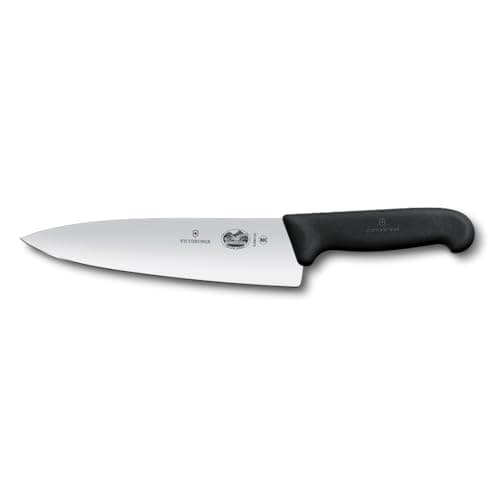
The knife that proves the checklist is not about price. Named steel (X50CrMoV15), published hardness (~55-56 HRC), published edge angle (~20 degrees per side), stated stamped construction, NSF certification, Swiss manufacture and a lifetime warranty - every one of the six checks passed, at the bottom of the market.

Best spec transparency at any price
8.7
$45.78Amazon
02
Wusthof Wusthof Classic 8"
Wusthof Classic 8"

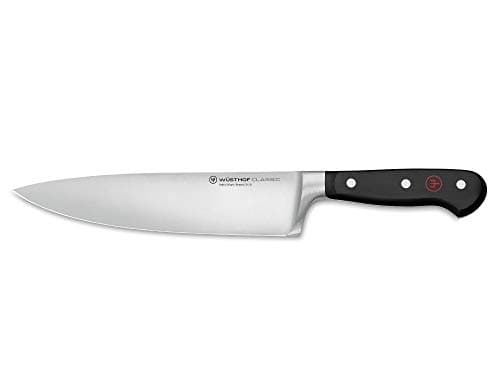
What a listing looks like when a maker has nothing to hide and something to boast about. Forged X50CrMoV15 at roughly 58 HRC, a published ~14 degree per side PEtec edge, full bolster, full tang, forged in a company-owned Solingen factory. Every check passed and the construction claims are the real thing rather than the language of forging.

Best build integrity
8.4
$170.00Amazon
03
Tojiro Tojiro Professional VG10 Chef Knife 8.2" (210mm)
Tojiro Professional VG10 Chef Knife 8.2" (210mm)

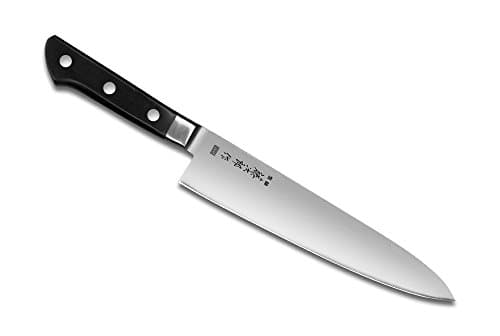
The knife that shows what an honest listing looks like with none of the decoration. A named VG-10 core clad in stainless, a 210mm gyuto profile, a symmetrical Western bolster handle, made in Japan - and no Damascus, no layer count, no story. It is the clearest demonstration that the specs and the marketing are separate things.

Best specs without decoration
8.7
$139.00Amazon
04
Mercer Culinary Mercer Renaissance 8"
Mercer Renaissance 8"

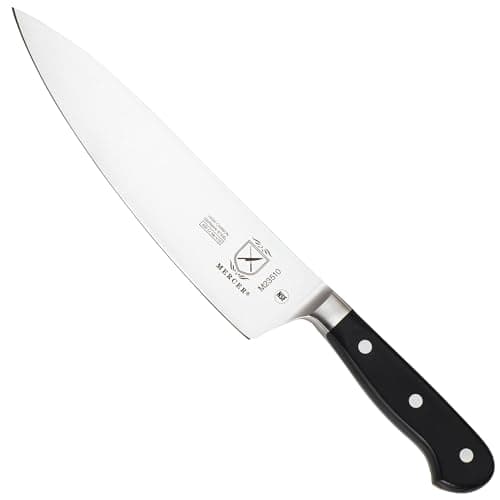
The listing that passes the construction checks at a price where almost nothing does. Forged X50CrMoV15 at roughly 58 HRC, taper-ground, with a full bolster and a full tang - the same construction vocabulary as the German knives, stated plainly, at a fraction of the money. Proof that 'forged' at a low price is sometimes real.

Best checks passed per dollar
8.4
$51.45Amazon

#ad · Live prices from the Amazon Product API, as of October 18, 2026. Where we have no verified live price, we show none — a gap beats a number that has rotted.

In detail

The picks, in full

01
Victorinox Victorinox Fibrox Pro 8"

Best spec transparency at any price

Victorinox Fibrox Pro 8"

Stamped X50CrMoV15~55-56 HRC~20 deg/side edgeNSF certified, Swiss made
8.7/10

The knife that proves the checklist is not about price. Named steel (X50CrMoV15), published hardness (~55-56 HRC), published edge angle (~20 degrees per side), stated stamped construction, NSF certification, Swiss manufacture and a lifetime warranty - every one of the six checks passed, at the bottom of the market.

Spec transparency
10
Build integrity
8
Steel quality
7
Handle & ergonomics
9.5
Value
9

Pros

  • Passes all six checks: named steel, published hardness, published angle, honest construction, non-slip handle, real warranty
  • States plainly that it is stamped rather than dressing it up as forged
  • NSF certification is a genuine third-party mark rather than a marketing phrase
  • Fibrox handle is textured for a wet hand, which the photograph makes obvious
  • A company with a service address and a product line decades old

Cons

  • Soft mid-50s steel means honing is a habit
  • Wide ~20 degree edge sets a ceiling on how keen it will ever feel
  • No forging, no bolster, no heft
  • Visibly plain - a listing with nothing decorative to show you

Don't buy this if…

…you want a knife that feels special - this one is on the page as proof that transparency and price are unrelated, not as an object.

Re-scored on this page's rubric — Spec transparency, Build integrity, Steel quality, Handle & ergonomics, Value — rather than carried over from our overall ranking, and reviewed at our Victorinox Fibrox Pro review.

It takes spec transparency with the only 10 on the page, and it is the cheapest knife here. That is the whole argument: the checklist is free to apply and it does not correlate with price. A maker that publishes steel, hardness, angle, construction and a certification is making a set of commitments, and a maker that publishes none of those is asking you to trust a photograph. Steel quality is a 7 because mid-50s stamped stainless is genuinely unremarkable steel — honestly described unremarkable steel.

$45.78View on Amazon

Price as of October 18, 2026. Prices change — Amazon's at checkout is the one that counts.

#ad · we may earn a commission from this link to Victorinox Fibrox Pro 8"

02
Wusthof Wusthof Classic 8"

Best build integrity

Wusthof Classic 8"

Forged X50CrMoV15~58 HRC~14 deg/side edgeFull bolster & tang
8.4/10

What a listing looks like when a maker has nothing to hide and something to boast about. Forged X50CrMoV15 at roughly 58 HRC, a published ~14 degree per side PEtec edge, full bolster, full tang, forged in a company-owned Solingen factory. Every check passed and the construction claims are the real thing rather than the language of forging.

Spec transparency
9.5
Build integrity
10
Steel quality
8
Handle & ergonomics
8
Value
6.5

Pros

  • Genuinely forged, stated as forged, with a full tang and a visible distal taper in the photos
  • Named steel, published hardness and a published factory edge angle - all three
  • Made in a company-owned Solingen factory, which is a checkable provenance claim
  • The best-finished handle junction here, which is the detail the photographs reward zooming into

Cons

  • The full bolster keeps the heel off a flat stone for the life of the knife
  • Heavy, and the weight is not optional on a forged German knife
  • Several times the price of the knife above it, which the specs only partly justify
  • The price makes the quality obvious, which rather defeats the purpose of a checklist

Don't buy this if…

…you sharpen on stones and intend to keep the knife for decades - a half-bolster knife is the better long-term shape.

Re-scored here; reviewed in full at our Wusthof Classic review.

It is on the page as the reference for what the construction checks look like when they are satisfied properly. Build integrity takes a 10: forged, full tang, full bolster, visible distal taper, tight handle junction, all of it stated rather than implied. If you want to learn to read the photographs described above, open this listing and a cheap “forged-style” listing side by side and look at the spine at the heel. The difference is immediately visible once you know to look.

$170.00View on Amazon

Price as of October 18, 2026. Prices change — Amazon's at checkout is the one that counts.

#ad · we may earn a commission from this link to Wusthof Classic 8"

03
Tojiro Tojiro Professional VG10 Chef Knife 8.2" (210mm)

Best specs without decoration

Tojiro Professional VG10 Chef Knife 8.2" (210mm)

VG-10 core, clad stainless210mm gyuto profileWestern-style handle with bolsterMade in Japan
8.7/10

The knife that shows what an honest listing looks like with none of the decoration. A named VG-10 core clad in stainless, a 210mm gyuto profile, a symmetrical Western bolster handle, made in Japan - and no Damascus, no layer count, no story. It is the clearest demonstration that the specs and the marketing are separate things.

Spec transparency
8.5
Build integrity
8
Steel quality
9
Handle & ergonomics
8
Value
10

Pros

  • Names its core steel - VG-10 - which is exactly the check most premium-looking listings fail
  • Clad construction stated plainly, with no layer count used as a substitute for a steel name
  • Symmetrical handle with no handedness, which the photograph makes obvious
  • Japanese manufacture by a maker with a long reputation among people who sharpen
  • The best steel quality on this page relative to its price by a wide margin

Cons

  • No published hardness figure as prominently as the German makers give it
  • Hard core means no bones, no frozen food and no twisting
  • Plain cladding and a plain handle - nothing in the listing to look at
  • Needs a ~15 degree sharpening setup rather than a Western pull-through

Don't buy this if…

…you want a knife that looks like a special object - this is the sensible, unglamorous choice and it looks it.

Re-scored here; it wins Shun vs Tojiro and is the first-Japanese-knife pick at best Japanese chef knives.

It ties the Victorinox at 8.7 on this rubric, and under our tie-break rule the cheaper knife is listed first — a genuine tie, stated rather than nudged. The reason it is on a checklist page is the contrast it draws with the knives the checklist is designed to catch: both this and a budget “67-layer Damascus” knife are clad Japanese-style blades with a patterned-steel heritage, and only one of them tells you what the cutting core is. That is the entire difference, and it is visible for free in the listing.

$139.00View on Amazon

Price as of October 18, 2026. Prices change — Amazon's at checkout is the one that counts.

#ad · we may earn a commission from this link to Tojiro Professional VG10 Chef Knife 8.2" (210mm)

04
Mercer Culinary Mercer Renaissance 8"

Best checks passed per dollar

Mercer Renaissance 8"

Forged X50CrMoV15~58 HRCFull bolster, full tangTaper-ground
8.4/10

The listing that passes the construction checks at a price where almost nothing does. Forged X50CrMoV15 at roughly 58 HRC, taper-ground, with a full bolster and a full tang - the same construction vocabulary as the German knives, stated plainly, at a fraction of the money. Proof that 'forged' at a low price is sometimes real.

Spec transparency
8
Build integrity
8.5
Steel quality
8
Handle & ergonomics
7.5
Value
10

Pros

  • Genuinely forged and taper-ground at a price where competitors use forging language without the forging
  • Named steel and a published hardness in the forged German band
  • Full bolster and full tang, both stated rather than implied
  • Mercer is a foodservice brand with a real service presence rather than an Amazon-only label

Cons

  • No published edge angle, which is the one check it fails
  • Full bolster blocks the heel on a stone, same as the Wusthof
  • Finish and handle are plainer than the German knives at the same construction
  • Heavier than a stamped knife without the Wusthof's refinement

Don't buy this if…

…you want the lightest possible knife or the best wet grip - the Victorinox beats it on both.

Re-scored here; it is the forged budget pick on best chef knives under $100 and on best for the money.

It is on the page because it is the counter-example that keeps the checklist honest. The obvious cynical reading of checks 1 to 4 is “just buy German”, and the Renaissance is a foodservice knife at a foodservice price that satisfies the same construction claims. It fails exactly one check — no published edge angle — and we mark it down for that rather than waving it through, because the whole point of a checklist is that it applies to knives we like too.

$51.45View on Amazon

$54.556% off

Price as of October 18, 2026. Prices change — Amazon's at checkout is the one that counts.

#ad · we may earn a commission from this link to Mercer Renaissance 8"

The thirty-second version

Open the listing. Search the page for a steel name.If there is not one, close the tab. If there is, look for a hardness figure, then for the word “forged” or “stamped” used as a statement rather than a flavour, then at the handle in the photograph. Four checks, thirty seconds, and it will eliminate most of what is sold in this category.

Price tells you almost nothing, and here is the proof

The four knives above span a very wide price range and they all pass. Meanwhile the knives that fail hardest are frequently mid-priced: a hundred-dollar blade with “67-layer high-carbon Damascus steel” in the title, 62 HRC claimed, no named core, a brand name that is two syllables of nothing, and a photograph of a bamboo board. That listing is designed around the absence of a steel name, and the price exists to signal quality because the specs cannot.

The reverse case matters too: cheap does not mean bad. The Victorinox and the Mercer Millennia are among the most-used knives in professional kitchens on earth, and both publish more about themselves than most premium listings do. Are expensive chef knives worth it is the page on where the returns actually flatten, and best chef knives under $50 is what passing the checklist looks like at the bottom of the market.

What to check in your hand, if you can

Four things no listing answers. Where the balance point is— rest the knife on one finger at the bolster and see whether it wants to fall forwards or back; neither is wrong but you will prefer one. Whether your pinch grip lands anywhere unpleasant — a moulded guard or a sharp spine edge at the heel will annoy you daily. Whether the spine is rounded— a sharp square spine digs into your index finger over a long prep session, and good makers round or polish it. Whether the handle is slippery— run a wet hand over it, because that is the state your hand will be in.

If you cannot hold it first, weight those risks towards conventional symmetrical handles and textured rather than polished materials. Knife handle materials covers what each material does when wet.

Signs a knife has already been treated badly

Useful if you are buying used, or assessing a knife you already own. A recurve at the heel— a visible dip in the edge line — means either a full bolster blocking the stone or years of sharpening only the middle. A rounded tip means it has been sharpened by someone lifting the handle at the end of the stroke. Chips mean hard steel meeting bone, frozen food or another knife; how to fix a chipped knife is the repair. Rust pitting at the edge is usually a dishwasher — why does my knife rust. And a shiny, obviously reground bevel that does not match the factory grind means a pull-through sharpener has been through it, which on a Japanese knife is close to terminal.

How we scored these four

Five metrics that mirror the checklist. Spec transparency rewards a maker who publishes a named steel, a hardness, an edge angle and an honest construction description, and is scored independently of how good the knife is. Build integrity reads construction, tang, taper and the quality of the handle junction. Steel quality reads the alloy and hardness on their own merits. Handle & ergonomics reads shape, material, handedness and wet grip. Value is all of it against the live price. The overall is the mean to one decimal place and ties break in favour of the cheaper knife. None of this involves a laboratory, and how we review sets out exactly what we do and do not do.
How we picked

We did not lab-test these knives

Everyone in this category says they tested twenty knives in a professional kitchen. We have not hands-on tested any of these, and we say so. What we did instead: compiled the published specifications — steel type and hardness (HRC), edge angle, blade geometry, weight and build — applied established sharpening standards, ran the value math (spec quality ÷ live price), and scored each product against a published rubric. The scores are judgments from documented research — not measurements we took, because we do not have a test lab and we will not pretend we do. Where a number came from someone else's work, we name them in Sources.

Questions

Frequently asked

How can you tell if a knife is good quality?
Check whether the listing names the steel and publishes a hardness. Those two lines eliminate most of the category. After that: a published edge angle, an honest statement of forged or stamped construction, a handle that suits your grip, and a maker with a real service presence.
Does a more expensive knife mean better quality?
No. Price is the weakest signal here. The knives that fail hardest on specification are often mid-priced listings built around a layer count and an unverifiable HRC claim, while some of the most-used knives in professional kitchens are among the cheapest and publish more about themselves than premium listings do.
What does 'high-carbon stainless steel' mean on a knife?
Almost nothing. It describes nearly every kitchen knife made and commits the maker to no composition. What you want is a named alloy: X50CrMoV15, VG-10, AUS-8, 1.4116. See knife steel types explained.
Is 'surgical stainless steel' a real grade?
No. It is not a grade or a standard and it appears on cutlery, scissors and jewellery alike. A listing that uses it instead of a named alloy is telling you the alloy is not a selling point.
Does a high layer count mean a better knife?
No. On a clad Damascus-style knife the layers are in the outer jacket and the cutting edge is a single core steel, so the layer count describes the pattern rather than the performance. A layer count with no named core steel is a red flag.
How do I tell if a knife is forged or stamped from a photo?
Look at the spine from the side. A forged blade is thick at the heel and tapers towards the tip, and usually has a steel bolster. A uniform-thickness spine with no bolster, or a collar that is obviously plastic, means stamped. See stamped vs forged knives.
Does NSF certification mean a knife is good?
It means it is cleanable to a food-equipment standard: smooth joints, no crevices that trap food, materials that survive commercial sanitising. It says nothing about sharpness, but unlike “professional grade” it is a real third-party mark you can check.
What if the maker does not publish a hardness or an edge angle?
A missing edge angle is common and a small mark against the listing; a missing steel name is close to disqualifying. Some good foodservice makers publish a steel family and no number, which is a gap in the information rather than evidence against the knife — but you should know you are accepting a gap.

Keep reading

Receipts

Sources

We do not run a testing lab, and we do not pretend to. Where a spec or a measured number came from someone else's work — a manufacturer's page, a published standard — we name them and link them. Where we could not verify something, we say so on the page rather than quietly leaving it out. Read our full method.