Skip to content
The Edge Bench

Stones, sharpeners & how-to · Sharpening

How to fix a chipped knife

You do not fill a chip - you grind the entire edge back until the chip is gone, then rebuild the bevel. It takes longer than you expect and a honing rod will not help.

By Stephen V.Updated How we review
#ad

We earn a commission when you buy through our Amazon links, at no extra cost to you. It never changes a verdict, and we say so when the cheaper knife is the better buy. How this works.

A chip is not filled and it is not honed out. You fix it by grinding the entire cutting edge back until the deepest point of the chip has gone, then rebuilding the bevel from coarse to fine. That is the whole method, and the reason it surprises people is the scale: to remove a chip half a millimetre deep you have to take half a millimetre off the whole length of the edge, or at least enough of it that the edge line stays smooth. It takes longer than you expect, it belongs on a coarse diamond plate rather than on your good finishing stone, and a honing rod does nothing at all for it.

Good news first: most chips are cosmetic and you can ignore them. If the chip is shallower than a fraction of a millimetre, routine sharpening will take it out over the next few sessions without you doing anything special. Only commit to a repair if the chip is deep enough to catch, visible as a notch in the edge line when you look down the blade, or big enough to leave a flat spot that will not cut.

First, is it actually a chip?

Three different failures look similar and want completely different responses.

A rolled edgeis the edge bent over to one side. It feels blunt and it reflects light along a line, and it is fixed in fifteen seconds on a honing rod. This is what almost every “suddenly dull” knife has. If a rod brings it back, it was never a chip — how to use a honing steel.

A worn edge is uniformly dull with no visible damage. That is normal sharpening territory, and how to sharpen kitchen knives is the page.

A chip is material missing. Look straight down the edge under a light: a chip shows as a notch in the edge line and as a bright flat spot where there should be nothing to reflect. That is the one this page is about.

A bent tip is also different again, and worth checking for before you start grinding: a tip that has been levered sideways can sometimes be straightened rather than ground back, which saves a lot of blade.

The repair, step by step

1. Measure the chip. Look down the edge and judge how deep the deepest point is. That depth is how much steel has to come off the edge. If it is more than about a millimetre you are reshaping the knife rather than sharpening it, and the professional option below gets more attractive.

2. Grind the edge back flat — deliberately blunt it. This is the step that feels wrong and is correct. Hold the knife perpendicular to a coarse diamond plate, edge down, and run it along the plate to take the edge off in a straight line until the chip is gone. You are creating a small flat along the top of the edge, which is sometimes called blunting the edge or creating a micro-flat. Keep checking down the edge until the notch has disappeared and the flat is an even width along the blade.

3. Rebuild the bevel on the coarse side.Now go back to your normal sharpening angle — around 20 degrees per side for a Western knife, 15-16 for a Japanese one — and grind on the coarse plate until the flat you just made has disappeared and the two bevels meet in an edge again. This is the long part. Work both sides evenly and keep looking: the flat getting narrower and then vanishing is how you know the bevel has reached the apex. For the angle itself, knife sharpening angles.

4. Work up through the grits.Move to a fine diamond face or a 1000-grit stone, raise a burr along the whole edge, then flip and do the other side. Finish on whatever your usual finest grit is. The coarse grinding left a rough edge with a weak apex, and this is the step that turns it into a usable one — whetstone grits explained covers the progression.

5. Deburr, and check the profile. A few light alternating passes, or a strop, to remove the wire edge. Then look at the knife side-on: if you removed a lot of metal in one area, the edge line may now have a dip in it, and the fix is to blend the surrounding edge until the line is smooth again. A knife with a straight edge line that is slightly shorter in the blade is a working knife; a knife with a scalloped edge line is not.

Three rules that make the difference

Use a coarse diamond plate, not your water stone.This job removes more material in one session than months of routine sharpening, and doing it on a 1000-grit water stone will dish the stone badly and take forever. A coarse diamond plate cuts faster, stays flat, and does not get consumed — see how long does a whetstone last for why that matters.

Keep the steel cool.This matters on a powered grinder and barely at all by hand. If you are using a bench grinder or a belt sander, heat will destroy the heat treatment at the edge — and once the steel has been softened, no amount of sharpening brings the edge retention back. Blue or straw discolouration at the edge means the damage is done. By hand on a plate with water, this is not a risk.

Accept that the knife gets shorter. You are removing blade height, and on a deep chip you will see it. That is the cost of the repair and there is no version of it where the metal comes back.

When to send it out instead

Three cases where we would not do this at home.

A chip deeper than roughly a millimetre, or several chips along the edge. The amount of metal removal and blending involved is a lot of hand work and easy to get wrong in a way that leaves the edge line wavy.

A broken tip. Reshaping a tip means regrinding the whole front profile of the knife to a new curve, which is a shaping job rather than a sharpening job and looks obviously wrong when done badly.

An expensive hard Japanese knife. A 60+ HRC clad blade is unforgiving, the bevels are narrow, and the knife is worth more than the service. Kai will re-sharpen Shun knives; plenty of independent sharpeners handle Japanese knives properly. Local knife sharpening services is the page on finding one and what to ask them.

Why it chipped, so it does not happen again

Chipping is almost always one of six things, and five of them are habits.

Hard steel meeting bone or frozen food.The classic. A 60+ HRC edge cannot deform to absorb the impact so it fractures. Keep a cheap tough knife for anything with bone in it — what HRC means on a knife explains the mechanism and best chef knives under $50 is where the tough cheap knife lives.

Twisting or prying. Levering through a squash, separating frozen portions, opening anything. Lateral force is what a thin hard edge is worst at.

Knives loose in a drawer.Steel knocking against steel chips edges, and it happens silently. This is a genuinely common cause and the fix is cheap — best knife storage.

Hard boards. Glass, stone, ceramic and bamboo. Usually these roll an edge rather than chip it, but on hard steel they chip. Best cutting boards for knives.

Chipping during sharpening.Too much pressure on a coarse stone, or a wobbling angle that lands the edge flat into the abrasive, will take small pieces out of a hard edge. If this is happening, lighten up and check your angle — knife sharpening mistakes.

The dishwasher. Knives knocking against the rack and other cutlery through a wash cycle, plus detergent attacking the edge. Can you put knives in the dishwasher.

The short answer

Quick picks

#KnifeBest forScorePrice
01
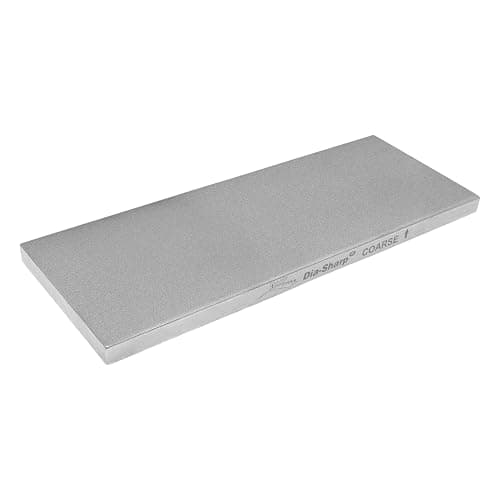
DMT DMT D8C Dia-Sharp Bench Stone, Coarse
DMT D8C Dia-Sharp Bench Stone, Coarse

The right tool for this specific job. A coarse diamond bench plate on a hardened steel substrate with a continuous diamond surface - it removes metal fast, stays dead flat while doing it, and is not consumed by the kind of heavy grinding a chip repair demands. It is also the plate you use to flatten your water stones afterwards.

Best for chip repair
8.1
$61.59Amazon
02
SHARPAL SHARPAL 162N Double-Sided Diamond Stone 8" x 3"
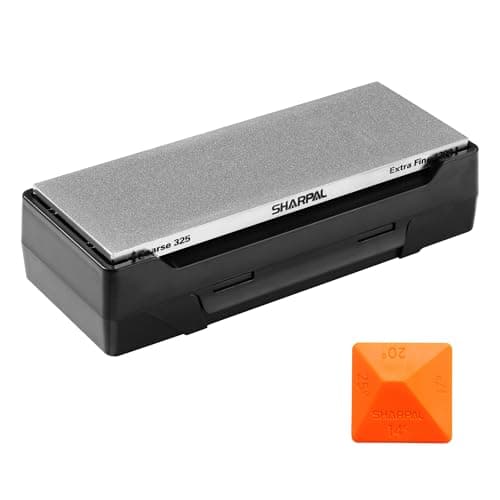
SHARPAL 162N Double-Sided Diamond Stone 8" x 3"

The best single purchase if this is your first chip and you do not already own plates. Coarse on one face for the grinding and fine on the other for rebuilding the bevel, on a large 8 by 3 inch flat substrate - which is the whole repair in one object rather than two. Buy this over the DMT if you are starting from nothing.

Best all-in-one for the whole repair
8.5
$69.99Amazon
03
Work Sharp Work Sharp Precision Adjust
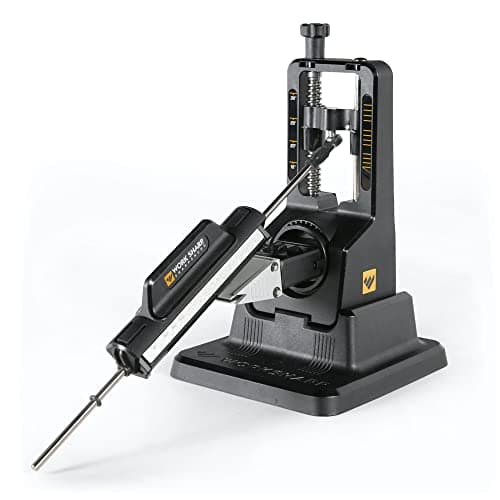
Work Sharp Precision Adjust

The answer if you do not trust yourself freehand, which after a chip is a reasonable position. A manual fixed-angle guide clamping the blade with diamond and ceramic rods and a 15-30 degree adjustment range - the angle is held for you, so the long coarse grinding phase cannot wander into a facet. Slower than a bench plate, and far harder to make worse.

Best guided option
8.4
$69.95Amazon

#ad · Live prices from the Amazon Product API, as of October 18, 2026. Where we have no verified live price, we show none — a gap beats a number that has rotted.

In detail

The picks, in full

01
DMT DMT D8C Dia-Sharp Bench Stone, Coarse

Best for chip repair

DMT D8C Dia-Sharp Bench Stone, Coarse

Coarse diamond, continuous surface8 in. bench plateHardened steel substrateAlso flattens water stones
8.1/10

The right tool for this specific job. A coarse diamond bench plate on a hardened steel substrate with a continuous diamond surface - it removes metal fast, stays dead flat while doing it, and is not consumed by the kind of heavy grinding a chip repair demands. It is also the plate you use to flatten your water stones afterwards.

Fit for the repair
9.5
Metal removal rate
9.5
Angle control
7.5
Finish after repair
7
Value
7

Pros

  • Coarse diamond is the fastest safe way to remove the amount of metal a chip repair needs
  • A continuous diamond surface supports the edge across the whole blade rather than dropping into gaps
  • Stays flat through heavy grinding, which a water stone will not
  • Does not get consumed by the job, so a repair costs you nothing in abrasive
  • Doubles as the flattening plate for every water stone you own

Cons

  • Single grit - you need a finer plate or stone to rebuild the edge after the coarse work
  • Coarse diamond is aggressive and unforgiving of a wobbling angle
  • More expensive than a coarse water stone of the same size
  • Overkill if you only ever maintain a working edge

Don't buy this if…

…you only ever maintain a working edge - coarse diamond is more aggression than routine sharpening needs.

Re-scored on this page's rubric — Fit for the repair, Metal removal rate, Angle control, Finish after repair, Value — rather than carried over from best diamond sharpening stones, where it is judged against the whole plate field.

It takes fit and removal rate because it is the archetype of what step two and step three of the procedure need. Angle control is a 7.5 rather than higher for an honest reason: coarse diamond cuts so fast that a few degrees of wobble becomes a visible facet, which is precisely when people make a chip repair worse. If you are not confident freehand, the guided option below exists for exactly this. Finish is a 7 because a coarse plate is the start of the job and never the end of it — you will finish on something finer.

$61.59View on Amazon

Price as of October 18, 2026. Prices change — Amazon's at checkout is the one that counts.

#ad · we may earn a commission from this link to DMT D8C Dia-Sharp Bench Stone, Coarse

02
SHARPAL SHARPAL 162N Double-Sided Diamond Stone 8" x 3"

Best all-in-one for the whole repair

SHARPAL 162N Double-Sided Diamond Stone 8" x 3"

Double-sided, coarse + fine diamond8 x 3 in. working surfaceMonocrystalline diamond on a flat substrateNon-slip base included
8.5/10

The best single purchase if this is your first chip and you do not already own plates. Coarse on one face for the grinding and fine on the other for rebuilding the bevel, on a large 8 by 3 inch flat substrate - which is the whole repair in one object rather than two. Buy this over the DMT if you are starting from nothing.

Fit for the repair
9
Metal removal rate
9
Angle control
7.5
Finish after repair
8
Value
9

Pros

  • Covers steps two, three and four of the repair on one plate - coarse to grind, fine to rebuild
  • A wide 8 by 3 inch face, so a long blade stays supported through the stroke
  • Non-slip base, which matters more than it sounds when you are applying real pressure
  • Flat and durable through heavy grinding, and never needs flattening itself
  • Costs less than buying a coarse and a fine plate separately

Cons

  • The fine face is still coarser than a finishing water stone, so a keen polished edge needs one more step
  • Flipping the plate mid-job means re-finding your angle
  • Coarse diamond is as unforgiving here as on any plate
  • No published figure for how long the diamond surface holds its cutting speed

Don't buy this if…

…you already own a coarse plate - the DMT above plus your existing stones covers the same ground without buying a second coarse face.

Re-scored here; it also leads how long does a whetstone last on durability and is the only thing that will touch a ceramic blade in are ceramic knives worth it.

It wins this page on the strength of covering most of the procedure in one object. That is worth more than it sounds for a repair job: the failure mode for a home chip repair is giving up halfway and leaving the knife blunter than it started, and having both grits to hand is a real defence against that. If you already own a coarse plate, you do not need this; if your drawer is one water stone and a chipped knife, this is the purchase.

$69.99View on Amazon

Price as of October 18, 2026. Prices change — Amazon's at checkout is the one that counts.

#ad · we may earn a commission from this link to SHARPAL 162N Double-Sided Diamond Stone 8" x 3"

03
Work Sharp Work Sharp Precision Adjust

Best guided option

Work Sharp Precision Adjust

Manual fixed-angle guide15-30 degree rangeDiamond + ceramic rodsWhetstone-quality edge
8.4/10

The answer if you do not trust yourself freehand, which after a chip is a reasonable position. A manual fixed-angle guide clamping the blade with diamond and ceramic rods and a 15-30 degree adjustment range - the angle is held for you, so the long coarse grinding phase cannot wander into a facet. Slower than a bench plate, and far harder to make worse.

Fit for the repair
7.5
Metal removal rate
6.5
Angle control
10
Finish after repair
9
Value
9

Pros

  • Holds the angle mechanically, which removes the one way a home chip repair goes badly wrong
  • The 15-30 degree range covers both Japanese and Western edges correctly
  • Diamond rods for the metal removal and ceramic for the finish, in one unit
  • Manual rather than powered, so there is no heat risk to the heat treatment at all
  • Gives a genuinely good edge, not a pull-through compromise

Cons

  • Much slower than a bench plate for the amount of metal a deep chip needs removed
  • Narrow rods mean you are working a short section at a time rather than the whole edge
  • A full bolster can block the heel in a clamp-style guide
  • Still will not rescue a broken tip, which is a reshaping job

Don't buy this if…

…they want sharpening to take no time at all - an electric unit is the honest answer for that, at the cost of blade life.

Re-scored here; it is ranked against the whole guided field at best sharpening systems, which is the page to read if you want a system rather than a repair.

It takes angle control with the only 10 on the page and loses on removal rate, which is exactly the trade a guided system makes. For a shallow or moderate chip it is arguably the better choice than a bench plate, because the repair will be slower but the edge will be geometrically correct at the end. For a deep chip, the grinding phase on narrow rods is genuinely tedious and a coarse bench plate is the tool. Either way, it is the right thing to own if the reason your knife chipped was your sharpening technique rather than a chicken bone.

$69.95View on Amazon

Price as of October 18, 2026. Prices change — Amazon's at checkout is the one that counts.

#ad · we may earn a commission from this link to Work Sharp Precision Adjust

Is it safe to use a chipped knife?

A small chip is not dangerous in itself, but it is worth knowing what it does. The chip is a flat spot that will not cut, so the blade catches and skips at that point in the stroke — and a knife that skips is a knife that can slide off what you are cutting. On a food-safety level, a chip in a kitchen knife is a missing piece of steel that went somewhere; if a visible fragment is gone and you were cutting food at the time, discard the food. That is the honest answer to “chipped knife in food”: the risk is small, the cost of the precaution is a portion of dinner.

A chipped tip deserves more caution, because the tip is where you apply force in a narrow place and a damaged tip is a weak one. If it is broken rather than nicked, stop using it for anything that involves pressing.

Can you fill a chip, or weld it?

No, and it is worth saying plainly because people ask. There is no filler that will take an edge and no home process that adds steel back. Welding or brazing a kitchen blade destroys the heat treatment around the repair and leaves a soft zone exactly where you need hardness. Grinding the edge back is the only real fix.

Should you just replace the knife?

Sometimes, and the arithmetic is not sentimental. If the knife is a stamped foodservice blade and the chip is deep, the repair is an hour of your time against the cost of a new knife that will be the same knife — replace it. The reason this site keeps recommending inexpensive knives for rough work is partly this: a cheap knife that chips is a non-event.

If the knife is forged, or hard Japanese steel, or has real blade height left, repair it or have it repaired. Those knives are designed to be ground down over decades and losing half a millimetre is a normal event in their life rather than the end of it.

What a professional does differently

Mostly: they use power, and they control heat. A sharpener with a wet belt grinder or a powered water wheel can remove the metal in minutes rather than an hour, with water carrying the heat away so the heat treatment survives. They will also blend the edge line properly afterwards, which is the part that is genuinely difficult by hand on a deep chip.

What to ask for when you hand it over: the angle you want it ground at, whether they work wet, and whether they will match the existing bevel. A sharpener who grinds every knife to one Western angle will take a Japanese knife out of spec. Local knife sharpening services goes through this in more detail.

How we scored these three

Five metrics built for the repair rather than for sharpening in general. Fit for the repair asks how well the tool suits grinding an edge back and rebuilding it. Metal removal rate is how fast it takes material off, which is the bottleneck in step two and three. Angle control is how hard it is to make the knife worse, which on a coarse abrasive is the main risk. Finish after repair is whether the tool can take the edge all the way back to usable or needs another step. Valueis all of it against the live price. The overall is the mean to one decimal place. We have not timed a repair in a lab and we are not going to pretend otherwise — see how we review.
How we picked

We did not lab-test these knives

Everyone in this category says they tested twenty knives in a professional kitchen. We have not hands-on tested any of these, and we say so. What we did instead: compiled the published specifications — steel type and hardness (HRC), edge angle, blade geometry, weight and build — applied established sharpening standards, ran the value math (spec quality ÷ live price), and scored each product against a published rubric. The scores are judgments from documented research — not measurements we took, because we do not have a test lab and we will not pretend we do. Where a number came from someone else's work, we name them in Sources.

Questions

Frequently asked

How do you fix a chipped knife?
Grind the whole edge back on a coarse abrasive until the deepest point of the chip is gone — deliberately blunting the edge into a small flat — then rebuild the bevel at your normal angle and work up through the grits. You cannot fill a chip and a honing rod will not touch it.
Can a chipped knife be repaired?
Yes, at the cost of blade height. The metal does not come back, so the knife ends up slightly shorter in the blade. Shallow chips come out through a few sessions of normal sharpening; deep ones need a deliberate repair or a professional.
Is it safe to use a chipped knife?
A small chip is usable but it leaves a flat spot that catches and skips, which is how a knife slides off what you are cutting. A broken tip is worse and should not be used for anything involving pressure. If a visible fragment went missing while you were cutting, discard that food.
Can you fix a chipped knife with a whetstone?
You can, but you should not use your good one. A chip repair removes more material in one session than months of routine sharpening, which will dish a water stone badly and take a long time. Use a coarse diamond plate for the grinding and save the stone for rebuilding the edge.
Why does my Japanese knife keep chipping?
Because hard steel at 60+ HRC fractures where soft steel would bend. The usual causes are bones, frozen food, twisting or prying, steel-on-steel contact in a drawer, and a hard board. Keep a cheap tough knife for anything with bone in it.
Why is my knife chipping while I sharpen it?
Too much pressure on a coarse abrasive, or an inconsistent angle that lands the apex flat into the stone. Lighten the pressure, slow down, and consider a guided system if it keeps happening — see knife sharpening mistakes.
Can you repair a broken knife tip?
Yes, but it means regrinding the whole front profile of the blade to a new curve, which is a shaping job rather than a sharpening one and looks obviously wrong when done badly. This is the repair we would most strongly send to a professional.
How much does professional chip repair cost, and is it worth it?
It varies by sharpener, so ask rather than assume. The decision is simpler than the price: for a cheap stamped knife, replacing it costs about the same and gets you a new knife. For a forged or hard Japanese blade with height left, repair is clearly worth it.

Keep reading

Receipts

Sources

We do not run a testing lab, and we do not pretend to. Where a spec or a measured number came from someone else's work — a manufacturer's page, a published standard — we name them and link them. Where we could not verify something, we say so on the page rather than quietly leaving it out. Read our full method.