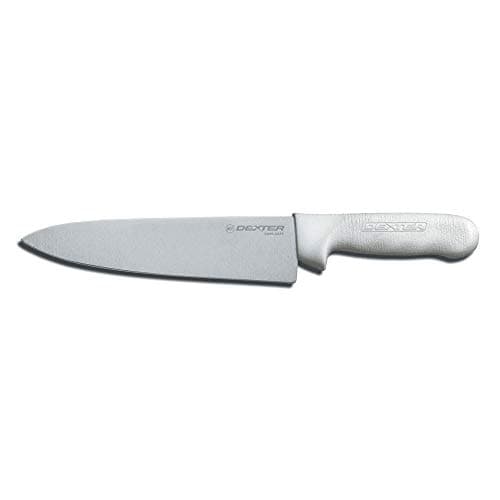
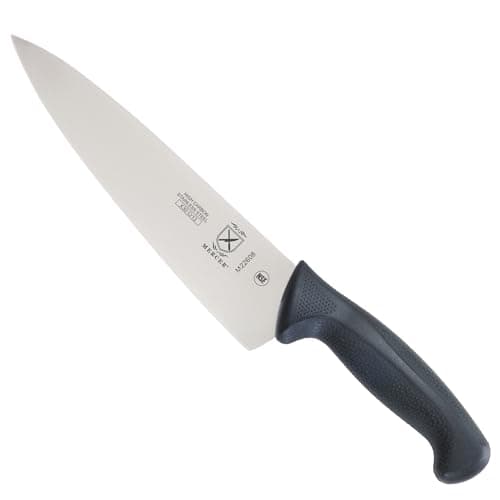
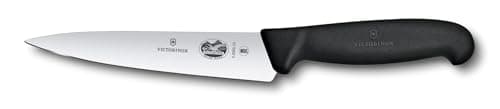
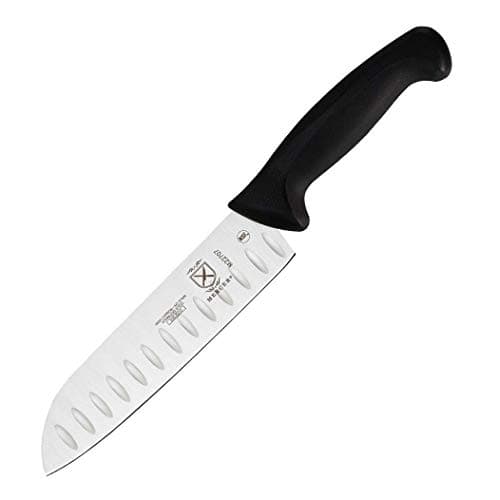
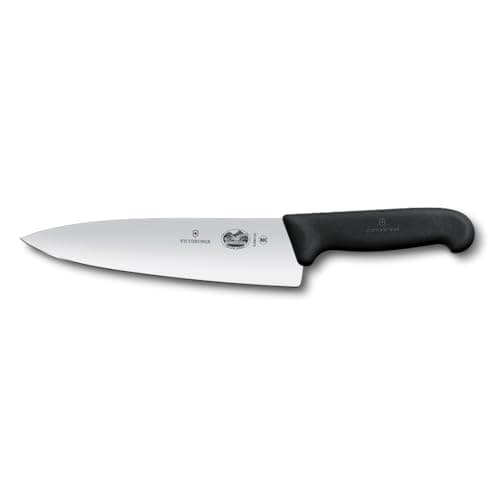
Buy the Victorinox Fibrox Pro 8" — it is the best chef knife under fifty dollars and the one to get if you want to stop reading here. It is the knife foodservice kitchens buy by the case, it is NSF certified and Swiss made, it carries the grippiest handle in the band, and it does not behave like a compromise. The rest of this list exists because “best” changes if you have small hands, if you portion a lot of raw protein, or if you have already decided you want a flatter Japanese profile instead of a curved Western one.
Every knife here was inside the band at our last price check. We do not print a number in the prose, because prices move and a sentence cannot: the Quick Picks table carries the live price and the date we pulled it, and Amazon's price at checkout is the only one that counts. If a pick has drifted over fifty dollars by the time you read this, the table will say so plainly rather than the page pretending otherwise.
One thing to be clear about before the list: this band is stamped steel territory, and that is a real limit, not a snobbery. Nothing sold under fifty dollars is drop-forged from a billet with a full bolster and a tang you can see through the handle. What you get instead — blanks punched from rolled sheet, heat treated to the middle 50s HRC, with a moulded or textured polymer handle — is light, cheap to replace, easy to re-sharpen and used in professional kitchens every day for exactly those reasons. If forged heft is what you came for, the honest answer is that it starts a band up: our best chef knives under $100 ranks the Mercer Renaissance, which is a genuinely forged knife, and three of that page's five picks sit above this one's ceiling, which is why these are separate lists rather than one.
The method is on how we review: we have not hands-on tested these knives and we do not claim to have. The scores below come from published specifications — steel composition and hardness, edge angle, blade length and geometry, handle material, certifications — and from value arithmetic against the live price. Everything sits under the chef knives hub.
What fifty dollars actually buys
It buys a stamped blade: a blank punched out of rolled steel sheet, ground to an edge and heat treated. It does not buy a forging. That single fact explains almost every other property on this page. A stamped knife is lighter, has no bolster and usually no visible tang, costs a fraction as much to make, and — this is the part the category never says out loud — cuts food essentially as well, because what a blade does to a carrot is decided by its geometry and its edge, not by how the blank was formed. Stamped vs forged knives is the long version of that argument.
It also buys, reliably at this price, a published steel and hardness. Every knife here is in the middle 50s HRC: Victorinox publishes X50CrMoV15 at roughly 55-56, Mercer publishes a high-carbon Japanese steel at roughly 56. That is softer than the hard Japanese knives people lust after, and the consequence is specific and manageable. A mid-50s edge rolls over rather than chipping, which means a honing rod straightens it in fifteen seconds and you only need an actual stone every few months. Hard steel is the opposite trade: a keener edge that lasts longer but chips instead of bending and needs real technique to restore. Neither is better. One of them is forgiving, and forgiving is the right property for a first knife. Knife steel types explained and sharpening vs honing cover the mechanism.
And it buys NSF certification on four of the five picks, which is a more useful signal than any marketing copy on the listing. NSF/ANSI 2 is a food-equipment standard about cleanability: smooth transitions, no crevices that trap food, materials that survive commercial sanitising. It says nothing about how well a knife cuts and everything about whether the handle will harbour bacteria at the blade junction. Commercial kitchens are required to care. You are not, but it is free information and it is the reason the same four knives keep appearing in professional settings.
What fifty dollars does not buy
Hard steel.Nothing in this band is above the middle 50s HRC. For a genuinely hard Japanese edge you are looking at a different conversation entirely — see best Japanese chef knives for beginners.
A bolster, or a forging.The cheapest properly forged chef's knife we rank anywhere on this site is the Mercer Renaissance, and it sits just above this band's ceiling — close enough that if the budget has any give at all, stretching is a real option. It is the forged pick on best chef knives under $100. For why a bolster matters more for sharpening than for feel, see full bolster vs half bolster.
A published edge angle, in most cases.Victorinox publishes roughly 20 degrees per side. Mercer and Dexter publish the steel but not the angle, which is why our scores for those two read the steel family and the blade geometry rather than a number we do not have. We will not invent one. If you intend to sharpen these yourself, treat them all as Western 20-degree edges until a maker tells you otherwise — knife sharpening angles explains why guessing low is the expensive mistake.
Spend the next fifty dollars on upkeep, not on a better knife
This is the single highest-return piece of advice on the page. A Victorinox that is honed every few uses outcuts a two-hundred-dollar knife that has not been touched in a year, and it is not close. If you have a hundred dollars total, the best allocation is not a hundred-dollar knife — it is a fifty-dollar knife plus a honing rod and eventually a sharpening stone. Soft mid-50s steel is the easiest steel in the world to maintain, which makes this band and this habit an unusually good match. How often to sharpen knives gives the cadence, and how to use a honing steel is the ten-minute skill that makes the difference.
Two other cheap things protect the edge more than an upgrade would. A wood or soft-plastic board instead of glass, bamboo or stone, because a hard surface rolls an edge in a single session. And keeping these knives out of the dishwasher — detergent and knocking against other steel will do more visible damage in a month than a year of cutting.
How we ranked this band
Five metrics, weighted for what actually goes wrong with a cheap knife. Cutting abilityreads blade geometry, published edge angle and blade height — how well the knife gets through food and clears your knuckles. Grip security is specifically about a wet or greasy hand, because that is when a cheap handle becomes a hazard rather than a nuisance. Edge upkeep rewards steel that comes back on a rod rather than steel that needs a stone and a technique. Durability reads build, stiffness and published certifications. Value per dollar is spec quality against the live price, which is why the cheapest knife here takes a 10 on it and still does not win the page. The overall is the mean of the five, to one decimal place. None of these numbers come from a test lab, because we do not have one, and how we review says so in those words.