Skip to content
The Edge Bench

Types & comparisons · Knife Types

Full bolster vs half bolster

A bolster is sold as balance and comfort. Its real consequence is sharpening - a full bolster keeps the heel of the blade off the stone for the life of the knife.

By Stephen V.Updated How we review
#ad

We earn a commission when you buy through our Amazon links, at no extra cost to you. It never changes a verdict, and we say so when the cheaper knife is the better buy. How this works.

If you sharpen your own knives, buy a half bolster or a sloped one. If you never will, a full bolster is fine and you can stop reading. The bolster is the thick collar of steel where the blade meets the handle on a forged knife, and the industry sells it on balance and comfort. Its genuinely important consequence is something else entirely: a full bolster runs all the way down past the heel of the edge, which means the heel physically cannot reach a flat stone. Sharpen the knife for ten years and everything except that last few millimetres gets thinner, until the edge has a visible dip in it.

That is the whole decision, and it is why a “half bolster” costs more rather than less despite being less steel. It is also why the Zwilling Pro costs more than the Zwilling Professional S, and the only difference between them.

What a bolster actually is

On a forged knife, the blade, the bolster and the tang are all one continuous piece of steel. During forging, a section just behind the blade is left thick instead of being drawn out, and that thick section becomes the bolster: a raised collar sitting between the sharpened edge and the handle.

It does three things honestly. It adds mass at the balance point, which shifts the knife's balance back towards your hand and is a large part of why a forged German knife feels the way it does. It acts as a finger guard, giving your index finger something to stop against so your hand cannot slide forward onto the edge. And it seals the blade-to-handle junction, which is a hygiene point rather than a performance one — no gap means no trapped food.

A stampedknife has no bolster at all, because there was never a billet to leave thick. Some stamped knives have a plastic or moulded collar in roughly the same place, which looks like a bolster and is not one — it is part of the handle. If a listing shows a collar on a knife described as stamped or “precision stamped”, that is what you are looking at. See stamped vs forged knives for why that distinction is less important than the category claims.

The one thing a bolster is not: a tang

These two get confused constantly and they are unrelated features. The bolster is the visible collar at the front of the handle, outside the knife. The tang is the extension of the blade steel running inside the handle. A knife can have a full bolster and a partial tang, a half bolster and a full tang, or any other combination. The tang is a structural question; full tang vs partial tang covers it properly. The bolster is a sharpening question, which is this page.

The three types, and what each costs you

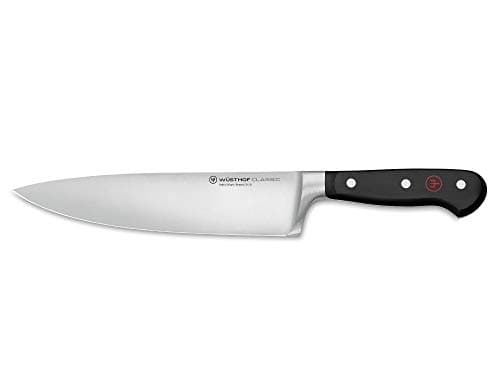
Full bolster. The collar runs down the full depth of the knife, flush with the heel of the blade. Comfortable, substantial, and the heel of the edge sits behind a wall of steel. Wusthof Classic, Zwilling Professional S and Henckels Classic are all built this way.

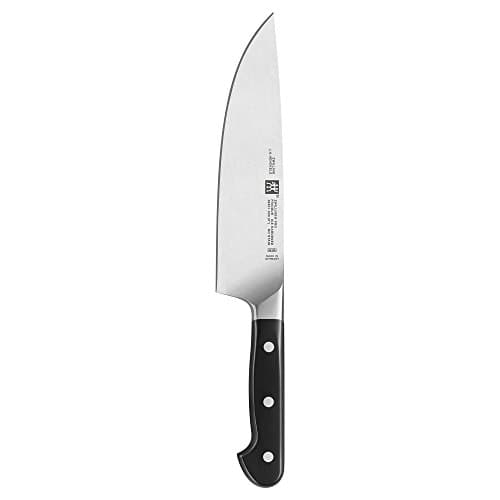
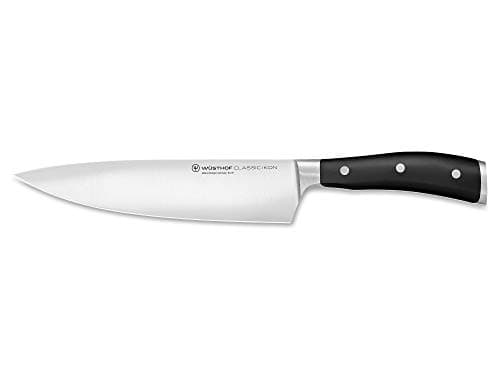
Half bolster (also “sloped” or “curved” bolster). The collar covers only the upper part of the junction and is cut away at the bottom, leaving the heel of the edge exposed. You keep the finger guard and most of the balance effect; the whole edge reaches the stone. Wusthof Classic Ikon and Zwilling Pro are the examples in our registry.

No bolster.Every stamped knife, plus Japanese knives generally — most Japanese knives have no bolster regardless of construction, which is one reason they are easier to sharpen fully and one reason they feel so different in the hand. Victorinox Fibrox, Mercer Millennia, Wusthof Gourmet and essentially all of our Japanese picks are bolsterless.

Why the full bolster costs you the heel

Sharpening works by dragging the bevel across a flat abrasive at a consistent angle. For the whole edge to be sharpened, the whole edge has to be able to touch that flat surface. On a full-bolster knife, the bolster is thicker than the blade and sits immediately behind the heel, so when you lay the knife on a stone the bolster hits first and holds the last few millimetres of edge a fraction above the surface.

The result is slow and cumulative. Every sharpening removes metal from the part of the edge that reaches the stone and none from the part that does not, so over years the sharpened section recedes and the heel stays where it was. The edge develops a recurve — a shallow dip, highest at the heel. You notice it when you try to cut something flat against a board with the back of the blade and the heel does not reach, or when you are slicing and the heel will not bite.

How long that takes depends entirely on how often you sharpen, and no maker publishes a number for it, so we are not going to invent one. For someone who has a knife professionally sharpened once a year it is decades away and effectively theoretical. For someone who sharpens on stones every couple of months it is a real thing that will show up within the life of the knife. That asymmetry is exactly why our advice depends on whether you sharpen rather than on which bolster is “better”.

It is fixable, incidentally, and the fix is unpleasant: a sharpener grinds the bolster itself back with a belt or a coarse abrasive so the heel clears. Some professional sharpening services will do this. It is a job for someone who has done it before, not a Saturday project.

Is the weight saving real? Mostly not

Half-bolster knives are often marketed on being lighter and better balanced. It is worth knowing how much lighter, because we checked when we reviewed one. Comparing Wusthof's own published weights for the Classic and the Classic Ikon, the half bolster accounts for roughly six grams — which is to say, nothing you will feel. The full write-up is in our Classic Ikon review.

So treat the lightness claim as marketing and the heel access as the real benefit. If you want a genuinely lighter Wusthof, the answer is the stamped Gourmet, which is about two and a half ounces lighter than the Classic because it has no bolster and no forging at all — our Gourmet review has the numbers.

The short answer

Quick picks

#KnifeBest forScorePrice
01
Zwilling Zwilling Pro 8"
Zwilling Pro 8"

The best implementation of the idea on this page, and the clearest demonstration of what it is worth. Forged in a Zwilling-owned German factory with FRIODUR ice-hardening and a full tang, with a curved sloped bolster that leaves the entire edge reachable on a stone. If you sharpen your own knives, this is the shape to buy.

Best sloped bolster
8.5
$169.95Amazon
02
Wusthof Wusthof Classic Ikon 8"
Wusthof Classic Ikon 8"

The half-bolster knife to buy if you want Solingen rather than Zwilling, and the one whose marketing we checked. Forged at 58 HRC with a ~14 degree per side PEtec edge, a half bolster leaving the heel exposed, and a double-bolster handle. The exposed heel is real and worth paying for; the weight saving is about six grams and is not.

Best half bolster
8.4
$154.00Amazon
03
Wusthof Wusthof Classic 8"
Wusthof Classic 8"

The full-bolster benchmark, and the right knife for most people who are not going to sharpen on stones. Forged X50CrMoV15 at roughly 58 HRC on a ~14 degree per side edge, with a full bolster and a full tang. The best-built knife on this page and the one whose heel will slowly fall behind the rest of the edge.

Best full bolster
7.3
$170.00Amazon

#ad · Live prices from the Amazon Product API, as of October 17, 2026. Where we have no verified live price, we show none — a gap beats a number that has rotted.

In detail

The picks, in full

01
Zwilling Zwilling Pro 8"

Best sloped bolster

Zwilling Pro 8"

Forged, company-owned German factoryFRIODUR ice-hardenedCurved sloped bolsterFull tang
8.5/10

The best implementation of the idea on this page, and the clearest demonstration of what it is worth. Forged in a Zwilling-owned German factory with FRIODUR ice-hardening and a full tang, with a curved sloped bolster that leaves the entire edge reachable on a stone. If you sharpen your own knives, this is the shape to buy.

Heel access
9.5
Balance & feel
8
Build
9
Sharpenability over years
9.5
Value
6.5

Pros

  • The curved bolster is cut away cleanly, so the whole edge including the heel reaches a flat stone
  • Keeps the finger guard and most of the balance benefit of a full bolster
  • Genuinely forged with a full tang and a real German heat treatment
  • A better long-term shape for anyone who intends to maintain their own edges for decades

Cons

  • The one advantage over the cheaper Professional S is worthless if you never use a stone
  • The most expensive knife on this page
  • Heavier than a stamped bolsterless knife, which is a preference not a virtue
  • Nothing about the cutting is better than the full-bolster version of the same knife

Don't buy this if…

…you will never touch a whetstone - the one clear advantage here is wasted, and the Professional S is the same knife for less.

Re-scored on this page's rubric — Heel access, Balance & feel, Build, Sharpenability over years, Value — rather than carried over from Zwilling vs Henckels or Victorinox vs Zwilling, where the same knife is judged on general merit and finishes lower. It is reviewed in full at our Zwilling Pro review.

It wins this page because this page scores the exact feature it exists to provide. That is worth being explicit about: a rubric built around the heel will rank the knife with the exposed heel first, and the same knife finishes last on a rubric built around value. Both results are true, and which one applies to you is a question about whether you own a stone. If you do not yet, best sharpening stones for beginners is where that starts.

$169.95View on Amazon

Price as of October 17, 2026. Prices change — Amazon's at checkout is the one that counts.

#ad · we may earn a commission from this link to Zwilling Pro 8"

02
Wusthof Wusthof Classic Ikon 8"

Best half bolster

Wusthof Classic Ikon 8"

Forged in Solingen, 58 HRCHalf bolster, heel exposed~14 deg/side PEtec edge9.1 oz, 3 mm spine, 1.75 in tall
8.4/10

The half-bolster knife to buy if you want Solingen rather than Zwilling, and the one whose marketing we checked. Forged at 58 HRC with a ~14 degree per side PEtec edge, a half bolster leaving the heel exposed, and a double-bolster handle. The exposed heel is real and worth paying for; the weight saving is about six grams and is not.

Heel access
9
Balance & feel
8.5
Build
9
Sharpenability over years
9
Value
6.5

Pros

  • Half bolster leaves the heel of the edge clear of the stone, which is the point of the design
  • Forged in a company-owned Solingen factory at a published 58 HRC
  • A ~14 degree per side factory edge, narrower than most German knives
  • Contoured double-bolster handle that a lot of people prefer to the Classic's

Cons

  • The lightness claim does not survive checking - the half bolster accounts for roughly six grams
  • Costs a clear premium over the full-bolster Classic for one feature
  • Still a heavy knife at 9.1 oz, and heavier than the Zwilling Pro's reputation suggests
  • You are paying for a sharpening benefit you only collect if you sharpen

Don't buy this if…

…you do not sharpen your own knives - you are paying a premium for a benefit you will never collect.

Re-scored here; it is reviewed in full at our Wusthof Classic Ikon review, which is where the six-gram finding came from, and ranked against the German field at best German chef knives.

It finishes a tenth behind the Zwilling Pro and the reason is heel access rather than anything else: the Ikon's bolster is cut back but the Pro's curved shape clears the heel slightly more completely. That is a fine distinction and either knife solves the problem this page is about. Choose on handle and on brand rather than on the score — Wusthof vs Zwilling is the page for that decision.

$154.00View on Amazon

$200.0023% off

Price as of October 17, 2026. Prices change — Amazon's at checkout is the one that counts.

#ad · we may earn a commission from this link to Wusthof Classic Ikon 8"

03
Wusthof Wusthof Classic 8"

Best full bolster

Wusthof Classic 8"

Forged X50CrMoV15~58 HRC~14 deg/side edgeFull bolster & tang
7.3/10

The full-bolster benchmark, and the right knife for most people who are not going to sharpen on stones. Forged X50CrMoV15 at roughly 58 HRC on a ~14 degree per side edge, with a full bolster and a full tang. The best-built knife on this page and the one whose heel will slowly fall behind the rest of the edge.

Heel access
4
Balance & feel
9
Build
10
Sharpenability over years
5.5
Value
8

Pros

  • The most substantial and best-finished knife here, forged in Solingen with a full tang
  • The full bolster is a genuinely comfortable finger stop and seals the handle junction
  • Mass at the balance point is a large part of why a forged German knife feels right
  • Cheaper than the half-bolster Ikon, for a knife that cuts identically

Cons

  • The heel of the edge cannot reach a flat stone, so it slowly develops a recurve over years
  • Fixing that later means grinding the bolster back, which is a job for a professional
  • Heavy, which is either the point or the problem depending on you
  • Full bolster also blocks the heel on most guided sharpening systems, not just on stones

Don't buy this if…

…you sharpen your own knives on stones and intend to keep this knife for decades - the Ikon or the Zwilling Pro exist for exactly that reason.

Re-scored here; it is reviewed in full at our Wusthof Classic review and it is the forged winner on best under $200. On general rubrics across this site it scores 8.4; here it scores 7.3.

That gap is the most useful number on the page, so we are not going to smooth it over. The Classic is a better knife than its score here suggests — it takes build with a 10 and balance with a 9, and nothing on this page is better made. It scores a 4 on heel access because that is what a full bolster does, and this page weights heel access heavily because that is the question it is answering. If you do not sharpen on stones, ignore the 7.3 and read the general ranking instead. If you do, the 7.3 is telling you something real.

$170.00View on Amazon

Price as of October 17, 2026. Prices change — Amazon's at checkout is the one that counts.

#ad · we may earn a commission from this link to Wusthof Classic 8"

Which should you buy, in two questions

Do you sharpen your own knives on a stone or a guided system, already, today? If yes: half or sloped bolster. The heel access is a feature you will collect on for as long as you own the knife, and the premium is real money for a real benefit.

If no — and be honest, because most people who intend to start do not — buy the full bolster, or buy a bolsterless knife. You will have the knife professionally sharpened once a year or not at all, and the recurve problem is measured in decades at that rate. Spend the difference on anything else. The Zwilling Professional S and the Wusthof Classic are both excellent full-bolster knives, and so is the Henckels Classic at a lower price.

The third option nobody frames properly: no bolster at all

A bolsterless knife has perfect heel access by definition, and most of the knives people actually enjoy cutting with have no bolster. Every Japanese knife we rank is bolsterless. Every stamped knife is bolsterless. The Victorinox Fibrox that wins half the roundups on this site is bolsterless.

What you give up is the finger guard and the mass at the balance point — which is to say you give up the thing that makes a German knife feel German. If you have never liked the feel of a forged German knife, the bolster is a large part of the reason, and the honest move is not to buy a cleverer bolster but to buy a knife without one. Japanese vs German chef knives is the bigger version of that decision, and best chef knives under $50 is where the bolsterless workhorses live.

Does the bolster matter on a guided sharpening system?

Yes, and it is worth knowing because it is not obvious. A clamp-style guided system holds the blade and sweeps an abrasive rod along it, and a full bolster blocks the rod at the heel the same way it blocks a stone. Pull-through sharpeners are usually worse: the carbide or ceramic wheels sit in a fixed slot and the bolster stops the knife entering far enough to reach the heel at all.

The one method a bolster does not interfere with much is a honing rod, because you sweep the edge along the rod from heel to tip and the rod is narrow enough to reach into the corner. That is another reason honing is the maintenance habit worth having regardless of what you own. Best sharpening systems ranks the guided options and how to use a honing steel covers the rod.

How to tell what a knife has from the listing

Look at the product photo from the side, at the junction between handle and blade, and follow the bottom line of the knife from the handle towards the tip. If the steel collar comes all the way down and meets the cutting edge in a continuous line, it is a full bolster. If the collar stops partway and you can see the heel of the blade standing clear below and behind it, it is a half or sloped bolster. If there is no collar, or the collar is obviously plastic and part of the handle moulding, it is bolsterless.

Makers are not consistent with the words. “Half bolster”, “sloped bolster”, “curved bolster” and “cut-away bolster” all describe the same thing. Some listings say “double bolster”, which refers to a second collar at the back of the handle and tells you nothing about the heel. Trust the photo over the copy — and more generally, see how to tell if a knife is good quality for the rest of what a listing will and will not tell you.

How we scored these three

Five metrics built for this one question. Heel access is how much of the edge can physically reach a flat abrasive. Balance & feelreads mass distribution and the finger stop — the things a bolster is marketed on. Build reads construction, published steel and hardness, tang and finish. Sharpenability over years asks what the edge looks like after a decade of maintenance. Valueis all of it against the live price. The overall is the mean to one decimal place. These are judgments from published specifications, not lab measurements — how we reviewsays so in those words, and the one dimensional claim on this page (the Ikon's six grams) comes from comparing Wusthof's own published weights.
How we picked

We did not lab-test these knives

Everyone in this category says they tested twenty knives in a professional kitchen. We have not hands-on tested any of these, and we say so. What we did instead: compiled the published specifications — steel type and hardness (HRC), edge angle, blade geometry, weight and build — applied established sharpening standards, ran the value math (spec quality ÷ live price), and scored each product against a published rubric. The scores are judgments from documented research — not measurements we took, because we do not have a test lab and we will not pretend we do. Where a number came from someone else's work, we name them in Sources.

Questions

Frequently asked

What is a bolster on a knife?
The thick collar of steel between the blade and the handle on a forged knife. It is part of the same piece of steel as the blade and the tang, left thick during forging. It adds mass at the balance point, acts as a finger guard, and seals the blade-to-handle junction.
Full bolster or half bolster - which is better?
Half, if you sharpen your own knives: a full bolster stops the heel of the edge reaching a flat stone, so over years the sharpened section recedes and the edge develops a shallow recurve. If you do not sharpen, the full bolster is a comfortable finger stop and costs you nothing you will notice.
Does a full bolster stop you sharpening a knife?
Not the whole knife — just the last few millimetres at the heel. The bolster is thicker than the blade and sits immediately behind the heel, so it contacts the stone first and holds that part of the edge a fraction clear. The rest of the edge sharpens normally.
Is a bolster the same as a full tang?
No, and they are constantly confused. The bolster is the visible collar outside the handle; the tang is the blade steel running inside it. A knife can have a full bolster and a partial tang, or the reverse. See full tang vs partial tang.
Do Japanese knives have bolsters?
Mostly not. Japanese kitchen knives are usually built without a bolster regardless of construction, which is part of why they are easier to sharpen fully and part of why they feel so different in the hand from a forged German knife.
Is a half-bolster knife lighter?
Barely. Comparing Wusthof's published weights for the Classic and the Classic Ikon, the half bolster accounts for roughly six grams — not something you will feel. Buy a half bolster for the heel access, not for the weight. For a genuinely lighter knife, buy a stamped one.
Can a full bolster be removed or ground back?
Yes, by grinding the bolster back with a belt or coarse abrasive so the heel clears. Some professional sharpening services offer it. It is not a home project — it is easy to overheat the steel or take the blade out of line.
Does a bolster matter on an electric or pull-through sharpener?
Yes, often more than on a stone. Pull-through wheels sit in a fixed slot and a full bolster can stop the knife entering far enough to reach the heel at all. A honing rod is the one method a bolster barely interferes with.

Keep reading

Receipts

Sources

We do not run a testing lab, and we do not pretend to. Where a spec or a measured number came from someone else's work — a manufacturer's page, a published standard — we name them and link them. Where we could not verify something, we say so on the page rather than quietly leaving it out. Read our full method.