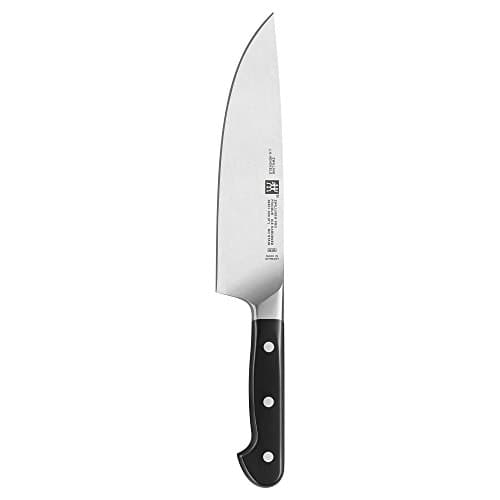
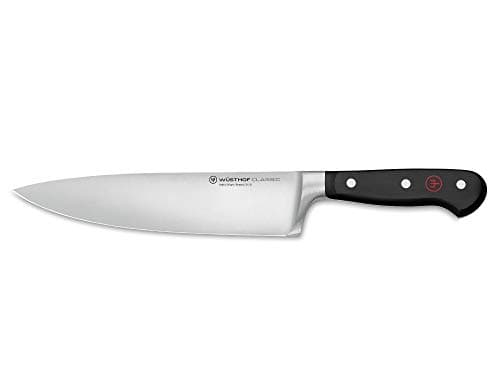
Wusthof and Zwilling are both headquartered in Solingen, both forge from the same broad family of German stainless, both land in the 56–58 HRC hardness band, and both build full-tang knives with riveted handles. If you are looking for a large performance gap you will not find one, and anyone who tells you otherwise is describing a preference. What does separate them is a set of construction decisions — and one of those decisions matters a great deal if you intend to keep the knife for twenty years.
| Feature | Wusthof Classic 8" | Zwilling Pro 8" |
|---|
| Steel | X50CrMoV15, forged | German stainless, forged, FRIODUR ice-hardened |
| Published hardness | ~58 HRC | ~57 HRC (Professional S line) |
| Edge angle | ~14° per side (PEtec) | ~15° per side |
| Bolster | Full bolster | Curved, sloped bolster (Pro line) |
| Tang | Full tang, triple-riveted | Full tang |
| Best at | Heft, balance, out-of-box keenness | Long-term sharpenability, pinch-grip comfort |
The bolster is the real difference
A full bolster — the thick collar of steel where the blade meets the handle — is a genuine feature: it adds weight toward your hand, gives a pinch grip something to rest against, and protects your fingers. It also blocks the last inch of the cutting edge from reaching a sharpening stone. Over years of sharpening, the exposed part of the edge is ground back while the heel behind the bolster is not, and the knife develops a visible step. Fixing that means grinding the bolster itself, which is a job for a professional.
Zwilling's Pro line answers this with a curved, sloped bolster that tapers away from the edge and leaves the full length of the blade accessible to a stone. It is a real advantage, and it is the strongest single argument for Zwilling over Wusthof — but only if you actually sharpen your own knives on a stone. If you use a pull-through or electric sharpener or send knives out, the point is moot and the two brands are effectively interchangeable.
Ice-hardening, and how much to make of it
Zwilling's FRIODUR process is a cryogenic step in heat treatment — cooling the steel well below freezing after quenching to convert retained austenite into martensite. This is real metallurgy, it does improve hardness consistency and corrosion resistance, and Zwilling performs it in its own factory rather than outsourcing it. It is also not a transformation: a FRIODUR blade and a conventionally-treated Solingen blade of the same alloy are close enough that no home cook would identify them blind. Treat it as evidence of process control rather than as a performance claim.
What Wusthof does better
The Classic's PEtec edge is ground to roughly 14° per side, which is keener than the German stereotype and keener than most of Zwilling's equivalent lines. Out of the box, the Wusthof is generally the sharper knife. It also has the more balanced feel to most hands — the full bolster puts weight exactly where a pinch grip wants it — and the range of Wusthof lines, spares and service options is the broadest in the category. If you plan to maintain the knife with a honing rod rather than a stone, the bolster objection never applies to you and the Classic is simply the better-executed knife of the two.
The short answer
Quick picks
| # | Knife | Best for | Score | Price |
|---|
| 01 | Wusthof Classic 8"The keener, better-balanced knife of the two out of the box, and the one to buy if you maintain with a rod or send knives out to be sharpened. The full bolster is a comfort and safety feature that becomes a long-term sharpening constraint only for people who use stones. | Best out-of-box edge and balance | | $170.00·Amazon |
| 02 | Zwilling Pro 8"The knife for someone who will own it for decades and sharpen it themselves. The curved sloped bolster keeps the entire edge on the stone for the life of the blade, and FRIODUR ice-hardening is done in Zwilling's own factory rather than outsourced. | Best for people who sharpen on stones | | $169.95·Amazon |
#ad · Live prices from the Amazon Product API, as of October 18, 2026. Where we have no verified live price, we show none — a gap beats a number that has rotted.
In detail
The picks, in full
Best out-of-box edge and balance
Wusthof Classic 8"
Forged X50CrMoV15~58 HRC~14 deg/side edgeFull bolster & tang
The keener, better-balanced knife of the two out of the box, and the one to buy if you maintain with a rod or send knives out to be sharpened. The full bolster is a comfort and safety feature that becomes a long-term sharpening constraint only for people who use stones.
- Edge & steel
- 8
- Sharpness
- 9
- Handling
- 8
- Build
- 10
- Value
- 7
Pros
- +Keener factory grind than the German norm
- +Full bolster gives the most secure, comfortable pinch grip here
- +Deepest range of spares, service and matching pieces
- +Slightly higher published hardness than the Zwilling
Cons
- −Full bolster eventually leaves a step at the heel under stone sharpening
- −Heavy - the heft is deliberate and not for everyone
- −Solingen pricing on a widely-matched specification
Don't buy this if…
…you intend to sharpen this knife freehand on stones for decades - the Zwilling Pro's sloped bolster ages better.
Best for people who sharpen on stones
Zwilling Pro 8"
Forged, company-owned German factoryFRIODUR ice-hardenedCurved sloped bolsterFull tang
The knife for someone who will own it for decades and sharpen it themselves. The curved sloped bolster keeps the entire edge on the stone for the life of the blade, and FRIODUR ice-hardening is done in Zwilling's own factory rather than outsourced.
- Edge & steel
- 8
- Sharpness
- 8
- Handling
- 8
- Build
- 9
- Value
- 7
Pros
- +Sloped bolster means the whole edge stays sharpenable forever
- +Curved bolster is more comfortable in a pinch grip for many hands
- +Ice-hardening performed in-house, not contracted out
- +Forged full tang with genuine German heft
Cons
- −Slightly less keen stated grind than the Wusthof Classic
- −Heavier than most cooks expect from photographs
- −Priced against Wusthof rather than against its own specification
Don't buy this if…
…you will never touch a whetstone - the one clear advantage here is wasted, and the Wusthof is keener out of the box.
Which should you buy?
Buy the Wusthof Classic if you want the keenest German edge out of the box, you like a substantial knife, and your maintenance plan is a honing rod plus an occasional professional sharpening. Buy the Zwilling Proif you already own a whetstone or intend to learn one, because the sloped bolster is the only difference here that compounds over time — our Zwilling Pro 8-inch review works through what that premium does and does not buy. If neither of those describes you, buy whichever is cheaper on the day — that is not a cop-out, it is the honest read of two knives this closely matched.
Watch the line names, not the brand names
Both companies sell several tiers under confusable names, and this is where buyers actually go wrong. Wusthof's Classic and Classic Ikon are forged; its Gourmet line is precision-stamped and a different proposition entirely. Zwilling sells Pro and Professional S as forged lines, while Henckels International is a separate, lower tier under the same corporate parent — the two names look almost identical on a box and are not the same product. Check whether the specific knife is forged and what its stated hardness is, rather than trusting the logo, and if the entry-tier knife is the one you are weighing, read Wusthof vs Henckels.
Neither one is a Japanese knife
If what you actually want is a keener, lighter, harder blade, both of these will disappoint you in the same way. German knives are built to be tough and forgiving; the trade is edge retention and thinness. Read Japanese vs German chef knives before choosing between these two, and Shun vs Wusthof for the cross-family version of this comparison.
How to make either one last
Hand-wash and dry immediately; the dishwasher is hard on both handle rivets and edges. Hone weekly with a rod — soft German steel rolls, and rolling is exactly what a rod fixes. Sharpen properly two or three times a year at the angle the knife was ground to. And cut on wood or soft plastic; glass and stone boards will undo the entire point of buying a good knife.
How we picked
We did not lab-test these knives
Everyone in this category says they tested twenty knives in a professional kitchen. We have not hands-on tested any of these, and we say so. What we did instead: compiled the published specifications — steel type and hardness (HRC), edge angle, blade geometry, weight and build — applied established sharpening standards, ran the value math (spec quality ÷ live price), and scored each product against a published rubric. The scores are judgments from documented research — not measurements we took, because we do not have a test lab and we will not pretend we do. Where a number came from someone else's work, we name them in Sources.
Questions
Frequently asked
Is Zwilling the same company as Henckels?+
Same parent, different tiers. Zwilling J.A. Henckels is the premium line; Henckels International is a separate, cheaper range. The logos differ — two figures for Zwilling, one for Henckels International — and so do the materials and finish.
Which is sharper out of the box, Wusthof or Zwilling?+
Generally the Wusthof Classic, whose PEtec grind is stated at around 14° per side against roughly 15° for the comparable Zwilling lines. The difference is small and disappears the first time either knife is sharpened at home.
Does the sloped bolster really matter?+
Only if you sharpen on stones. A full bolster blocks the heel of the edge from the stone, so over many years the sharpened part of the blade recedes and a step forms at the heel. A sloped bolster avoids that entirely. If you use a pull-through, an electric sharpener or a service, it makes no practical difference.
Are these knives dishwasher safe?+
Both are usually labeled as such, and neither should go in one. Detergent is abrasive and alkaline, the heat cycle stresses handle rivets, and the blade knocks against everything else in the basket. See
knife care and maintenance.
Is there a cheaper knife with the same specification?+
Yes — forged X50CrMoV15 at around 58 HRC is not exclusive to Solingen. Mercer's Renaissance line matches the spec sheet at a much lower price, trading finish quality for it. Comparison in
Victorinox vs Mercer and
best chef knife brands.
Receipts
Sources
We do not run a testing lab, and we do not pretend to. Where a spec or a measured number came from someone else's work — a manufacturer's page, a published standard — we name them and link them. Where we could not verify something, we say so on the page rather than quietly leaving it out. Read our full method.