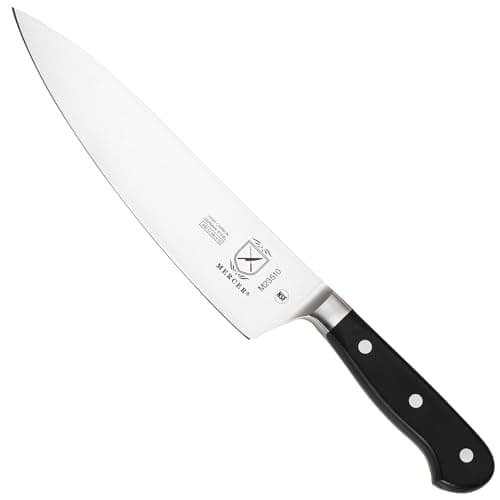
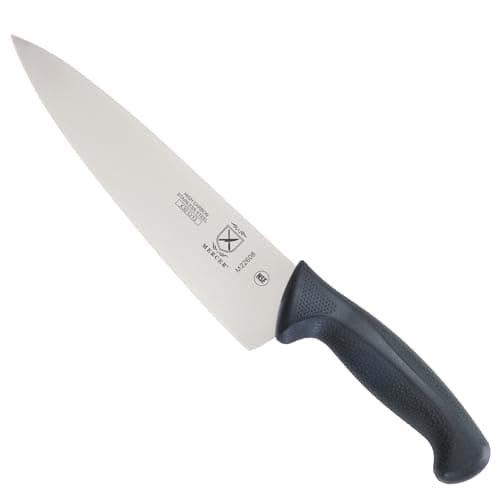
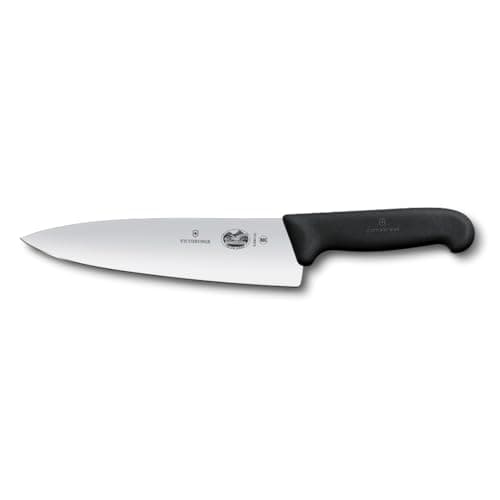
Ask anywhere for a cheap chef's knife recommendation and you will get one of two answers: Victorinox Fibrox Pro or Mercer. Both are commercial-kitchen tools sold at commercial-kitchen prices, both are NSF certified, both are stamped from softer steel with textured synthetic handles, and both massively outperform anything sold as a "home" knife at the same money. The differences are real but narrow — and one of them, the option of a forged Mercer, is the reason this comparison is worth having at all.
| Feature | Victorinox Fibrox Pro 8" | Mercer Millennia 8" | Mercer Renaissance 8" |
|---|
| Construction | Stamped | Stamped | Forged, full bolster |
| Steel | X50CrMoV15 | High-carbon Japanese steel | X50CrMoV15 |
| Published hardness | ~55–56 HRC | ~56 HRC | ~58 HRC |
| Handle | Fibrox, textured | Santoprene with finger guard | Delrin, riveted |
| Weight class | Very light (~7.4 oz) | Very light | Substantial |
| NSF certified | Yes | Yes | Yes |
The grip is the everyday difference
Between the two stamped knives, handle feel decides it and nothing else really does. The Fibrox handle is a slightly tacky textured polymer with a subtle swell — most people find it the most secure grip in the entire budget category with wet or greasy hands. The Mercer Millennia handle is Santoprene over polypropylene with a molded finger guard and a more pronounced ergonomic shape; some cooks prefer it emphatically, others find the guard intrusive under a pinch grip. Neither is objectively better. If you can hold both, do — this is the whole decision.
Where Mercer pulls ahead: the forged option
Victorinox does not offer a forged knife anywhere near this price band. Mercer does, and the Renaissance line is the reason many culinary schools issue Mercer kits. Forged X50CrMoV15 at around 58 HRC with a full bolster and a taper-ground blade is, on paper, the same specification as a Solingen flagship — at a fraction of the money. The compromise is finish: the grind is less refined, the handle is functional rather than shaped, and close inspection shows where the money was saved. But the steel and the construction are real.
So the honest framing is: Victorinox wins the stamped comparison on grip and reputation; Mercer wins the overall comparison by offering a forged step up that Victorinox does not match. If a light stamped knife is what you want, the Fibrox is the safer buy. If you want heft and a bolster on a budget, Mercer is the only one of the two that sells it. More context in stamped vs forged knives.
What neither of them does
Neither holds an edge like a hard Japanese blade. Both sit at 55–58 HRC, which means both will need honing regularly — and both are perfectly designed for that, because soft steel rolls and a rod fixes rolling. Neither is thin behind the edge the way a Japanese knife is, so both wedge slightly in dense produce. And neither will ever feel like a special object. That is the deal at this price, and it is a good deal.
Which should you buy?
Buy the Victorinox Fibrox Pro if you want one light knife with the most secure handle in the category and no further decisions. Buy the Mercer Renaissance if you want forged weight and a bolster, and you are willing to accept a rougher finish to get them cheaply. Buy the Mercer Millennia if price is the binding constraint or if the Victorinox handle does not suit your hand. There is no wrong answer among the three, which is a genuinely unusual thing to be able to say about a category. And if what you really want to know is whether the forged Solingen step above all three is worth the money, our Victorinox versus Wusthof comparison runs the same exercise against the German benchmark.
What to spend the savings on
The reason this comparison matters is what it frees up. Any of these three plus a honing rod, a beginner whetstone and a decent wood or soft-plastic board costs less than one mid-tier branded knife — and cuts better than that knife would after six months of neglect on a glass board. Maintenance and cutting surface beat the knife itself in almost every real kitchen.
Both benefit from the same habits
Soft steel rolls, so hone weekly and the edge behaves. Hand-wash and dry — NSF certification means these survive commercial dishwashers, but the edge and handle still last longer if you do not. And sharpen properly two or three times a year; at 55–58 HRC these are the easiest knives in the category to learn on, which is another quiet argument for starting here. See the easiest knives to sharpen.
When to upgrade, and to what
The honest answer is: when you notice a specific limitation, not on a schedule. If the knife wedges in dense vegetables, you want thinner Japanese stock. If you are honing every other day, you want harder steel. If your hand aches, you want a different handle or a different length. Each of those points at a different upgrade — and none of them points at "spend more on a nicer version of the same thing". Our under-$200 roundup is where the next real step lives.
How we picked
We did not lab-test these knives
Everyone in this category says they tested twenty knives in a professional kitchen. We have not hands-on tested any of these, and we say so. What we did instead: compiled the published specifications — steel type and hardness (HRC), edge angle, blade geometry, weight and build — applied established sharpening standards, ran the value math (spec quality ÷ live price), and scored each product against a published rubric. The scores are judgments from documented research — not measurements we took, because we do not have a test lab and we will not pretend we do. Where a number came from someone else's work, we name them in Sources.