Skip to content
The Edge Bench

Roundups & reviews · Chef Knives

Victorinox vs Wusthof: stamped Swiss against forged Solingen

One is the cheapest knife worth owning. One is the forged German benchmark at roughly three and a half times the money. The specifications explain the gap, and they also explain why most cooks should buy the cheap one.

By Stephen V.Updated How we review
#ad

We earn a commission when you buy through our Amazon links, at no extra cost to you. It never changes a verdict, and we say so when the cheaper knife is the better buy. How this works.

The Wusthof Classic 8" wins this comparison on our rubric, and the Victorinox Fibrox Pro 8" is the one most people reading this should actually buy. Those two sentences are not in conflict, and the whole page is the explanation. The Wusthof is a forged, full-bolster, full-tang Solingen knife at around 58 HRC with a factory edge ground near 14 degrees per side — genuinely the better object, and it scores like one. The Victorinox is a stamped Swiss blade at around 55–56 HRC on a roughly 20-degree edge that costs a fraction of it, grips better with wet hands, and cuts well enough that professional prep lines run on it. Buy the Wusthof if you want a forged knife you will keep for thirty years and you will maintain it. Buy the Victorinox if you want a sharp knife on your board this week and would rather spend the difference on a stone.

The third knife on this page exists because the question is usually asked wrong. "Victorinox vs Wusthof" is almost always read as "cheap vs forged", but Wusthof also sells a stamped8-inch chef's knife — the Gourmet — made in the same Solingen factory from the same X50CrMoV15 alloy. That is the true like-for-like comparison, and it is the one that shows you what you are paying for. The Gourmet is the Wusthof name, the Wusthof service network and the Wusthof steel without the forging, and it still costs roughly twice the Victorinox. If the brand is what you want, it is the cheapest honest way to get it. If performance per dollar is what you want, it is the weakest of the three.

One thing to settle before the table: nobody here is hiding a secret steel. All three knives are built around the same basic German stainless recipe, X50CrMoV15 or a close equivalent, which is a soft, tough, very forgiving alloy. None of them will hold an edge like a Japanese knife at 61 HRC, and none of them will chip the way one does. What separates them is construction, hardness, grind angle and weight — four published numbers — and then price. If you want the Japanese side of that argument instead, our Japanese versus German comparison is the page for it, and the Shun versus Global head-to-head runs the same exercise between two Japanese brands.

The short answer

Quick picks

#KnifeBest forScorePrice
01
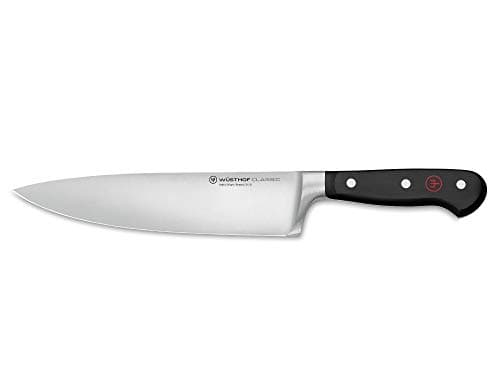
Wusthof Wusthof Classic 8"
Wusthof Classic 8"

The best object on this page and the highest score, on the rubric and by a clear margin on build: forged X50CrMoV15 at around 58 HRC, full bolster, full tang, with a factory edge ground keener than the German norm at roughly 14 degrees per side. Buy it if you want one knife for the next thirty years and you will keep it honed.

Best forged knife here
8.4
$170.00Amazon
02
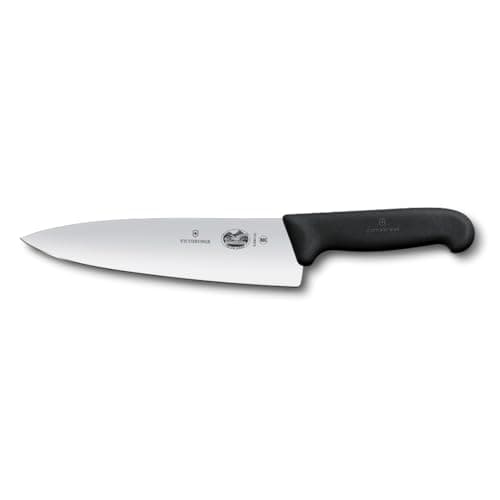
Victorinox Victorinox Fibrox Pro 8"
Victorinox Fibrox Pro 8"

The knife to buy if you are reading this page because you are not sure the premium is real. Stamped Swiss X50CrMoV15 around 55-56 HRC with the grippiest wet handle in the category, NSF certified, at a price that makes it the benchmark everything else gets measured against. It loses on build and wins on value hard enough to finish a tenth of a point behind a knife three times its price.

Best value and best wet grip
8.2
$47.00Amazon
03
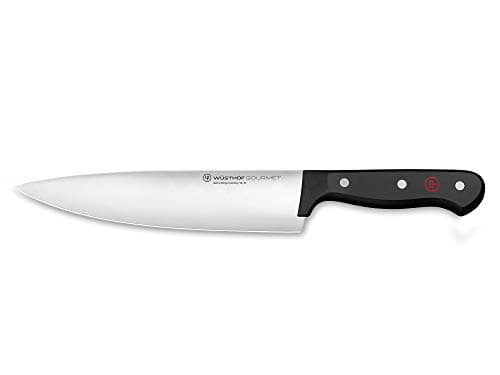
Wusthof Wusthof Gourmet 8"
Wusthof Gourmet 8"

The true like-for-like Wusthof: precision-stamped in Solingen from the same X50CrMoV15, around 56 HRC, at roughly 6.4 oz. If you want the Wusthof name, the Wusthof steel and the Wusthof service network without the forged premium, this is the cheapest honest route to it - and it still costs about twice the Victorinox it is competing with.

Best lightweight Wusthof
7.8
$69.98Amazon

#ad · Live prices from the Amazon Product API, as of October 9, 2026. Where we have no verified live price, we show none — a gap beats a number that has rotted.

In detail

The picks, in full

01
Wusthof Wusthof Classic 8"

Best forged knife here

Wusthof Classic 8"

Forged X50CrMoV15~58 HRC~14 deg/side edgeFull bolster & tang
8.4/10

The best object on this page and the highest score, on the rubric and by a clear margin on build: forged X50CrMoV15 at around 58 HRC, full bolster, full tang, with a factory edge ground keener than the German norm at roughly 14 degrees per side. Buy it if you want one knife for the next thirty years and you will keep it honed.

Edge & steel
8
Sharpness
9
Handling
8
Build
10
Value
7

Pros

  • Keener factory grind than the German norm, so it arrives genuinely sharp
  • Full bolster gives the most secure, comfortable pinch grip of the three
  • Deepest range of spares, service and matching pieces of any brand here
  • Forged full tang gives the heft and balance stamped knives cannot

Cons

  • Full bolster eventually leaves a step at the heel under stone sharpening
  • Heavy - the heft is deliberate and not for everyone
  • Solingen pricing on a widely-matched steel specification
  • Roughly three and a half times the Victorinox for a knife that does not cut three and a half times better

Don't buy this if…

…you want the lightest knife or the best wet grip - the Victorinox beats it on both, for much less money.

The score here is reproduced from our Wusthof versus Zwilling page, which established it, and from the full Classic 8" review. It has not been re-rated for this comparison. What the number says is straightforward: this is a 10 on build and a 7 on value, and both of those are true at once.

The practical difference you will feel against the Victorinox is weight and the bolster. The Classic is a substantially heavier knife with a thick forged spine, and a full bolster — a raised steel collar between blade and handle — that stops your fingers from sliding forward and makes a pinch grip feel planted. Cooks who rock-chop against a board tend to love it. Cooks who prefer a light, agile blade find it tiring, and there is no amount of specification reading that will tell you which you are. The one objective downside of the full bolster is long-term and only matters if you sharpen on stones: the collar runs down past the heel, so the last half-inch of edge is hard to reach on a flat stone and slowly develops a step. Wusthof's own answer to that is the Classic Ikon, which carries a half bolster.

$170.00View on Amazon

Price as of October 9, 2026. Prices change — Amazon's at checkout is the one that counts.

#ad · we may earn a commission from this link to Wusthof Classic 8"

02
Victorinox Victorinox Fibrox Pro 8"

Best value and best wet grip

Victorinox Fibrox Pro 8"

Stamped X50CrMoV15~55-56 HRC~20 deg/side edgeLight ~7.4 oz
8.2/10

The knife to buy if you are reading this page because you are not sure the premium is real. Stamped Swiss X50CrMoV15 around 55-56 HRC with the grippiest wet handle in the category, NSF certified, at a price that makes it the benchmark everything else gets measured against. It loses on build and wins on value hard enough to finish a tenth of a point behind a knife three times its price.

Edge & steel
7
Sharpness
8
Handling
9
Build
7
Value
10

Pros

  • The grippiest handle here with wet or greasy hands
  • Very light - comfortable through long prep for most hands
  • Swiss-made with published specifications and NSF certification
  • Cheap enough to own a spare, and cheap enough that the stone you buy with it still costs less than one Wusthof

Cons

  • Softest steel in this comparison - honing is not optional
  • No forged option anywhere in this price band
  • Widest stated edge angle here, so the factory cut is blunter than either Wusthof
  • Utilitarian looks, no bolster, no heft

Don't buy this if…

…you want the heft and bolster of a forged knife - Victorinox simply does not sell one at this price.

Score reproduced from our Victorinox versus Mercer comparison, which established it on the same rubric. The two-tenths gap to the Wusthof is the honest summary of this entire page: on a rubric where value is one metric out of five, a knife at a fraction of the price finishes marginally behind a forged Solingen blade. If you weight value more heavily than we do — and for a first good knife you probably should — the order flips.

The specification difference that matters most is the edge angle, and it is the one people skip. Victorinox grinds nearer 20 degrees per side against Wusthof's roughly 14; that is a blunter, more obtuse, more durable edge that will not cut as cleanly out of the box. It is also the easiest edge on this page to restore, because softer steel abrades faster and a wider angle is more forgiving of a wobbly hand. Our easiest knives to sharpen guide makes the Fibrox the example it is built on. A $40 knife plus a decent 1000-grit stone will out-cut an unmaintained $170 knife every day of the week, which is the single most useful thing anyone can tell you about this comparison.

$47.00View on Amazon

Price as of October 9, 2026. Prices change — Amazon's at checkout is the one that counts.

#ad · we may earn a commission from this link to Victorinox Fibrox Pro 8"

03
Wusthof Wusthof Gourmet 8"

Best lightweight Wusthof

Wusthof Gourmet 8"

Precision-stamped in SolingenX50CrMoV15, ~56 HRC~6.4 ozRiveted synthetic handle
7.8/10

The true like-for-like Wusthof: precision-stamped in Solingen from the same X50CrMoV15, around 56 HRC, at roughly 6.4 oz. If you want the Wusthof name, the Wusthof steel and the Wusthof service network without the forged premium, this is the cheapest honest route to it - and it still costs about twice the Victorinox it is competing with.

Edge & steel
7
Sharpness
8
Handling
9
Build
7
Value
8

Pros

  • Noticeably lighter than the forged Classic - the lightest knife on this page
  • Made in Solingen with the same steel alloy as the flagship line
  • Backed by Wusthof's service and sharpening network
  • Soft enough to maintain with a honing rod alone

Cons

  • Stamped, so no bolster and less balance than the Classic
  • Softer than the forged line, so it needs honing more often
  • Priced above specification-equivalent stamped knives on the name
  • Loses the value argument to the Victorinox and the build argument to the Classic, which is why it finishes third

Don't buy this if…

…you want the heft that made you consider Wusthof in the first place - this is deliberately the light option.

Score reproduced from our home-cooks roundup, where this knife was first written up. It is on this page for one reason: it is the knife that answers "is the Wusthof premium about the brand or about the forging?" with evidence rather than opinion. The Gourmet is the brand without the forging, and it scores 7.8 — below the stamped Swiss knife that costs roughly half as much.

That is not a criticism of the knife, which is well made and genuinely pleasant to use if you find the Classic heavy. It is a criticism of the purchase. If weight is your objection to the Classic, a lighter knife is the right answer and this is a good one; our small-hands guide covers the rest of that problem. If price is your objection to the Classic, the Gourmet is the expensive way to solve it. See stamped versus forged knives for what the construction difference does and does not buy you.

$69.98View on Amazon

$100.0030% off

Price as of October 9, 2026. Prices change — Amazon's at checkout is the one that counts.

#ad · we may earn a commission from this link to Wusthof Gourmet 8"

The four published numbers that decide this

Everything in this comparison reduces to four figures the makers publish, plus the live price. Here they are side by side so you can check our reasoning rather than take it.

SpecificationVictorinox Fibrox Pro 8"Wusthof Classic 8"Wusthof Gourmet 8"
ConstructionStampedForged, full tangPrecision-stamped
SteelX50CrMoV15X50CrMoV15X50CrMoV15
Published hardness~55–56 HRC~58 HRC~56 HRC
Edge angle~20° per side~14° per side (PEtec)Not published separately
BolsterNoneFull bolsterNone
Weight~7.4 ozHeaviest of the three~6.4 oz
Made inSwitzerlandSolingen, GermanySolingen, Germany
NSF certifiedYesNot listedNot listed
Our score8.28.47.8

Read the hardness column first. Three HRC points between the Victorinox and the Classic is a real difference and a small one — it is the difference between honing twice a week and honing once. It is nothing like the gap to a Japanese knife at 61 HRC, which is a different maintenance regime entirely. Then read the edge angle, which is the bigger deal: Wusthof's PEtec grind at roughly 14 degrees per side is a genuinely keener factory edge, and it is the thing you will notice in the first five minutes with the knife. And then read the construction row, because that is what the money is actually buying.

What forging buys, and what it does not

A forged knife is hammered from a single billet, which leaves a thick spine, a full tang running the length of the handle, and usually a bolster. A stamped knife is cut from rolled sheet. The honest list of what forging gives you is: weight, balance, a bolster, and a thicker spine that tapers toward the edge. The honest list of what it does not give you is edge retention or sharpness, both of which come from the steel and the grind. A stamped blade in the same alloy at the same hardness will hold an edge the same way.

That is why the Gourmet matters as a control. Same factory, same alloy, two HRC points softer, no forging — and the result is a knife most people cannot distinguish from the Classic in a blind cut test, at a lower price. You are buying the heft and the bolster, and whether those are worth the gap is a question about your hands, not about quality. Our stamped versus forged explainer goes through the manufacturing in more detail.

The maintenance question, which decides it for most people

Both brands sit in the soft-steel, wide-angle, forgiving half of the kitchen knife world, which means both of them respond extremely well to a honing rod and both of them are easy to sharpen. That matters more than the purchase price. A Victorinox honed before each session and put on a stone every couple of months will cut better than a Wusthof Classic that lives in a drawer and has never been touched — and the second scenario is far more common than anyone selling knives wants to admit.

If you are not currently sharpening your knives, spend the Wusthof money this way instead: the Victorinox, a 1000/6000 combination stone, and a honing rod. That is three purchases, it comes to less than one Classic, and it is the single biggest upgrade available to a home kitchen. If you already sharpen, the Classic is a better knife and the heel-step issue is the only caveat — in which case read the Classic Ikon review before you buy, because the half bolster solves exactly that.

Who should buy which

Buy the Victorinox Fibrox Pro if this is your first good knife, if you work with wet hands, if you prefer a light blade, or if you would rather put the difference into sharpening gear. It is the pick on our under-$100 roundup and the reason that page exists.

Buy the Wusthof Classicif you want a forged knife, if you rock-chop and like weight behind the cut, if the bolster's security matters to you, or if you want a single knife with a thirty-year service path behind it. It is also the knife to buy if you are buying a gift and want the recipient to feel the object in their hand — see our knife gift guide.

Buy the Wusthof Gourmet only if you specifically want Wusthof and specifically want light. In every other scenario one of the other two is the better purchase.
How we picked

We did not lab-test these knives

Everyone in this category says they tested twenty knives in a professional kitchen. We have not hands-on tested any of these, and we say so. What we did instead: compiled the published specifications — steel type and hardness (HRC), edge angle, blade geometry, weight and build — applied established sharpening standards, ran the value math (spec quality ÷ live price), and scored each product against a published rubric. The scores are judgments from documented research — not measurements we took, because we do not have a test lab and we will not pretend we do. Where a number came from someone else's work, we name them in Sources.

Questions

Frequently asked

Is Wusthof actually better than Victorinox?
As an object, yes — the Classic is forged, harder, keener from the factory and built to a higher standard, and it scores higher on our rubric. As a purchase for most home cooks, no. The Victorinox cuts well enough that professional prep lines run on it, grips better with wet hands, weighs less, and costs a fraction as much. The gap in our scores is two tenths of a point, and the gap in price is roughly three and a half times.
Which one holds an edge longer?
The Wusthof Classic, by a small margin. It is published at around 58 HRC against the Victorinox at roughly 55–56, and harder steel resists the edge rolling over for longer. Both are soft by Japanese standards, so both will need a honing rod regularly rather than occasionally. Neither will behave like a knife at 60–61 HRC — see our Shun versus Global comparison for what that side of the market looks like.
Is the Wusthof Gourmet just a cheap Wusthof?
It is a stamped Wusthof rather than a cheap one: made in the same Solingen facility, from the same X50CrMoV15 alloy, at around 56 HRC and roughly 6.4 oz. What it lacks is the forging, the full tang and the bolster. That makes it lighter and less balanced, and it does not reduce its ability to take or hold an edge, which comes from the steel.
Can I sharpen both of these on the same stone at the same angle?
Close enough for practical purposes, but not identically. Victorinox grinds nearer 20 degrees per side and Wusthof nearer 14, so if you sharpen a Wusthof at 20 degrees you will slowly make it a blunter knife than the factory intended. Both are soft enough that a standard 1000-grit stone works well on either. Our angle guide covers how much precision actually matters here.
Does either knife come sharp out of the box?
Both do, and the Wusthof noticeably more so because of the narrower factory grind. A new Victorinox is sharp in a workmanlike way; a new Wusthof Classic is sharp in a way people comment on. That difference closes the first time either one goes on a stone, which is worth remembering before you pay for it.

Keep reading

Receipts

Sources

We do not run a testing lab, and we do not pretend to. Where a spec or a measured number came from someone else's work — a manufacturer's page, a published standard — we name them and link them. Where we could not verify something, we say so on the page rather than quietly leaving it out. Read our full method.