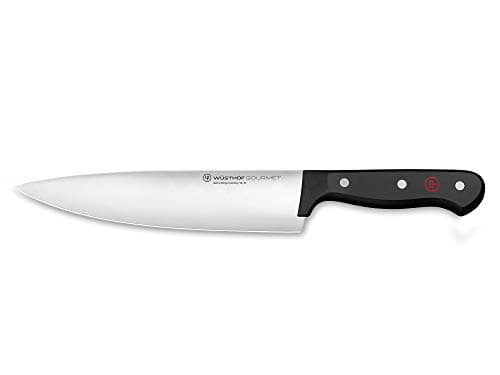
Our Classic Ikon review took apart Wusthof's claim that a half bolster "reduces the weight of the knife" and found that against the published figures it comes to about six grams. This is the knife where the lightening is real. On the same retailer spec sheet, the 8-inch Gourmet weighs 6.5 oz (186 g) against the forged Classic's 9.3 oz (265 g). That is 79 grams, near enough a 30% reduction, and it is the single most useful thing to know about this knife.
The Gourmet is Wusthof's stamped line. Wusthof's own wording for how it is made is "laser-stamped from a single piece of high-carbon, stain-resistant WÜSTHOF steel" — one blade punched and ground out of rolled stock rather than hammered from a billet, which is the difference stamped vs forged knives covers in full. What surprises people is how much of the forged knife survives that decision. The alloy is the same X50CrMoV15. The published edge is the same 14 degrees per side, double bevel. The factory is the same one in Solingen. The warranty is the same limited lifetime warranty. We have not cooked with this unit and we do not run a test lab; what follows is compiled from published specifications and the value math we apply to every pick, exactly as set out in how we review. This knife already ranks in best German chef knives, in best chef knives for home cooks and in Victorinox vs Wusthof; this page is the long version of those entries.
The three numbers that separate it from the Classic
Put the two spec sheets side by side and the entire decision is in three figures. Weight: 6.5 oz against 9.3 oz. Hardness: 56 HRC against 58 HRC. Spine at the heel: 2.7 mm against 3.0 mm.Everything else that gets printed on a box — alloy, edge angle, blade length, handle material, country of manufacture, warranty — is the same on both knives.
Two Rockwell points is a real difference and a small one. It means the Gourmet's edge rolls over sooner under the same work, so you will reach for a honing rod more often; it also means the edge comes back faster when you do, and the steel is even more forgiving of a wandering angle on a stone. If you have never owned a knife harder than 58 HRC, two points will not announce themselves. If you are coming from a Japanese blade at 60–61 HRC, you will notice. Knife steel types explained covers what hardness does and does not buy, and how often to sharpen knives sets the cadence.
The 79 grams, though, is the kind of difference that changes whether you enjoy cooking. It is roughly the weight of a large egg removed from the end of your arm, through every repetition of a two-hour prep session. There is no performance argument here in either direction — heavier knives are not better knives, they are different tools — but there is a comfort argument, and it is the reason this knife exists. If you have ever put a forged German chef's knife down mid-onion because your wrist was tired, read chef knives for small hands and then come back to this one.
The thing nobody mentions: no bolster means the heel reaches the stone
A stamped knife has no bolster. There is no collar of steel between blade and handle at all, because there was never a billet to leave one in. That is usually filed under what you lose — and it is: no finger guard at the heel, less mass behind the blade, a different balance point. But it has a consequence that the marketing never connects.
The Wusthof Classic Ikon exists, and lists well above the Classic, substantially because its half bolster stops short of the heel so that the full length of the edge can be sharpened for the life of the knife. On a full-bolster Classic the last inch of edge never touches a stone, and after a decade of sharpening the heel stands proud of the edge as a visible step — the long-term complaint we treat as a buying factor in easiest knives to sharpen. The Gourmet, the cheapest 8-inch chef's knife Wusthof sells, has no bolster to get in the way at all. The heel is fully exposed from day one.
We are not going to pretend that makes the Gourmet a better knife than an Ikon. The Ikon is forged, harder, heavier, better balanced and better finished, and a bolster is also a safety feature your fingers appreciate. But if an accessible heel is the specific reason you were looking at the Ikon, the specification you want is available in Wusthof's entry line for a fraction of the money, and nobody is going to tell you that in a store.
Where it sits against the knives that actually compete with it
Here is the honest problem with this knife, and it has nothing to do with Wusthof. At its street price the Gourmet is not competing with the Classic — it is competing with every good stamped knife on the market, and that is a brutal field. The Victorinox Fibrox Pro is stamped from the same X50CrMoV15 family, is NSF certified, has a grippier handle when wet, and costs meaningfully less; Mercer Millennia undercuts both by a wide margin. On a pure specifications-per-dollar basis, neither of those is a worse buy than this one, which is exactly why the Gourmet does not appear in our best value roundupat all — on this site a page about value ranks the knives that win on value.
What the Gourmet has that they do not is the Solingen factory, the keener published 14-degree grind against Victorinox's wider Western edge, and Wusthof's service and sharpening network behind it. Those are real things. Whether they are worth the gap is a judgment about what you value, not a specification, and we would rather say that plainly than dress a preference up as a performance claim. If you want the argument laid out head-to-head, Victorinox vs Wusthof is that page, and Wusthof vs Henckels covers the other knife that lands on the same shelf at the same money.
Who this knife is for
Three people, specifically. Someone who tried a forged German chef's knife and found it tiring — this is the same knife shape and the same steel with 79 grams removed. Someone who wants a knife made in Solingen and is not prepared to spend Classic money to get one. And someone who sharpens on a stone and wants an edge with nothing in the way of the heel, which the Gourmet gives you for less than any half-bolster model.
It is also a sensible second knife for a household that already owns a forged Classic: the light one for long vegetable prep and for whoever in the house dislikes the heavy knife, the forged one for the jobs that want mass behind the blade.
Who should buy something else
If weight and balance are what you want from a German knife, buy the Wusthof Classic or the Zwilling Professional S and accept the heft — it is the feature, not the flaw. If you want the cheapest genuinely good stamped knife and the badge does not matter, the Victorinox Fibrox Pro is the shortest path and best chef knives for the money ranks that field. If you want a forged knife at this price, the Mercer Renaissanceis forged German steel for about what the Gourmet costs — it is simply not made in Germany. And if what you actually want is a keener, harder edge rather than a lighter knife, you want a different steel philosophy altogether: Japanese vs German is the decision to make before you spend anything.
Living with it
Hone it more often than you would a Classic and you will barely notice the two Rockwell points — how to use a honing steel has the method, and a rod removes no metal so there is no cost to doing it before every session. When it does need a stone, stay close to the published 14 degrees per side rather than the 20 a pull-through sharpener will impose; knife sharpening angles explains how to match a factory grind and how to sharpen kitchen knives is the step-by-step. Work the heel too: on this knife there is nothing stopping you.
Wusthof's published care instruction for the Gourmet is the same as for the forged lines — hand wash, towel-dry immediately, avoid abrasive sponges and do not leave it soaking. Follow it. Can you put knives in the dishwasher sets out what a cycle actually does to an edge and to a riveted handle, and knife care and maintenancecovers the rest. A stamped blade this thin is also the wrong tool for frozen food and bone — if those are regular jobs, a cleaver is the honest answer.
One thing to check before you click buy
The Gourmet line is wide and the listings look alike. The 8-inch chef's knife we are reviewing is model 1025044820, the black-handled version; the same blade also sells with white and gray handles under different model numbers, and the line includes a 7-inch hollow-edge santoku, a 6-inch, a 10-inch and various sets. Check the length and the model number in the cart rather than trusting the photograph, and if you want the santoku shape instead, read chef's knife vs santokufirst. Blade height is one figure the sources disagree on — Wusthof publishes 1.9 in for the blade width, the spec sheet says 1.87 in — so treat that one as approximate.