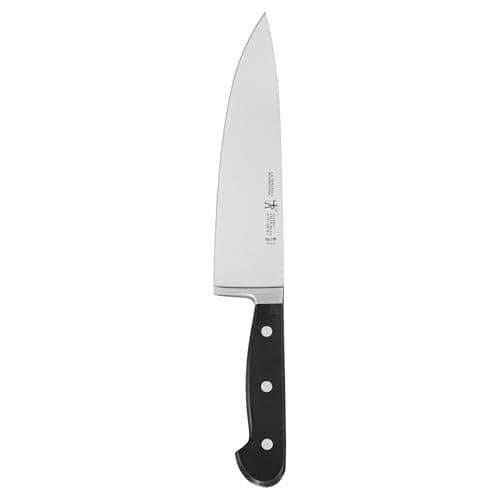
Before anything else: "Henckels" is two different brands, and the one you are probably looking at is not made in Germany. HENCKELS — the single-figure logo, sold as the value tier — lists the country of origin for its Classic 8-inch chef's knife on its own product page as "Made in Spain". The Amazon listing for the same knife is titled "HENCKELS Classic 8-Inch Chef Knife, Razor-Sharp, German Engineered". Both statements are accurate. They are describing different things, and almost nobody puts them side by side.
ZWILLING J.A. Henckels — the twin-figure logo — is the premium tier, it is German-made, and it is a different comparison: we run that one on Wusthof vs Zwilling, and if that is the brand you meant, read that page instead. The clue is the logo and the price. Two little figures facing each other means Zwilling. One figure means the value line. The corporate parent is the same company, which is exactly why the names collide in a search box: you can buy the same HENCKELS Classic chef's knife on zwilling.com and on henckels.com, under the same model number.
Wusthof, by contrast, is one brand with one story. Every knife in the lines we rank is made in Solingen, and Wusthof publishes the hardness, the edge angle and the alloy for each one. That difference in disclosure, more than the postcode, is the thing that actually decides this comparison — and it is why the ranking below is not close.
What each maker publishes, and what it does not
We score knives from published specifications and value math rather than from a test kitchen; the method is on how we review. That makes disclosure a specification in its own right, and here the two makers are not comparable.
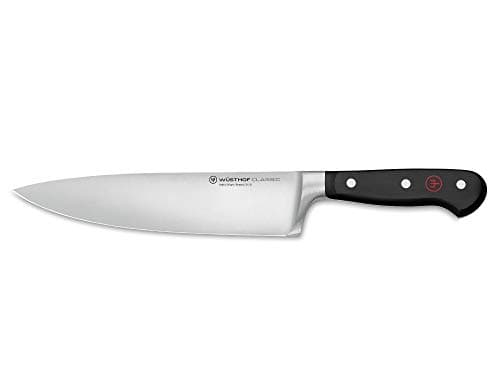
For the Wusthof Classic 8", Wusthof publishes: forged construction, Solingen manufacture, 58 HRC, a Precision Edge Technology grind at about 14 degrees per side, a full bolster and full tang, a triple-riveted POM handle, a limited lifetime warranty, and a care instruction to hand wash and towel-dry immediately. Retailer spec sheets add 9.3 oz (265 g), a 1.9 in blade height and a 3 mm spine at the heel.
For the HENCKELS Classic 8", HENCKELS' own US product page publishes: "fully forged construction", "high-quality, German stainless steel", a "traditional triple-rivet handle", "dishwasher safe", a lifetime warranty, and "Made in Spain". It publishes no hardness figure, no alloy designation, no edge angle and no weight. Zwilling's listing for the same model fills in a hardness range of 55–58 HRCand describes the edge only as a "fine edge with V-edge finishing" — which is where the ~56 HRC figure in our German chef knives roundup comes from, and why we round to the bottom of the range rather than the top.
That gap is not a conspiracy; value brands routinely publish less. But it changes what you can know before you buy. With the Wusthof you can check the hardness against knife steel types explained, match the sharpening angle in knife sharpening angles, and know what you are maintaining. With the HENCKELS you are buying a shape, a warranty and a reputation, and you will find out the rest on your board.
"Made in Spain" is not an insult
We want to be careful here, because the easy version of this page sneers at Spanish manufacturing, and that would be wrong. Spain has a real cutlery industry with a long history, and plenty of excellent knives are made there. Forged is forged: the HENCKELS Classic is a genuinely forged, full-bolster, full-tang knife, which is more than you get from most knives at its price, including Wusthof's own stamped Gourmet.
The honest objection is narrower. "German engineered" in a product title, next to a German brand name and a German-looking riveted handle, invites you to believe you are buying the thing that made Solingen famous. You are buying a competent forged knife made somewhere else to a lower price, and the price is the tell. Decide that trade deliberately rather than by accident, and you will be happy with it. That is the same test we apply to the Mercer Renaissance, which is forged German steel made outside Germany and is one of the best value knives on this site.
The third knife, and why it changes the answer
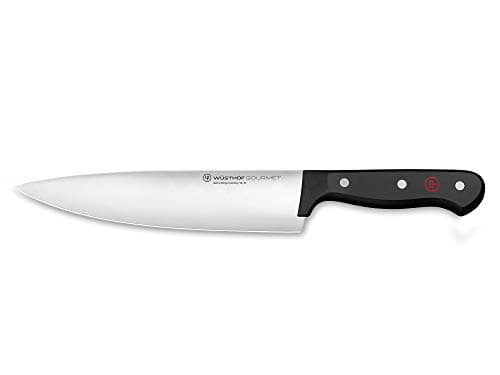
A HENCKELS Classic and a Wusthof Gourmet land within a few dollars of each other. That is the comparison most people in this price band are actually making, whether they realize it or not, and it is a genuinely interesting one because the two knives are opposites:
The HENCKELS is forged, in Spain, with a full bolster and real mass, and no published hardness or grind angle. The Gourmet is stamped, in Solingen, with no bolster at all, at 6.5 oz against the Classic's 9.3, and Wusthof publishes 56 HRC and 14 degrees per side for it. One gives you the construction; the other gives you the postcode, the keener published grind and a fully sharpenable heel. Neither is the obvious winner, and we have ranked them on the rubric rather than on which story we like better. Our Wusthof Gourmet review is the long version of that knife, and stamped vs forged knives is the mechanism behind the trade.
One difference you can act on today: the dishwasher
The two makers take opposite published positions. HENCKELS says the Classic is dishwasher safe. Wusthof says hand wash and towel-dry immediately, and avoid soaking and abrasive sponges. If a knife going in the machine is a condition of it actually getting used in your house, that is a real point for the HENCKELS, and it is the maker's own position rather than our inference. We would still wash either of them by hand, and can you put knives in the dishwasher sets out the four mechanisms that do the damage — impact, chloride pitting, detergent alkalinity and prolonged moisture — and why heat is the least of them.
Which one should you buy?
Buy the Wusthof Classicif you want one chef's knife for the next thirty years, you will hone it regularly, and the money is available. It wins the rubric, it is the only knife here whose every relevant figure is published, and the forged Solingen build is not marketing.
Buy the HENCKELS Classicif you specifically want the heft and the finger guard of a forged, full-bolster German-style knife and your budget is about a third of the Wusthof's. You are getting real construction, a lifetime warranty and a knife rated for the dishwasher. Go in knowing it is made in Spain and that nobody will tell you how hard the steel is.
Buy the Wusthof Gourmet if what you want from Wusthof is the factory and the published specification rather than the forging, or if a 9.3 oz knife is simply too heavy for your hand. It is the lightest knife here by a wide margin and the only one at this price actually made in Solingen.
And if you came to this page comparing Wusthof against the premium Henckels brand, the knife you want is a Zwilling and the page you want is Wusthof vs Zwilling. Our Zwilling Pro review and Zwilling Professional S review cover the two models that actually compete with the Wusthof Classic.
How to read a "German" knife listing
Four phrases do most of the work in this category, and only one of them is a manufacturing claim. "Made in Germany"or "Made in Solingen" is the real one. "German steel" tells you where the alloy recipe came from, not where the knife was made. "German engineered" and "German design"tell you about the drawings. All four can appear on a knife made anywhere. The fix takes ten seconds: find the maker's own product page for the exact model number and look for a country-of-origin line. If there is not one, assume the knife is not made in the country the brand name suggests. We apply the same test across every brand we rank, and best chef knives on Amazon covers how to read a marketplace listing more generally.
The two logos, settled
Two figures facing each other is ZWILLING J.A. Henckels: the premium brand, the German factory, the Pro and Professional S lines. One figureis HENCKELS: the value brand, broader sourcing, lines like Classic, Statement, Solution and Forged Accent. They share a corporate parent, which is why you can find the same HENCKELS model number on both companies' websites, and why the names blur together in a search box. It is not a trick — it is a conventional good-better tier structure, the same thing Wusthof does with Gourmet, Classic and Classic Ikon. The difference is that Wusthof's tiers all share a city, and Henckels' do not.
What neither of them fixes
Whichever knife you buy here, the edge will be dull within weeks of real use, and at that point the knife you chose matters far less than whether you can put an edge back on it. None of these three is a difficult knife to sharpen — soft Western steel is the forgiving end of the spectrum, which is the whole argument of easiest knives to sharpen. Hone before each session with a decent rod, learn a 1000/6000 stonewhen you are ready, and keep the blade off glass and stone boards, which do more damage to an edge than anything else in a kitchen — cutting boards for knives explains why board hardness is the largest single determinant of edge life.