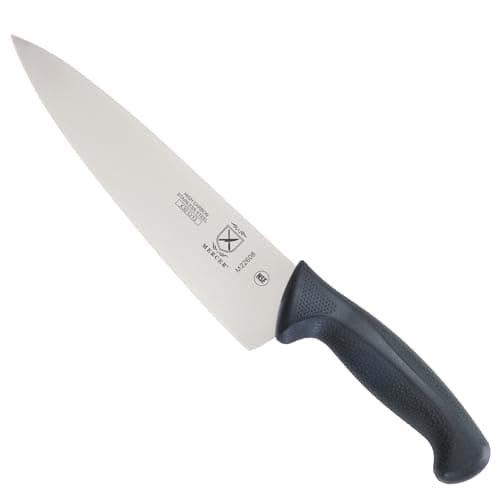
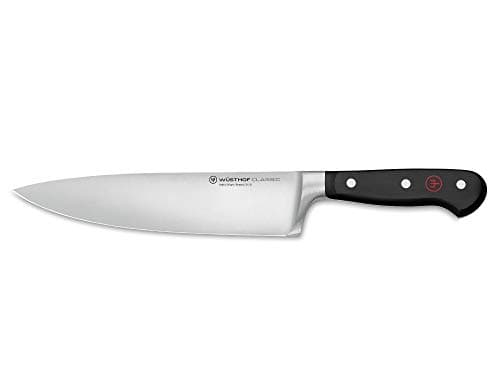
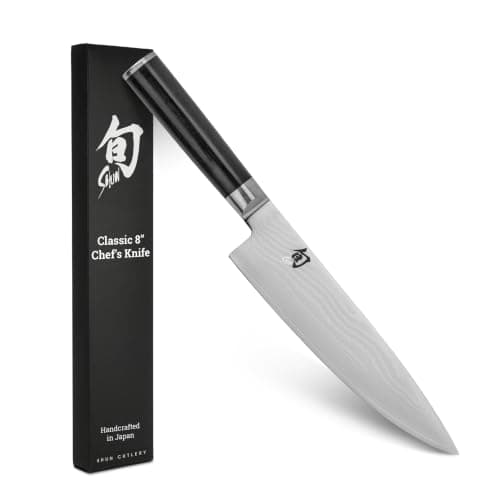
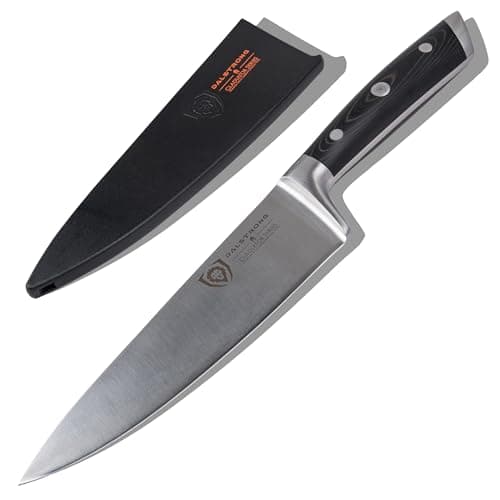
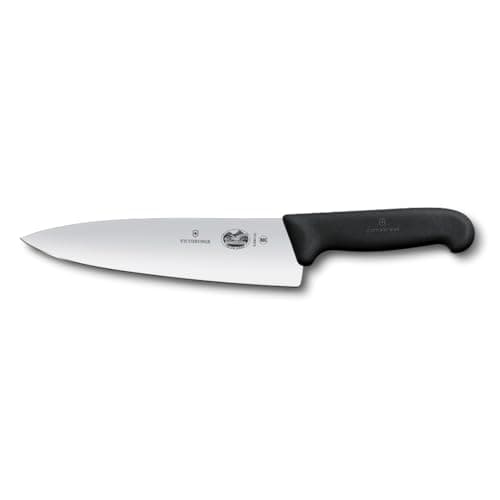
Amazon is simultaneously the best and worst place to buy a chef's knife. Best, because the established makers all sell there and the pricing is usually the keenest you will find. Worst, because the same search results are packed with house brands that exist only as a logo applied to whatever a contract factory offered that quarter — 67-layer Damascus, a hardness number with no alloy attached, a thousand five-star reviews and no maker behind any of it.
We are an Amazon affiliate site, and we would rather say that plainly and then be useful about it than pretend the marketplace has no problems. The picks below are knives from makers with published specifications you can check against the manufacturer's own site. The second half of this page is the part that will save you more money: how to read a listing well enough to tell a real knife from a relabeled one.
How we ranked these
No lab, no hands-on testing — our method is published. Every pick scores on published steel and hardness, ground edge angle, handling, build and value against the live price. An additional filter applies on this page: the manufacturer must publish the specification independently of the marketplace listing, so the claim can be verified somewhere other than the place trying to sell it to you.
How to read a knife listing
Look for an alloy name, not an adjective.X50CrMoV15, VG-10, AUS-10, 1.4116, SG2 — these are real, checkable steel designations. "High-carbon stainless steel", "German steel" and "surgical steel" are not specifications; every stainless kitchen knife on earth qualifies for at least one of them.
Distrust a hardness number with no steel attached."62 HRC" is meaningless without knowing what was hardened — and on the cheap end it is frequently just untrue, because nobody is going to test it. A maker that names both numbers is telling you something falsifiable, which is the point.
Check who ships and sells it."Ships from and sold by Amazon.com" or by the brand's own storefront is the safest combination for a knife, because commingled inventory is how counterfeits of popular models reach buyers. For an expensive Japanese knife in particular, buying from the brand's official store is worth a small premium.
Read the one-star and three-star reviews only. Five-star reviews on cutlery are dominated by first-week impressions of a factory edge, which every knife has. The failures — chipped tips, handles separating, edges that would not hold — live in the low and middle ratings, and they are the reviews that describe the knife you will own in a year.
Be suspicious of a brand that sells everything. If the storefront also offers garlic presses, yoga mats and phone cases, the knives are a sourced product line, not a metallurgy program. That does not make them unusable, but it does mean nobody stands behind the specification.
What we would skip
Skip any listing whose headline is a layer count. "67-layer Japanese Damascus VG10 professional chef knife" from a brand with no website is the single most common shape of this problem: the cladding claim is checkable-looking, the core claim is not, and the hardness figure is whatever the copywriter typed. Skip knives sold in a bundle with a sheath, a sharpener and a peeler at a price that could not cover the steel. And skip anything whose review history shows a sudden burst of five-star reviews for an unrelated product — that is a repurposed listing.
More broadly: skip the entire idea that Amazon rank tells you anything about knife quality. It reflects sales velocity, advertising spend and review volume. Some of the best knives in this category sit well down the results because their makers do not run marketplace ad campaigns.
Prices, and why ours move
Marketplace pricing on knives is unusually volatile — the same model can swing a long way inside a month. Every price on this site is pulled live and stamped with the date it was checked, and if our data goes stale the number disappears rather than misleading you. That is also why we do not write prices into prose anywhere on this site: a number typed into a sentence is wrong within a week and nobody notices.
Returns are the marketplace's real advantage
A knife is a hand tool, and no specification tells you whether a handle suits your grip. The genuine advantage of buying online from a major retailer is the return window: order the knife, hold it, do one onion, and send it back if the handle fights you. Use that. It is worth more than any amount of reading — including this page.
If you would rather buy elsewhere entirely, our guide to where to buy chef knives covers specialist retailers, department stores and buying direct, and what each is actually better at.