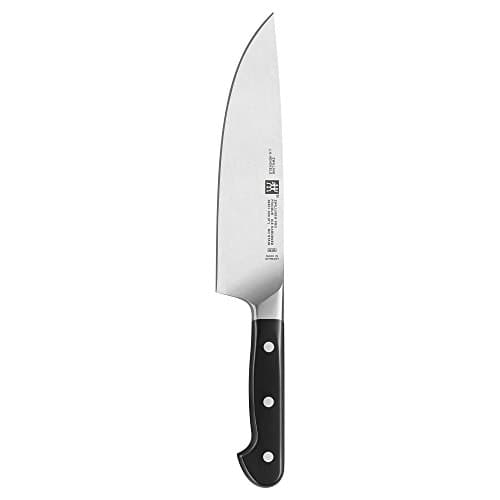
Here is the finding that should decide this purchase, and almost no review of this knife leads with it. Zwilling publishes the same specification for the Pro as it does for the cheaper Professional S: special-formula high-carbon stainless steel, a published hardness of 55–58 HRC, forged from a single piece of steel by the SIGMAFORGE process, ice-hardened by FRIODUR, a full tang with a triple-riveted handle, made in Germany. Not similar — the same published numbers, from the same maker, on the same website. What the Pro premium buys is not better steel. It is geometry: a differently shaped bolster and a differently shaped blade.
That is not a knock on the knife. Geometry is a legitimate thing to pay for, and in this case it solves a real, permanent problem that the Professional S has. But it reframes the decision entirely, because geometry either matters to how you use a knife or it does not, and most buyers can answer that in about ten seconds. We have not cooked with this unit and we do not run a test lab; what follows is compiled from Zwilling's own published specifications and the value math we apply to every pick, exactly as set out in how we review. This knife ranks in best German chef knives and is one of the two knives in Wusthof vs Zwilling; this page is the longer version of those entries.
The bolster, which is the entire argument
A bolster is the collar of steel between the blade and the handle. On a traditional German knife it runs all the way down to the heel, which gives your fingers a guard and adds mass behind the blade — and it also means the last inch of edge never touches a sharpening stone. Sharpen the rest of the blade for ten or fifteen years and the heel is left standing proud of the edge as a visible step. It is not a defect and it will not stop the knife working; it is simply what happens, and it is the single most common long-term complaint about forged German knives.
The Pro line's answer is a curved bolsterthat sweeps up away from the heel rather than running down to it. Zwilling describes it as acting "as an extension of the hand, encouraging cutting with improved precision, safety, and comfort," and says it supports a professional pinch grip. The practical consequence is the one that matters: the full length of the edge reaches the stone, for the life of the knife. Our easiest knives to sharpen guide treats this as a more important buying factor than steel type for anyone who maintains their own edges, and this is the knife that argument was written about.
The corollary is blunt: if you will never put this knife on a whetstone, the thing you are paying extra for does you no good whatsoever. Someone who hones weekly and sends a knife out for professional sharpening once a year gets no benefit from an accessible heel, because they are not the one grinding it. That is the ten-second question, and the honest answer for a lot of home cooks is no.
The two-Pro trap
This is the part worth reading before you click buy, because Amazon makes it very easy to get wrong. Zwilling sells two different 8-inch Pro chef's knives at the same list price, and their marketplace titles differ by a single word.
- Pro 8" Chef's Knife (38401-203)— the one reviewed here. Zwilling describes the profile as a "gently curved belly ideal for rocking cuts, straight back excels at chopping." Handle length 5.12 inches.
- Pro 8" Traditional Chef's Knife (38411-203)— sold on Amazon as the "Traditional Chef's Knife." Zwilling describes it as a "flatter blade profile with a straighter edge from heel to tip, ideal for push- and pull-cutting." Handle length 4.53 inches.
Same steel, same hardness, same forging, same curved bolster, same blade length, same list price — and a different cutting stroke. If you rock-chop, the curved-belly 38401 is the one you want; if you push-cut the way most Japanese knives encourage, the flatter Traditional is arguably the better match, and it has a handle more than half an inch shorter. Neither listing explains this in its title. Read the model number, not the name.
The steel, in plain terms
Zwilling does not publish an alloy designation for its "special formula" steel, which is worth saying plainly rather than filling the gap — it is a chromium-molybdenum-vanadium stainless in the German tradition, and the published 55–58 HRC band is exactly where that tradition sits. A distributor listing for the Pro gives 57 HRC and a 15-degree-per-side V-edge, which is consistent with that band and with what Zwilling says about its edges, but Zwilling itself publishes neither number on the product page, so treat both as approximate rather than as the maker's commitment.
What the band tells you is more useful than the exact figure. At 55–58 HRC this edge fails by rollingrather than chipping, which means a honing rod does real work on it and a bad moment against a bone is recoverable instead of expensive — see knife steel types explained. It also means edge retention is good by Western standards and nowhere near a 61 HRC Japanese blade. FRIODUR, Zwilling's cryogenic step after hardening, is genuine process control that helps toughness and corrosion resistance; it does not move the knife into a different hardness class, and Zwilling does not claim it does.
Who this knife is for
A cook who sharpens their own knives freehand and intends to own this one for decades. That is a genuinely narrower group than the marketing implies, and it is the group for whom this is arguably the best German chef's knife you can buy: the accessible heel means the knife you are sharpening in year twenty is the same shape as the knife you bought, which is not true of a full-bolster blade. It also suits anyone who has handled a Professional S and found the full bolster crowded their pinch grip — the curved bolster gives the same finger protection with more room for the fingers.
Who should buy something else
If your maintenance plan is a honing rod plus occasional professional sharpening, buy the Zwilling Professional S instead and put the difference toward a stone and a board. Every published material specification is the same and it costs less. If you want the keenest German edge out of the box, the Wusthof Classic states a keener factory grind at a similar price, and Wusthof vs Zwilling settles that head-to-head properly. If you want forged German heft for much less money, the Mercer Renaissanceis the shortest route there. And if the weight is the problem rather than the price, a lighter blade will serve you better — chef knives for small hands explains why.
Living with it
Hone it before you cook and you will rarely need a stone; at 55–58 HRC the edge rolls and a rod stands it back up in seconds — how to use a honing steel has the method and how often to sharpen knives the cadence. When it does need a stone, the whole point of this knife is that you can work the heel like any other part of the edge; follow how to sharpen kitchen knives on a whetstone. Zwilling lists the knife as dishwasher safe but recommends hand washing, and that recommendation is the one to follow — knife care and maintenance covers what a cycle does to an edge and to a riveted handle.
On the Pro and the Professional S sharing a name
Zwilling's naming is genuinely unhelpful here and it costs buyers money. "Pro" and "Professional S" sound like the same line at two trim levels; they are separate lines whose published materials are identical, and the difference you pay for is the bolster rather than anything in the steel. Add the two different 8-inch Pro chef's knives on top of that and there are three similarly named Zwilling 8-inch chef's knives a buyer can land on by accident. The defense is the model number: 38401-203 is the curved-belly Pro, 38411-203 is the flatter Traditional Pro, 31021-203 is the Professional S. Our chef knife brands guidemakes the same point about Zwilling and Henckels International being different tiers under one parent — this is the same trap one level down.