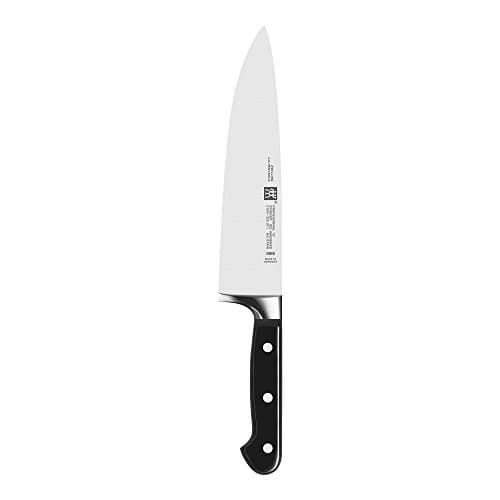
The Zwilling Professional S is the German knife people buy when they have done the reading. It is forged in a factory Zwilling owns, uses FRIODUR ice-hardened steel at around 57 HRC, carries a full bolster and a full tang, and typically sits near $100 — roughly what a stamped Wusthof Gourmet costs and considerably less than a forged Wusthof Classic. We have not cooked with this unit; what follows comes from published specifications and the value math on how we review.
It is, in short, the value pick of the forged German field, which is why it anchors that slot in our German roundup and appears in the under-$200 list. It also carries the two drawbacks that define traditional German knives: it is heavy, and the full bolster will make sharpening the heel harder every year you own it.
What FRIODUR ice-hardening does
FRIODUR is Zwilling's name for a cryogenic step in heat treatment: after hardening, the steel is cooled far below freezing before tempering. The published benefits are better corrosion resistance, a more uniform structure and improved edge stability at a given hardness. It is a real process rather than a marketing word, and it is part of why a Zwilling at around 57 HRC behaves more like a slightly harder knife than the number suggests. What it does not do is turn German steel into Japanese steel — you should still expect to hone regularly, and you should still expect the edge to roll rather than chip, which is the more forgiving failure mode. Our steel guide explains why.
The full bolster problem, stated plainly
The Professional S has a traditional full bolster: the collar of steel between blade and handle continues all the way down to the heel. It feels reassuring, it protects your fingers, and it is the single thing about this knife that will annoy you in a decade. Because it sits proud of the cutting edge, the last inch of blade never touches a stone. As you sharpen the rest of the edge over years, the heel is left standing out as a small hook, and the only proper remedy is grinding the bolster back — a job for a professional. Zwilling's own Pro line uses a sloped bolster specifically to solve this — see our Zwilling Pro 8-inch review, which shares this knife's published steel and hardness and differs mainly in that bolster — and Messermeister's Meridian Elite skips the heel bolster entirely. If you plan to maintain your own knives, read easiest knives to sharpen before you commit.
Professional S versus Wusthof Classic
These two are the German mainstream, and the honest comparison is closer than the price gap suggests. Both are forged in Germany, both use similar X50CrMoV15-class steel, both carry a full bolster and a full tang, and both will outlive your kitchen. The Wusthof runs slightly harder at around 58 HRC and has a marginally keener Precision Edge; the Zwilling has the ice-hardening process and usually costs substantially less. The most useful difference is the handle: Wusthof's traditional riveted shape and Zwilling's more contoured one suit different hands, and that is worth more than the spec sheet gap. Our Wusthof Classic review covers the other side.
Weight, and who it suits
This is a heavy knife by modern standards, and weight is not neutral. Behind a rock-chop through a pile of carrots, mass is doing useful work and the knife feels effortless. Two hours into batch prep it is doing the opposite. If you have small hands, wrist trouble, or a habit of long prep sessions, a lighter blade will genuinely serve you better — either a stamped Western knife or a Japanese blade around 6–7 oz. Our size guide covers how to work out what fits your hands before you buy.
Keeping it sharp
At around 57 HRC this is easy steel to maintain. Hone before each session with a ridged steel rod — the technique is in how to use a honing steel— and sharpen a few times a year on any competent stone at roughly 15 degrees per side to match the factory grind. Nothing exotic is required; the forgiving nature of German steel is exactly why it is the right recommendation for anyone learning. Just accept, as above, that the heel is going to lag behind the rest of the edge.
How we picked
We did not lab-test these knives
Everyone in this category says they tested twenty knives in a professional kitchen. We have not hands-on tested any of these, and we say so. What we did instead: compiled the published specifications — steel type and hardness (HRC), edge angle, blade geometry, weight and build — applied established sharpening standards, ran the value math (spec quality ÷ live price), and scored each product against a published rubric. The scores are judgments from documented research — not measurements we took, because we do not have a test lab and we will not pretend we do. Where a number came from someone else's work, we name them in Sources.