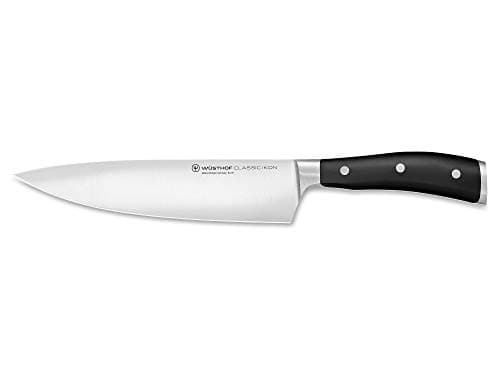
Wusthof explains the Classic Ikon's defining feature in a single sentence on its own product page: "The half bolster, the junction between handle and blade, reduces the weight of the knife, making it easier to handle. It also allows the entire blade to be sharpened more easily." That is two separate promises, and they are not equally good. One of them is the best argument for buying a forged German knife in 2026. The other, when you put the published weights side by side, comes to about six grams.
Everything else about this knife is the Wusthof Classic, and Wusthof does not pretend otherwise: forged in Solingen, a published 58 HRC, the same X50CrMoV15-class German stainless, the same Precision Edge Technology grind at roughly 14 degrees per side, the same triple-riveted POM handle material, the same limited lifetime warranty. We have not cooked with this unit and we do not run a test lab; what follows is compiled from published specifications and the value math we apply to every pick, exactly as set out in how we review. This knife already ranks in best German chef knives and in best chef knives in the world; this page is the long version of those entries.
The claim that holds up: the heel reaches the stone
A bolster is the collar of steel between blade and handle. On a traditional German knife it runs all the way down to the heel, which gives your fingers a guard and puts mass behind the blade — and it also means the last inch of edge never touches a sharpening stone. Sharpen the rest of the blade for ten or fifteen years and the heel is left standing proud of the edge as a visible step. It is not a defect and it will not stop the knife working. It is simply what happens, and it is the single most common long-term complaint about forged German knives, which is why we treat it as a buying factor in easiest knives to sharpen.
The Ikon's half bolster stops short of the heel, so the full length of the edge reaches the stone for the life of the knife. That benefit is permanent, it compounds, and it is invisible on day one — which is exactly why most buyers never weigh it. It is also conditional in a way worth being blunt about: if you will never put this knife on a whetstone, the thing you are paying extra for does you no good at all. Someone who hones weekly and sends knives out for professional sharpening once a year gets nothing from an accessible heel, because they are not the one grinding it. That is a ten-second self-assessment, and for a lot of home cooks the honest answer is no.
The claim that does not: "reduces the weight of the knife"
Wusthof publishes no weight for either knife, so we took all three figures below from a single retailer spec sheet — Cutlery and More — rather than mixing sources, because a weight comparison across two different measuring methodologies is not a comparison at all. On that one sheet, the 8-inch Classic Ikon is 9.1 oz (259 g) and the full-bolster 8-inch Classic is 9.3 oz (265 g). Both carry a 3 mm spine at the heel. The half bolster saves you six grams.
Six grams is less than the disagreement between sources: our own German roundup quotes the Classic at 9.1 oz from a different sheet, which would make the two knives identical. Either way, nobody's hand can feel it. If you came to the Classic Ikon because you wanted a lighter Wusthof, this is not the knife — a stamped blade is, and stamped vs forged explains what you give up to get there, while chef knives for small hands covers the case where weight is the actual problem.
Here is the part that makes the weight sentence look like boilerplate rather than a specification: Wusthof prints the same sentence on a different knife where it is true.The Classic Half Bolster 8-inch (model 1040130120) carries an identical description — and on the same spec sheet it weighs 7.7 oz (217 g) against the Classic's 9.3 oz. That is a difference you can feel. It also has a 2.5 mm spine at the heel rather than 3 mm, so a thinner blade is doing part of the work there, not the bolster alone. One sentence, two knives, one of them actually lighter.
Which brings us to the awkward question
If an exposed heel is the reason to buy a Classic Ikon, Wusthof already sells an exposed heel in the cheaper Classic line. The Classic Half Bolster has the same X50CrMoV15-class forged Solingen blade, the same published 58 HRC, the same roughly 14-degree PEtec edge, the same triple-riveted POM handle and the same lifetime warranty — and on Wusthof's own store it lists below the Classic Ikon. It is live on Amazon as we write this; we verified that before publishing. Street prices on the two models move independently and have at times put the Ikon underneath it, so compare them on the day rather than trusting either list price.
So what does the Ikon premium buy, once you take the heel access out of the equation? The handle. Not the material — both are POM — but the shape. The Ikon handle is contoured rather than straight-sided, and it carries a second bolster at the butt end, which is what distributors mean when they call it a "double-bolster design" and market it on "excellent heft and balance." That is the opposite sales pitch to Wusthof's own weight-reduction line, and both can be true at once: the half bolster is at the blade end, the second bolster is at the pommel.
We cannot score a handle shape from a specification sheet and we will not pretend to. What we can tell you is that the Ikon blade is also slightly shallower than the Classic's — 1.75 in of blade height against 1.9 in— so you get marginally less knuckle clearance over the board, and that published handle lengths for these three models disagree across sources (Wusthof lists 4.5 in for all three; two retailers list 5 in and 5.1 in). Treat every handle figure you read on this model as unreliable and go and hold one, which is the same advice we give about the Global G-2 for the same reason.
One more thing before you click buy
There are two Classic Ikon 8-inch chef's knives: the black-handled 1040330120 and the crème-handled 1040430120, sold as the Classic Ikon Crème. Same blade, same steel, same bolster, same dimensions, different handle color and a different listing. Wusthof's own black-handle product page was, at the time of writing, printing the crème SKU in its specification table — so if the model number on the page you are reading does not match the color in the photograph, that is why. Buy on the color you want and check the SKU in the cart.
Who this knife is for
A cook who sharpens their own knives freehand, wants a forged German blade, and cares about the handle. That is a narrower group than the marketing implies, and for them this is arguably the best German chef's knife you can buy: the knife you are sharpening in year thirty is the same shape as the knife you bought, which is not true of a full-bolster blade, and the contoured grip is the one thing here that the cheaper Classic Half Bolster does not replicate. It also suits anyone who has handled a Classic or a Zwilling Professional S and found the full bolster crowding their pinch grip.
Who should buy something else
If your maintenance plan is a honing rod plus occasional professional sharpening, buy the Wusthof Classicand put the difference toward a stone and a board — every published material specification is the same. If you want the exposed heel and nothing else, Wusthof's Classic Half Bolster (1040130120) is the direct route and the lighter knife. If the curved-bolster approach appeals more than the half-bolster one, the Zwilling Pro solves the same problem a different way and Wusthof vs Zwilling settles that head-to-head. If you want forged German heft for much less money, the Mercer Renaissanceis the shortest path there. And if what you actually want is a keener edge rather than a better bolster, you want harder steel — Japanese vs German is the decision to make first.
Living with it
Hone it before you cook and you will rarely need a stone; at 58 HRC the edge rolls rather than chips and a rod stands it back up in seconds — how to use a honing steel has the method and how often to sharpen knives the cadence. When it does need a stone, the whole point of this knife is that you can work the heel like any other part of the edge, so work the full length of it: follow how to sharpen kitchen knives on a whetstone and keep close to the factory grind, which knife sharpening anglesexplains how to match. Wusthof's own care line is "wash by hand and immediately towel-dry", and to avoid abrasive sponges and leaving the knife soaking — follow it, and read knife care and maintenance for what a dishwasher cycle does to an edge and to a riveted handle.
What PEtec does and does not claim
Precision Edge Technology is Wusthof's laser-guided edge-grinding process, and the company markets it as producing a blade "20% sharper" that "stays sharper twice as long" than an ordinary knife. Read that carefully: the comparison is against an unnamed ordinary knife, not against a rival brand, and nothing in it changes the steel. A 58 HRC blade has 58 HRC edge retention no matter how precisely the bevel was ground — knife steel types explained covers why hardness, not grinding, sets that ceiling. What the process does deliver is a keener and more uniform factory angle than the old German 20-degree standard, consistent from heel to tip, which is a genuine and checkable improvement and the reason both Wusthof Classic lines score eight rather than seven for sharpness here.