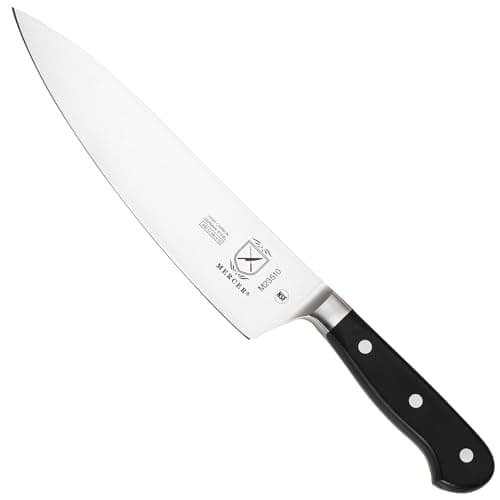
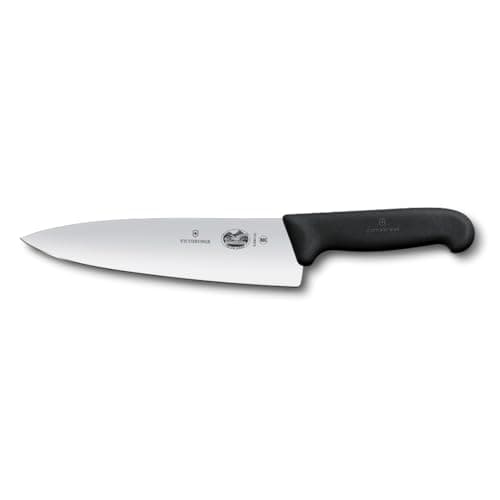
Buy the Victorinox Fibrox Pro 8" as your chef's knife, and build the rest of the kit from inexpensive NSF-certified stamped knives. That is the whole recommendation, and it is for anyone starting a culinary program, a ServSafe-governed kitchen placement, or a first commercial job. A school kitchen is communal, wet, fast and hard on equipment. Your knife will be used by someone else, left on a drainboard, knocked off a bench and sharpened badly by a classmate. In that environment the specifications that decide a good purchase are wet grip, NSF certification, how fast the steel comes back on a stone, and how little it hurts to replace — not Rockwell hardness and not Damascus cladding.
The single most expensive mistake students make is bringing a premium Japanese knife to school. A Shun Classicat 60–61 HRC is a better knife than anything on this page and the wrong knife for this situation: hard steel micro-chips, chips need a whetstone and a calm twenty minutes, and neither exists during a service lab. Soft German and Japanese-stamped steel at 53–58 HRC rolls instead of chipping, and a rolled edge comes back on a honing rod in fifteen seconds. Our easiest knives to sharpen guide is the single most relevant page on this site for a student.
Before you spend anything, read your school's tool list and ask two questions: what does the program supply, and does it require a specific kit? Many programs sell a branded roll as part of tuition, and buying a duplicate set is a straightforward waste of money. A typical required list is a chef's knife, a paring knife, a serrated bread or utility knife, a boning knife, an offset or sandwich knife, a peeler, and a steel — and the five knives on that list are what this page covers. Where the list says "8-inch chef's knife, NSF certified" and nothing more, you have the freedom to choose, and the picks below are what that freedom is worth spending on.
How these are scored. This lineup spans five knife types, so the per-type rubrics on our dedicated roundups cannot be compared across it. Every pick here is scored on one rubric built for this situation — school-list fit, durability, grip security, edge maintenance and value — and ranked strictly by the resulting average. The published specifications are unchanged from the roundups that established them; only the rubric is specific to this page.
What a school kitchen does to a knife, and what to buy because of it
Every criterion on this page comes from one observation: a school kitchen is not your kitchen. The knife lives in a roll that travels, gets used on boards you did not choose, goes through a shared pot sink, and sits next to thirty identical knives. Four consequences follow, and they are the rubric.
Wet grip is the safety specification.Hands are wet or greasy for most of a lab, and a knife that rotates in the hand is the single most common cause of a cut. Victorinox's textured TPE Fibrox and Mercer's Santoprene are both designed for this; a smooth polymer or polished wood handle is not. This is the reason the forged Mercer finishes last here despite being the best-made knife on the page.
NSF certification is usually what the tool list means.When a program writes "commercial grade" it generally means a knife with a sealed, non-absorbent handle that an inspector will pass. Every pick above except the forged Mercer Renaissance is NSF certified, and it is worth checking the listing rather than assuming.
Soft steel is the right steel.This is counter-intuitive and it is the most useful thing on the page. At 53–58 HRC an edge rolls over under abuse and comes back on a honing rod. At 60–61 HRC it chips, and a chip needs a stone and time you will not have. Softer steel also sharpens faster on whatever stone the school supplies, which may be flat, worn, or the wrong grit. The common sharpening mistakes guide is worth ten minutes before the first lab.
Replaceability is a feature.Knives go missing in shared kitchens. A $40 chef's knife you can replace from a supermarket in an afternoon keeps you working; a $200 Japanese knife out of stock for two weeks does not. Mark everything — tape on the handle, initials on the roll — and expect to replace at least one piece.
The kit, slot by slot
| Slot on the tool list | Our pick | Why |
|---|
| 8" chef's knife | Victorinox Fibrox Pro 8" | Best wet grip, NSF, most forgiving edge to maintain |
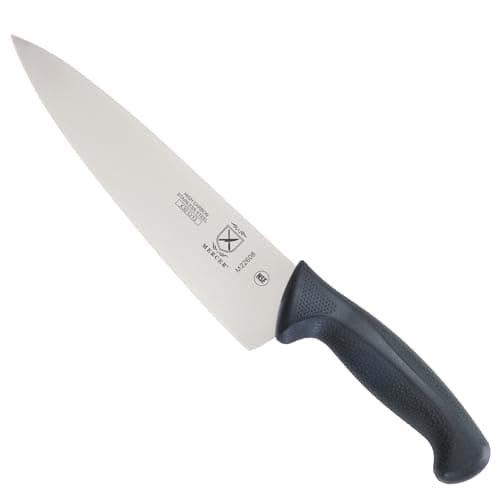
| Chef's knife (budget alternative) | Mercer Millennia 8" | Usually cheapest; pick it if the Fibrox handle does not fit your hand |
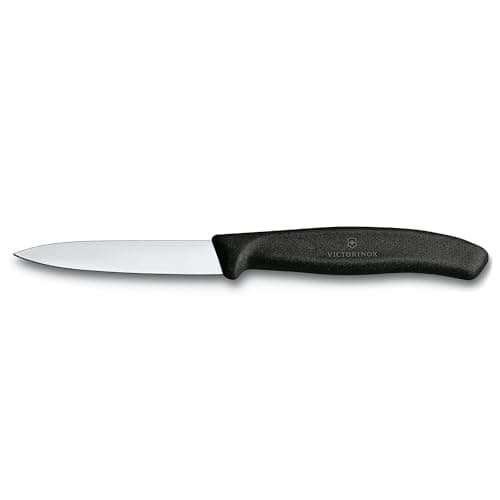
| Paring knife | Victorinox Swiss Classic 3.25" | Cheap enough to buy two, which is the correct number |
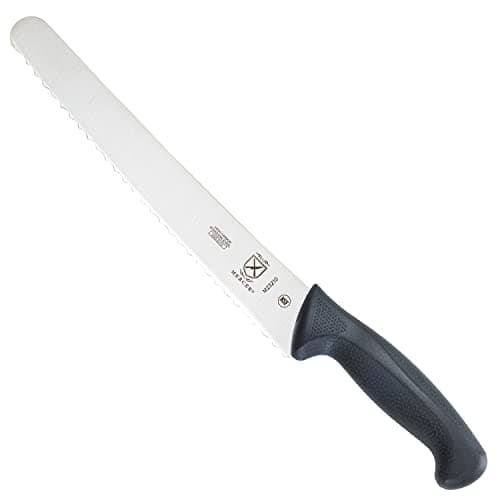
| Serrated / bread | Mercer Millennia 10" wavy edge | Serrated edges are consumables; buy the cheap good one |
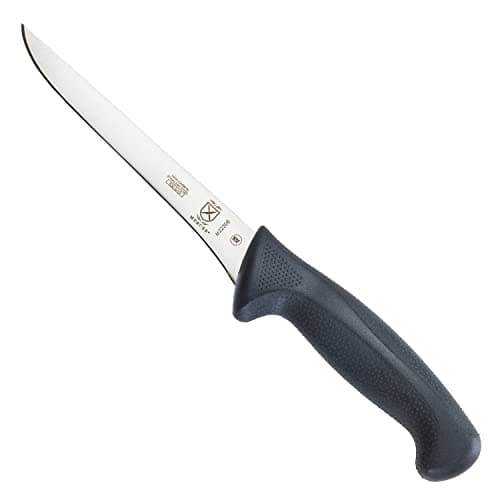
| Boning | Mercer Millennia 6" stiff (M22306) | Publishes its stiffness; cheapest honest option in the category |
| Forged upgrade, if required | Mercer Renaissance 8" | Forged X50CrMoV15 at ~58 HRC without Solingen pricing |
| Honing steel | See our honing roundup | Non-negotiable with steel this soft; a rod is used daily, a stone is not |
A honing rod is the one piece this page does not rank, because it is a different category with its own roundup: start with our honing steel roundup and read honing versus sharpening first if the distinction is new to you. A student who hones daily will out-cut a classmate with a better knife who does not, every single time.
What to skip
A block set. You need specific pieces in a roll, not a counter block. Our are knife sets worth it guide covers why sets are mostly filler, and in this context the filler is also luggage.
Premium Japanese steel. Covered above and worth repeating. If you want one eventually, buy it after graduation for your own kitchen; our Japanese beginners roundup is the page for that purchase, not this one.
A santoku, nakiri or cleaver, unless the list asks.They are good knives and they are not on a Western culinary tool list. A chef's knife does those jobs well enough that no instructor will mark you down.
A second chef's knife. One, honed, is better than two that are both dull.
After school: what to keep
The honest answer is that most of this kit is consumable and you should expect to replace it. The pieces worth keeping are the forged Mercer if you bought one, and the honing rod. When you are buying for your own kitchen rather than for a shared one, the constraints change completely — wet grip stops being the binding specification and edge retention starts mattering, which is when a Japanese knife becomes a sensible purchase. See our professional chef knives roundup for what working cooks buy once they are choosing for themselves.