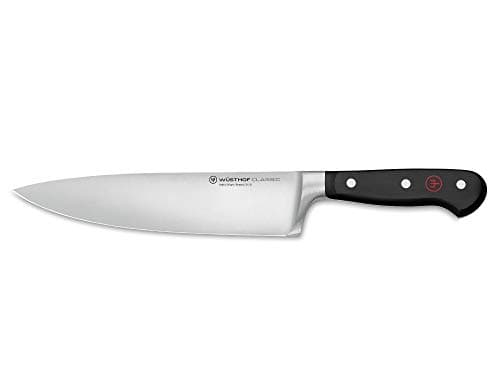
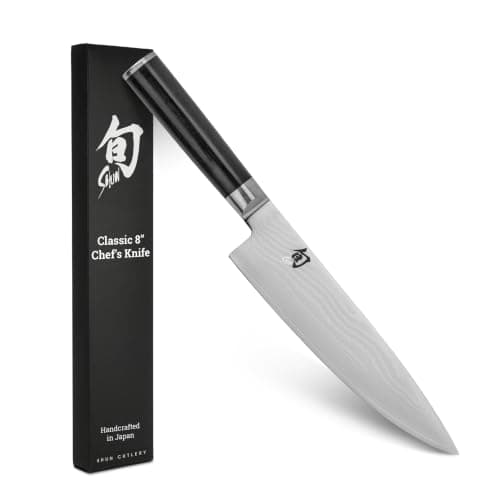
If you want one comparison that explains the entire chef-knife market, this is it. The Shun Classic and the Wusthof Classic are both flagship 8-inch knives from serious makers at broadly similar prices, and they resolve the central engineering trade-off in opposite directions. Shun runs a harder core at a keener angle: it cuts more cleanly and stays sharp longer, and it chips. Wusthof runs softer steel with more mass: it is tougher and easier to maintain, and it dulls sooner.
Neither choice is wrong. What is wrong is buying the Shun and using it like the Wusthof, which is the single most common way people ruin an expensive knife.
| Feature | Shun Classic 8" | Wusthof Classic 8" |
|---|
| Core steel | VG-MAX, clad in 68 Damascus layers | X50CrMoV15, forged |
| Published hardness | ~60–61 HRC | ~58 HRC |
| Edge angle | ~16° per side | ~14° per side |
| How the edge fails | Micro-chips | Rolls over |
| Correct maintenance | Whetstone (or fine ceramic rod) | Honing rod, plus occasional stone |
| Weight & feel | Light, precise, blade-forward | Heavy, planted, bolster-balanced |
| Handle | D-shaped Pakkawood (right-hand contoured) | Symmetrical triple-riveted synthetic |
Angle is not the whole story
Read the table quickly and you will notice something odd: the Wusthof's stated edge angle is keenerthan the Shun's. That is accurate, and it is why edge angle alone is a poor proxy for how a knife cuts. Two other properties matter as much. First, how thin the blade is behind the edge— the Shun's thinner Japanese stock parts food that the thicker German blade has to wedge apart. Second, how long the apex survives— at 60–61 HRC the Shun holds its keenness for far longer than the Wusthof holds its (arguably keener) one. In practice the Shun feels sharper for weeks; the Wusthof feels sharp for days and then needs a rod.
Rolling versus chipping
This is the difference that decides which knife suits you. Softer steel yields: the very edge bends over microscopically under load, which is why a German knife that "feels dull" often just needs ten seconds on a honing rod to stand the edge back up. Harder steel does not bend, it breaks: a Shun that meets a chicken bone or a frozen corner takes a small chip, and no rod on earth puts that back. It needs metal removed on a stone until the chip is gone.
So the honest question is not "which is better" but "what happens in your kitchen". If knives get put in the sink, used on bone, or handed to whoever is helping, the Wusthof is the correct engineering choice. If your knives are hand-washed, dried, kept on wood, and used by you, the Shun is the better cutter by a clear margin.
Handedness, which people forget
The Shun Classic's D-shaped Pakkawood handle is contoured for a right-handed grip. Many left-handed cooks use it without complaint; some find it genuinely uncomfortable over a long session. The Wusthof's handle is symmetrical and neutral. If you are left-handed this is a real consideration — see left-handed chef knives.
The short answer
Quick picks
| # | Knife | Best for | Score | Price |
|---|
| 01 | Shun Classic 8"The better cutter, unambiguously - thinner stock, harder core, longer between sharpenings. It asks for hand-washing, a whetstone and discipline about what it touches, and it repays all three every time you use it. | Best cutting performance | | $140.15·Amazon |
| 02 | Wusthof Classic 8"The tougher, more forgiving knife, and the right answer for most shared kitchens. Softer steel means the edge rolls instead of chipping, which means a rod fixes it - no stone skills, no anxiety about what the blade might meet. | Best for real-world durability | | $170.00·Amazon |
#ad · Live prices from the Amazon Product API, as of October 17, 2026. Where we have no verified live price, we show none — a gap beats a number that has rotted.
In detail
The picks, in full
Best cutting performance
Shun Classic 8"
VG-MAX core~60-61 HRC~16 deg double bevel68-layer Damascus
The better cutter, unambiguously - thinner stock, harder core, longer between sharpenings. It asks for hand-washing, a whetstone and discipline about what it touches, and it repays all three every time you use it.
- Edge & steel
- 10
- Sharpness
- 10
- Handling
- 8
- Build
- 9
- Value
- 5
Pros
- +Cleaner cut through dense produce thanks to much thinner stock
- +Holds a keen edge far longer than any German knife here
- +Light and precise - noticeably less tiring on long prep
- +Kai runs a genuine service and resharpening program
Cons
- −Chips rather than rolls, and a chip needs stone work
- −D-shaped handle is contoured for right-handed use
- −A honing rod does comparatively little at this hardness
- −Damascus cladding shows every fingerprint and water spot
Don't buy this if…
…your kitchen involves bones, frozen food or knives left in a sink - this knife will be chipped inside a year.
Best for real-world durability
Wusthof Classic 8"
Forged X50CrMoV15~58 HRC~14 deg/side edgeFull bolster & tang
The tougher, more forgiving knife, and the right answer for most shared kitchens. Softer steel means the edge rolls instead of chipping, which means a rod fixes it - no stone skills, no anxiety about what the blade might meet.
- Edge & steel
- 8
- Sharpness
- 8
- Handling
- 8
- Build
- 10
- Value
- 7
Pros
- +Rolls rather than chips - a honing rod is a complete maintenance answer
- +Tolerates bone, joints and the occasional frozen edge
- +Symmetrical handle works equally well for left-handed cooks
- +Forged heft suits cooks who rock-chop
Cons
- −Thicker stock wedges in dense vegetables where the Shun glides
- −Loses its edge noticeably faster
- −Heavy for extended fine work
- −Full bolster complicates heel sharpening over the years
Don't buy this if…
…the quality of the cut is what you care about most - the Shun is the sharper, thinner, better-cutting knife and it is not close.
Which should you buy?
Buy the Shun if you cook often, wash by hand, will keep a cheap second knife for rough jobs, and are prepared to learn a whetstone. You will get a better cut every single day and you will not have to sharpen it nearly as often. Buy the Wusthofif your kitchen is shared, if knives sometimes get treated badly, if you are left-handed and sensitive to handle shape, or if the honest answer to "will I buy a stone?" is no. A German knife that gets honed will outperform a Japanese knife that never gets sharpened, every time.
The answer a lot of people should hear: buy both, eventually
These knives are not really competitors in a well-equipped kitchen — they are complementary. The Japanese blade does the vegetable and boneless-protein work where thinness and keenness pay; the German blade does the squash, the chicken, the thing that turns out to have a bone in it. Owning a keen knife and a tough knife is a more useful kitchen than owning two of either. If budget forces one, buy the tough one first.
Cheaper ways to buy the same trade-off
Both positions are available for less money. On the Japanese side, MAC and Tojiro deliver thin stock and a hard core without the Damascus premium — see best Japanese chef knives for beginners. On the German side, Mercer's Renaissance line matches Wusthof's spec sheet at a fraction of the price, trading finish quality. The full map is in best chef knife brands. And if you have already settled on Japanese and are choosing between brands rather than philosophies, Shun versus Global is the head-to-head for that.
Whatever you buy, match the sharpening to the steel
The most expensive mistake in this comparison is not choosing wrong — it is buying the Shun and putting it through a Western pull-through sharpener set near 20°. That regrinds a 16° Japanese edge into a blunter Western one, permanently, and it is invisible until the knife stops cutting the way it did. Our sharpeners for Japanese knives roundup lists the devices that can actually hold 15 degrees. If you buy hard steel, buy a stone or a guided system you can set to 15°.
How we picked
We did not lab-test these knives
Everyone in this category says they tested twenty knives in a professional kitchen. We have not hands-on tested any of these, and we say so. What we did instead: compiled the published specifications — steel type and hardness (HRC), edge angle, blade geometry, weight and build — applied established sharpening standards, ran the value math (spec quality ÷ live price), and scored each product against a published rubric. The scores are judgments from documented research — not measurements we took, because we do not have a test lab and we will not pretend we do. Where a number came from someone else's work, we name them in Sources.
Questions
Frequently asked
Is a Shun better than a Wusthof?+
It cuts better and holds its edge longer. It is also more fragile and needs stone sharpening. "Better" depends entirely on whether your kitchen suits a hard, keen blade — for a lot of shared home kitchens the Wusthof is the more sensible knife.
Will a Shun chip if I use it normally?+
Not under normal vegetable and boneless-protein work on a wood or plastic board. Chips come from bone, frozen food, hard boards (glass, stone, ceramic) and drops. Keeping a cheap Western knife for those jobs solves the problem completely.
Can I use a honing steel on a Shun?+
Not a ridged steel rod — it is too aggressive for a 61 HRC edge. A fine ceramic rod is acceptable for light realignment; a whetstone is the correct tool. Kai also offers a factory sharpening service.
Which lasts longer?+
Both last decades with proper care. The Wusthof survives abuse better; the Shun survives sharpening better, because its harder steel needs less metal removed each time. The limiting factor for both is usually the owner, not the knife.
Is the Damascus cladding on a Shun functional?+
Partly. The clad layers add rigidity and corrosion resistance around the core, and they help food release slightly. They do not make the knife sharper — the VG-MAX core does the cutting. More detail in
Damascus steel knives explained.
Receipts
Sources
We do not run a testing lab, and we do not pretend to. Where a spec or a measured number came from someone else's work — a manufacturer's page, a published standard — we name them and link them. Where we could not verify something, we say so on the page rather than quietly leaving it out. Read our full method.