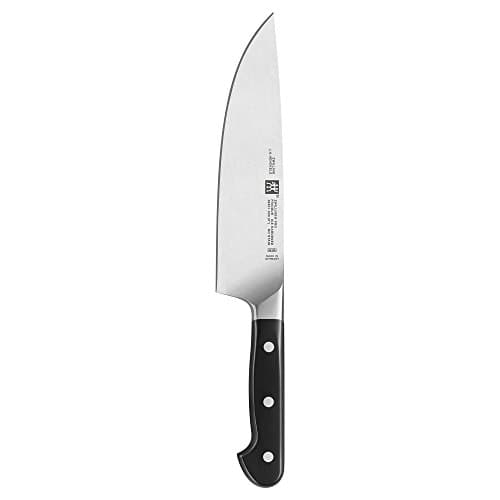
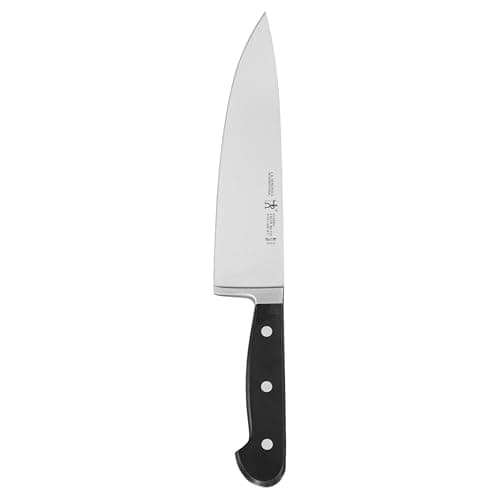
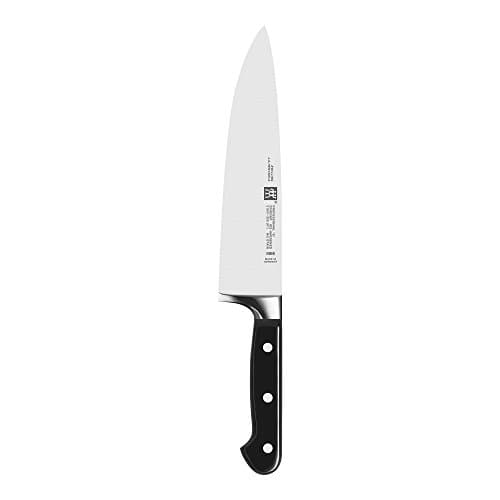
Buy the Zwilling Professional S. It is the cheapest Zwilling on this page and it beats the more expensive Zwilling Pro on our rubric. The thing to understand before anything else: Zwilling and HENCKELS are not rivals. They are two brand tiers under one company, Zwilling J.A. Henckels of Solingen, and the twin-man logo versus the single-man logo is how you tell which tier you are holding. Zwilling-branded knives are forged in the company's own German factory. The HENCKELS entry tier is a different proposition — and per HENCKELS' own product page, its Classic 8-inch chef knife is made in Spain.
That is not a quality verdict, and this page does not treat it as one. Forged is forged wherever the forge is. The real objection to the HENCKELS Classic is that HENCKELS publishes no hardness, no alloy and no edge angle for it at all, while the Amazon listing title says “German engineered” — which is a different claim from German made, and worth knowing before you pay for the second one.
The scores below are reproduced verbatimfrom each knife's natural parent page on this site rather than re-rated, so the three averages are directly comparable: the Zwilling Pro from our shared German field, the Professional S from its full review, and the HENCKELS Classic from Wusthof vs Henckels. All three use the same five metrics. Judged from published specifications and value math only — see how we review. We have not cooked with these knives and we do not have a test lab.
How to read the two logos
Twin men:Zwilling. The premium tier — Pro, Professional S, Four Star, Twin Signature — forged in company-owned German plants, FRIODUR ice-hardened, with published hardness and edge angles on most lines.
One man:HENCKELS, previously sold as “J.A. Henckels International.” The value tier, manufactured across several countries, with specifications published patchily or not at all. Some lines are stamped, some forged; the Classic reviewed here is genuinely forged with a full bolster and full tang.
Both carry the lifetime warranty and both are the same company's products. The confusion is entirely deliberate branding, and it is why “I bought a Henckels” tells you almost nothing about what someone owns.
The short answer
Quick picks
| # | Knife | Best for | Score | Price |
|---|
| 01 | Zwilling Professional S 8"The winner, and the cheapest Zwilling here. Real forged German construction, FRIODUR ice-hardened to around 57 HRC, ground at roughly 15 degrees per side, with a full bolster and full tang - at roughly two-thirds of the Pro's price. Buy it if you want a tough, planted knife that will survive anything a home kitchen does, and you are not planning to sharpen the heel to a whisker over the next twenty years. | Best value forged German | | $137.98·Amazon |
| 02 | Zwilling Pro 8"The knife for someone who will own it for decades and sharpen it themselves. The curved sloped bolster keeps the entire edge on the stone for the life of the blade, and FRIODUR ice-hardening is done in Zwilling's own factory rather than outsourced. It loses this page only on price. | Best for people who sharpen on stones | | $169.95·Amazon |
| 03 | HENCKELS Classic 8"A genuinely forged, full-bolster, full-tang knife with a lifetime warranty at the cheapest price any of that is available for - and, per HENCKELS' own product page, made in Spain rather than Germany, with no hardness, alloy or edge angle published anywhere. Buy it for the construction, not for the name on it. | Best forged on a budget | | $79.95·Amazon |
#ad · Live prices from the Amazon Product API, as of October 18, 2026. Where we have no verified live price, we show none — a gap beats a number that has rotted.
In detail
The picks, in full
Best value forged German
Zwilling Professional S 8"
Forged, company-owned German factoryFRIODUR ice-hardened, ~57 HRC~15 deg/side edgeFull bolster, full tang
The winner, and the cheapest Zwilling here. Real forged German construction, FRIODUR ice-hardened to around 57 HRC, ground at roughly 15 degrees per side, with a full bolster and full tang - at roughly two-thirds of the Pro's price. Buy it if you want a tough, planted knife that will survive anything a home kitchen does, and you are not planning to sharpen the heel to a whisker over the next twenty years.
- Edge & steel
- 8
- Sharpness
- 7.5
- Handling
- 7.5
- Build
- 9
- Value
- 8.5
Pros
- +Genuinely forged in Zwilling's own German factory, not by a licensee
- +FRIODUR ice-hardening gives good toughness and corrosion resistance
- +Full bolster gives a secure, confident pinch grip
- +Keener factory angle than the traditional 20-degree German grind
- +Published hardness and edge angle, which the HENCKELS below has none of
Cons
- −Heavy in the hand over a long prep session
- −Full bolster keeps the heel off a sharpening stone permanently - the one thing the Pro fixes
- −Handle shape genuinely divides opinion; hold one if you can
- −Still costs appreciably more than the HENCKELS Classic for a difference in published specification rather than in visible construction
Don't buy this if…
…you sharpen your own knives and care about the heel - the Pro's sloped bolster exists for exactly that, and it is the reason to pay more.
Scores reproduced verbatim from its full review, the natural parent page. It wins this comparison on value, which is the only metric that separates it from the Pro — the two knives share a factory, a steel treatment and a build quality, and differ in the bolster and the price. For most buyers that makes this the correct Zwilling.
It is worth being clear about what you are buying against the HENCKELS below. Both are forged, full-bolster, full-tang knives with lifetime warranties. The Zwilling publishes its hardness and its angle and names its factory; the HENCKELS publishes none of those things. That is the gap the price is covering, and whether it is worth it depends on how much you care about verifiable specification.
Best for people who sharpen on stones
Zwilling Pro 8"
Forged, company-owned German factoryFRIODUR ice-hardenedCurved sloped bolsterFull tang
The knife for someone who will own it for decades and sharpen it themselves. The curved sloped bolster keeps the entire edge on the stone for the life of the blade, and FRIODUR ice-hardening is done in Zwilling's own factory rather than outsourced. It loses this page only on price.
- Edge & steel
- 8
- Sharpness
- 8
- Handling
- 8
- Build
- 9
- Value
- 7
Pros
- +The sloped bolster means the whole edge stays sharpenable forever - a genuine design advantage, not a styling one
- +The curved bolster is more comfortable in a pinch grip for many hands
- +Ice-hardening performed in-house rather than contracted out
- +Forged full tang with real German heft
- +The best long-term purchase here if you own a whetstone
Cons
- −Slightly less keen stated grind than the keenest German flagships
- −Heavier than most cooks expect from photographs
- −Priced against Wusthof rather than against its own specification
- −Roughly half again the Professional S for one structural advantage
Don't buy this if…
…you will never touch a whetstone - the one clear advantage here is wasted, and the Professional S is the same knife for less.
Scores reproduced verbatim from the shared German field on this site's comparison set and the full review at Zwilling Pro 8". It finishes a tenth of a point behind the Professional S, entirely on value, and it is the better knife for one specific buyer: the person who sharpens on stones and intends to keep the knife for thirty years. A full bolster permanently excludes the heel from a flat stone; a sloped one does not. Over decades that is the difference between a knife with a usable heel and a knife with a step in it.
If you are comparing it to Solingen's other flagship rather than to its own cheaper sibling, Wusthof vs Zwilling is that page and this one does not re-run it.
Best forged on a budget
HENCKELS Classic 8"
Fully forged, full bolsterGerman stainless, 55-58 HRCMade in Spain, "German engineered"Triple-riveted, dishwasher safe
A genuinely forged, full-bolster, full-tang knife with a lifetime warranty at the cheapest price any of that is available for - and, per HENCKELS' own product page, made in Spain rather than Germany, with no hardness, alloy or edge angle published anywhere. Buy it for the construction, not for the name on it.
- Edge & steel
- 6.5
- Sharpness
- 7
- Handling
- 7.5
- Build
- 7
- Value
- 8
Pros
- +Genuinely forged with a full bolster and full tang at a stamped-knife price
- +The only knife here its maker rates as dishwasher safe
- +Traditional triple-riveted German silhouette that a lot of cooks specifically want
- +Lifetime warranty and the widest availability of the three
Cons
- −Made in Spain, not Germany - the listing title says "German engineered", which is a different claim
- −HENCKELS publishes no hardness, no alloy and no edge angle for it at all; the 55-58 HRC range comes from Zwilling's listing for the same model
- −Full bolster on a budget knife keeps the heel off a stone for the life of the knife
- −At the bottom of a 55-58 HRC range the edge needs honing frequently
Don't buy this if…
…you are buying it because you think you are getting Zwilling quality - those are two tiers under one parent company, and this is the entry one.
Scores reproduced verbatim from Wusthof vs Henckels, the natural parent page for this knife, where it is judged against Solingen's flagship and its stamped sibling. We have not re-rated it here, so the 7.2 can be read directly against the two Zwillings.
What it comes down to: this is a real forged knife and the cheapest route to forged construction that we rank. It loses edge-and-steel and build not because we found it poorly made but because almost nothing about its steel is published, and this site scores what makers publish. If a verifiable specification matters to you, the Professional S is the knife; if forged construction at the lowest possible price is the requirement, this is it, and you should know what the badge does and does not promise. Best chef knife brands places both tiers in the wider field.
The bolster, which is the real decision between the two Zwillings
A full bolsteris the thick collar of steel between blade and handle that runs all the way down to the heel. It makes for the most secure pinch grip available and it means the last stretch of edge sits above the level of a flat stone — so no matter how carefully you sharpen, that part never gets touched, and over years of sharpening the rest of the blade a visible step forms at the heel.
A sloped or curved bolster, which is what the Zwilling Pro has, tapers away before the heel so the whole edge reaches the stone. That is the entire structural difference between the Pro and the Professional S, and it is worth roughly a third more money if and only ifyou sharpen your own knives on a flat stone. If you use a pull-through, an electric sharpener or a service, it changes nothing for you — see best sharpening systems and best electric knife sharpeners for what those do instead. Wusthof's answer to the same problem is the half bolster on the Classic Ikon, measured in our Ikon review.
What FRIODUR actually means
FRIODUR is Zwilling's name for ice-hardening: after the blade is heated and quenched it is taken to a deep sub-zero temperature before tempering. The intent is a more complete transformation of the steel's structure, which Zwilling associates with better toughness and corrosion resistance. It is a real process rather than a marketing word, and Zwilling performs it in-house on both the Pro and the Professional S — which is part of why both score 8 on edge and steel while the HENCKELS, whose treatment is not published, scores 6.5. Knife steel types explained covers what hardness and heat treatment do to each other.
So which one, in three lines
Most people: the Zwilling Professional S. Same factory, same ice-hardening, same forged build as the Pro, materially cheaper.
If you own a whetstone and plan to keep the knife for decades: the Zwilling Pro, for the sloped bolster. That is the one upgrade here that buys something structural.
If the budget is firm and forged construction is the requirement: the HENCKELS Classic, with your eyes open about what is published and where it is made. If you would rather spend that money on a knife whose specifications are all published, our best chef knives under $100 page goes somewhere else entirely.
If what you are really weighing is whether a forging is worth it at all rather than which German brand to buy, Victorinox vs Zwilling puts the Professional S and the Pro against a stamped Swiss knife that costs a fraction as much.
How we picked
We did not lab-test these knives
Everyone in this category says they tested twenty knives in a professional kitchen. We have not hands-on tested any of these, and we say so. What we did instead: compiled the published specifications — steel type and hardness (HRC), edge angle, blade geometry, weight and build — applied established sharpening standards, ran the value math (spec quality ÷ live price), and scored each product against a published rubric. The scores are judgments from documented research — not measurements we took, because we do not have a test lab and we will not pretend we do. Where a number came from someone else's work, we name them in Sources.
Questions
Frequently asked
Are Zwilling and Henckels the same company?+
Yes. Both are Zwilling J.A. Henckels of Solingen. Zwilling (twin-man logo) is the premium tier, forged in company-owned German factories; HENCKELS (single-man logo, formerly J.A. Henckels International) is the value tier, made in several countries. Same warranty, different propositions.
Which is better, Zwilling or Henckels?+
Zwilling, on our rubric and by a clear margin on published specification: the Professional S scores 8.1 and the Pro 8.0 against the HENCKELS Classic's 7.2. The HENCKELS is still a genuinely forged knife and the cheapest forged construction we rank.
Are Henckels knives made in Germany?+
Not all of them. HENCKELS' own product page for the Classic 8-inch chef knife states it is made in Spain, while the Amazon listing title describes it as “German engineered” — a different claim. Zwilling-branded knives are forged in company-owned German plants.
Is the Zwilling Pro worth more than the Professional S?+
Only if you sharpen on a flat stone. The Pro's sloped bolster keeps the whole edge sharpenable for the life of the knife; the Professional S's full bolster does not. Everything else — factory, steel treatment, forged build — is shared.
How does Zwilling compare to Wusthof?+
They are Solingen's two flagship houses and we compare them directly at
Wusthof vs Zwilling. In short, Wusthof grinds keener out of the box and Zwilling's sloped bolster is the better long-term sharpening proposition.
Is a Henckels the same as a Zwilling if the warranty is the same?+
No. The warranty covers defects, not specification. The two tiers differ in where they are made, what is published about the steel, and in the case of the knives on this page, by almost a full point on our five-metric rubric.
Receipts
Sources
- Zwilling — Professional S 8" chef's knife 31021-203 (forged, FRIODUR ice-hardened, full bolster, full tang, German manufacture, published hardness and edge angle)
- Zwilling — Pro 8" chef's knife 38401-203 (forged, FRIODUR ice-hardened, curved sloped bolster, full tang, company-owned German factory)
- HENCKELS — Classic 8" chef knife 31161-201 (fully forged construction, German stainless steel, triple-rivet handle, dishwasher safe, lifetime warranty, "Made in Spain")
- Zwilling — HENCKELS Classic 8" chef's knife listing 31161-201 (the 55-58 HRC range HENCKELS' own page does not publish)
We do not run a testing lab, and we do not pretend to. Where a spec or a measured number came from someone else's work — a manufacturer's page, a published standard — we name them and link them. Where we could not verify something, we say so on the page rather than quietly leaving it out. Read our full method.