Skip to content
The Edge Bench

Roundups & reviews · Chef Knives

The best Zwilling knives

Zwilling's catalog resolves to two published decisions: forged or precision-stamped, and a bolster that blocks the heel or one that does not. Seven knives ranked by what those two specifications actually buy you.

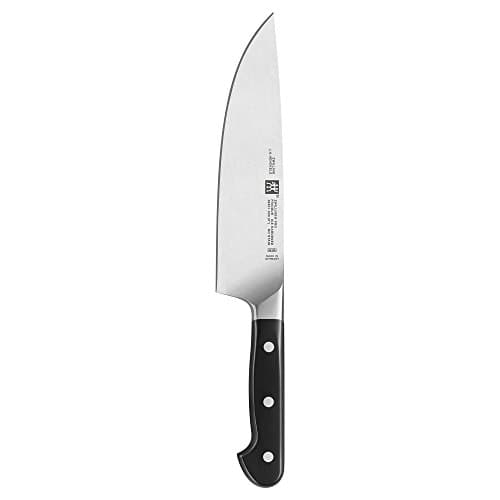
Zwilling Zwilling Pro 8" Chef's Knife

Our top pick · Best overall

Zwilling Pro 8" Chef's Knife

8.6

The best Zwilling knife and the one to buy first. Forged from a single billet in a company-owned German factory, FRIODUR ice-hardened into a published 55-58 HRC band, full tang - and a curved sloped bolster that leaves the entire edge reachable on a flat stone for the life of the knife. That last feature is the whole reason it beats the Professional S at roughly the same money.

$129.99Amazon

#ad · Full ranking below

By Stephen V.Updated How we review
#ad

We earn a commission when you buy through our Amazon links, at no extra cost to you. It never changes a verdict, and we say so when the cheaper knife is the better buy. How this works.

Buy the Zwilling Pro 8" — it is the best Zwilling knife and the right first purchase for anyone buying into the brand. Forged from a single piece of special-formula high-carbon stainless in a company-owned German factory, FRIODUR ice-hardened into a published 55–58 HRC band, full tang, and — the reason it wins — a curved bolster that sweeps away from the heel instead of stopping at it, so the whole edge reaches a flat stone for the life of the knife. The budget pick is the Zwilling Gourmet 8", precision-stamped rather than forged, same steel family, same ice-hardening, same German factory: a real Zwilling for a fraction of Pro money, and the right answer if weight or price is the constraint.

Every knife here was in stock and priced at our last price check. We do not print a number in the prose, because prices move and a sentence cannot: the Quick Picks table carries the live price and the date we pulled it, with a Check price button on every row.

Zwilling is organized by line, and only two things actually differ

Zwilling's range is genuinely intimidating on a shop shelf — Pro, Professional S, Four Star, Twin Signature, Gourmet, and the Miyabi brand sitting alongside it — and the published differences between the Western lines come down to two specifications. Read them once and the catalog collapses into something simple.

Forged or precision-stamped.Pro and Professional S are forged from a single billet, which is what allows a bolster and a substantial full tang. Gourmet is precision-stamped — laser-cut from rolled sheet, no bolster, triple-riveted onto an exposed full tang. Both are ice-hardened, both carry a published 55–58 HRC, and both are made in Germany. What forging buys here is not steel quality: it is mass, balance and the ability to have a bolster at all. Stamped vs forged knives is what each of those words is actually promising.

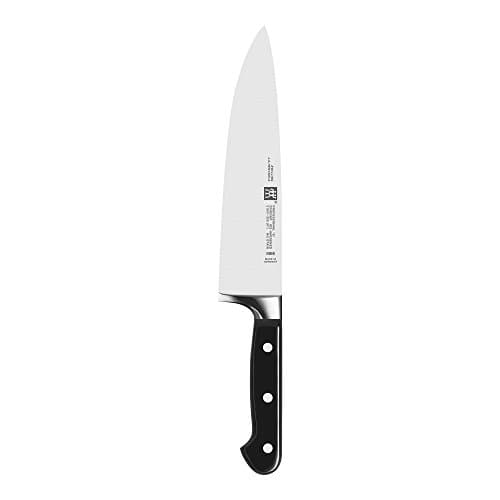
Full bolster or curved bolster.This is the decision that matters most over a twenty-year ownership and the one nobody explains at the counter. Professional S carries a forged full bolster that doubles as a finger guard and runs down to the heel. Pro carries a curved, sloped bolster that pulls back and leaves the heel exposed. A full bolster sits thicker than the blade immediately behind the heel, so the last few millimeters of edge never touch a flat stone — and over years of sharpening the blade slowly develops a recurve there. Full bolster vs half bolster works through why that happens and how long it takes to show.

Everything else is shared. The steel family, FRIODUR ice-hardening, the published hardness band, the German company-owned manufacture, the lifetime warranty against defects, the spares catalog. So once you have picked a line, choosing between Zwilling knives is a question of shape — and that is how the list below is ordered: the knives worth owning, in the order worth buying them.

Two things a buyer would not guess

The Pro and the Professional S cost roughly the same.At our last price check the two 8-inch chef's knives were close together, with the Professional S slightly the cheaper of the two — which is not how people expect it to read, because Pro is assumed to be the premium line and Professional S the older one. They are priced as alternatives rather than as a ladder, so the choice is genuinely about the bolster and not about budget. Check the table.

Zwilling does not publish an edge angle for these lines.That is worth saying plainly, because we rank several brands that do — Wusthof publishes about 14 degrees per side, Shun about 16, Misen about 15. Zwilling publishes hardness, construction, origin and edge type (fine V-edge) but not an angle, so we score that as unpublished rather than assuming a figure. In practice a German factory edge in this class is sharpened nearer 20 degrees per side than 15, which is also the safe setting to put a guided sharpener on if you own one. Knife sharpening angles has the table of what each maker actually states.

The method is on how we review: we have not hands-on tested these knives and we do not claim to have. The scores come from published specifications — steel family and hardness band, construction, bolster and tang geometry, blade length, handle material, country of manufacture — and from value arithmetic against the live price. Everything sits under the chef knives hub.

The short answer

Quick picks

#KnifeBest forScorePrice
01
Zwilling Zwilling Pro 8" Chef's Knife
Zwilling Pro 8" Chef's Knife

The best Zwilling knife and the one to buy first. Forged from a single billet in a company-owned German factory, FRIODUR ice-hardened into a published 55-58 HRC band, full tang - and a curved sloped bolster that leaves the entire edge reachable on a flat stone for the life of the knife. That last feature is the whole reason it beats the Professional S at roughly the same money.

Best overall
8.6
$129.99Amazon
02
Zwilling Zwilling Professional S 8" Chef's Knife
Zwilling Professional S 8" Chef's Knife

The same forging, same steel and same ice-hardening as the Pro, with a traditional forged full bolster that doubles as a finger guard. Buy it over the Pro if you grip high on the blade and want something solid between your finger and the edge - and accept that the heel will slowly recurve if you sharpen on flat stones for decades.

Best traditional full-bolster build
8.2
$93.06Amazon
03
Zwilling Zwilling Pro 7" Santoku (Hollow Edge)
Zwilling Pro 7" Santoku (Hollow Edge)

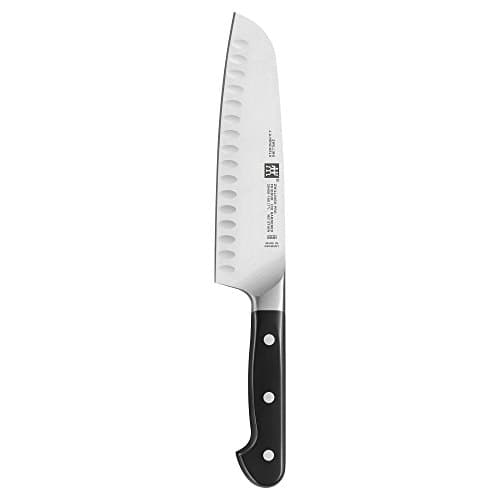
The forged German reading of a santoku, and the second knife to buy if the Pro 8-inch is your first. Same forging, same ice-hardening, same curved bolster, with a flatter profile and scalloped hollow-edge dimples that help wet slices fall off the blade. Buy it if you push-cut more than you rock-chop.

Best second knife
8.3
$127.95Amazon
04
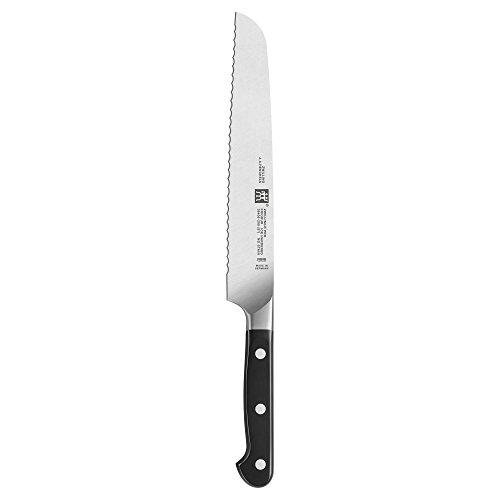
Zwilling Zwilling Pro 8" Bread Knife
Zwilling Pro 8" Bread Knife

The forged serrated knife in the line, and the one piece of Zwilling that is genuinely difficult to improve on. Forged from a single piece, FRIODUR ice-hardened, 55-58 HRC, curved bolster, exposed full tang - on a serrated edge, where you will never sharpen it, so you are buying the blade and the handle rather than the steel's sharpenability.

Best bread knife
7.6
$103.95Amazon
05
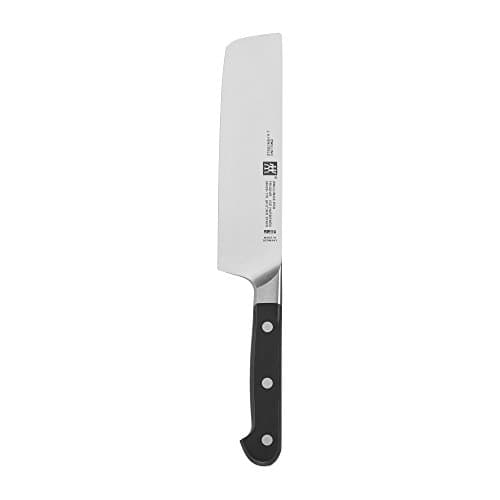
Zwilling Zwilling Pro 6.5" Nakiri
Zwilling Pro 6.5" Nakiri

A forged German nakiri, which is close to a contradiction in terms and works better than it sounds. Same forging, ice-hardening and curved bolster as the rest of the Pro line, on a tall, straight, flat-edged vegetable blade. Buy it as a third or fourth knife if you do a lot of vegetable prep and want something indestructible.

Best for heavy vegetable prep
8.1
$127.95Amazon
06
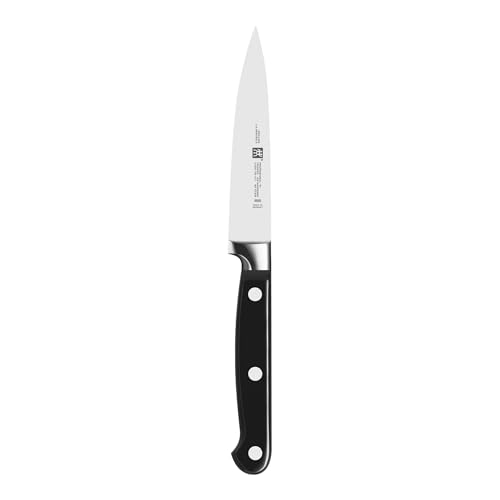
Zwilling Zwilling Professional S 4" Paring Knife
Zwilling Professional S 4" Paring Knife

A fully forged paring knife with a real forged bolster finger guard, which is a specification almost nobody offers at this size. Precision-forged from a single piece of stainless, FRIODUR ice-hardened, published 55-58 HRC, three-rivet polymer handle, 3.94-inch blade. Buy it if you want a paring knife built to the same standard as the chef's knife.

Best paring knife
7.7
$56.98Amazon
07
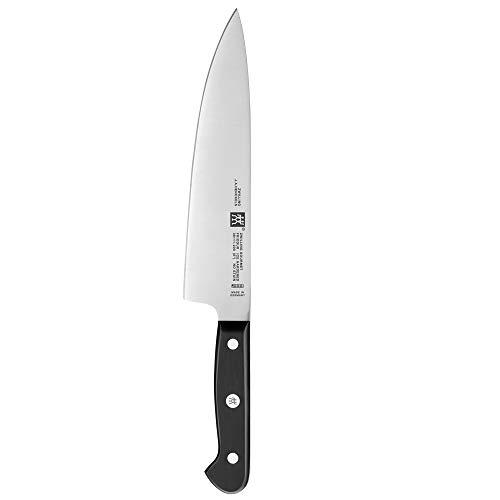
Zwilling Zwilling Gourmet 8" Chef's Knife
Zwilling Gourmet 8" Chef's Knife

The budget pick, and the honest answer for most kitchens. Precision-stamped rather than forged - laser-cut, no bolster, triple-riveted onto an exposed full tang - but the same special-formula steel, the same FRIODUR ice-hardening, the same published 55-58 HRC band and the same German factory. It gives up mass and a bolster, not steel.

Budget pick
8.2
$84.99Amazon

#ad · Live prices from the Amazon Product API, as of November 20, 2026. Where we have no verified live price, we show none — a gap beats a number that has rotted.

In detail

The picks, in full

01
Zwilling Zwilling Pro 8" Chef's Knife

Best overall

Zwilling Pro 8" Chef's Knife

Forged, company-owned German factoryFRIODUR ice-hardened, 55-58 HRCCurved sloped bolsterFull tang, triple-riveted
8.6/10

The best Zwilling knife and the one to buy first. Forged from a single billet in a company-owned German factory, FRIODUR ice-hardened into a published 55-58 HRC band, full tang - and a curved sloped bolster that leaves the entire edge reachable on a flat stone for the life of the knife. That last feature is the whole reason it beats the Professional S at roughly the same money.

Build & construction
9.5
Cutting ability
8.5
Edge retention
8
Sharpenability
9.5
Value per dollar
7.5

Pros

  • The curved bolster keeps the whole edge sharpenable forever - a genuine design advantage, not styling
  • Forged single-piece construction gives the heft and balance no stamped knife can match
  • FRIODUR ice-hardening is a documented heat treatment with a published hardness band, not a marketing word
  • The 55-58 HRC band sits in the easy-sharpening range - it comes back on a stone in minutes and forgives a beginner
  • Made in Zwilling's own German factory rather than outsourced, with a deep spares and service network

Cons

  • No published edge angle, so you are sharpening to a guess rather than to a stated number
  • Heavy next to anything stamped or Japanese - noticeable across a long prep session
  • The 55-58 HRC band will not hold a keen edge as long as a 60-61 HRC Japanese blade
  • The Gourmet further down this page cuts food competently for a fraction of the money

Don't buy this if…

…you want a finger guard under your index finger - the curved bolster deliberately gives that up, and the Professional S below is the same knife with a full bolster instead.

Re-scored on this page's rubric rather than carried over; it already appears on best German chef knives, in Wusthof vs Zwilling and in Victorinox vs Zwilling.

The specification that earns it first place is the bolster geometry, not the forging. Several brands forge this class of steel to the high 50s; very few Western makers sweep the bolster back off the heel. The practical consequence shows up in year five rather than week one: a full-bolster knife sharpened on a flat stone gradually loses the last few millimeters of edge because the thickened bolster holds the heel off the abrasive, and the blade develops a shallow recurve that is miserable to fix. The Pro simply never develops it.

What it does not give you is a stated grind. Zwilling publishes the steel, the heat treatment, the hardness band, the construction and the country, and stops short of an angle — so we score sharpenability on geometry and hardness, which are published, and leave the angle unscored rather than inventing one. Best sharpening stones and best knife sharpeners under $100 are the two pages to read before you first put it on an abrasive; for this knife the 20-degree preset on a guided system is the safe default.

$129.99View on Amazon

$169.9524% off

Price as of November 20, 2026. Prices change — Amazon's at checkout is the one that counts.

#ad · we may earn a commission from this link to Zwilling Pro 8" Chef's Knife

02
Zwilling Zwilling Professional S 8" Chef's Knife

Best traditional full-bolster build

Zwilling Professional S 8" Chef's Knife

Forged special formula steelFRIODUR ice-hardened, 55-58 HRCFull bolster finger guardFull tang, three rivets
8.2/10

The same forging, same steel and same ice-hardening as the Pro, with a traditional forged full bolster that doubles as a finger guard. Buy it over the Pro if you grip high on the blade and want something solid between your finger and the edge - and accept that the heel will slowly recurve if you sharpen on flat stones for decades.

Build & construction
9.5
Cutting ability
8.5
Edge retention
8
Sharpenability
7
Value per dollar
7.5

Pros

  • The full bolster is the most secure pinch grip in the Zwilling range and a real finger guard
  • Identical forged construction and ice-hardening to the Pro - nothing is given up on steel
  • Heavier feeling at the heel, which many cooks read as 'quality' and genuinely prefer
  • At our last price check it was slightly cheaper than the Pro, so it is not a downgrade purchase
  • The oldest continuously produced line Zwilling sells, with the deepest spares availability

Cons

  • The full bolster blocks the last few millimeters of edge from a flat stone, which causes a recurve over years
  • No published edge angle, same as the Pro
  • Heaviest knife on this page - the thing people either love or put back on the shelf
  • Nothing here outperforms the Pro except the finger guard, so it is a preference purchase rather than an upgrade

Don't buy this if…

…you sharpen your own knives on a flat stone and intend to for twenty years - buy the Pro, which is the same knife with the heel left reachable.

Reviewed in full at our Zwilling Professional S review, and it is the Zwilling that appears in alternatives to Wusthof as the closest substitute for a Classic.

It loses this page on exactly one specification and wins a different buyer on the same one. The full bolster is a genuine finger guard: a thick, forged, rounded mass that stops your index finger sliding forward onto the edge, and for anyone who grips high on the blade or who has been cut doing that, it is a real safety feature rather than tradition. The cost is that it also stops the heel of the blade reaching a flat stone, which is why it scores two and a half points below the Pro on sharpenability and nowhere else.

If you do not sharpen your own knives — if the plan is a pull-through sharpener every few months, or a trip to a local service once a year — the bolster penalty never arrives and the two knives are functionally equivalent. In that case buy whichever is cheaper on the day. Local knife sharpening services covers what to look for if that is your route.

$93.06View on Amazon

$169.9945% off

Price as of November 20, 2026. Prices change — Amazon's at checkout is the one that counts.

#ad · we may earn a commission from this link to Zwilling Professional S 8" Chef's Knife

03
Zwilling Zwilling Pro 7" Santoku (Hollow Edge)

Best second knife

Zwilling Pro 7" Santoku (Hollow Edge)

Forged special formula steelFRIODUR ice-hardened, 55-58 HRCCurved bolster, full tangHollow (Granton) edge
8.3/10

The forged German reading of a santoku, and the second knife to buy if the Pro 8-inch is your first. Same forging, same ice-hardening, same curved bolster, with a flatter profile and scalloped hollow-edge dimples that help wet slices fall off the blade. Buy it if you push-cut more than you rock-chop.

Build & construction
9
Cutting ability
8.5
Edge retention
8
Sharpenability
9
Value per dollar
7

Pros

  • A flatter edge profile than the chef's knife, which suits push-cutting and straight-down chopping
  • Hollow-edge dimples genuinely reduce sticking on potato, cucumber and cheese
  • Keeps the Pro line's curved bolster, so the whole edge stays reachable on a stone
  • Shorter blade is easier to control on a small board than an 8-inch chef's knife
  • The most useful shape to own alongside a chef's knife rather than instead of one

Cons

  • At Western weight and hardness it is the most expensive way to buy a santoku - Japanese makers do this shape harder and lighter for less
  • The flat profile makes rock-chopping herbs awkward if that is your main motion
  • 7 inches is short for breaking down anything large
  • No published edge angle, same as the rest of the line

Don't buy this if…

…this would be your only knife - a santoku's flat profile and short blade make it a poor single-knife kitchen, and the Pro 8-inch chef's knife is the one to buy first.

It is ranked against the Japanese field on best santoku knives, and chef knife vs santoku is the page to read if you are deciding which shape to buy at all.

The honest position on this knife is that it is excellent and over-specified for the job. A santoku is a light, thin, flat-profile vegetable-and-everything knife, and the Japanese makers who invented the shape build it at 60–61 HRC on thinner stock for less money. What Zwilling adds is toughness and mass: this is a santoku you can be careless with, drop in a drawer, run through a dishwasher cycle and sharpen badly, and it will survive all of it. If that describes your kitchen, the premium is buying something real.

The hollow-edge scallops are worth one sentence of honesty. They do help release sticky slices — that is a real effect, not marketing — but they do nothing for sharpness, and they are a mild nuisance when you sharpen, because the dimples interrupt the bevel you are trying to keep even. How to sharpen kitchen knives covers keeping a consistent bevel by hand.

$127.95View on Amazon

$149.9915% off

Price as of November 20, 2026. Prices change — Amazon's at checkout is the one that counts.

#ad · we may earn a commission from this link to Zwilling Pro 7" Santoku (Hollow Edge)

04
Zwilling Zwilling Pro 8" Bread Knife

Best bread knife

Zwilling Pro 8" Bread Knife

Forged single piece, GermanyFRIODUR ice-hardened, 55-58 HRCSerrated edgeCurved bolster, exposed full tang
7.6/10

The forged serrated knife in the line, and the one piece of Zwilling that is genuinely difficult to improve on. Forged from a single piece, FRIODUR ice-hardened, 55-58 HRC, curved bolster, exposed full tang - on a serrated edge, where you will never sharpen it, so you are buying the blade and the handle rather than the steel's sharpenability.

Build & construction
9
Cutting ability
8.5
Edge retention
8.5
Sharpenability
5
Value per dollar
7

Pros

  • Forged rather than stamped, which is rare on a serrated knife and gives it real spine stiffness
  • 8 inches is long enough for a boule and short enough to store and handle easily
  • The curved bolster and triple-riveted handle match the rest of the Pro line exactly
  • A serrated edge in this hardness band outlasts a plain edge by years in normal use
  • Cheapest of the three forged Pro-line pieces here at our last price check

Cons

  • You cannot meaningfully sharpen a serrated edge at home, so forged steel buys you the least here of anywhere in the line
  • 8 inches is short if you regularly cut long sourdough or sandwich loaves - Zwilling sells 9- and 10-inch versions
  • Expensive for a knife that does exactly one job
  • Serration pattern is published only as 'serrated edge', with no tooth geometry stated

Don't buy this if…

…you buy sliced bread or cut one loaf a month - a stamped serrated knife at a quarter of the price does this job nearly as well, because the edge geometry rather than the steel does the work.

It sits fourth deliberately, and the reason is the same one that puts serrated knives low on every brand page we build: a serrated edge is never maintained, so the one thing a premium forged line sells you — steel you can bring back to keen for twenty years — is the one thing you cannot use. Compare it against the open field on best bread knives, and read how to sharpen a serrated knife for what maintaining one actually involves.

Where the forging does earn its place is stiffness. A bread knife is used with a sawing motion through resistance, and a thin stamped blade flexes measurably doing it — which is why cheap bread knives wander off vertical through a tall loaf. A forged spine with a bolster does not. That is a real, felt difference, and it is why this knife is on the page rather than being dismissed.

Zwilling publishes the construction, the heat treatment, the hardness band and the bolster geometry for this knife, and describes the edge only as serrated — no tooth pitch, no scallop depth. We score it on what is stated.

$103.95View on Amazon

$129.9520% off

Price as of November 20, 2026. Prices change — Amazon's at checkout is the one that counts.

#ad · we may earn a commission from this link to Zwilling Pro 8" Bread Knife

05
Zwilling Zwilling Pro 6.5" Nakiri

Best for heavy vegetable prep

Zwilling Pro 6.5" Nakiri

Forged special formula steelFRIODUR ice-hardened, 55-58 HRCCurved bolster, full tangMade in a company-owned German factory
8.1/10

A forged German nakiri, which is close to a contradiction in terms and works better than it sounds. Same forging, ice-hardening and curved bolster as the rest of the Pro line, on a tall, straight, flat-edged vegetable blade. Buy it as a third or fourth knife if you do a lot of vegetable prep and want something indestructible.

Build & construction
9
Cutting ability
8
Edge retention
8
Sharpenability
9
Value per dollar
6.5

Pros

  • A genuinely flat edge, so a single straight push separates the slice cleanly without a rocking stroke
  • Tall blade gives good knuckle clearance and a usable surface for scooping prep off the board
  • The toughest nakiri we rank - it tolerates handling a thin Japanese nakiri would not survive
  • Curved bolster keeps the whole edge reachable, which matters more on a flat profile than a curved one

Cons

  • Heavy for the shape - a nakiri is traditionally light and thin, and this is neither
  • Cannot rock-chop at all, by design, so it is a specialist rather than a general knife
  • Expensive for a fourth knife
  • Japanese nakiris at 60-61 HRC cut thinner and cost less, if you will treat them properly

Don't buy this if…

…you are buying your second knife - a santoku or a bread knife earns its place in a two-knife kitchen long before a nakiri does.

Ranked against the Japanese field on best nakiri knives, with santoku vs nakiri for the shape decision and best knives for cutting vegetables for the job.

The interesting thing about a forged nakiri is what it does to the shape's main weakness. A traditional nakiri is thin and light, which is why it slices so cleanly and also why it chips if you hit a squash seed or a frozen edge. Zwilling's version trades the thinness for mass and toughness, which blunts the shape's advantage and removes its main failure mode. It is a worse nakiri and a more durable kitchen tool, and which of those you want depends entirely on how careful you are.

$127.95View on Amazon

$159.9520% off

Price as of November 20, 2026. Prices change — Amazon's at checkout is the one that counts.

#ad · we may earn a commission from this link to Zwilling Pro 6.5" Nakiri

06
Zwilling Zwilling Professional S 4" Paring Knife

Best paring knife

Zwilling Professional S 4" Paring Knife

Forged single piece, GermanyFRIODUR ice-hardened, 55-58 HRCForged bolster finger guard3.94 in blade, 8.19 in overall
7.7/10

A fully forged paring knife with a real forged bolster finger guard, which is a specification almost nobody offers at this size. Precision-forged from a single piece of stainless, FRIODUR ice-hardened, published 55-58 HRC, three-rivet polymer handle, 3.94-inch blade. Buy it if you want a paring knife built to the same standard as the chef's knife.

Build & construction
9
Cutting ability
8
Edge retention
8
Sharpenability
7.5
Value per dollar
6

Pros

  • Forged construction and a forged bolster on a 4-inch knife is unusual and gives it real balance in the hand
  • The bolster finger guard matters more on a paring knife than anywhere else, because this is the knife you use in your hand away from a board
  • Same steel, heat treatment and hardness band as the Pro and Professional S chef's knives
  • Short enough to control precisely and tall enough to be useful on a board

Cons

  • Costs several times what an excellent stamped paring knife costs, and a paring knife is the shape where that gap is hardest to justify
  • Zwilling's own spec sheet lists an exposed tang while the description says the handle is bonded to a full tang - the two statements conflict and we score it as unresolved
  • Heavier than a thin paring knife, which some cooks find less nimble for in-hand work
  • No published edge angle

Don't buy this if…

…you are buying one paring knife to peel vegetables - this is the shape where a cheap stamped knife performs closest to an expensive forged one, and a thin inexpensive blade is arguably better at it.

Ranked against the open field on best paring knives, and chef knife vs paring knife is the page on what each shape is for.

This knife exists so that a Zwilling kitchen can be internally consistent, and judged on that it is exactly right: same forging, same ice-hardening, same hardness band, same handle, matching look. Judged purely as a paring knife it is the weakest value on the page, because paring is the one job where a thin, light, cheap stamped blade genuinely competes with a forged one — there is no mass to leverage and no long edge to keep straight.

We flag one documentation problem rather than resolving it: Zwilling's published spec sheet for this item lists the tang as exposed while the product description describes the handle as bonded to the full tang. Those are different constructions, both are on Zwilling's own page, and we score the build on what the forging and bolster claims support rather than picking one of the two.

$56.98View on Amazon

$79.9929% off

Price as of November 20, 2026. Prices change — Amazon's at checkout is the one that counts.

#ad · we may earn a commission from this link to Zwilling Professional S 4" Paring Knife

07
Zwilling Zwilling Gourmet 8" Chef's Knife

Budget pick

Zwilling Gourmet 8" Chef's Knife

Precision-stamped (laser cut), GermanyFRIODUR ice-hardened, 55-58 HRCNo bolster, exposed full tangTriple-riveted plastic handle
8.2/10

The budget pick, and the honest answer for most kitchens. Precision-stamped rather than forged - laser-cut, no bolster, triple-riveted onto an exposed full tang - but the same special-formula steel, the same FRIODUR ice-hardening, the same published 55-58 HRC band and the same German factory. It gives up mass and a bolster, not steel.

Build & construction
7
Cutting ability
8
Edge retention
8
Sharpenability
9
Value per dollar
9

Pros

  • Identical published hardness band to the forged lines - the steel and heat treatment are not downgraded
  • No bolster at all, which means the entire edge reaches a flat stone from day one
  • Lighter than the forged lines, which suits smaller hands and long prep sessions
  • A fraction of Pro money at our last price check, for a knife that cuts food just as well
  • Dishwasher safe per Zwilling, like the rest of the range - though hand-washing still treats the edge better

Cons

  • No bolster and no forged mass, so it feels light and less planted - the thing people notice first
  • Stamped blades are thinner at the spine, which some cooks read as flimsy in heavy work
  • No finger guard of any kind
  • No published edge angle, same as the forged lines

Don't buy this if…

…you want the heft and the hand-feel of a forged knife - that is precisely what stamping removes, and no amount of steel quality substitutes for it.

It posts the same overall as the Professional S and sits last, and that is a deliberate ordering rather than an arithmetic accident. The rubric rewards it heavily on value and sharpenability and penalizes it only on build, which is correct as far as it goes — but this page is answering “which Zwilling should I buy”, and the forged knives are what the brand is for. Someone who wants a light stamped German chef knife has better options still, which is what best chef knives for the money is about. Someone who wants a Zwilling on a budget should buy this one.

The genuinely interesting thing here is what stamping does notcost you. Zwilling publishes the same 55–58 HRC band and the same FRIODUR ice-hardening for the Gourmet as for the Pro, in the same German factory. So the edge-holding story is roughly the same, the sharpening story is slightly better (there is no bolster to hold the heel off a stone at all), and what you give up is mass, balance and a finger guard. For a lot of home kitchens that is a trade worth making on purpose rather than a compromise. Best chef knives under $100 is where it sits against the rest of that band.

$84.99View on Amazon

Price as of November 20, 2026. Prices change — Amazon's at checkout is the one that counts.

#ad · we may earn a commission from this link to Zwilling Gourmet 8" Chef's Knife

Which Zwilling should you actually buy?

One knife, and you sharpen it yourself.The Pro 8". The curved bolster is the only specification in the Western Zwilling range that gets better the longer you own the knife.

One knife, and you want a finger guard.The Professional S 8". Same forging, same steel, same ice-hardening, traditional full bolster. At our last price check it was slightly cheaper than the Pro, so this is a preference rather than a saving.

One knife, on a budget.The Gourmet 8". Same steel family, same hardness band, same factory, precision-stamped instead of forged. The honest answer for most kitchens.

A second knife.The Pro 7" santoku if you push-cut, the Pro 8" bread knife if you buy whole loaves. Those two cover more real cooking than a third chef knife ever will.

Matching the whole kitchen.The Professional S 4" paring knife finishes a forged Zwilling set, and the Pro 6.5" nakiri is the specialist to add after that if you do a lot of vegetable work.

What FRIODUR ice-hardening actually is

It is the one piece of Zwilling branding that refers to a real, documented process rather than to a feeling. After forging and hardening, the blade is cooled well below zero before tempering. The point is metallurgical: deep cooling converts more of the retained austenite in the steel to martensite, which gives a more complete, more uniform hardening and better corrosion resistance than quenching alone. Zwilling applies it across the whole Western range — Pro, Professional S and Gourmet alike — and publishes a 55–58 HRC band as the result.

What that band means in use: this is soft steel by Japanese standards, where 60 and 61 HRC are normal, and that is a deliberate trade rather than a shortfall. Knife hardness HRC explainedhas the detail, and the short version is that softer steel bends where harder steel chips. A 55–58 HRC blade rolls its edge over, which a honing rod straightens in ten seconds; a 61 HRC blade loses a chip, which only a stone fixes. For a kitchen where knives occasionally meet a bone, a frozen edge or a dishwasher rack, that is the safer end of the scale.

Zwilling, Henckels and Miyabi are three different things

This confuses almost everyone, and it is the single most useful thing to get straight before you spend money. Zwilling— the twins logo — is the premium line, forged or precision-stamped in company-owned German plants. Henckels, sold with the single-figure logo, is the group's lower-priced brand, and its manufacturing is not all German. Miyabiis the group's Japanese brand, made in Seki, running much harder steel at much narrower angles. They share a parent company and nothing else about the specification. Zwilling vs Henckels goes through the two logos in detail, and Shun vs Miyabi covers the Japanese side.

The sharpening question, answered properly

Zwilling does not publish a per-side edge angle for the Pro, Professional S or Gourmet lines, which leaves owners guessing with a guided sharpener. Three things follow from that.

Set a guided system to 20 degrees per side, not 15.A German factory edge in this hardness band is ground nearer 20, and setting a narrower angle means grinding a whole new bevel — a long job that removes real steel. Knife sharpening angles has what every maker on this site publishes, including the brands that do state a figure.

A ridged steel rod is fine here.At 55–58 HRC the edge rolls rather than chips, which is exactly what a honing rod is for, and this steel is soft enough that a traditional grooved steel will not damage it — best honing steels and grooved vs smooth honing steel cover the distinction. Harder Japanese blades are the ones that need ceramic.

Buy the bolster geometry you can live with.If you are going to own a stone, the Pro line's curved bolster is worth more to you over twenty years than any other difference on this page. If you are not, it is worth nothing and the Gourmet is the sensible purchase. Best sharpening stones for beginners is where to start if you have never used one.

And cut on something softer than the knife.Board hardness does more to an edge than brand choice does, and at 55–58 HRC these blades are soft enough that a hard surface rounds them over quickly. The best cutting boards under $100 ranks six surfaces on published material hardness, and names the popular board material that quietly ruins knives.

How we ranked these

Five metrics, built for the question this page asks. Build & construction reads forged versus precision-stamped, tang, bolster and country of manufacture. Cutting ability reads blade geometry and profile against the job the shape is for. Edge retentionreads the published hardness band — which is the same 55–58 HRC across all three lines, so it separates these knives far less than it separates brands. Sharpenability is scored on bolster geometry and edge type, and it is where this page actually discriminates: a curved bolster scores 9.5, a full bolster 7, and a serrated edge you cannot maintain at home scores 5. Value per dollaris specification quality against the live price. The overall is the mean of the five to one decimal place. No published figure was upgraded to a measurement, no unpublished figure was invented, and the missing edge angle is scored as missing — how we review says all of this in those words.
How we picked

We did not lab-test these knives

Everyone in this category says they tested twenty knives in a professional kitchen. We have not hands-on tested any of these, and we say so. What we did instead: compiled the published specifications — steel type and hardness (HRC), edge angle, blade geometry, weight and build — applied established sharpening standards, ran the value math (spec quality ÷ live price), and scored each product against a published rubric. The scores are judgments from documented research — not measurements we took, because we do not have a test lab and we will not pretend we do. Where a number came from someone else's work, we name them in Sources.

Questions

Frequently asked

What is the best Zwilling knife?
The Zwilling Pro 8" chef's knife. It is forged from a single billet in a company-owned German factory, FRIODUR ice-hardened into a published 55–58 HRC band, and its curved sloped bolster leaves the entire edge reachable on a flat stone — the one Zwilling specification that keeps paying you back for as long as you own the knife.
What is the difference between Zwilling Pro and Professional S?
The bolster, and effectively nothing else. Both are forged in a company-owned German factory from the same special-formula high-carbon stainless, both are FRIODUR ice-hardened, and both publish a 55–58 HRC band. Professional S has a traditional forged full bolster that acts as a finger guard and runs to the heel; Pro has a curved sloped bolster that leaves the heel exposed and therefore sharpenable. At our last price check they cost about the same.
Which Zwilling line is the best?
Pro, if you sharpen your own knives, because of the curved bolster. Professional S if you want a full bolster finger guard. Gourmet if price or weight is the constraint — it is precision-stamped rather than forged, but Zwilling publishes the same steel family, the same ice-hardening and the same 55–58 HRC band for it, so what you give up is mass and a bolster rather than steel.
Are Zwilling knives better than Henckels?
They are different brands at different price points under one parent company. Zwilling carries the twins logo and is made in company-owned German plants; Henckels is the group's lower-priced brand and its manufacturing is not all German. They share a corporate owner, not a specification — Zwilling vs Henckels goes through it.
What angle should I sharpen a Zwilling knife at?
Zwilling does not publish a per-side angle for the Pro, Professional S or Gourmet lines, so we do not either. A German factory edge in this hardness band is ground nearer 20 degrees per side than 15, and 20 is the setting to use on a guided system — choosing a narrower angle means grinding an entirely new bevel. Knife sharpening angles has what every maker we cover actually states.
Are Zwilling knives dishwasher safe?
Zwilling states dishwasher safe across these lines. It is still the wrong thing to do to a knife: detergent is abrasive and alkaline, blades knock against racks, and the edge dulls faster than hand-washing. Zwilling's claim is about the knife surviving, not about the edge — can you put knives in the dishwasher has the detail.
Is a Zwilling knife worth the money?
For a forged knife you intend to sharpen and keep for decades, yes — the construction, the documented heat treatment and the published hardness band are all real. For a knife that just needs to cut food competently, the Gourmet does that for a fraction of the forged price, and are expensive chef knives worth it is the honest version of that argument.

Keep reading

Receipts

Sources

We do not run a testing lab, and we do not pretend to. Where a spec or a measured number came from someone else's work — a manufacturer's page, a published standard — we name them and link them. Where we could not verify something, we say so on the page rather than quietly leaving it out. Read our full method.